


TerryE
-
Posts
3826 -
Joined
-
Last visited
-
Days Won
30
Everything posted by TerryE
-
But will you or the future owners know that in 10 years time ;-P
-
Just reading the Hep2O Installation Manual:
-
Data Cat5 and other wiring
TerryE replied to Auchlossen's topic in Networks, AV, Security & Automation
We just bough a load of twin coax and our electrician laid is as par of first fix, even to rooms where we aren't currently planning to have an outlet. We are just leaving them snaked in the wall adjacent to a socket -- that way recovering the cable if we do want to commission a point is trivial. whereas tring to lay a new one after boarding out will be a total pain. Ditto with our Cat 5e. -
Thanks guys. Will go with this.
-
How good a condition are the quarry tiles in? I only ask because we had a similar issue in our kitchen when we moved into our farmhouse 30-odd years ago. Ours were ~1" thick and 8×8" so I decided to lift them and keep them. It was trivial to do and they came in handy as getting genuine Victorian tiles like this is a real problem. I just raked out some of the clinker bed and put down a polythene membrane and 3" of concrete with a 1" wet render immediate on top to float level. OK, this was in the days before insulation was even considered! If you have damp walls then the plaster might have gone, so you've also probably got an issue with the integrity of the DPC. You may need a silicon injection layer, and replaster in which case you should consider doing this before you relay the floor slab.
-
You need to do your overall heat calcs and determine the net heating load (that is allowing for occupants and electricity usage ending up as waste heat) in the winter to sustain your house temperature. This will probably be around a kW or 2. You can reckon on 7W/Km² heating from the UFH so if your floor is much more than 3° warmer than your target heating requirement, then you are going to have problems regulating your heating. JSH's approach was to add a mix-in circuit to the UFH manifold so that the water circulating in the slab was no more than a set point (25°C in his case). This makes the system far more controllable. What's your mains pressure and flow rate like? Do you need a buffer tank on the mains input side? You will also need double check valves on your mains input and in front of your external tap at a minimum. We also to-and-fro'd about 10 vs 15mm but decided to keep it simple and use 15 throughout because our average pipe run is ~3m.
-
We originally intended to use SureCav between our MBC timber frame and the local (Cotsworld-like) stone skin. Anyway we were unhappy about the price and our builder was unhappy about the profile build-up, so we decided between us that we could manage keeping the cavities clean by other methods. There are two alternatives that we considered, but ended up using a third which work well. The first two alternatives were: To use internal slipformers. You can Google this and I found some decent Youtube videos on this technique. These can be awkward to manipulate and the stonemason still needs to pack in the mortar at each rise to stop the mortar snots falling down between the board and the skin. To leave two access holes at the end of each wall run and use a small piece of wood on draw cords between the tow holes as a sort of a flying shuttle to pull the snots across to the nearest hole where they can be cleared. The holes are then stoned in once the elevation is complete. In the end both approaches seems to add quite a bit of work for the stone workers, so our builder and his mason where reluctant to use either approach. So we have ended up using a suggestion by Janet which was to create a fabric sock to leave in the cavity between each wall tie rise, hence my name: Janet's snot socks. We had some of the blue tenting fabric left over and this proved just about ideal: a lot stronger and a little more flexible than building polythene sheet. Our mason is putting in a line of wall-ties at 45cm levels and at 40cm centres (because this is where the wooden uprights are.) We position the socks along each course over the wall-tie. There's a bracing batten along the bottom of each and a couple of hooks which we can catch with wire coat hangers to hook the socks out. We also use some steel strapping to keep the stone-side of the sock intimate with the stone line. The frame-side is stapled with a few hammer tack staples. Immediately before the mason puts in the next line of ties we rescue the socks and tip out the snots, then reposition resting on the ties once he has them in place. Anyway here are a few photos to give you the idea. The last shows a view down the gap when the wall was about 135 cm high. It's now up to 1.8m and the gaps are still very clean. OK, this is a little bit of a faff for us but we are building to a budget and this is a lot cheaper than SureCav, and is working well.
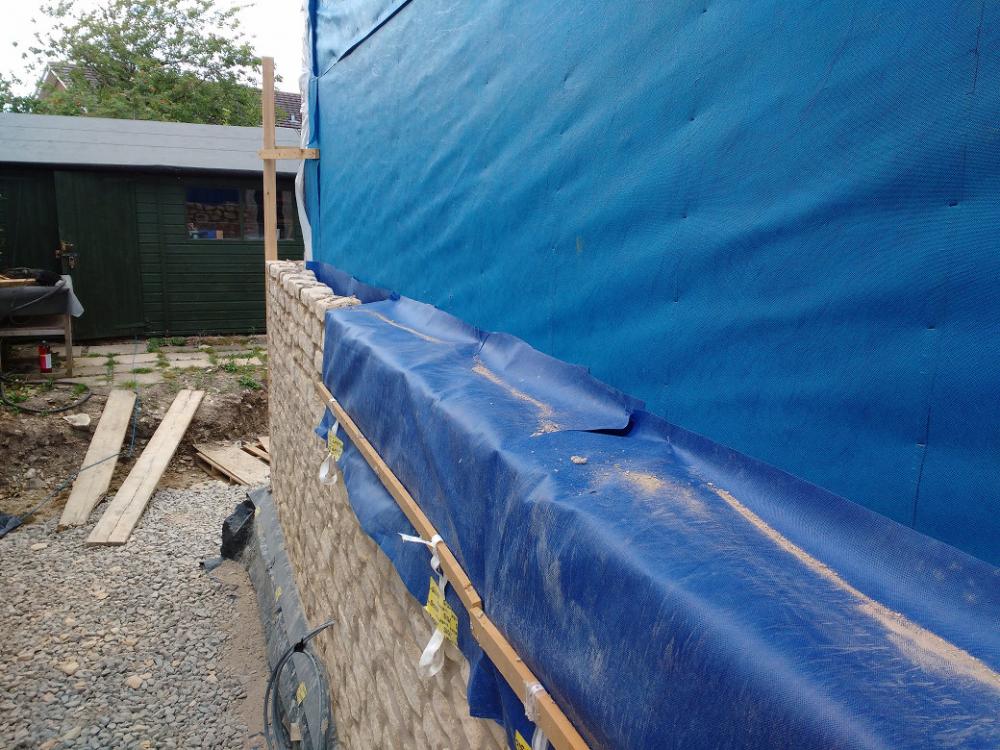
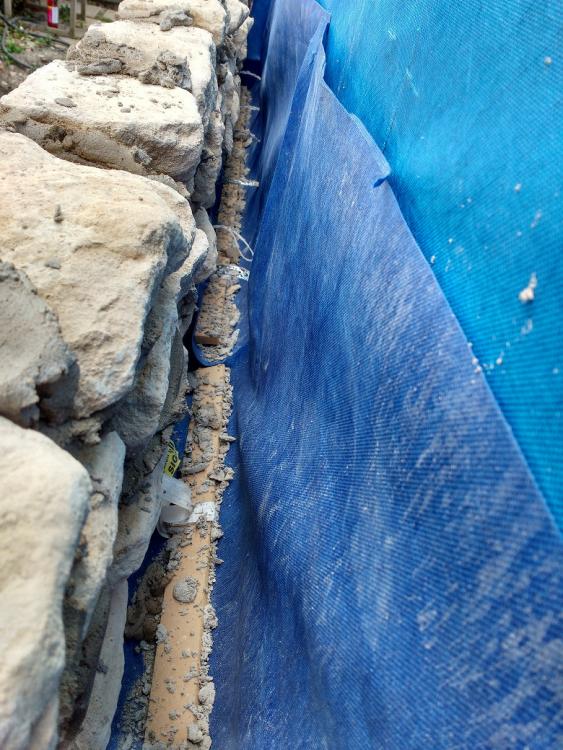
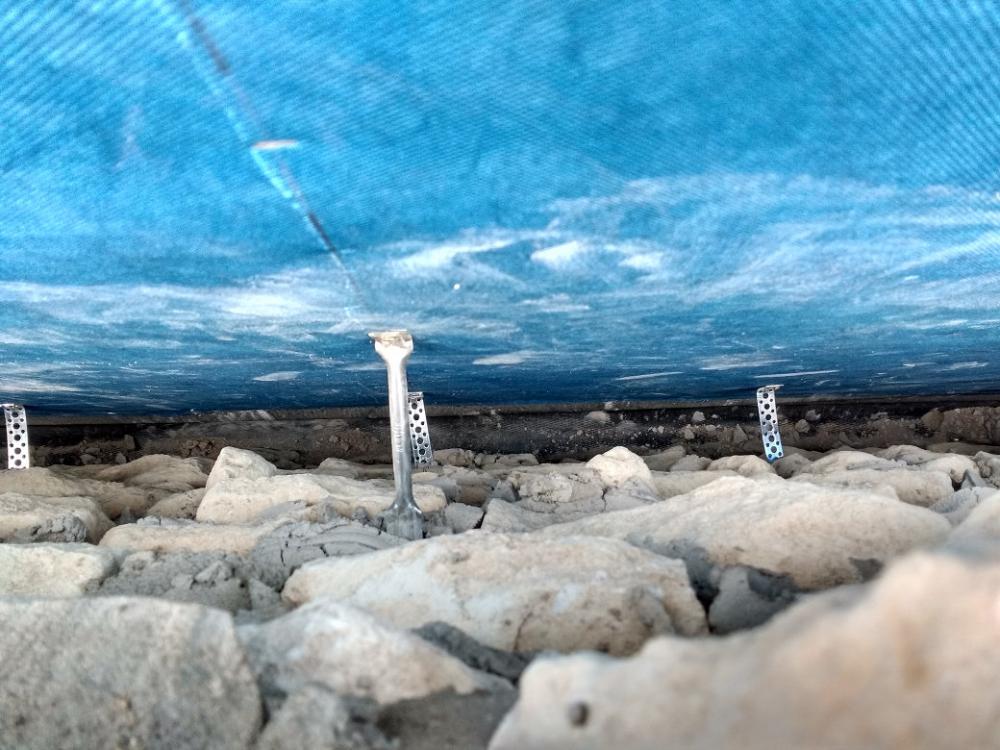
-
A lot of the electricity providers don't do meter installs. You have to go to one of the big ones. We've got electricity to our build and a meter box connected by Western Power. We plan to use BGas to connect our electricity meter, but are in a hurry to do so since we will just get connection charges. (Since we're building our house at the the bottom of our garden, we are currently using extensions from our adjacent garden shed.) We've switch suppliers 5 times In our existing farmhouse (in 32 years), but we've only had one meter change and that was in the middle of a contract because the E7 switcher failed. In the new house we will switch to Ovo or one of the other green tariff providers after our 12 month contract with BGas is up.
-
£10 handy inspection camera/borescope for Android
TerryE replied to readiescards's topic in Boffin's Corner
Hi Vijay, I bought one as well but I can't get any of my Android devices to recognise it and I tried a range of Andoid versions, all on-the-go compatible, and various apps. I plugged it into my Ubuntu laptop and used lsusb to query it; no probs. The USB interface is a bog standard Cubeternet webcam USB slave (at least that;'s what it reports, but it is more likely a cheap Chinese clone). So out of curiosity I fired up VLC on my laptop and connected to it -- it worked first time! Still got to find a way of connecting it to an Android hand-held though. -
We are using HEP2O but the issue would be the same for PEX. Use of cable detectors before drilling into any walls is becoming more common. However I want to make sure that any vertical (non-metal) pipe runs are also detected. Any suggestions for the most elegant / simplest way of doing this? IIRC these detectors use an capacitance based induction loop, so any conductive material will trigger a detection. So is there a standard approach? How have you guys done this? Perhaps the simplest way would be to run a strand of 2.5mm copper along side each vertical run.
-
We had to use this as thermal break on our stone skin (the details are really a separate post, but this was all OKed by the MBC structural engineer). Here is where we sourced ours: Phstore - Foamglas Perinsul HL.
-
House fire - how to control mvhr
TerryE replied to warby's topic in Mechanical Ventilation with Heat Recovery (MVHR)
Maybe this is a different topic since I agree with the who cares what the MVHR is doing bit, but definitely +1 to evacuating occupants, however my personal view is that immediate evacuation is not always the only option for some classes of fire. For example, I would recommend keeping a fire blanket in the kitchen and a couple of decent fire extinguishers in the house. If the fire is localised (e.g. a pan fire on the stove) then killing the seat of the fire immediately is one option. Clearly if there is any chance that the fire has reached a timber frame fabric then the house should then be evacuated by all occupants until the professionals have given the all clear before being reoccupied. And the smoke risks shouldn't be underestimated. PS. I haven't been a professional fireman but I did spend 9 weeks standing in for them during a strike in 1978-9 and put out a few fires during that time, so I have probably seen a lot more house fires than most. -
You have to be really careful stacking any natural wood products. You will tpyically need to store them perfectly flat or perfectly vertical with regular spacers between each door. If you don't then you can get differential moisture gradients across the wood and this can cause warping either during storage or after being hung and the gradient equalises. The warping might be transient, but if it isn't then it is problem to rectify.
-
@Nickfromwales, thanks we found the Hep2O brass manifolds on eBay, etc.. I was thinking of doing the extract from the eBuild post where you posted this pic originally, but of course DB has now removed the ability of registered eBuild members to view pictures, so the pic itself was lost except from memory. I was also planning to replicate something like this : 6+6 high flow (H+C) and 6+11 low flow (H+C). There's a lot of low flow colds -- but that's because it doesn't seem to be worth the hassle of doing local Ts and tapping toilets off wash basin colds. As far as I can see you main copper runs are 22mm rather than 28mm. I can't see any reason for going up to 28 if you have a pressurised system at 2 bar-ish.
-
Jack, not sure since I haven't been able to compare them. AFAIK, they have the pretty much the same mechanical properties. Maybe @Nickfromwales or @JSHarris knows the answer to this one. PS. On some of the websites the standard variant is described as "exceptionally flexible" so there might be a difference. More research needed over the weekend.
-
I note that Hep2O comes in two variants: Standard for plumbing only, and Barrier Pipe, for plumbing and central heating use. The BP variant includes a oxygen impermeable membrane. A few of the online plumbing suppliers only stock the BP variant. As far as I read it, this is certified for potable use. Does anyone know of any reason why we shouldn't just buy the BP variant?
-
Finished floor level question in my timber frame
TerryE replied to janedevon's topic in Timber Frame
AFAIK, it is standard for the soleplate to be at slab level. If you want a polished slab then the soleplate will be at FFL. In our case, we are having slate on the GFL so the FFL will actually be 10+6 mm (slate + adhesive) or 16mm above the soleplate. Though in our case we have an MBC passive slab and timber frame so the soleplate is part the frame truss. -
Rest and relaxation - escaping from the build
TerryE replied to Stones's topic in General Self Build & DIY Discussion
Our poison is our cottage on one of the Greek islands. The main downside is it's really hard to come home to the grind This is moonrise in the Autumn from our terrace. Shirt sleeves and a glass of wine!!
-
The reason that people want the red and black is that if they make a small change on the QT, then they can claim that the work was done before the new regs came. Before this your work only had to comply with electrical regs. After this, all electrical work at a minimum has to be certified by a "competent person" (that is an electrician with the appropriate ticket), so the general rule is new colours and you must have a certificate. Hence the high prices on the second hand market for RnB cable.
-
MBC Foundation EPS protection
TerryE replied to Leaway's topic in General Self Build & DIY Discussion
That can be quite a high maintenance option. We've got an outer ring beam up to ground level but with an EPS wrapper below GL We're surrounding our house with course crushed gravel and paving out to 45cm apart from some engineering brick boxed planters. -
planning I am deeply deeply angry: so I need your advice, please
TerryE replied to ToughButterCup's topic in Planning Permission
No the worst that can happen is that you totally piss off both the neighbours and the planners. You have to live the neighbours long after the build is complete. The planners can make your life hell just because. You then have to do some minor material amendment because the EO catches you out after a neighbour raises an enforcement objection; your application is then turned down, and the whole development turns into a crock of shit. -
planning I am deeply deeply angry: so I need your advice, please
TerryE replied to ToughButterCup's topic in Planning Permission
Ian, you have often advised me in the past to suck it up or some paraphrasing. We spent getting on for £2K on our archaeological survey. This made absolutely no rational sense: the trigger was a Saxon find about ½mile from our house at the opposite end of our village. I pointed out that there were 4 other applications for planning permission under way that were closer to the find than us that (including an extension to our local primary school) where a survey hadn't been required. Of the five plots, ours had been a farmyard and outbuilding since the 1700s, whereas the others had been previously untouched farmland whereas. (Yup, sure enough -- all there found was evidence of farm pen fence post holes and a lot of "made up ground" over the base Oadby member clay.) I tried to reason with the LPA archaeologist, but her response was that It is the decision of the assigned case officer whether to assign a consultation to the archaeology office and she had no input on applications where she wasn't assigned. She was more happy to have the discussion, but she was heavily overworked and so it would have to be by letter (and her current response time was 6 weeks per letter) so I should allow a minimum of 3 months and possibly 6 moths, but in her experience the LPA would probably not remove the condition once allocated unless we provided compelling evidence to do so. In other words, just shut up and accept the decision, or we will make your life hell. And that is what we did: the £2K was a random irrational tax that funded jobs for the boys in the LPA and the archaeology survey companies. The planning system has processes, and processes sometimes have quotas, and their allocation is often random and unjust (in our case maybe "it was a farmhouse so why not have a survey here"). The last thing that bureaucracies want is for the end users to start disrupting the smooth running of the processes and they will often retaliate out of principle when the opportunity arises. Another case for us: our LPA Enforcement Officer decided that our slab was in the wrong place so asked that we put in a minor material amendment to correct the plans. "A formality". The thing was that the slab was in the correct place relative to the front road, but one of our neighbours over the back had pinched a bit of our garden. Our builder said: don't apply because in doing so you admit that the slab is in the wrong place and what do you do if they turn the amendment down? Demolish the slab and house and start again? So we dug our heels in and refused: the slab was in the correct place with respect to the highway. The EO gave in and closed this issue, but also insisted that we submit a NMA for our front door which didn't match the submitted detailing, also "don't discuss with your last case officer, since a new one might be assigned". Yup, and we only learnt the identity of the case officer when we received his rejection of the same application that the EO asked us to submit! In your case: You have now practically passed this hurdle -- albeit at a lot of cost and time. By raising this issue you will piss off the planners because you are making waves that will cause further work. By raising this issue you will potentially alienate the neighbours. You need to maximise the goodwill of both your neighbours and planners -- until they have signed off your build as complete. So this is just a case of where you need to suck it up. Making waves will only reflect back at you. My suggestion is that if you do want to make an issue of this, then wait until your build is complete and signed off. By this stage the heat of the indignity and emotion will have died, and you can take a far more rationale and analytic view of the issue. If the underlying issue is there, then this is the right time to try to raise it and resolve it. -
Buying part of a neighbour's garden - the process
TerryE replied to jack's topic in Party Wall & Property Legal Issues
As I said above our neighbours solicitor got the boundary totally wrong -- 4 feet out on the wrong side of our path and registered their property without consulting us. No one noticed, and in fact their property was bought and sold four times without anyone noticing because it's absolutely obvious where it is. However, as far as the LRO were concerned the onus was on us to prove that they had made a mistake, which was a bit difficult since the seller was dead by the time; we didn't know who the solicitor was etc. If a mistake has been made and accepted by the LRO, then I believe that they are liable for cost recovery, so guess what? Getting them to admit this is impossible. Double check everything with your in-laws. -
Recommended bathroom suite merchant??
TerryE replied to Hillydevon's topic in Bathrooms, Ensuites & Wetrooms
See I love Megabad. Though thanks to the Leavers winning we all have to pay an extra 15+% premium -
Buying part of a neighbour's garden - the process
TerryE replied to jack's topic in Party Wall & Property Legal Issues
Jack, as you probably recall, Jan and I decided to split our garden of our farmhouse to do our new build on. After talking you our solicitor about the pros and cons in our case it made a lot of sense to split our plot into the new build and the existing farmhouse pretty much as a first stage. (We were taking out a mortgage on our Farmhouse to help fund the build, but we wanted to keep the new build out of the mortgage equation.) In the event doing this was a roller coaster that took over six months, mainly because we've own our farmhouse for 33 years and it wasn't registered, so this was the first registration. We discovered that when our neighbour sold her cottage 19 years ago, her solicitor drew the boundary in totally the wrong place and claimed a path that had belonged to our property since before WW1. Of course we were never consulted so had no reasonable opportunity to object. Our solicitor used the Deed of Rectification process to remedy this and this was rejected by the LRO as we hadn't provided adequate proof that the this was an error in the original registration of the neighbouring property and said that we had to do this by a TP1. Our neighbour pissed us around just because. I had a statement of truth from the then buyer that the fence was old and an established part of our property when she bought it, and I had a copy of the 1913 deeds which explicitly included the path in our property, but it was only with the threat of taking the guy to court with a claim of adverse possession, plus an official sweetener of £1,000 that he agreed to sign the TP1 and it all went through. Anyway the only real relevance of all this to your case is that I spent a lot of time going through all of these LRO PGs and discussing their implications with my second solicitor from the practice who was very good. So leaving this aside, the actual split of the plot into two was pretty straight forward. It makes sense to use a solicitor to do this, and it is the solicitor is who has a named point of contact in the LRO. Whoever within your family bought the property has a copy of the original title deed from the LRO, and if not your solicitor will request this. In practice if your division is a straight line or even a dog leg then just getting your TA to resubmit your new proposed titles are essentially a clone of the original with a couple of measurements to define the new boundary corners. The LRO won't vary the other boundaries with 3rd party properties anyway. If you look at the LRO title plans they no longer record boundary ownership, so there's no point in using them on the plans. If you want to record such facts on the title then these are restrictive convents which define that the property A owns the boundary fence, etc. However, why bother? If you have photographic evidence of you putting up the fence and receipts for the materiel then it is clearly your property. You absolutely want to avoid the setting up of a determined boundary. These only get created in the case of a boundary dispute and require a precision plan submitted by a chartered land surveyor. The are expensive to set up and raise a red flag for future purchasers by implying that there has been a boundary dispute. The normal rules for a boundary are that the the LRO title is only an approximation (and the LRO publishes tolerances). The boundary on the ground so long as it is within these tolerances takes precedence, so you need to ensure that the physical boundary is clearly identified. (E.g. concrete posts at the 3-way boundaries and concreted posts or spurs along a taughtline between. Then take and keep a photographic record of their position (e.g. with the front page of a newspaper or whatever.) Some other things to think about: If you yourself don't own the garden, then why not do the split and get your inlaws to transfer into your name and your title using a TP1 before they put the restored property on the market. OK, it's an ask an may involve money, but this is a two way conversation. This will remove the land from an potential negotiations with the prospective buyers during the sale. The last thing that you want in two years time is someone saying to your FiL: OK I'll throw in an extra £nK if you include the extra garden. If you have any development plans which might impact on the new neighbours then consider get at least an outline planning application and better a full application in and approved before putting the house up for sale. Yes this might impact the value is the prospective buyer baulks at this during the sale, but this is surely a lot better than the DFL buying the house then putting the kibosh on any plans your have by mounting an strong objection, the new build on went through all of this crap doubly.



