


TerryE
-
Posts
3826 -
Joined
-
Last visited
-
Days Won
30
Everything posted by TerryE
-
Gosh, you call that a cow shed! Are you going to hide it behind straw bails for 7 years? But seriously it looks good, and I hope that you enjoy the final result.
-
I've got an RPi server that been running for about a year. Zero problems. I have it eNet connected to my router with SSH and HTTPS ports open (not the defaults) and private self certified certificates. I don't bother with openDNS. Peter comments that the Linux distro is an overhead, but running it rather than some other OS might cost s few extra watts or a kW or so extra per year. But Linux means that so many open-source packages can be downloaded for free and with minimum hassle. But IMO, using one for an IoT (Internet of Things) device is not it's sweet spot. Better an Arduino, PIC or an ESP chip for this type of role. I personally prefer the ESP8266 series, though I do have a couple of their next generation ESP32 chips, but I am a bit biased because I am one of the team that develops the Lua firmware build for the ESP devices. As far as integrating my IoT devices directly with any cloud service, then my paranoia kicks in: any direct portal to the web can create a back path to hack into your systems. So I am not going to have any direct paths from my IoT devices to the wider Internet. None. My IoT devices each typically do a single job and they talk simple encrypted protocols to a locked down server (which is an RPi). I access this RPi when needed via my public internet-facing shared service using an HTTPS tunnelled service. All geeky crap, but I am a geek so you'll have to excuse me.
-
We miss him as well
-
@worldwidewebs Andrew, you've got an MBC frame so you must do your basic heat calcs. I doubt that you will be losing more than a couple of kW on your heating days -- unless you have large areas of glass. 9 loops = ~ 800-900m of pipe or ~150m². If you reckon on 7W/Km², then you will generate ~1 kW/K across the slab, so if your slab is much hotter than a few degrees more than room temperature then you will soon get too hot. Therefore: I would really question the sense of having 5 zones from a control PoV. You will need to do a mix down in your UFH. Read Jeremy Harris's blog posts on his adventures in designing his UFH slab system: pure gold-dust.
-
Members' experiences of Timber frame and slab suppliers
TerryE replied to TerryE's topic in Timber Frame
@IanR maybe you can do a write up on your Touchwood experiences and @PeterStarck add your comments as a separate topic? To be honest, it's the first time that I've come across them. -
Members' experiences of Timber frame and slab suppliers
TerryE replied to TerryE's topic in Timber Frame
This apples and oranges issue is really difficult to get your head around. We've discussed the issues of the slab interface, and in one site visit that we did, the builder was using a TTFC frame on his our conventional foundation. The TTFC guys used a sole plate, but the foundation was so out of true that the packing under the plate was over 10mm in places, and two internal load-bearing walls were ~50mm out. The main problem here was that there was a steel pillar landing on their junction so the base plate was only a quarter on the load-bearing wall. Our slab was done in a single pour with the UFH built in and the whole thing power floated flat to a couple of mm, so no UFH mats, having to lay it or worrying about internal screeding / alignment / thermal bridging issues. So my personal view is that whoever does the slab and whatever technique is used, it makes a huge amount of sense to embed any UFH, address and thermal design / bridging issues and power float the entire slab to better than a few mm vertically and <10mm in plan before any framing or conventional skin is erected. Another issue is air tightness. Air exchange accounts for some 13% of our total heat losses, but that is with a good seal and MVHR. Without effective HR, then our air exchange heat losses would be approaching 60%. So IMO effective air-tightness is absolutely essential in achieving energy budgets and to achieve this the design has to address some key vulnerabilities which can compromise this. A good example is how the air tightness around the floor decks and joists is achieved. Doing this post frame-erection is a nightmare, so my view is that you will have a lot of challenges if your frame supplier doesn't air tightness in the frame design criteria and be willing to offer an airtightness commitment. A third issue is weather proofing. We closely integrated our frame erection and installation of our Internorm windows, so that on Day 0 we started with a bare slab and by the end of Day 9 we could lock the door on a totally weatherproof build, and start to let the whole thing dry out and come to a moisture equilibrium. Even so the floor boarding was exposed to a couple of days rain during the build, and I can detect slight flaring along some board edges from this, I guess. This is mostly less than a mm, but it is still noticeable on some joins if you eyeball them at floor level from close up. In my view, getting the frame quickly covered and weather-tight is essential if building in the UK. If your frame provider does just that, then you need to address how you are going to get the roof (sarked and) felt and battened and the window openings sealed. -
Members' experiences of Timber frame and slab suppliers
TerryE replied to TerryE's topic in Timber Frame
Comparing these suppliers does seem to be a case of apples and oranges in that they vary in price, but also in scope. We looked at 3 others before selecting MBC. The Timber Frame Company (TTFC) is still actively trading; the other two which we ranked higher on price/scope have since gone into receivership. -
(Mods please move this if there's a better home folder). We seem to be dominated here by testimonies about MBC timber frame and slab offerings and installations. Quite a few of the members here including me had bought an MBC frame and slab, and have nothing material other than praise. However, this shouldn't be an "I love MBC" forum, so I feel that we should really have the views and recommendations of members who have chosen another supplier, so that new members can have a range of suppliers to evaluate. I would be interested in these views.
-
My Bosch measure as been superseded by a newer model, but it is mm accurate up to 30m or further in low light conditions. I use rechargeables because, as Bitpipe says, it goes through the batteries if you use it a lot. @worldwidewebs, by project manager, I really meant your designated point of contact within MBC. In my case it was Trish O'Dwyer. This person has no on-site responsibilities, but is responsible as a single interface for agreeing and signing off plans, timescales, customer issues, etc. I should hope that any framing company provides such a level of continuity for a service like this. In terms of delivery time-scales, I naively thought that the MBC teams would work a normal 5 day week, but these guys are nearly all southern Irish based. The building industry in Eire hasn't really fully recovered since the 2008 crash, so competition for jobs drives down labour rates. By working (largely) over here they get top $. Most work a cycle 2 weeks on and 1 off (or whatever is dictated by their family commitments). When they are here they tend to work 12hr days, 7 days a week when possible because they all seem to have a committed work ethic and are paid on an hourly rate. They don't allocate contingency between jobs as this would be non-productive if not used, but instead just roll from one job to the next. As a result it isn't at all unusual for notional start times to slip a few days or more if there has been bad weather.
-
The main villain in tenrms of solar gain is a large area of sun-facing window.
-
@worldwidewebs, as the old Reagan quote goes: Trust but verify. You don't need to do the checks yourself, but make sure that the guys do them. They should be happy to let you witness the checks. Anyway I think ya at every self builder should get themselves a decent laser measure, and doing a double check is a simple two person job.,if you want to do it yourself. In terms of a asking MBA about resourcing, why not talk to the crew leader onsite, or your allocated MBC project manager?
-
Cassette is the trade term for the individual panel, and you will see them being erected in @Alex C 's Youtube videos as below. Panelvent is the special breathable fibre board that covers the outside of each panel, and this in turn is covered by a special fabric of VCL (vapour control layer) which together let the frame breath and let moisture out but largely prevent it getting in/ The air tightness layer is the inner surface (the green stuff) which seals the frame so that your MVHR works effectively. I have an MBC frame myself as do a few other active members and I've been tracking their designs for 3 years. Some their earlier designs with Seamus O'Loughlin date back a few years before that. As far as the number of staff on site, the important thing is the quality. The site has to be properly levelled and the frame correctly constructed to the right dimensions. You should have a copy of the detailed slab design with key measurements edge and diagonals. Ditto UFH plans. @Alex C and others have posted Youtube time-lapses so you should watch these. The pour itself will require a minimum crew of 3 who are experienced and so you need to ensure that it will be correctly resourced before any concrete or associated kit comes to site. Some things to check: Frame dimensions and level Detailing of door openings Any foulwater and service pipes must be postioned to cm accuracy and foulwater gradients in-spec All rebar cages and mats must be correctly spaced off the EPS and tied The UFH layout must allow for partition walls and no-go areas such as under kitchen units During the pour all ring beam's should be properly vibrated down, and slab's tamped The final slab has to be power-floated in the correct window: the Goldilocks period, not too wet, not too firm. It should be level to within 2-3mm across the entire slab.
-
@worldwidewebs, I went through your blog. Very interesting. Thanks. I see that MBC have continued to evolve their cassette design and techniques. Your cassettes had the VCL OSB pre-fitted whereas our cassettes only had the outer Panelvent fitted; the VCL was delivered in sheet form and fitted by the erection crew. I know that Jeremy eulogised about the frame tolerances, but ours was out by ~1cm on a rear gable. I don't blame the crew and we are happy with the end result. (The frame was erected in shitty November weather.) One issue was that the cassettes were fixed directly to the slab, and getting these mm perfect is hard when its raining and a bit blowy. I thought on reflection that it would have been better if a separate sole plate had been laid first to register the exact cassette positions, and I see that they now do this. Good. But overall we are delighted with the final result, and I hope that you are likewise. Edit: Sorry this is a cross post as I also read @Alex C's blog Passive House Selfbuild, which you might want to compare with your experience. I will be very interested in the some of the frame detailing on your build.
-
@jack, I am just going by another member who got an MBC warm slab recently on sandy soil and according to him Hilliard spec'd Type 1. We were told to have no fines also, and used crushed gravel, but the team suggested that we use type 1 for the last 50mm stone layer as this made it a lot easier to lay the blinding sand layer.
-
Apparently it depends on the underlying soil type. For clays Hillliard will specify a no-fines type, but for free draining soils such as sands, he might specify Type 1
-
Toilets- S traps, P traps, holes in the floor...
TerryE replied to Crofter's topic in Waste & Sewerage
Nick, you must lay some huge turds if 80mm is too small for you -
Toilets- S traps, P traps, holes in the floor...
TerryE replied to Crofter's topic in Waste & Sewerage
You could also happily use 80mm pipe and fittings for this. There's also nothing to stop you sightly over-sizing the hole to give yourself some wiggle room and then just foam and silicon seal it in (this would all be hidden by the back to the wall). -
Slab Insulation, UFH and Mesh
TerryE replied to MarkH's topic in Energy Efficient & Sustainable Design Concepts
@MarkH cable ties. We were pretty conservative about our UFH footprint and stayed well clear of walls, units, etc. and stuck to the floor areas where there is no chance of having to drill into the slab or use fixings. Our house is essentially to passive standard, so the number is heating days is pretty small and the total demand will typically be a couple of kW tops, so didn't have to push the UFH area hard. This is the MBC system and quite a few of the members here have got it without any problems. -
Slab Insulation, UFH and Mesh
TerryE replied to MarkH's topic in Energy Efficient & Sustainable Design Concepts
Here is the lads pouring our slab. We have a passive slab hence the rebar box ring and 2 load-bearing internal walls. Note how the UFH piping is snappied to the rebar mesh. We also have extra 200×200mm bracing sections every 2m on the slab areas. (The funny T that Danny on the left is holding is the laser target -- the slab was levelled end-to-end within a few mm.) As Nick says, I am surprised that your BCO would be happy with 100mm unreinforced concrete.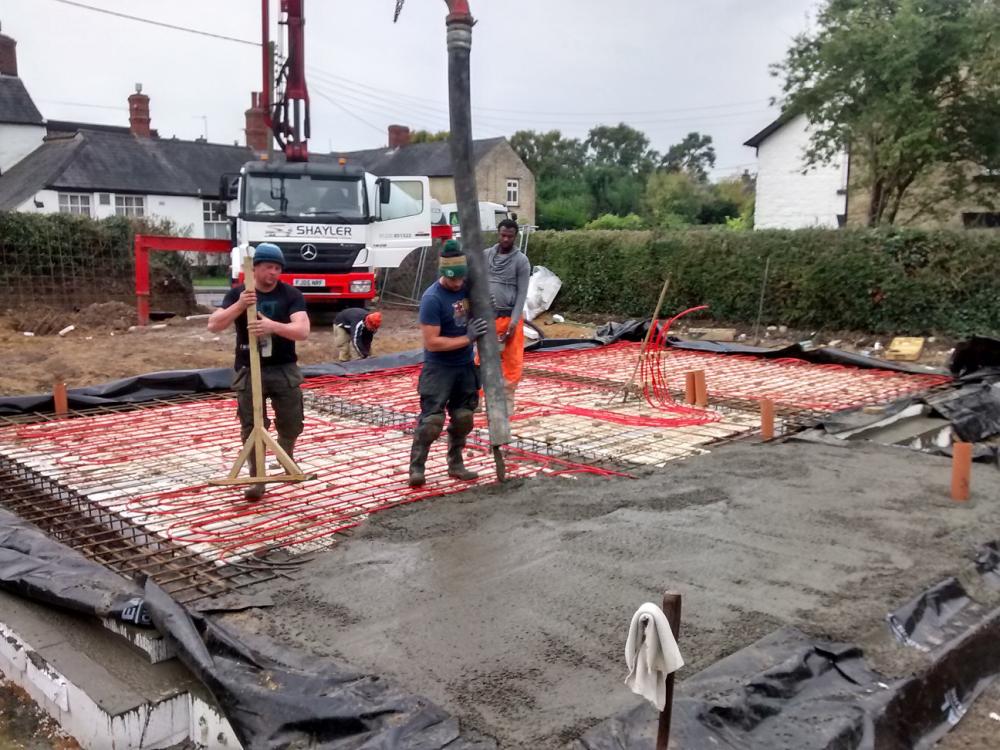
-
Nah, I've got the full hazchem selfie of Jan and I doing the acoustic insulation, but I dare not post it without permission! I will leave it to J to decide. We solved the original issue by the brute force approach by stripping and repapering the worst effected wall (for other reasons).
-
On our application, we documented house key dimensions, and I see that @Barney12 has omitted these. A friend who is also a member of the forum told me that when he got his architects drawings (which had all dimensions detailed), he transcribed them removing all dimension info onto his own scale drawings (with the "do not scale from this drawing caveat") for submission in his application. Sounds like a very sensible approach given this dialogue. We had a spat with our LPA EO over the position of our slab -- it "had shifted 600mm towards our neighbours boundary" so they requested that we submit a minor-material amendment "document this change". On checking, we realised that our neighbour had moved his corner fence post 0.5m into our garden behind our laurel hedge and that the slab was correctly positioned w.r.t. the adjacent highway to its front, so we declined. They wouldn't admit any mistake, but they did eventually agree that "it would not be expeditious to proceed with the case" and closed it. What pissed me off was that there were no measurements to the boundary given on the plan, and it was behind a 1.3m deep laurel hedge apart from one narrow gap where we had take a sycamore out some years before and where they took their measurements to come to this conclusion. As to NMAs, the same EO asked us to put in an NMA because the front door didn't match the detailing in our application, so we agreed on this one -- also pointing out in our application that the front door wasn't visible from the public highway and the only reason that we had changed the style was that our window and door supplier (who was specified in a previous MMA to our application) had later informed us that this was the only style available in the range detailed in our application (and we had to use it because the attached side window had to match the others on the frontage and comply with our application). The LPA then rejected the NMA and as the case officer subsequently clarified "any change to the principle elevation is material", and "it doesn't matter that the door isn't visible from the highway; callers to the house will see that style is not in keeping with a traditional cottage style". We've just had a second EO visit and the officer didn't even notice that we've still to change the door! The whole process is crap, IMO.
-
Nah, I accidentally removed my old pic from my profile and it must have been 5-10 years old, so it needed updating anyway. I can't remember what I was doing when Jan took this mugshot but it was pretty shitty as I was fully suited up. I'll dig out another some time.
-
Why HVDC for the inter-country interconnect cables?
TerryE replied to readiescards's topic in Electrics - Other
In a word: inductance. Piping AC in a submarine cable has horrendous power losses. DC doesn't; just the basic I²R. All of the AC <-> DC is solid state these days. The technology is amazing. But even for long distance overland power distribution, HVDC is starting to have more net advantages. -
Hummm, I think that a margin of error might be 50-75 mm but as Ferdinand says, I suspect that 180mm × 2 might cause the enforcement officer to gag. The last think that you want is for fight a stop order. Can't you explore thinner alternatives? Surely there are pretty good weather proof thin skins such as brick slips if the LPA doesn't require stone or the like. In our case our wall is profile is ~50mm thicker than planned but we can point to factors: (i) the local stone that the LPA required us to use was a nominal 100mm but is more like 125 on average and we've cut them back to 150mm if larger and so need a 75mm gap rather than the nominal 50mm to keep a health separation between the stone skin and the timber frame. And yes, we trimmed the sizes of our rooms when we decided to go for a twinwall rather than single wall timber frame.
-
A few = anything up to 30

