


TerryE
-
Posts
3826 -
Joined
-
Last visited
-
Days Won
30
Everything posted by TerryE
-
Dave, in many ways using copper is actually easier because the installation within the building fabric is robust and rigid. I've done gas plumbing before, but that was in the days before you had to go on a long course and get a certificate to prove that you understand that you can't use flux and have to pressure test everything as part of commissioning. I've still got the clear plastic tube to use as a manometer, but it would some new red wine to colour the water. Our primary hob is induction, and as Jan says these two rings are purely backup so that we aren't totally stuffed in a power cut, so we'll probably keep it simple and use a single bottle.
-
We were lucky enough to be able to coordinate the window installation with the frame erection, so the windows went in starting the last day of the frame erection when the MBC crew were working in the loft anyway, but if you can't do this then (i) make up temporary windows or equiv out of tarpaulin grade clear plastic and (ii) make up a simple lobby out of framing and OSB3 and get yourself the cheapest Wickes exterior door and frame that you can buy so that you can secure the building. It's just so much easier working out of the wet. Like Jeremy we had a delay of about 6 months, but ours was between the frame going up and starting the inside work. This gave us time to experience the space and we made quite a few small changes as a result: swapped the use of an internal bedroom and divided the largest into a bedroom + smallish walk-in wardrobe + ensuite; moved another couple of non-loadbearing internal walls; swapped the side for the racking on another wall. This also gave us time really to think through the layout of the wet rooms and kitchen. Jeremy recommends building a physical model of your build during design -- well there is nothing like a 1:1 model to plan out your house in and this can take time to get right
-
When I did price comparisons, the OSMA range seemed way over the top of some of the others, so we decided to switch to Polypipe, but when I looked around for online plumber's merchants who stock a decent subset of their PVCc there wasn't a great choice of one willing to quote decent discount prices, so configured up the entire waste and soil system and the price came out at over £1K for the two stacks, which seemed high to me. So we then shopped around some more, and "Plumbing for less" site just so much more price competitive. However they skip some of the less popularitems -- e.g. they don't sell the single boss adapters, but their price for a 4 boss adapter to 1×spigot adapter works out slightly less anyway. The big prob is no Polypipe PVC-C solder fit in their range, so we decided to configure up a full 2-stack solution using their in-stock items which involve 2 core uPVC stacks with all of the 50 or less branchwork in ABS and the price came out at just over £400!! For a 60% saving here, whilst still sticking with a reputable brand and a 5-star trust-pilot rated supplier is just too compelling.
-
Re the vertical entry gathers: agreed to all of this, but our first joist is hard against the Larson strut wall so that means that the soil pipe centre is some 95mm out from the wall. The 6.way box manifold only stands out another 2-3 cm from the pipe is you are using and remover the front bosses. We can't drop the manifold under the floor because the gap between the two joists is too narrow. Re using tee's connection, etc. surely a constraint here is Part H1 Table 2 and Diagram 3, plus clearing access requirements. In our case we have a short stack AAV terminated in our bathroom which handles 2 toilets, 2 basins, a bath and 2 showers on the 1st floor 1 toilet and a basin on the ground floor a full stack AAV terminated in the loft which handles 1 toilet, basin and shower in loft 1 toilet and basin on the first floor 1 utility sink on the ground floor. We've had to up the size of some runs to comply with table 2.
-
Yup, I fitted one in my bathroom about 28 years ago and haven't had a problem. My issue about this form factor is that the footprint means that I would need to move the boxing-in in the bathroom out another 50-75mm to accommodate it.
-
Could do but not in OSMA. Time to discuss with Jan.
-
As I said there is a universal solvent for the OSMA brand that contains a mix of solvents that work liquefy both ABS and PVC, but if the resulting two plastics are immiscible then you don't really get a true weld, do you? And if there is some bonding then there's no guarantee that it will be watertight as you can easily get gaps. Send a bit risky to me. After all, all I am talking about it when an ABS branch connects to the PVC-U stack, and this is also the weakest point for expansion cracks to form. At least a push fit spigotis designed for this scenario. Need to think about this one. BTW, I have 11 such 50mm and below branches connecting into my 2 stacks.
-
I am finalising my foul-water designs based on OSMA pipework. OSMA use 3 different materials for their soil and waste pipe systems: PVC-U (Unplasticised Polyvinyl Chloride) PVC-C (Cholorinated Polyvinyl Chloride) which is a PVC variant with better high temperature properties ABS (Acrylonitrile Butadiene Styrene) PVC-U is used for the heavy stuff such as the main 110mm pipes and fittings, and the PVC-C and ABS uses for the narrow bore wastes (50mm and bellow) as these need to be hot water tolerance. In general ABS pipework is cheaper than the PVC-C equivalent and slightly more robust. OSMA do a universal cleaner and a universal solvent which contain a soup of cleaners / solvents capable of cleaning both ABS and PVC. As far as I can see you can solvent-weld within one type, and also PVC-U to PVC-C, but I can't find any manufacturers that will endorse attempting to weld ABS to PVC-U, so you have to use some form of push fit boss connector at a PVC to ABS interface. So as far as I can see, if you want to avoid boxed-in push fit connections then you must use PVC-C waste systems. Is this correct?
-
IIMO, you have to be very careful to read the T&Cs attached to the architects proposal. Who owns the IPR and the copyright on the work that you have commissioned? The architects practice will often retain this and put strict constraints on how you can use their work. You might find that you can only use this work if you pay them to oversee the subsequent phases of the build. A total fee of 7% of the value of the project isn't uncommon, and this also means that you need to get the build independently valued, so you need to add in the QS fees that you hadn't budgeted. £2,400 sounds to good to be true, and the usual reason that things sound to be true is ...
-
Same as me Peter. The 6-8 week delay is in scheduling the actual ground works.
-
We've just got a basic one which is fine for what we needed. IMO, the bells and whistles are only worth while if you are doing a lot of level taking. You don't even need a laser receiver to work on your own if you make a cross T support and velcro your sighting rule to it; you just need to walk to and from the dumpy each measurement, which is fine if you are just doing the odd level check. But if you do buy a second hand dumpy, then you must make sure that it's properly calibrated -- a bit of a faff but easy enough to do. As to what to look for, try to make sure that its "only one owner / one project" preferably with the original boxing still intact. I'd avoid a knocked around builders hand-me-down.
-
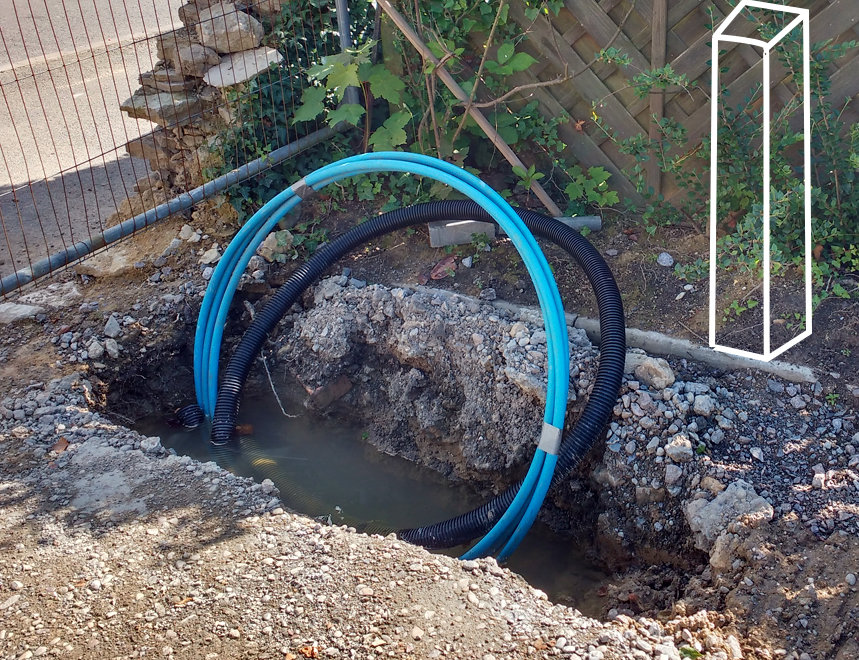
This was an occasional but recurring topic on eBuild, including a topic that Jan and I initiated. Our water supplier (Anglian Water) has a strict policy to the effect that: the pipe into the house must be a min of 75cm deep and their surveyor must review the house installation for compliance before scheduling any connection works on the public highway. (There is a waiver for approved installers but in practice these guys only deal with large installations.) The standard way to get around this is to do this installation in 2 phases: Install a standpipe and request connection to the standpipe. This triggers digging up the road and connection to your property including the installation of a meter, stopcock and double check valve at or near the boundary. This has a 6++ weeks lead time. When the house and plumbing is "finished", then apply for approval to connect up the final supply to the house. This has a 1-2 week lead time in our area. So you can parallel up the external works and 1st / 2nd fit with the roadworks for the costs of a standpipe and the extra site visit, which is often worth doing even if you are never going to use the standpipe in anger. What is crazy is that our water table near the boundary is about 150mm below the street level so IMO there is no way that A.W. will put their meter and stop cock at 750mm because it will be permanently covered in ½m water. I did suggest just making the standpipe available and fitting it at the same time as the digging, but no: there is an absolute rule: the Anglian survey engineer has to review the installed standpipe and standpipe tail for compliance with their guidelines before any groundwords can be scheduled.) See attached photo where I've marked the position of the standpipe; there wil be a second coil of MDPE from the standpipe. The black pipe is for the electricity supply. You can buy made up standpipes such as this one: PL34 Standpipe which costs £235+VAT and is as per attached image, but I will buy the bits and make up my own for about £30. One wrinkle is that A.W. insist that the bibcock must not have a hose connector -- so I can either spend ~£30 for one without a hose connector of use a £7.50 one and angle-grind off the hose connector. Hey-ho!!
-
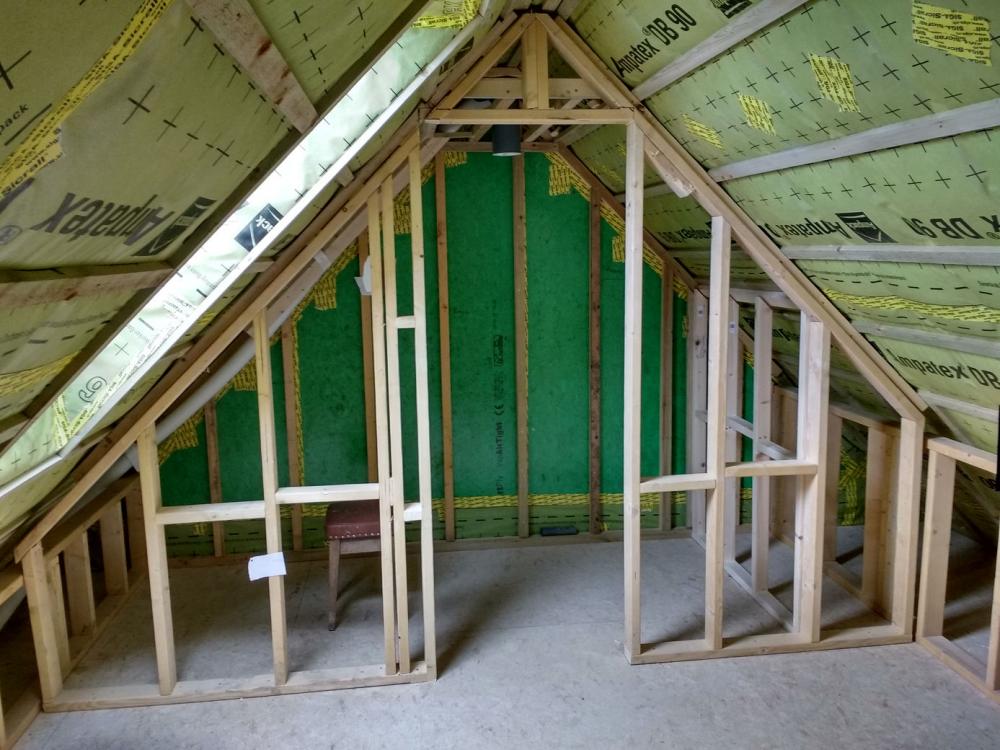
Thanks @Nickfromwales and @Auchlossen; much appreciated. This ensuite is in our son's bedroom, and he can be a bit of a dozy bugger. One thing that worries me is that this ensuite is tucked into the the rear gable, and the apex is tight at the frame head so we've only got about 3 cm floor clearance unless I start thicknessing the frame head down further, and so we can only have a small thresh on the door. IMO the disaster scenario would be if say he had a shower and dropped a flannel over the tray trap so the floor in the ensuite would then start to fill and top the door thresh spilling into the untanked bedroom. We have a secondary drain in the floor near the door in the wetroom in our Greek cottage. Is it worth doing something similar in this ensuite? OK, this backup drain might never get called upon, so the tanking integrity doesn't need to be of the same robustness as the main shower tray. However, it seems that using this as an emergency overflow would be a lot more to be preferred than topping the door bar and dumping water into the bedroom!! PS. How to you like my model toilet pan?
-
One dimensional thinking
TerryE replied to tonyshouse's topic in Energy Efficient & Sustainable Design Concepts
OK, I think that we agree on the issue, but maybe diverge on labelling it. In my view it would be extremely difficult to model this stuff in 2 or 3D. I would describe this more as understanding the limitations of a 1D model and therefore where the assumptions that underpin the model start to fail materially. External corners; window and door framing, etc. But the failing here might not be modelling ones but engineering ones -- for example slab PUR has excellent U values so long as there aren't any convection gaps which will allow air to circulate back-to-front and pump heat out of the house bypassing the beautiful insulation barrier, or in my slab where 230 × 20mm rebar has the same thermal conductance as 8" of continuous concrete -
One dimensional thinking
TerryE replied to tonyshouse's topic in Energy Efficient & Sustainable Design Concepts
Yes, the issue isn't that you are losing an extra 30W of heat along a linear feature such as the centre column in a corner window. This isn't a great variation to the total budget in the grand scheme of things; it's that this heat loss occurs in a very small area and this can result in a surface temperature that is below the dew point for the house's absolute humidity, with this acting as a condensing surface. A local surface temperature drop of a few degrees won't be a problem. One of 10° or more will be. -
I see that the Karndean FAQ says that it isn't suitable for wetrooms, but is there any realistic alternative to tiling for upstairs wetrooms?
-
In the absence of other advice, it looks like we'll go with the JDK ones and the TP standard softwood frames with separate stop, as these are reasonable quality and the trade website is within 10-20% of comparable "best buys". We're doing all of the fitting ourselves. One issue here is that the final wall widths don't match any of the stock frames so I have to rip them on my table-saw and finish them in my planer thicknesser whatever I buy. This might seem a bit of a fuss, but at least this way I get the quality and accuracy that I want without paying £2-300 a day for a chippy whose finished work will just annoy both me and Jan.
-
One dimensional thinking
TerryE replied to tonyshouse's topic in Energy Efficient & Sustainable Design Concepts
Tony, a serious response to what I think is a serious point. 1D models have reasonable analytic approximations and can be numerically solved with some economy. With 2, 4 and 4 (time) D models the computational burden rises by orders of magnitude with dimension. Yes they can be solved but is the solution understandable? Is the input data set sufficiently accurate to merit the extra complexity? In a well designed passive style house such as the cellulosic filled Larson strut filled frame with a decent insulated slab then a 1D model will get within 10-15% of a decent 3D model, and at the same time the 1D approximation makes it easy to understand the forcing factors. Yes, as you improve the U values of your surfaces then the linear elements are a more important component, but IMO the issue here isn't modelling them, it is understanding the vulnerabilities and preventing them in the first place by design. If I look at our house, then the major design cock-up was nothing to do with the wall or ceiling make-up or 1D vs 2D modelling assumptions, etc.. It was that we have an external stone skin so Hillard, MBC Structural Engineer, made a simple mistake (IMO) which solved a structural problem but at the same time created a huge thermal bridge between the slab and the outer ring beam. OK, I spotted this in time to put a mitigation in place: that is by leaving the EPS300 slab framing in place and adding a layer of Foamglas Perinsul blocks between the slab and the stone skin, but this detail would have killed the performance of the slab if left unmitigated. Hopefully this won't be a solution for future builders in my position because Hilliard and I have discussed the best ways of avoiding this vulnerability in future designs which require a stone skin. The more spherical (blockhouse-ish, whatever) your house is then the more that the 1D model approximation dominates true life performance. Yes it is a terrible approximation if your house has many facets / reentrants, but the fact is that building this way might look architecturally interesting, but the real thermal performance is going to be crap however you model it. -
That's what we did. For a couple of months the main waterproof layer was the membrane -- even though MBC wouldn't warrant this -- but we had absolutely no problems. Then we lifted the stapling along the eaves edge and fitted the arras rail before the slater started work. We also wrapped the front face and the underneath is a folded aluminium L section as I discussed recently in another topic.
-
Your sketch up pretty well matches my description of what we've done. We used some arras rail from the local timber yard for the 90/45/45 section. The membrane goes over this, and the ventilation strip is pinned to this and the tile /slate sits on top:
-
Ferdinand, as I see it @oranjeboom has 3 remediation paths: (a) leave the wibbly high infill, levle and use a high U-value insulation, (b) dig out and relevel, (c) the external skirt option. 100mm of PIR might not be ideal but it will perform reasonably. Depending on the total area digging out and rewacking might only be a couple of days work and if necessary hiring a minidigger to avoid the backbreaking work. I would discount your external skirt option as it won't be as effective as the other two and is a major undertaking. So I would personally choose one of the first two, probably the second. This underlines the wisdom of the slab makers approach (and they used a fairly small wacker plate BTW) whcih was to lay the hard core in 50mm layers and level (using laser) and whack down each layer then finish with 50mm sharp sand whack and top up to final level using screed bars. I
-
The Great Thermal Mass Myth................
TerryE replied to Jeremy Harris's topic in Boffin's Corner
I think there are separate but related discussions about use of "thermal mass" (and yes, that meant to tease J) for external bulking and interior bulking. In my and Jermey's house the bulk of the thermal capacity is on the exterior shell to the living environment, that is in the slab and the the filling in the the Larson strut frame. This acts a huge high-stop filter on external variations. Any internal bulking is intended to top up heat losses. The is a lumped system, and any internal heat capacity and time constants need to be matched to exterior ones. IMO the main benefit of interior "thermal mass" is to act as an absorber of internal heat variations -- the odd 4 visitors, vacuuming, etc. But designing a total system to work effectively is going to be complicated. -
The Great Thermal Mass Myth................
TerryE replied to Jeremy Harris's topic in Boffin's Corner
Come on Nick, why the cynicism? If you remember I did a post on the eBuild forum where I did just that for my wall profile and did some time simulations showing the time response to various external temperature profiles, and I showed the cross-sectional heat profiles. The equation is the standard heat equation. OK, it was a 1D model, but that was good enough. It should that for the standard twinwall with an external stone skin, the time constant was so long compared to 24 hrs that I really didn't have to worry about diurnal effects or modelling them when doing my Heat balance calcs. A simple steady state approximation is perfectly adequate. At that point I stopped doing time varying thermal models - no point. -
The Great Thermal Mass Myth................
TerryE replied to Jeremy Harris's topic in Boffin's Corner
I was a mathematician by training, so I am one of those rare wierdoes who is comfortable thinking in equations. So if you are like me then this Wikipedia description is useful: Thermal time constant. The physics of this is dictated by what is called the heat equation, and this is classed as what is known as linear time invariant systems. This formula has the dimensions of time, that is you can measure it and quote it in seconds, hours of whatever time unit takes your fancy, and it is a measure of how sluggish your system is to respond to step changes in external conditions. Dropping the funny formula symbols, this article includes a summary: In other words, the time constant says that larger masses and larger heat capacities lead to slower changes in temperature, while larger surface areas and better heat transfer lead to faster temperature changes. I would say: the longer the time constant the more sluggish is the response to changes in external temperature. The time constant for the walls of my house with its external stone skin and twinwall filled with cellulosic filler is a few days, and because of this I don't really have to worry about diurnal temperature variations in designing my heating system- 122 replies
-
- 2
-

-
- thermal mass
- heat capacity
- (and 4 more)
-
Jeremy you are correct -- not pea-shingle, but a fine sharp stone, say 3-5mm. The comment about being weed-free is useful. Thanks
