


TerryE
-
Posts
3826 -
Joined
-
Last visited
-
Days Won
30
Everything posted by TerryE
-
Joists: how level should level be?
TerryE replied to ToughButterCup's topic in General Construction Issues
The squeak occurs when one or more nails slip in the nail hole. The spiral ones and screws are far less likely to pull and slip. Joist spans over 2.5m need extra measures to prevent the tendency to twist when loaded. Staggered solid noggins are typically used for solid joists. In the case of PosiJoists extra lateral bearers. (I think our build two overlapped were 3×4s were slid in during erection for each long span to run the length of the room and then fixed in place before the floor was nailed in position.) Re the carpetting issue, we screwed down all of our boarding before the room were carpeted as an extra precaution to avoid squeak. The only one that we missed was one lateral to joist cross. Bugger again. It's any lateral runs that are a PITA as you have to be physically able to get the pipe in there. In a couple of cases we used straight - 45 - straight 45 - straight to form a nice roddable slow bend and one that I could get into position and still solder fit. We followed Nicks et all suggestion a radial HEP2O system with no hidden joints. HEP20 has enough forgiveness to pull through though it is really a two man job. Ditto the flexible radial MVHR systems. -
Joists: how level should level be?
TerryE replied to ToughButterCup's topic in General Construction Issues
Our ONE joist cockup was that one of the cross braces running through the joists was only nailed into the joists and obviously not spiral nailed. When you walk across one joist (and only only one in the house that does this), it flexes a mm or two relative to the cross brace and this generates an audible creak. This is half way between my bedside and the ensuite. BUGGER. I didn't notice until after our bedroom had been carpeted. PS In the case of PosiJoists, these are also called strongbacks. -
the cost of a cheap dehumidifier from Argos or whatever is alot cheaper than the remedying the consequentials. You probably want one or two running in the house anyway if you have a mix of rooms at 2nd-fix and finished. Drying out generates a LOT of moisture which is best removed. At this time of the year, you need active dehumidifiers, IMO.
-
Joists: how level should level be?
TerryE replied to ToughButterCup's topic in General Construction Issues
The main PITA with boards IMO are (i) planning all of your rigid runs: potable water, foul water and MVHR as well as electric of course. This is a LOT easier with eco joists but gets harder with the webbed and solid ones. These runs need carefully designed and laid out. Foul water piping requires fall away within tolerances. The joists require cross bracing. Don't leave this to your trades as chaos can ensue. Start will the fattest / stiffest and do the electricals last. Remember that you will have to meet structural and fire BRegs when planning these penetrations as well of course the dynamic of putting the bloody things in in the first place. So many houses have above-board boxing in along walls to accommodate horizontal foul water runs and these look totally naff IMO. Non in our house -- though a couple of internal walls have been doubled up to hid a multitude of messiness without being obvious. -
Joists: how level should level be?
TerryE replied to ToughButterCup's topic in General Construction Issues
Ian, I can't recall, but what type of joist are you using? Solid timber, eco joist (that's the ones with the metal zig-zag web or the ones with the OSB web? IMO you can tolerate a mm or two and there's little point in sanding. Anything more than a mm or two would require a planer anyway. The main annoyance that we had was that our Ecojoist had jointing plates occationally and these added 2mm or so over the joint. We had 2400 × 1200 22mm boards, but these still had a very slight ripple over the jointing plates. Any small pimples will get squished into the floor or ceiling boards -
A lot of the members here have got houses built to an equivalent energy performance to Passivhaus, but without formal certification. For example my house has an MBC twinwall and passive slab, Internorm windows / doors and Fakro roof lights, etc. My attitude to Passivhaus itself is that it is a "designer label" in that whilst I agree with the underlying energy saving principles and have built my house to them, I think that the actual scheme itself and certification is overly bureaucratic and by itself add no value. IMO, the most important thing is for you and your architect to understand your true underlying goals and to design a house that you will truly enjoy living in. Don't allow yourself to be lulled into a design that looks good on paper, but a year after you move in you keep thinking to yourself: I wish that we had done that differently. For example, many architects seem to love "acres of glass" which results in a loss of privacy for the occupants: if you don't own the overlooking sight-lines, then you can't control overlooking. Also large windows can a greenhouse effect that can be expensive and difficult to mitigate, especially if such measures are an afterthought. The energy design of a house is important, but a very common mistake is to fail to understand that achieving the cooling goals can be far more challenging than the heating ones. Put simply, with current technologies correctly applied it is fairly straightforward to build a house that is cheap to heat in the winter season. It can prove a lot more difficult keeping the house cool enough in the other three seasons. 6m² of glass can generate over 3 kW of incident heat on a sunny autumn day and +3 kW will turn an average room in a zero-energy house into an oven in hours. Many of the members here are willing to host visits, and this can be a very effective mechanism for you and your partner to get a good gut reaction as to what would work well for you and what wouldn't. In our case, Jan and I have lived in our new house for a year now, and we can truly say that if we could redo this again, the things that we would consider doing differently are very minor.
-
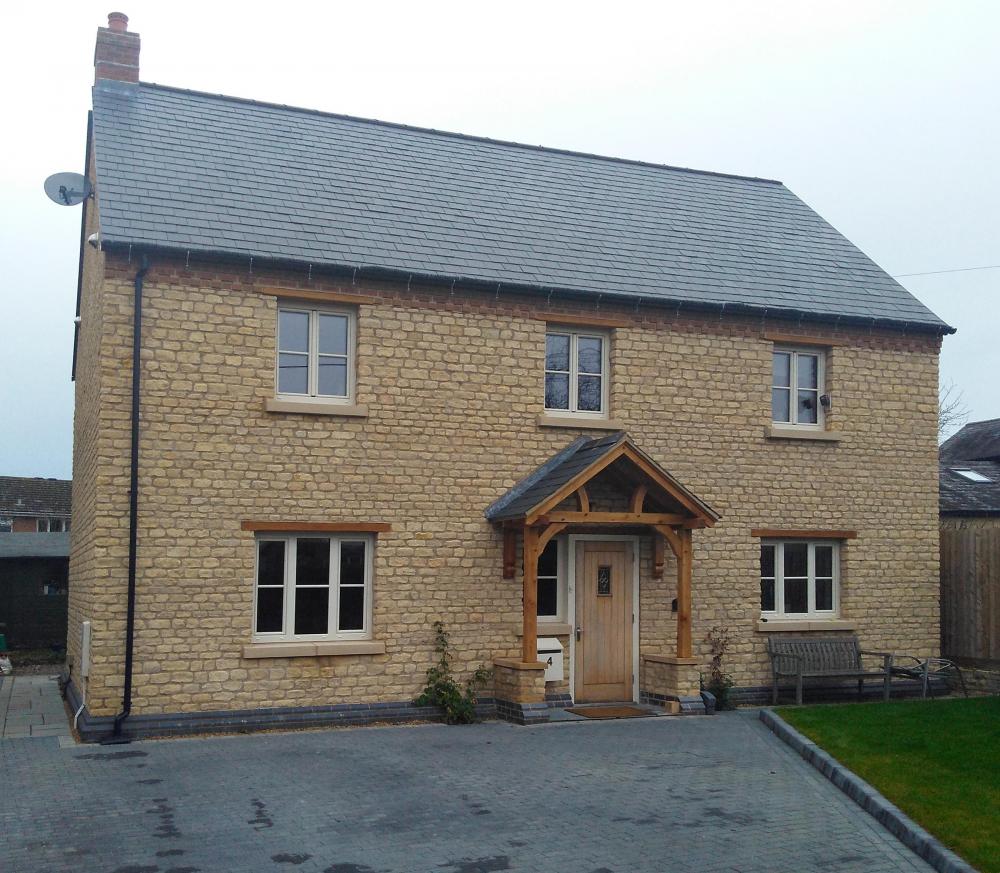
IMO -- and it is a personal one -- our MBC passive raft with embedded UFH worked out cheaper than the equivalent traditional foundations + beam+block + insulation + UFH and screed and was a lot less hassle, but the caveat here is that doing a passive raft well is a skilled job and you risk being let down badly if the build crew aren't good at what they are doing -- in that everything has do be right for the pour and once started the crew is working against the clock. OK we also have a twinwall, but our supplier also does single-wall solutions so it can be done. We also had a complication with our slab because of our external skin and a potential thermal bridge that the SE designing the slab missed. See this post: But the final result looks good (sorry for the cloudy day). The engineering brick plinth wraps the outer EPS 300 and the outer stone skin sits on a foamglass layer to complete the thermal isolation of the slab. The entire house is heated by a single immersion heater element in what is known as a Willis heater, but that's a separate discussion.
-
Where oh where do I put it?
TerryE replied to Sue B's topic in Mechanical Ventilation with Heat Recovery (MVHR)
If is best positioned somewhere reasonably centrally to keep the runs to your manifolds simple and ditto for the external inlet and outlet pipe. You will also need some routine maintenance access as described in the installation manual. They also tend to be a fairly noisy -- on a par with a fridge but continuous when running so housing it in a cupboard or a services room (rather than a living one) is a good idea. -
The water flowing in the UFH loop has CH inhibitor in it so it is definitely NOT potable and is entirely separate from the potable supply. In our case our potable circuits are at 3 bar and the UFH circuit at 1 bar. I do have a filler connection form one to t'other but this uses a two one-way filler valve in series and a separate small expansion vessel on the UFH side. If you need to transfer heat from one circuit type to another without mixing the supplies then you can use some form of heat exchanger such as an internal coil in tank or a plate heat exchanger (PHE). In the case that Ed is discussing were you also have another ASHP circuit, this is going outside and needs to be cold tolerant in a way not needed for a UFH circuit and so the ASHP circuit will typically have an anti0freeze content and will typically be separated from the UFH circuit by coil HEs in a buffer tank or thermal store, or by a direct PHE.
-
Using Flow Restrictors to achieve schedule G" of the BRegs
TerryE replied to TerryE's topic in General Plumbing
@PeterStarck Just ordered 5. Collect tomorrow. -
Using Flow Restrictors to achieve schedule G" of the BRegs
TerryE replied to TerryE's topic in General Plumbing
@JSHarris I suspect that the washer type will fit well with the type but not the domed aerator type. These last will be easier to swap out and we'll need to do this, as they flow about 8-10 l/min..
-
Using Flow Restrictors to achieve schedule G" of the BRegs
TerryE posted a topic in General Plumbing
We've discussed this general issue as an aside on various topics but AFAIK from my search of the forum, we don't have a topic covering this specifically. BReg part "G2 and Regulation 36" states: The Water Efficiency Calculator is available as an Excel or OpenOfiice Calc spreadsheet and IMO is easy to use. The challenge is filling in the data in a way that the BInsp will believe. As Jeremy and others have mentioned, the easiest way to have a demonstrable confidence in estimating flow rates is to fit flow restrictors on all taps. @JSHarris post covers this well. In our case we have a 3 Bar direct system, so the flow rate at all of our taps is high. I see little point in having any of the hand basins at more that 4 ltr / min. This is more than enough for hand washing and limits the splash-back that would otherwise occur for fully open taps. 6 ltr/ min for our utility sink and 6 or 8 ltr/ min for our kitchen sink; 8 ltr/ min for our showers. So much for the theory, but now the implementation. The challenge that we have is the non-standardisation of tap aerator fittings. We've standardised our taps during initial purchase, but we still have 4 different types: some have a male thread, some female; some flanged some not. Some simple through flow; some proper aerator. None have the sort of negative feedback restrictor that gives a reasonably constant flow over a range of static pressures. (Note that most require a minimum pressure of 1 bar to work correctly.) Finding decent datasheets is difficult but this is the one for some Pegler restrictors. Jeremy kindly provided a link to QS Supplies: all Eco Home Restrictors which seems to give a complete range at competitive prices. If anyone has good alternatives then please post the links to the topic. Note that the flow restrictors seem to follow a colour coding convention -- I suppose to allow any inspector a simple visual inspection of the faucet to determine flow rate. The main challenge seems to be (i) choosing the right flow rate for you and (ii) choosing the correct sizing spec to match your tap outer. For that reason many seem to replace the whole body as the threads usually come in one of two sizes. The restrictors are easy to fit and to remove (so long as you remember to keep the original fitting) ? In terms of estimating what 1.7 or 4 or whatever ltr/min flow rate feels like, the easiest way is to use a ½ltr jug and counting to adjust the flow rate on your exisiting tap and to ask yourself whether this is enough to wash your hands or whatever. But remember that fitting an aerator (if your taps don't currently have them) effectively doubles the perceived flow rate as the water is mixed roughly 50:50 with an air-bubble stream.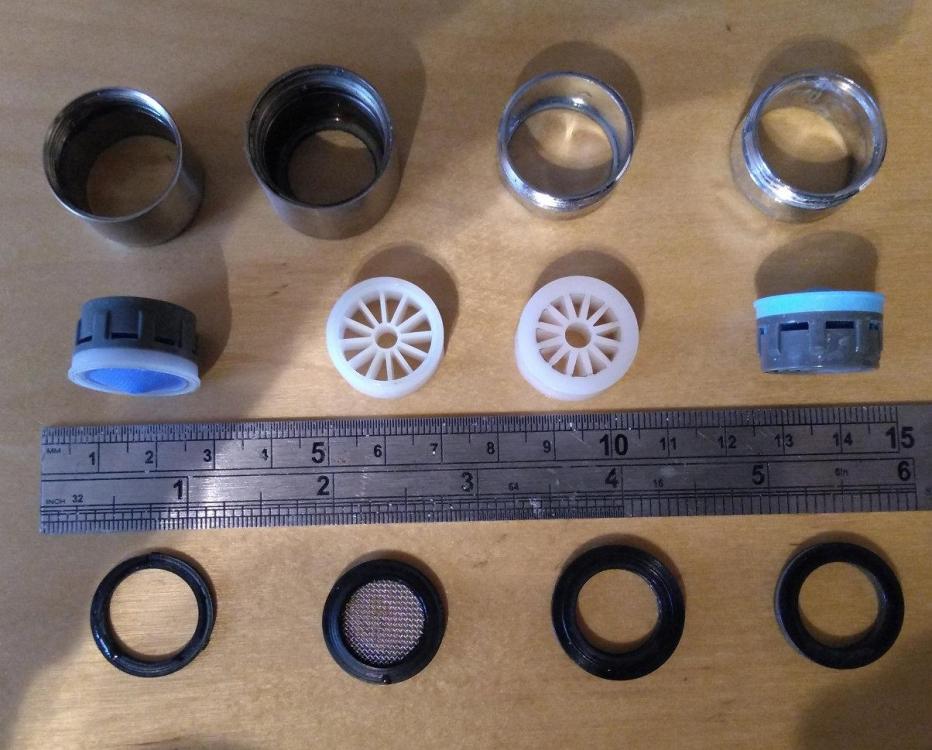
-
The tale of the sale of our old house
TerryE replied to Jeremy Harris's topic in General Self Build & DIY Discussion
I thought that FD had a banking app that used fingerprint for 2FA (2 factor authentication). This would work fine over WiFi as well as 4G. There are a lot of other 2FA schemes available that don't require SMS. Nationwide uses a card reader which works with your bank card (chip). -
Best simple ideas and concepts to design in to new build
TerryE replied to albert's topic in New House & Self Build Design
Or alternatively buy one with a timer built in. We put ours on overnight. We don't tend to generate many dirties when we are sleeping. -
@joe90, as I mentioned in my previous post, the UFH is used to top up the heat in the house, and it has to be hotter that room temperature for this to happen. At the moment it is pretty mild so we need about 15 kW per day or just over 0.6 kW average which requires our slab surface to be just under 1½°C warmer that the air temp. When it gets really cold this can go up to 4°C warmer. Setting the heater to 1°C above target wouldn't work for us so most of the cold months. @Ed Davies, I have pretty much abandoned using the slab temp as a control variable. It's just too much of a PITA as heating it changes the temperature on a far lower time constant than the overall response of the house. Step changes like visits (our warm bodies leave the house or extra ones arrive) are hard to control for. I have switched to using the day-averaged hall temperature. My overall strategy is still to do the bulk heat input during the E& off-peak, but the spread any residual over day once the slab has dropped below a trigger temperature. Just a change to some lines of code, so no hardware changes required. I'll report back when I have some decent stats.
-
Yup, same here. Vacuum every 3 months and replace every year -- and like Jeremy we live in a rural location. Goodness knows how dirt they would get in a city or suburban location.
-
Karen, I realise that this is always a Q of priorities, but I would keep a close eye on the humidity in the unheated half if you aren't running the MVHR (you can buy cheap LCD thermo + humidity readout sensors for around £10). You don't want to let it get up to condensing levels, as this will encourage mould and mildew in the unheated half which will be a PITA when you want to sell and move. Commissioning the MVHR would be one way of mitigating this.
- 23 replies
-
- 1
-

-
- heating
- thermostat
- (and 1 more)
-
Jeremy, there is one caveat here. I will just expound this for other readers. If your circulation temp is 24°C, say and your environment set point is at 20°C the the maximum delta T with you slab at circulation temp is 4°C and so the maximum heat output of the slab is roughly 4 × 75 × 7 W, say 2kW. If you need more than this -- either because it is extremely cold outside or you are heating the house after absence, then you wont be able to achieve your set point. In general , I would suggest that people decide on a maximum heat output for their slab and crank the figures to set the maximum temperature accordingly.
-
It seems to me that there are two broad thermal management approaches: Thermos flask, that is you have a very low U-value external boundary and minimise other heat losses, but within this outer boundary any heat barriers are an order of magnitude+ lower than the external barrier. In this scenario it makes sense to keep the whole internal environment at the same time-constant set point and accept the heatflow at the barrier. That's in reality what people like Jeremy, Jason, and I do. Energy costs are very small because of the efficiency of the external barrier, and because there aren't material internal barrier you can use a single heat source like groundfloor UFH , so the whole heating system is so much simpler -- we have no rads; no upper floor UFH or the like with all of the entailed costs and complexity. Onion ring / many layers. This is opposite to the thermos flask approach: only heat the living space that you use and when you use it to the comfortable temperature, so the snug might be at 21°C for 7 hrs a day, the other lived-in rooms at 19°C for 12 hrs a day, the whole house at 14°C etc. This is a sort of defence-in-depth approach to heat losses. @Ed Davies, in your case you seem to be running the living room at an average of around 18½-19°C by ToD heating rather than a target of 21°C . The rest of the house probably has similar but stepped down figures. so the first order would be to plug a ΔT of 2½ °C into your houses U-value calcs for see what the energy implications would be. Karen, in practice you seem to be using your house as 2×Semis with one effectively unheated. There will be an internal wall interface between the two halves, and an internal stud wall with PBoard either side and acoustic insulation will have a U-value of roughly 1 W/m²K and the heat flowing from the warm to the cold side at a ΔT of 10°C will be 10X W where X is the area of the internal partition interface. So this internal wall is like a huge radiator sucking heat out of the warm half and heating the cold half. The cold half will be in rough equilibrium with external wall losses matched by the input from the warm side. Keeping half the house warm will save around maybe 25% or less of the heating bill rather than the 50% that you might expect -- still this is still a non-trivial amount. TBH, J in your case I didn't think that it was about money, but we've now dismissed this. As far as monitoring our HA I use a combination of the Node RED node-email to push alarms which I pick up anywhere using my phone, and OpenVPN which is simple to use and is brilliant for doing remote access / monitoring. I run the server install on an RPi which opens a (non-standard) port onto the internet for SSL connection, and so I can securely access my HA and other services / servers in the house from anywhere -- and I can also watch iPlayer from a Greek Taverna.
-
To answer @Pete's Q we set ours at 22.8 °C. We originally used 21°C as discussed by Jeremy et al, but found that we needed to put light sweaters on in the evening when sitting quietly. The extra hike means that we can dress indoors for summer T shirt weather all year round. We find we prefer this, but as I've mentioned on other posts, we spend a lot of time on one of the Greek islands so have got used to the warmer temperatures. It's all a matter of personal preference -- or friction if you live as a couple and one partner prefers it a degree or two warmer than the other. The thermal capacity of the internal fabric -- all of the plasterboard et al -- is non-trivial; about the same as the slab IIRC. The time constants of the house as a system is many days. Because our only source of heat is the groundfloor slab, our 1st floor is about 1°C cooler than the ground floor, but apart from that offset, pretty much everything -- walls, floors, all the internal fabric -- stabilises at the same temperature. If we put too much or too little heat in, then the air temperature might vary be ½°C or so, but because all of the fabric is at this steady temp, then the house will rapidly recentre at this set point. Changing the set-point is hard work -- for example when we stepped from 21 - 22.8 °C it took 2-3 days for the house to settled down again. So I would guess that it would take quite a lot of heat input and 7-10 days to lift a passive house by 6°C or so and restabilise. Do the maths. Let us say that you dropped the house by an average of 3°C over 24 days then for our house this would save us about 60kWh heat or 20 kẂh electricity if using an ASHP. @jack, you've also got and MBC slab and frame so the numbers will be similar for you. Is all of the hassle of living in an icebox for 3 or so days worth saving a couple of £s in electricity charges?
-
You can't assume with a TF. You really do need to design. The frame needs to be able to carry its design load without buckling. It also needs to have adequate sheer stiffness to avoid collapsing by scissoring under the maximum design wind speeds. The BIsnp should expect to see all of these design details approved by a "competent person" -- in this case a qualified structural engineer.
-
I find it strange that people don't seem to understand the difference between recirculating heat and recirculating air. It's almost as if the incoming air has somehow been contaminated by the exhaust. I just tell people that the entire air in the house is exchanged every 2 hrs. That's not quite true because our MVHR at 30% flow does about 10% every 20-25 mins so there will be the odd lingering molecules. The main point is that the air in the house is a lot fresher overall than no MVHR and an odd window cracked open.
-
It's the nominal room temp that we want to maintain. If we can a target of 23°C, say, and this requires 30kW input then the slab surface on average needs to be (30/10) above this or at an average of 26°C. Thanks for the sign cock-up. Just check my git history and did a crap edit about 5 days ago. The temp has been steadily falling since then and the error in catch-up so has always been slightly +ve since -- hence my not picking this up.
-
Jeremy, perhaps that's the most important point: you are now in, and theory gets replaced by practice. congrats
-
Ed, to be honest, I haven't really decided what my end control algo will be. What I did decide to do was to try a temporary simple control regime to see how it performs, and to gather enough data to refine it, before doing so. My system is implemented in software rather than bespoke hardware, so a change involves tweaking a few lines of JavaScript in my NodeRED setup and hitting Deploy, rather than having to buy and to install wiring and bits of kit. I use a two on/off time scheduling system and during the on times, the Willis puts 2.88 kW into the slab. The main one ends at 7am and so is entirely in the E7 cheap rate window; the other starts at 5pm. I run the UFH pump for 10 mins before each hour and average the return temperatures on the hour. The 10 min value was a matter of trial and error: when I take the temps every 30 secs, I can see that it takes about 7 mins or so for the three return thermometers to stabilise to a steady flow return temperature, so after 10 mins I am confident that their average is the actual average slab temp to the resolution of the thermometers. (The other upside of this regular circulation is that as @JSHarris has found doing a regular recirculation redistributes the local heat from any hot spots from sunlight by windows.) From my 3D modelling of the heat flows (and which really tracks the actual slab characteristics well) I know that the temperature is hottest immediately around the UFH pipes and falls away as the heat flows radially into the slab during the heating periods, but that the heat has spread pretty uniformly throughout the slab by 6 hrs or so after the heating has turned off. (There is a residual uniform gradient towards the slab surface, so the surface is about ½°C cooler than at the level of the UFH pipework.) But by 1pm, the measured temperature is a good estimate of the actual slab temperature. So I do a linear fit of the hourly temperatures from 1pm to 5pm and take the 3pm point as my surrogate datum (yes, I know that I could have taken the average, but I wanted to track the rate of heat loss as well). I use an incremental approach to determine how much heat that I need to put into the slab. Based on the heat needed, I can calculate the temperate offset that I need the slab to be at. This gives me a target temperature for the slab, and by comparing to this 3pm actual. I then adjust the total heat for the day up or down depending on this error. By now my crappy explanation has lost most readers. Sorry for this. But for those still tracking this explanation, I've included the bit of NodeRED code that implements this as a footnote. This isn't a perfect solution, just a "let's hope that it is good enough" one until I get a good handle on what I need to do to implement a more robust approach. I also collect the hall temperature using a DS18B20 thermometer which in the studwork against the back of the hall plasterboard (and this entirely invisible), and I use a Met Office feed to collect the daily forecast data. I also plan to add another temperature probe in between the stone skin and TF. I might use these in the future, but the reality is that my first stab at this works pretty well -- so well that there isn't enough pressure to try to improve it. Over the last month the total heating time has wandered from 2hrs a night to 11hrs as the external temperature varies, but does this purely by comparing the actual slab temp with what I calculate it should be. The hall temperature varies by about +¼ to -¾°C from our target set point, but the low drops are more to do with our comings and goings letting in cold air into the hall than the temperature in the rest of the house. Jan and I have never lived in such a comfortable environment before and we are still getting used to this, let alone planning to improve it further. onTime1 = msg.onTime; // This is the total ontime for the previous day for (j = 0; j<2; j++) { heatReq = onTime1 * WILLIS_OP; tGoal = (TARGET_T + heatReq/KWH_PER_DELC_SLAB).toFixed(2); error = (tGoal - t15).toFixed(2); let sign = error >= 0 ? 1 : -1; if (Math.abs(error) > 0.25) { onTime1 += 0.5; } node.warn (`${j}: ${msg.onTime} to ${onTime1} for error ${error}`); } onTime2 = (onTime1 < 6) ? onTime1 : (onTime1 < 7) ? 6 : 7; onTime1 -= onTime2; let on1 = 0, off1 = 0, on2 = 0, off2 = 0; if (onTime1 > 0) { on1 = today + 17*HOUR; off1 = on1 + onTime1*HOUR; node.send({topic : 'house/heating/time1', payload : JSON.stringify({on: on1, off: off1}) }, null, null); } if (onTime2 > 0) { off2 = today + (24+7)*HOUR; on2 = off2 - onTime2*HOUR; node.send({topic : 'house/heating/time2', payload : JSON.stringify({on: on2, off: off2}) }, null, null); }


