


TerryE
-
Posts
3826 -
Joined
-
Last visited
-
Days Won
30
Everything posted by TerryE
-
Like @joe90 we don't have a plant room per se. We have a plant cupboard off in our ground floor toilet which houses our potable water and UFH manifolds, SunAmps, Willis, etc. It's central location (keeping all runs balanced) is more important / useful than size. Our MVHR manifolds are directly above in an eaves cupboard on our second floor. Again it's central location helps balance the runs. The MVHR itself is in an adjacent storage room.
-
As the regulars will know, we are still using a Willis Heater and won't be installing the ASHP until the late summer. This seems to draw 2.88 kW. The E7 window is enough to keep our house at temperature unless the outside temp is consistently below about 5-6 °C and what I've been doing is to leave a small oil filled radiator on an E7 timer which outputs another ~kW into the upstairs airspace, and this is enough to keep the entire house cosy using E7 alone, though the heating algorithm will occasionally top up during the day if needed. So for us a 7×3 kWh target would still leave maybe 30-40 heating days where we would need a peak rate top up. 7×4 kWh would drop this peak overflow down to single digit days a year. However, when you factor in the CoP of an ASHP, the marginal annual cost of this overflow into peak rate is still extremely small compared to the upfront ASHP costs. As someone who has yet to install their ASHP, and especially when I factor in payback periods, keeping the install complexity and cost low is more of a driver than squeezing the last ££ out of the running costs. For example, as I know that my slab will happy take up 4kW over a 7+ hour heating period, I do wonder whether I even need a buffer tank, and instead go for just using a PHE to couple the ASHP and UFH circuits.
-
echo $PATH gives you the program search path. In general most binaries are under /usr/bin, but they can be under /opt/bin or /usr/local/bin or anywhere on the path. There are good YouTube intros to the Unix File System and pretty much anything else you need, for example "Intro to bash" or "Linux top commandline commands". The magic command here is find.
-
Dave, I am more than happy to go through this on a 1-1 for any Unix s**t. Why not give me a call?
-
Thanks @Christine Walker, I suspect hat @CADjockey realises that this might be a possibility. Whilst the original lender might not support this option, any lender is free to remortgage their property and given that the outstanding sum is ~12% of the total value, then it sounds like the mortgage is an old one so the early redemption penalties will be zero or pretty minimal. When we planned our new build, we had had a relationship with Nationwide of over 30 years. All of our banking and our mortgage had been with them. At that time they still had a service of deed retention if you kept a £1 amount outstanding on the mortgage, which we had. During the course of our loan with them, we had obtained a couple of principle extensions to finance building work / improvements on our farmhouse -- quick, simple and pain-free -- so we expected that remortgaging for about 25% of the value of the farmhouse (and within our joint pension income to repay) to finance the element of the new build that we couldn't fund out of our savings would be straightforward, but no: Nationwide turned us down flat. In the end we went to a broker who found us a far better deal. The Monmouthshire BS were very happy to offer us an interest on capital only for an initial 3 years and about ¼% over base rate. We were open about it's use to finance the new build and in fact the reason that they were willing to offer a capital-only repayment loan was because "build the new house and then sell the old to release equity" was our repayment strategy, and they assessed this as very low risk. So my suggestion is first approach some of these smaller lenders or specialists and to discuss options or to pay for an independent broker who has the professional expertise and can shop around for you. In our case I felt that his fees and service gave us excellent value for money: 1¼% was a lot better than the 10% bridging that some others were offering. This sort of thing all takes time. In our case because we had split the plot and so the new-build was now an adjacent separate title to the farmhouse, so luckily we could start ground-works, do the detailed design and commission the TF and slab, etc. using our saving and in parallel to the financial negotiation. In the case of a demolish and rebuild, you just can't do this without breaching you loan agreement: the new agreement has to be in place before you can start any demolition.
-
The one thing that you do need to be careful about as you have an outstanding mortgage is that the lender will be registered as having an interest in your property. This means that you can't do material changes (like knocking out down or even building an extension) without getting their permission. The reason for this is that the property itself acts as collateral for the loan. Many of the big lenders will simply not be interested in doing this. You might need to remortgage with a lender that is willing to offer more flexible packages, such as a specialist self-build lender, or one that will take the value of the plot itself as collateral.
-
?
-
I do think that whole Q of what you should be aiming as your goal here is relevant in terms of deterrence, detection, alarming, collection of data to aid prosecution and physical security. I feel that most professional gangs / thieves are just that: professional, and as such act rationally within their own personal values / mores -- which admittedly might be very different to those of tradesmen and home owners, and hence their behaviours act out differently. I feel that most thieves will act to maximise personal gain vs expected costs and risks. So for example if they know that the site is covered by 3G cameras and invisible alarming then they might just decide to try elsewhere. This is like the old joke about two men running from a marauding lion and one gasps: "why run: it's going to catch us!", and other replies "no, I only need to run faster than you". So anything you do that triggers the thought "nah, not worth the risk; let us do the site down the street instead" might be worthwhile. So a couple of cameras with 3G aerials on top; motion activated sensors; etc.; having a standard shipping container or ½ container on-site with decent bolts. This means that the thieves will need to carry high spec bolt croppers and / or cutting equipment and getting caught in possession will be treated as de facto proof of intent to burgle. What sort of time response do you need to notify the police of an in-progress? if this is longer than the probable time to execute the theft then the putative thieves would mark this down as not worth the risk. Another issue is that the audience for such measures isn't just the thieves; it's your insurers. Most will require you to implement a reasonable level of care in protecting your goods and property. Taking such steps could reduce your premiums and will reduce the risk of claims being challenged.
-
Note quite surely: aren't the rules that the wardrobe has to be supported structurally on 3 sides and that the doors, one shelf and one hanging rail are VAT deductible? There's nothing to stop you having more rails and shelves; it's just that you can't claim the VAT back on them. The idea underlying the criterion is that the feature can only be VAT reclaimable if it is a permanent part of the house and in practice not something that would be stripped out take taken with the occupants when moving home, so there is some logic here even though the detail is a bit silly. Things like any permanently fitted unit or cupboard has the same selection rules. So for example in our lofted 3rd floor we will be claiming against the doors and furniture of the under-eaves fitted cupboards.
-
I know this has been discussed in the past (e. g. site security - 3G wildlife cameras??, They try again how can we stop them), but I had a tradesman coming to quote for erecting a fence and he commented in passing that he'd just had about £5-8k worth of fencing materials stolen from his store, which got me thinking that this is a potential issues for all members here. In his case, the thieves had accessed his site (which was secure from the road side) by a route over 3 fields and breeched the back fence. They made maybe 3 trips and had cleaned him out of his fencing stocks. Having a row of Heras panels across any adjacent access onto the rode is no longer an effective counter-measure. Apparently more sophisticated gangs are increasingly using Google Earth and drones to survey access to and contents of building and store sites. I've used a wildlife camera in the past, and my son-in-law has couple of cameras linked to his own RPi-based home-automation system; he also uses wifi/bluetooth to detect the presence of known mobile phones in the house, so that if it is unoccupied, then any photos / video captured are sent off site and he also gets an SMS alert and preview. I personally could build a similar ESP32-based system for off-site use. A complication here would be if there wasn't power on site, and a RPi based system simply consumes too much power to use in this scenario unless fronted by something like an ESP32 or similar low power IoT processor and only powered up if an incident is occurring. There are also loads of Zigbee and other low-powered battery based IoT sensors available. However, integrating all of this requires quite a lot of knowledge and this is not something that an average self-builder or tradesman could undertake. So what are sensible objectives here: deterrence? detection and alarming? collection of data to aid prosecution? physical security? What are members current thoughts and recommendations?
-
We did a lot a hammer stapling and tidying of our external tenting layer and made sure everything was correctly overlapped and fixed, but this was more to do with vapour control and had nothing to do with airtightness as this was achieved by the internal sealing layer. We had a pumped cellulosic filler for insulation and this effectively eliminated the risk of any convention loops / paths within the cassette panels themselves. We didn't bother trying to close any tiny airgaps in the external Panelvent layer. I am really not sure what if anything doing this would achieve. The one thing that we did do was to ban all of our trades attempting to put any services of fixings through the walls: where these were needed, then (as I've posted before) we installed the appropriate pipe openings front to back ourselves and sealed these. These pipes were then foamed and sealed after the wires or whatever have been pulled through the pipe. In the case of the out skin wall-ties, we marked the centre line of the framing on the outer tenting, and all ties had to be screwed in at the lines to ensure that they were screwed into the backing CLS, but this was more a structural requirement than an airtightness one.
-
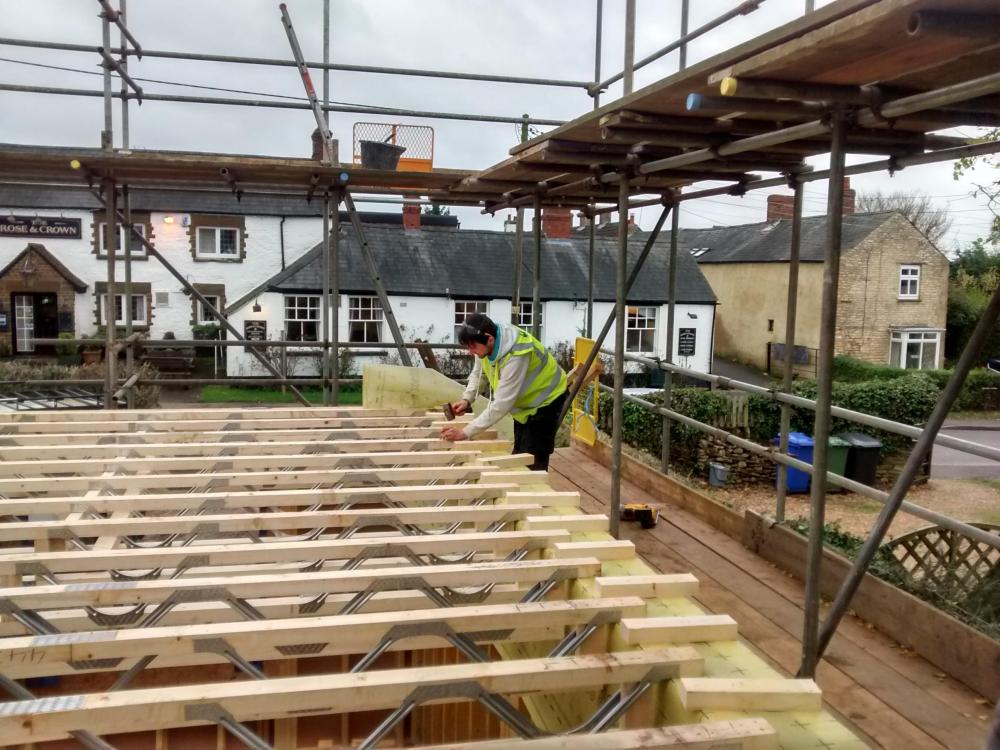
Since you're an old forum hand, then I can afford a bit of gentle sarcasm: well before you erect the frame -- oops too late. ? My underlying point is that your TF company and erectors should have integrated air tightness design features into the erection. In our case the TF supplier wrapped the joist ends with airtightness membrane (see pic below before they brought the top layer back in-front of the next stage cassets); they used a special "green" OSB3 which has a high-spec airtight surface, and every joint was properly taped. You can do the same in retrospect but it's a lot of work, especially around all fenestration and joist-ends.
-
Is there such a thing as a top entry manifold?
TerryE replied to Triassic's topic in Underfloor Heating
Pete, you don't even need auto vents -- that's just a nice to have and probably overkill iMO: just a couple of conventional drain cocks will do fine, as you'll only be bleeding the system after first filling when the fill is still degassing. A two port manifold can easily be tucked into a bathroom (even under washbasin) cupboard. -
Oh, the wonders of real-time programming. Welcome to the club!
-
Use the PVGIS site to calculate the incident average kWh energy on your windows. You will see that (depending on shading) that thermal cooling to mitigate excess solar gain in spring and autumn is going to be as much of a challenge as heating in the 2-3 peak winter months. External shutters are effective but can be unsightly and are expensive. A combination of reflective film, internal blinds, always circulating UFH (which redistributes heat from the in -sun hot spots around the entire slab), and boost MVHR can mitigate the overheating to an acceptable level. I have yet to come across an example of a member's architect who really understands these issues.
-
There's a bunch of LRO guidelines that relate to this. Download and read. IIRC, the rule of thumb is that for normal boundaries within urban areas they only claim ½m accuracy and this falls to 2m or worse in rural areas. "The boundary is what the boundary is" takes precedence. We bought a farmhouse plot 35 years ago in pre-registrations days and one side of our garden was separated from the back gardens of 4 houses in a 70s estate development on the previous farmland. The posts and plot corner-markers for the boundary fence between us and the 4 neighbours had been placed along a taught line and luckily we have photographic evidence supporting this. However, we planted a laurel hedge along the boundary a few years after buying the farmhouse -- and later discovered that two of our neighbours had moved their fence posts as far into our garden as the laurel hedge would allow. What an unnecessary PITA, especially when we decided to take out the hedge. LRO documents won't help avoid this sort of dispute and resolution. Concreting in concrete spurs for the boundary posts and taking supporting photographic evidence will. The only time that the LRO requires determined boundaries is if you have been in formal boundary dispute with the adjacent plot owner. Once you are in formal dispute, then the LRO will want a properly surveyed boundary plan, with this work carried out by an appropriately qualified land surveyor. Neither you nor your neighbour want to go down this route, as it can involve legal and surveyor costs that are factors more than the disputed land, and once a formal boundary dispute has been registered this will come up on any pre-sale searches and will materially impact the saleability and value of both properties. So both parties should avoid this and seek a negotiated resolution, using mediation if necessary. If the boundary is agreed then use permanent physical markers to define it and stay with a simple markup of the LFO furnished 1:1250 digitised maps. Going back to our two neighbours one (or his successor) was happy for us to straighten the boundary when we offered to replace then entire fence with a high quality one. The other couple are a total **!!@@ IMO, but is it really worth getting into a huge barney because they've swung the end of their fence 45cm into out plot, created a dogleg in the fence and pinching a couple of m² of our garden? There is one major loophole in the LR system if you have an unregistered property. When first registering, your solicitor is supposed to confirm that any adjacent plot holder agrees with the boundaries, but no one ever checks up on this and it is almost impossible to get the LRO to agree that mistake has been made as such cost-consequences of such mistakes are borne by the them. Instead the onus is on the adjacent plot owner to prove that mistake has been made. This can be really difficult. On another boundary we ended up paying a neighbour a £1K inconvenience sweetener to sign a TP1 for a path to our front door that had always been part of our property at least since its first sale in 1913 (when it was formally detailed as part of out property), but the solicitor of a previous neighbour had included it in their property in error on first registration. No one consulted us so we didn't even know! The one time that you can remedy such mistakes is to threaten the adjacent seller with a boundary dispute if he or she doesn't agree to correct the boundary by mutual agreement as this would in effect make his or her property a lot less saleable. I think that this is a reasonable course of action to consider if you are seeking to rectify a genuine error in previous registrations.
-
Most of the chips with a H/W FIFO support near full and near empty interrupts so in the case of the ESPs for example, the RTOS and non-OS SDK drivers use an ISR (interrupt service routine) to top-up and/or to empty these FIFOs to / from a program buffer.
-
You can easily get this precision to a local datum with a Dumpy.
-
There's nothing in the planning regs that says that you have to add to your site levels back to an ordnance survey datum. Have a look at other local planning applications. We just use a nominal datum on the street level. At the end of the day, the planners is just want to be confident that the as-built levels are accurate and as designed relative to this street front.
-
Some devices such as the ESP8266 and the ESP32 have internal hardware support for serial port FIFOs. I don't think that the Atmel IoT devices do, but someone can correct me if I'm wrong. The standards serial to uart chips typically have a 128 byte FIFO on them and will happily support baud rates up to 256Kbaud. Using this sort of high baud rate makes avoiding timeouts and handling timing within your code a lot simpler.
-
New members come to this forum, and they will find a lot of common themes expressed by experianced self builders. They will also find issues which are controversial in that you will find different opinions represented; the subject of the use of architects and project managers is controversial. No one would dispute that you need these functions to be carried out to have a successful self build. The real issue is whether a typical "competent person" (i.e. with the appropriate qualifications) that a new builders sometimes commission to do this work actually provide value for money. Members will find examples on this forum of people who have carried out very successful self build without using architects or project managers. I think that @JSHarris and myself all good examples here but there are others. There is also quite a range of examples where, quite honestly, the architects and project managers concerned and who were commissioned by the new builders did a bad job. What is best often depends on the new builders of themselves. In my case for example, I have quite a lot of the project management experience in IT, and having taken early retirement I also had the time to do the PM myself. I addressed all of the visualisation issues myself and scoped out the basic layout, but I then use an architect technician to do all the drawing sets for the planning application, and my timberframe company did all of the detail sections and build details. We ended up with a fantastic house, and saved maybe £60K costs in the process from our constrained capital pot to divert into other build expenses. Focusing just on the issues of architecting a house: in my view many prospective new builders have aspirations of living in a grand design, but without understanding the build and financial implications of trying to realise this properly. Many such grand ideas just don't fit into the needs of a comfortable and well thought out house within the price bracket that the builder can afford, or they rarely work in practice. IMO, a good architect should discourage their client from choosing options which they will regret in practice, but sadly they don't. A good example here is the use of "acres" of glass instead of standard windows. Of course this can have its place for example if you are on the edge of a wilderness and have spectacular views, but if you have a setting in the middle of a built up area, then your views are of other people's houses and gardens, so all you have are a lot of nasty thermal design issues and a loss of privacy.
-
I can't understand the reason for the large northeast facing window in the bathroom. It seems like a peepers chartered to me: lot of cost, a loss of privacy, and for a little extra benefit. You seem to have more light in the bathroom than most of the rooms. I suggest you lose the corner window and stick with a standard window on one of the walls. I know that some of the posters here have advocated the benefits of using an architect. Others including myself and @JSHarris found using an architect technician as more flexible and cost-effective. You seem to have very clear idea of the architectural drivers for your house so I'm personally qnot sure what an architect would add. As to the master bedroom another alternative is to have an outward opening door. This would save the cost of creating the alcove.
-
At the end of the day, the SunAmps are a heat store and you need to supply that heat. If you use electric heating elements then to CoP must be 1 hence the C rating. Pre-heat + SunAmp allows you run your ASHP at a single temp, but still get some CoP gearing.. BTW, based on this last year's historic data, using an ASHP rather than Willis for UFH will save us about £450 p.a. in electricity bills; and maybe £50-100 more if we use the buffer tank for DHW preheat. If I am looking for a 5-year payback on any ASHP + buffer tank investment, then this sets a pretty hard limit for me.
-
Our double SunAmp PV works well. Capacity is an issue if someone runs a large bath, but this is a once in a blue-moon event: I do have flow metering into the PVs so I could in principle add some NodeRED rules to do automatic top-up if needed, but this just hasn't been a big enough issue to go to the hassle yet. I am still looking at the trade-offs for using a small buffer tank when I add the ASHP -- we could also use this for SunAmp PV preheat which would both increase the on-demand capacity and raise the overall CoP of the DHW to around maybe 1.5.
-
Jan and I had real fun threading the insulated double run for the external ASHP down one -- I only wish that we'd used a 160mm run with a low bend for this!! In the end, thanks to a suggestion by @JSHarris we ended up using flexible connectors to make the bend.

