


Mr Punter
-
Posts
8220 -
Joined
-
Last visited
-
Days Won
24
Everything posted by Mr Punter
-
1. When you install a floor / bottom in a basement, do you still need a load of insulation. If a basement is underground on 3 1/2 sides. Just a lightwell exposed. If that floor is say 4mt underground is the temperature not stable, and quite warm at that point ? Yes you do, although not quite as much 2. I believe that to comply with building regs you have to have Two methods of keeping water out ? Any idea what is normally done ? I was thinking about a french drain around the base to a sump with a pump which would take that water to a suitable soakaway ? I'm not sure what other methods might be used ? Often either waterproof concrete or external membrane and perimeter drain plus type C internal drained cavity. 3. I know that sometimes basements are constructed using formwork, and waterproof concrete. Any ideas as to what other methods might be suitable ? Concrete block 4. If a bathroom was to be fitted in a basement, i take it that a macerator pump would be required to take the waste up to ground level where it could be discharged into a normal 100mm soil pipe ? Mini pump station is better and quieter as it does not need to blitz, only runs occasionally and has a decent bore discharge pipe.. 5. Any directions to web sites, or you tubes, that might give me a better idea of methods available ? 6. Anything else you think i might need to consider ? Ground investigation will have a large impact on the engineering. Also consider ventilation and fire escape.
-
I did a development of 4 storey townhouses with large windows and getting them in was a nightmare. We did a floor at a time, craning in the pallets, then broke down the pallets to distribute the windows on that level to the correct plot before protecting and securing them. Constant whinging from the TF company. Not least of the issues was the TF company specified Trad Deck as their fall prevention, which looks good in theory but with windows and sliding doors in narrow plots was just crazy.
-
Is there any point in leaving it until the scaffolding is down and the ground is flattened?
-
I am certainly no expert, but if you are spanning joists between left and right steels it can sometimes be easier and just as good notch them in and rest them on the steels and noggin between. Block and beam gives a nice platform to work on with the genie. With trestles, I recently bought some galvanised ones with feet that can rotate for stacking. Pissed off with others rusting to bits and shinning me when I move them. Time will tell. Your ground floor footprint looks generous. Very nice site. What size house?
-
Just cover the stuff you have stored with dust sheets.
-
Wall starter kit not used! What can I do?
Mr Punter replied to johnannik's topic in Bricklaying, Blockwork & Mortar
Put a couple of screw in wall starters before you build any higher. Also, fix a wide strip of stainless eml across the join before you render. -
If there is currently no lintel across the masonry leaf I can't see why you would need one with the wider opening. You may need to mess around with the downpipe as well. And relocate those air bricks.
-
Lead flashing directly under cill acceptable?
Mr Punter replied to warmington_ash's topic in Roofing, Tiling & Slating
I think you need to find out from Building Control. They may also want you to have a cavity tray, which is very difficult to achieve. -
The flitch beam is to support the roof over the wider opening. You could locate it further up. I assume the Naylor lintel is to finish to the top of the doors and will be rendered to match the rest.
-
External wood paint or wood preserver for battens?
Mr Punter replied to Thorfun's topic in General Joinery
That makes sense. I didn't notice the gaps in the photo. Be interesting to see how much the gaps grow and shrink with the seasons. I have some 140mm wide hardwood ipe decking that we fitted butted up and it can have now have gaps of about 15mm in the summer. I thought this may be a timber frame and you were wanting the cladding to be flush with the face of the brickwork below? -
It looks quite unusual. If you have loose / fibrous insulation and PIR the PIR normally goes inboard. The VCL normally goes inboard of all the insulation. I might be concerned that the unvented void would get cold and you may get condensation on the inside of the VCL on the pitched section. Maybe do a condensation risk analysis for reassurance.
-
I have carried out some alterations on a building and took advice from a structural engineer as to which wall were loadbearing. We removed a wall that was thought to be non-structural only to find that it was carrying the ceiling / floor above. Luckily fairly easy to work around, but unless you do a very intrusive (and costly) survey it is difficult to always know. Yours looks like it was once a commercial building and they often have a heavier duty spec compared to resi.
-
floor plans - ideas/feedback
Mr Punter replied to thetinothproject's topic in New House & Self Build Design
Option 1. The shower room is probably too small to dry yourself and may not get used. An ensuite to the guest room would be good. If you lose the current shower and move the stairs to the other side, you could have a proper en suite and a WC. I prefer the kitchen sink under a window. And I prefer sliding doors to bifolds.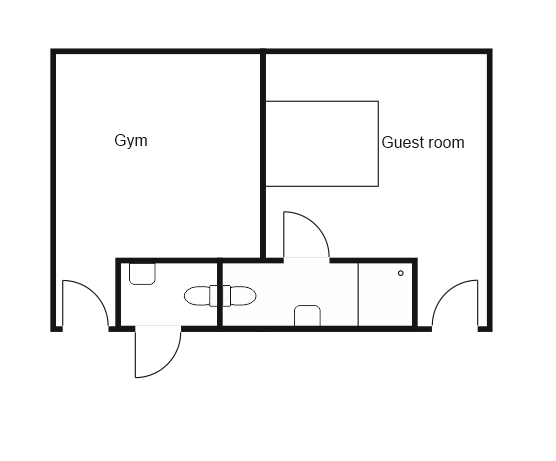
-
External wood paint or wood preserver for battens?
Mr Punter replied to Thorfun's topic in General Joinery
Why did you paint the battens? Won't they be covered with the cladding? Also, did you fit the counterbattens to get the cladding to line up with the brickwork? -
You could have a water butt with a diverter to the downpipe when it is full.
-
I learned about CDM 2015 on an SMSTS course. It has been designed to fit all sizes and types of construction projects but in fact does not. Most smaller builders and contractors just have a few pro-forma RAMS at best. Most of the risks on site can be eliminated or controlled. Falling is the biggest risk on most sites.
-
Rationel Windows, recommended way to couple?
Mr Punter replied to DukeOfTarp's topic in Windows & Glazing
The plastic caps happen a fair bit, especially when they are direct fixed through the frame. It looks like they have fixed metal straps to the windows then fixed these to the inner leaf, which is standard. The gaps often have a filler piece or backer rod, then mastic. It may be that the profiles for the doors and the side lights are not matching, so there is not a neat solution. Not fantastic, Your Grace, but not terrible either. -
Have a look at ID Systems. They do a narrower profile triple track pocket door. They are well thought of and specialise in this type of thing.
-
A site I am doing has combined drainage but we have had to run surface and foul separately all the way to the boundary where it then connects to the combined system. I cannot see Southern Water ever installing a separate surface water system, but sometimes I just do what I am told.
-
Wrong glass type - who is responsible?
Mr Punter replied to DeanAlan's topic in Building Regulations
BC are keen to pick up on this one. I don't think there is a significant risk that someone will fall down the stairs and through a window. It is not something you ever hear of. I have had one of these in the past and we fixed a timber across the window which I assume the homeowner later removed. -
Concrete will carry larger loads over greater spans than timber the same section size. If you are doing a lot it would be worth getting a decent engineer to spec them.
-
The update is appreciated. Did you change the floor plan?
-
100%
-
All looks fairly straightforward! A pity I didn't see this before the bank holiday. It looks a perfect project for a long weekend.
-
Advice on Kitchen relocation - Average costings?
Mr Punter replied to HKL91's topic in New House & Self Build Design
Bungalows can often end up a rabbit warren of small rooms or through rooms. The living and dining look a decent size and if you could put the kitchen into the dining it may work well. Make bedroom 2 into a playroom / study / snug. You may be able to put a WC and basin into the cupboard in the hallway.


