


Mr Punter
-
Posts
8581 -
Joined
-
Last visited
-
Days Won
27
Everything posted by Mr Punter
-
Could you request that they repair the road, as it is adopted?
-
I have seen this applied. It looks a bit like Artex broken leather pattern but has not cracked or needed painting 6 years down the line.
-
Redesigned for the millionth time!
Mr Punter replied to JTLondon's topic in New House & Self Build Design
I agree with @Russell griffiths. You are proposing to turn a 3 bed semi into a 4 bed semi near a busy road. This may add, say, 100k to the end value. Have a good look at Rightmove and see if you could find a 3 bed detached in the area that has potential. I had a quick look at Wembley. 3 bed semis are £500-600, 4 bed semis £600-700, 3 bed detached £680-800, 4 bed detached £700-900. -
You could use a band seal type like https://www.wolseley.co.uk/product/flex-seal-dc65-drain-coupling-50-65mm-pf91540-44/
-
I found Fermacell expensive, heavy, difficult to cut and difficult to install electrics. I have recently used Knauf Soundshield Plus which is a multi purpose plasterboard so has improved sound, impact and fire resistance. I think GTEC Universal board is similar. Go with 15mm thickness and double up if you want more. I think they sometimes use 2 x 15mm Fermacell for secure institutions as it is so tough, but unless you are planning to set about the walls with a club hammer it is OTT for housing.
-
If they can do the cantilever in engineered timber it will make it simpler to finish and insulate, with less cold bridging. Typically the cantilever will need to project into the building at least twice the distance as it projects out and this will be concealed in the floor zone.
-
Or if you can get it cheap enough, Egger Protect is very good. It is coated both sides, easy to clean and you can tile onto it.
-
Builders Merchants opens Ann Summers branch
Mr Punter replied to Pocster's topic in General Plumbing
Um I slipped and fell on it... -
Building regulations for attached garage
Mr Punter replied to Randomiser's topic in Building Regulations
My brother has a house on clay with piled foundations. Later he had an orangery built attached to the house using a raft foundation. I looked fine at first. Now none of double doors operate correctly and he is thinking of demolishing it. Mixing foundation types on shrinkable soil is very risky. -
Get a topographic survey done if you have not already. Ask them to include the neighbouring buildings. Your architect can then easily add the proposed elevation of your buildings to create a context elevation. The survey will prove invaluable throughout.
-
I have a Makita rail saw. It was used to cut Fermacell wall board with a vacuum attached. One of the labourers cut through the edge of one of the rails so they now only work nicely for 1400 long cuts. Quite a good tool but it is mains powered and comes in a big makpac case so good if you set yourself up to do a fair bit with it, otherwise a cordless with a fence works for most things.
-
Hi @deuce22 you may want to edit your earlier post as it starts with stuff to do with dentistry. Also where you have your drawing, perhaps remove your address.
-
I still can't work out why your Ubiquiti Unify APs did not work out.
-
Loss of privacy is usually to do with overlooking and the planners are particularly concerned with windows having views of private rear gardens and can sometimes be dealt with y making such windows fixed shut obscure glass up to 1700m from ffl. The sunlight is a bit more subjective and if it is an issue you may have to produce a daylighting study to justify that the scheme does not cause excessive overshadowing to the rear garden or reduce the light to existing rooms to an unacceptable extent.
-
I have seen these used by cable TV installs where the wire comes through the wall. Can you post a picture of the finished fitting if you go ahead with it? I really like the one in the first post but the circular ceiling recess looks like mission impossible.
-
My guess was that it said "Prayer room" before it was redacted, but I couldn't work it out as it is only the size of a cupboard.
-
Any chance of a large porch to: A) stop all the heat escaping when your groceries are delivered / someone is at the door and you need to communicate but not let them in B) give those in the kitchen / living / upstairs landing some privacy from anyone calling or entering
-
Framin' ridiculous innit?
Mr Punter replied to ToughButterCup's topic in General Self Build & DIY Discussion
I can see the appeal of feet and inches for framing. 16 or 24 inches on center is what it is all about for the Yanks. Funny that there are still lots wood based sheets in imperial sizes, but not plasterboard. -
I think the tackers are given a price and supplied materials by the boss, who goes with whatever is cheapest. They have their own tools, but I guess most don't have collated screw guns and the boss buys individual screws cheap enough. For commercial jobs on metal frame I can see why collated is standard.
-
Best stage to lay a concrete garage floor slab.
Mr Punter replied to epsilonGreedy's topic in Foundations
Did the tree make much difference? -
Best stage to lay a concrete garage floor slab.
Mr Punter replied to epsilonGreedy's topic in Foundations
Have a look at https://www.labcwarranty.co.uk/resources/foundation-depth-calculator/ These are, I think, quite risk averse, but that is no surprise. -
I have the whole house version of the Combimate, (cost £135.80 inc delivery and a years Combiphos) where you fill the container completely with the Combiphos balls. They are £25 per 800g delivered and need changing once a year.
- 199 replies
-
- 1
-

-
- hard water
- water softener
- (and 1 more)
-
I can see you are looking at building a 4 bed house of around 250m2. Do you have a budget set? This will cost between £200k to £600k depending on whether you do it all yourself to a basic standard or hand it to someone to deliver a top spec building. You will need to select an architect for this project. Shop around very carefully. Look at the style of building they have designed and if you are able to, talk to their clients. Look to apply for detailed planning in, perhaps, six months time, as your architect (if they are any good) will probably have a number of projects on the go and the design is often an iterative process, as is the planning application.
-
Timber cladding abutting brick inside corner detail
Mr Punter replied to Andrew's topic in General Construction Issues
I would run the brickwork up to 25mm from the timber frame return. On the timber clad wall, form a corner from 2 pieces of larch ripped down to 75mm. Butt 1 side of this corner to the brickwork and the other fix to your timber batten having run some dpc vertically. Bring out the timber battens on this section to the same depth of your batten + corner. You may need to add an extra stud or 2 to the timber frame to support the corner.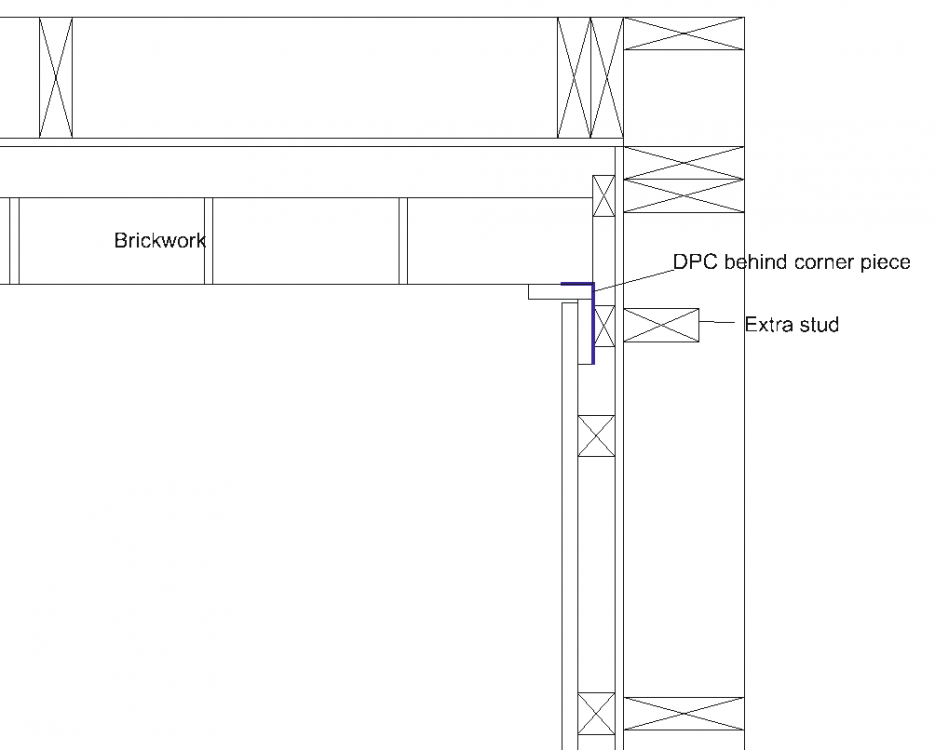
-
I love my laser measure: who's solved this problem, though?
Mr Punter replied to ToughButterCup's topic in Tools & Equipment
Good for high ceilings too.


