

.jpg.c21f3ac78c9b7efd90cbdcb312744dc5.jpg)
jack
-
Posts
7462 -
Joined
-
Last visited
-
Days Won
41
Everything posted by jack
-
I'm sure you've seen the ICF and basements sub-forums. Worth a look if you haven't.
-
Welcome to BuildHub!
-
.jpg.c21f3ac78c9b7efd90cbdcb312744dc5.thumb.jpg.7adcad4c0e384f5ecd7d56b0618df6e5.jpg) People can always object, even without a basis. For a valid objection though, they need to have a reason supported by law. What I'm saying is that you don't need to own land to get permission that involves its use. For example, if I know your address, there'd be nothing to stop me applying for planning permission to knock down your house and replace it with a new one. The fact that you own the house is irrelevant in planning terms, and you wouldn't be able to stop me getting permission just because you own the land. The planners would advise the owners, just like the advise neighbouring properties. Of course, getting planning means nothing - I can't actually implement what I get planning for, because it's your land. There's a risk, but I'd be tempted to look into providing the required turning space by using that land on the assumption that an access easement already exists. I don't think it's something the planners would be interested in once they've ticked their box. The question would then become whether the owners of the shaded land want to fight you on the easement point. That said, it would be cleaner if you could buy it outright, especially given your desire to build on it.
People can always object, even without a basis. For a valid objection though, they need to have a reason supported by law. What I'm saying is that you don't need to own land to get permission that involves its use. For example, if I know your address, there'd be nothing to stop me applying for planning permission to knock down your house and replace it with a new one. The fact that you own the house is irrelevant in planning terms, and you wouldn't be able to stop me getting permission just because you own the land. The planners would advise the owners, just like the advise neighbouring properties. Of course, getting planning means nothing - I can't actually implement what I get planning for, because it's your land. There's a risk, but I'd be tempted to look into providing the required turning space by using that land on the assumption that an access easement already exists. I don't think it's something the planners would be interested in once they've ticked their box. The question would then become whether the owners of the shaded land want to fight you on the easement point. That said, it would be cleaner if you could buy it outright, especially given your desire to build on it. -
Yep, that's my understanding too. Plus if you buy it, I believe you reset the adverse possession clock as new own owner. As Dave says, there may be easement rights associated with existing use that could carry over, but I'd check with your conveyancing solicitor about the details of that. What about just applying for planning permission that includes this area as part of your turning requirements? There's no requirement for you to own land to get planning permission on it. The owner will be notified and can object, of course, but only on the basis of planning considerations. They could, of course, prevent you from actually using it according to whatever planning scheme you get approved, but that may be fine for your purposes. You could potentially agree to purchase subject to the required strip of land being acquired. Re: it taking a long time, in my experience, these types of situations can be hurried along if you're willing to be the squeaky wheel. Get to know who's handling at the council (or whoever owns it). Make sure they understand that you're trying to get this sorted so you can start building your family home. Be friendly, and don't overdo it, but if you're calling or emailing every couple of weeks just to touch base and see how things are progressing, you may be surprised just how fast things might move. The main one is that if the seller tries it on and isn't successful, you'll likely face a hostile reception if and when you subsequently attempt to negotiate a purchase. The upside is that the cost of proceeding with a claim is just the land registry fee and whatever your lawyer charges. That's likely to be cheaper than buying the land outright. In your case, you'd also need to find out whether the seller offering to buy has affected any adverse possession rights that might otherwise have been claimed. I suspect they'll really need to speak to a specialist about this. I'm sure you've seen it, but the Wikipedia article on adverse possession is a good starting point.
-
What Nick said, for sure. For neatness, consider spacing the pipes as accurately as possible where they come out of the slab before the pour. No big deal, but it does annoy me that mine are slightly crooked and unevenly spaced.
-
We changed architects and it was one of the best (if difficult) decisions we made. We got on brilliantly, but she just wasn't designing anything that inspired us, even after three full rounds of redesigns with several layouts per round. The first design from the second architect was just "oh yes, of course that's what we should do". Not saying that course of action is appropriate here, of course! The second architect had been our original choice, but he'd originally turned us down on the basis he was concerned about building to passivhaus standards. He was a lot more comfortable when we came back to him, because we'd found a building company whose standard construction method dealt with the basics of insulation and airtightness.
-
Welcome to BuildHub! I can't help with the other stuff, but assuming the parking spot is on the plot, I can't see why there'd be an expectation about others using a parking spot on your land. I assume the planning approval doesn't say anything about it being for the road (that would seem unusual to say the least). Have you checked whether there's any sort of covenant attached to the land? What about existing easements (eg, have people been using this land for parking for some time?) Assuming you haven't agreed anything in writing (including emails, ideally) and you're able to confirm that no rights to park exist, the seller can say what they like now, and I believe you can ignore it once you own the plot. You conveyancing solicitor should be able to confirm all of this.
-
Wow, that's about the best you could hope for in the circumstances. Building is an imperfect business, and all you want when things do go wrong is for the people involved to admit what they've done and put it right promptly.
-
Welcome! Does he have a reason for being negative about it, or is the lack of experience/knowledge driving his opinion?
-
AndyT ( Andy Trewin ) formerly of Sunamp
jack replied to Nickfromwales's topic in General Alternative Energy Issues
Yes, I believe that's right. It will stay at the transition temperature as heat is extracted until it's completely melted, and will then start cooling again. Presumably the material can also be heated above 58 deg C, in which case it will cool like any other material until it reaches the transition temperature. -
It should be loose before it's put together, but it shouldn't come apart like that. I'd call Wunda Loads of people on here have used Wunda - haven't heard a single bad word about them or the kit they supply. Same with Grundfos - nothing wrong with it at all.
-
This is where I got mine - price was as good as anywhere: https://www.wundatrade.co.uk/shop/home/actuator-auto-balancing/
-
Limiting floor temperature with smart heating controls
jack replied to PeteTheSwede's topic in Underfloor Heating
Would it be possible to limit the supply water to 28 deg C? -
Indeed, and it was exactly this issue that led to me bringing up this issue. Thanks very much for your work on this Jeremy. I'll have a play with it.
-
Welcome to Buildhub!
-
Standard wet UFH (ie, screed on insulation, UFH loops in screed). I believe they're going for engineered wood on top, but not sure whether that's a definite.
-
MAJOR electrical issues in 5 year old house - any ideas?
jack replied to jack's topic in Consumer Units, RCDs, MCBOs
I got hold of the model number. According to the data sheet it's inverter driven (note: I may have been misremembered the comment about the short circuit being on one coil):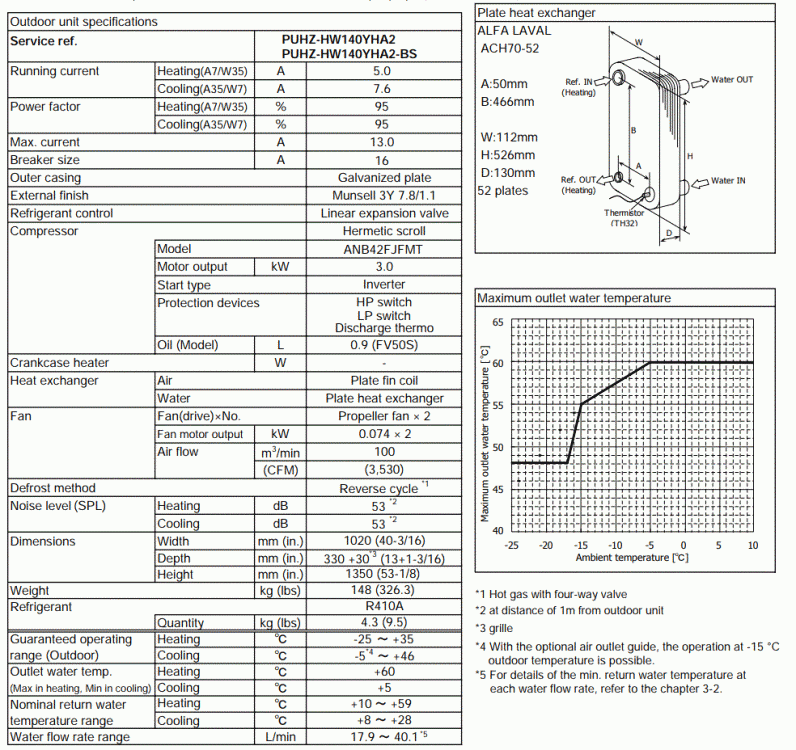
-
MAJOR electrical issues in 5 year old house - any ideas?
jack replied to jack's topic in Consumer Units, RCDs, MCBOs
Latching would seem to make sense, but apparently the tech support guy was adamant that the light only operates in real time. Yes, all the electricians who've seen the installation agree, especially given the low loop impedances that have been measured. According to my father in law this morning, it's only 4 years since they moved in (I was convinced it was 5). It's a new build and the ASHP was new when installed. Would Mitsubishi still have been selling non-inverter-driven ASHPs at that time? I'll see if I can get the model number and check. -
MAJOR electrical issues in 5 year old house - any ideas?
jack replied to jack's topic in Consumer Units, RCDs, MCBOs
The fly in this ointment is that surge protector's tech department insists that the warning light doesn't latch. That means that if you see the light, there is an ongoing voltage difference of at least 30V between N and E. I don't know how long that was present for, but it was at least hours. In fact, I think my parents in law said it was still flashing the next day. I can check. It's also possible the tech person has this wrong - it would certainly make a lot more sense if it latched (and make it more plausible that the ASHP motor failing caused the problem). -
MAJOR electrical issues in 5 year old house - any ideas?
jack replied to jack's topic in Consumer Units, RCDs, MCBOs
My electrician's just dropped by for a cup of tea and a chat after finishing up for the day. It seems that the ASHP compressor motor has packed up, with at least one dead short across one of the coils (not sure if more than one). The noise filter has packed it in, and another control board is also suspect. One possible scenario is that the short was initially intermittent, resulting in high speed switching within the coil. The thinking is that this might have caused spikes that have caused the damage. Again, this doesn't seem particularly likely, but it's no less plausible than any other proposal currently on the table. Oh, and it also doesn't explain the >30V fault that was seen on the surge protector. It was, however, established that this protector wasn't installed correctly, as it's much too far from what it's supposed to be protecting (not that this explains the 30V fault light). The next step will be a full house inspection to see whether there are any other issues. Between them, my electrician, the other electrician (works for the company that wired the house), and the ASHP guy have decided that a separate surge protector at the ASHP would be a useful thing to have. I think we'll also install an RCD on the incoming three phase main. Thanks again for all your help with this. It's clearly an unusual situation, as everyone is scratching their heads about how something that measures so well now can have behaved so badly only a couple of weeks ago. -
MAJOR electrical issues in 5 year old house - any ideas?
jack replied to jack's topic in Consumer Units, RCDs, MCBOs
I believe they've asked around, but not sure how far afield they've gone. The next door neighbour also has three phase off the same cable on the street and they've confirmed no problems during the periods when the damage happened. -
MAJOR electrical issues in 5 year old house - any ideas?
jack replied to jack's topic in Consumer Units, RCDs, MCBOs
One of electricians floated that as a possibility - long dry weather followed by rain causing some sort of intermittent tension on the joint. Conclusion was that it's possible but unlikely to now have become completely undetectable. I don't really know much about power electrics, so I can't really follow the details of what the electricians were discussing, but could it be that a break in the PEN results in the additional bonded earths at the house becoming the return path for the respective live phases? Not sure... No-one's quite sure exactly where it is! But we're on fairly sandy soil here, so water tends not to hang around in the soil for long. I doubt it would remain immersed for long periods, but not sure. Yes, that's right. It is a puzzlement, no doubt. All possibilities so far identified seem to be very unlikely, but something has to have caused all of these issues in two separate events separated by weeks. I'll let you know if we learn anything more once the ASHP guy's done his bit. -
MAJOR electrical issues in 5 year old house - any ideas?
jack replied to jack's topic in Consumer Units, RCDs, MCBOs
UPDATE I've just returned from the house. My electrician is there with an electrician from the company that installed the wiring and surge protector. It's presently a complete mystery. All measurements are coming back clean and well within range. Loop impedances are all rock steady at around 0.19-0.20 ohms. All connections appear tight. Currently there's some speculation about whether the ASHP could have been failing and somehow dropping a large spike back when turning the compressor motor off. Possible but seems unlikely. Another (probably even less likely) possibility is a joint in the front garden. 5 years ago, the landscaper broke the incoming main, and a joint was made and buried. It seems possible that there's an intermittent fault between neutral and earth at that point, although consensus seems to be that there should be some evidence of that even if it isn't in full fault mode right now. All of this is genuinely just speculation right now, and there's a lot of head scratching going on. The ASHP guy was running an hour late, and I had to leave just as he arrived. I've asked the electrician to let me know what else they find in due course. Oh, and there's definitely no RCD on the incoming three phase. One of those will be installed as part of all this, although naturally that won't address whatever the actual problem is. -
MAJOR electrical issues in 5 year old house - any ideas?
jack replied to jack's topic in Consumer Units, RCDs, MCBOs
Thanks for that David. I've told them to make doubly clear that they aren't claiming, and I think they're on it (father in law runs a business that includes delivery vans in London, so he's had a lot of experience with insurers over the years!) I don't think they're too concerned if it isn't covered - the main thing at the moment is identifying the source of the problem so they aren't potentially throwing good money after bad. -
MAJOR electrical issues in 5 year old house - any ideas?
jack replied to jack's topic in Consumer Units, RCDs, MCBOs
Thanks Dave, I'll mention it to my parents in law.
.jpg.c21f3ac78c9b7efd90cbdcb312744dc5.thumb.jpg.7adcad4c0e384f5ecd7d56b0618df6e5.jpg)

