

.jpg.c21f3ac78c9b7efd90cbdcb312744dc5.jpg)
jack
-
Posts
7460 -
Joined
-
Last visited
-
Days Won
41
Everything posted by jack
-
I don't believe any domestic waste water heat recovery unit is rated to cope with four showers. The one you linked recommends a maximum of 24 L per minute (total) for system types B and C, and only 16 L per minute (less than one of your showers) for system type A. If you want to "save the planet" as you say, then why not use this opportunity to change your family's usage patterns rather than just replicating the current pattern in the new place? Assuming you have kids who are using at least a couple of these simultaneous showers, then the flow rate is ultimately up to you. A few weeks ago I installed flow restrictors on our kids' showers to limit them to 9 L per minute (down from about 12 or 13 L max per minute beforehand) and the showers work perfectly fine. Not sure the kids have even noticed - I didn't tell them and they haven't mentioned it. Depends very much where you are in the UK. There have been hose pipe bans in the south east more than once in the last decade due to water shortages.
-
.jpg.c21f3ac78c9b7efd90cbdcb312744dc5.thumb.jpg.7adcad4c0e384f5ecd7d56b0618df6e5.jpg) I have a Brink Excellent 400, which is in the same family of closely-related MVHR units. I have a ~290 m2 house with probably higher than average volume. I'll have to dig it out to be sure [which I've now done and corrected the following number], but I believe our calculated base rate was 180 225 m3/hr, which seems low compared to what you're aiming for given your floor area. Either way, I never run it on anything like that. I think it's currently set on 80 m3/hr, and stays like that 24/7 unless I manually boost it when cooking or we have a lot of people over. We never have problems with condensation and the bathrooms dry out fast enough that I don't bother with a humidity-based boost (I'd have set it up, but one of the decorators we had in decided to step on a cardboard box to reach something. It collapsed, which caused him to smash the humidity sensor that was in the box. I was only 80% sure it was him when I found it a couple of days later, so unfortunately I wasn't able to clearly place the blame). Can you adjust the rate away from those manual setting defaults? I believe we were able to do so for ours at a resolution of maybe 5 m3/hr.
I have a Brink Excellent 400, which is in the same family of closely-related MVHR units. I have a ~290 m2 house with probably higher than average volume. I'll have to dig it out to be sure [which I've now done and corrected the following number], but I believe our calculated base rate was 180 225 m3/hr, which seems low compared to what you're aiming for given your floor area. Either way, I never run it on anything like that. I think it's currently set on 80 m3/hr, and stays like that 24/7 unless I manually boost it when cooking or we have a lot of people over. We never have problems with condensation and the bathrooms dry out fast enough that I don't bother with a humidity-based boost (I'd have set it up, but one of the decorators we had in decided to step on a cardboard box to reach something. It collapsed, which caused him to smash the humidity sensor that was in the box. I was only 80% sure it was him when I found it a couple of days later, so unfortunately I wasn't able to clearly place the blame). Can you adjust the rate away from those manual setting defaults? I believe we were able to do so for ours at a resolution of maybe 5 m3/hr. -
I'd never heard of him before, but he makes that series imo.
-
Are these costs realistic for a 500m2 house
jack replied to miike's topic in General Self Build & DIY Discussion
Agreed. I stopped contributing to the thread when it was suggested that developer margins of 25% net are "pretty standard". -
Ah right, I understood "pipes" as being UFH pipes. The hot and cold water pipes are embedded within the insulation, not the slab. That said, the top of the pipes (or at least the coloured conduit they're run in) does seem to be in contact with the slab. The pipework being in contact with the slab is going to make the cold water potentially quite warm when the UFH is on. Maybe that's fine (and perhaps preferable to having it being very cold, which might be the other alternative in Sweden where it looks like this house is being built).
-
As far as I can tell, most people on BuildHub who have an insulated raft have their UFH pipes zip-tied to the reinforcement mesh as shown in this video. It's certainly how mine was done.
-
Are these costs realistic for a 500m2 house
jack replied to miike's topic in General Self Build & DIY Discussion
Yes, I've spent many an hour in the past looking at some of the stuff that comes up for sale on eBay with similar discounts. In the end, it just didn't work out for us, but I can see the appeal if you can bring together enough of the right components to suit your layout in a style you're happy with. -
Are these costs realistic for a 500m2 house
jack replied to miike's topic in General Self Build & DIY Discussion
Do you have any idea (order of magnitude is fine) of a typical cost to uninstall and move a decent kitchen? -
Are these costs realistic for a 500m2 house
jack replied to miike's topic in General Self Build & DIY Discussion
I clicked on several. All of them are in situ and need to be dismantled. On that point they're no different to eBay. Apparently you can talk to them about dismantling and delivery - it'd be interesting to see what sort of costs are involved and who takes on the (significant) risk of damage. And it still doesn't solve the other significant issue of finding the right combo of layout and design. -
Are these costs realistic for a 500m2 house
jack replied to miike's topic in General Self Build & DIY Discussion
@miike: I don't know enough about costs to contribute much more on that point to this thread, but my general feeling is: if it were possible to build the house you're talking about building for the price you're talking about building it for, developer margins would be a lot higher than they are. As far as I can tell, you're doing very little of the work yourself, which is the main way that self-builders tend to be able to get costs down somewhat. You're willing to buy second hand to save money, but I think you're overestimating how easy it will be to source, uninstall, transport, and reinstall something like a second hand kitchen without signicant damage, assuming you can even find one with exactly the layout you need. Who's going to uninstall it from where you buy it, for example? Kitchen fitters won't get involved in that sort of work. Your builder might help, but are they going to take on the risk of damaging things during uninstallation and transport? You'll also have the issue of going to trades with a picture of your house and having them estimate based on their perception of what you're willing to pay. They'll see what you're building and where, and price accordingly. We had it repeatedly during our build. I don't mean to sound negative, but there's a reason why the estimated build costs for houses are what they are. -
Are these costs realistic for a 500m2 house
jack replied to miike's topic in General Self Build & DIY Discussion
Agreed - the price jump when you add in drawers is eye-watering. They're hugely more useful/useable than cupboards for most things though. -
Are these costs realistic for a 500m2 house
jack replied to miike's topic in General Self Build & DIY Discussion
TBF, the OP isn't making these choices just to suit himself. In his second post in this thread, OP talks about "ROI" and refers to comparative properties in his area going for £6k/m2. So he appears interested in market value as well as satisfying his own needs, which is what has drawn some of the comments about fittings quality. The general argument some (including me) are making is that, if you ever need to sell a house like this into the market where it's located, many - perhaps even most - potential buyers will have minimum expectations for things like number and brand of kitchen appliances. I don't think anyone is going to care that you have a Candy washing machine, since they'll be bringing their own, but a single Beko oven could very well be off-putting to some. Of course it will sell, but you'll absolutely put off some potential buyers. Having built a very modern house (flat roof, multi-intersecting box type thing that's arguably already in danger of dating), I think it's dangerous to weight things so heavily towards design relative to finish. With sharp modern designs, you can't hide imperfections behind trim boards and decorator's caulk the way you might get away with in a Barrett box. Small imperfections can be surprisingly visible. You therefore need to ensure a high quality finish if you want to achieve the ROI you're looking for, and that rarely comes cheap. I just had a closer look at your renderings. Have you priced the roof structure? There's a lot of unsupported spans and glass. You're talking about some significant (for which read "expensive") engineering if you want to keep it that glassy and open. -
Ha, I shouldn't post last thing at night or first thing in the morning!
-
@Nickfromwales, the issue here is that this is a replacement unit. While a quieter unit will help, any installation issues (e.g., lack of attenuators, undersized ducts) won't be fixed. There may also be issues of matching the connections of a new unit with the main ducts currently in situ. @Yvonne, can you share some photos of your installation? Do you know whether attenuators have been installed? They'll usually be either a box or a much thicker section of ducting between the MVHR unit and the distribution manifold (big box with lots of smaller ducts coming out of it).
-
@Yvonne, do you know what speed your original unit was set to run at? If set for the normal statutory flow levels it could well have been running faster than actually required. Generally, I think most have found that the statutory rate is far higher than needed. As a guide, I generally run mine at just below half the rate suggested by the rules.
-
Are these costs realistic for a 500m2 house
jack replied to miike's topic in General Self Build & DIY Discussion
There was a discussion the other day about electrics in a new house and the consensus was that £20k was optimistic. That was for a much smaller house than yours. Respectfully, if I saw a kitchen in a house like this with a single built-in oven, my first assumption would be that you'd run out of money by the time you got to the kitchen! My general feeling is that you seem willing to sacrifice a lot of quality in order to get a very large house on an extremely tight budget. Maybe you'll be happy with that, but my own experience is that we really regretted some of the cost saving decisions we made, and we weren't working to anything like the budget constraints you've set. -
When submit VAT claim
jack replied to Streetfield's topic in Self Build VAT, Community Infrastructure Levy (CIL), S106 & Tax
Yup. They happily cite bits of cases that suit them and ignore many similar cases that say the opposite. Some interesting comments in this thread about how HMRC policy and behaviour has changed over time. For example, this was the written guidance on the form in 2011 and previously in 1996: There is no equivalent language in the current notes, suggesting that HMRC has intentionally changed its policy to make it harder for self-builders to claim.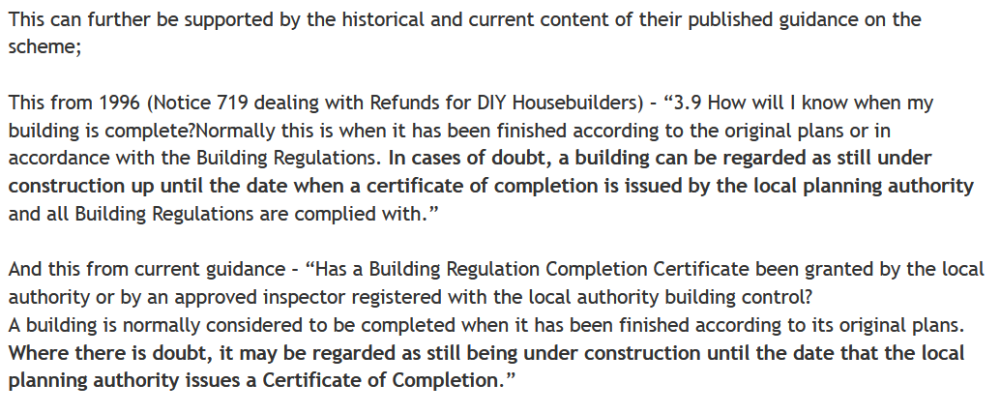
-
Thanks ass hat.
-
Photos added to the first post. For future posts, you can add photos using the tools underneath the text window:

-
The forum welcomes photos but not via external URL. You need to upload them when composing the post. I'll edit your first post to include them when I'm at my desk later this morning.
-
Just FYI, the formal test involves taking an average of pressurisation and depressurisation.
-
I was more referring to the general concept of an insulated screed over a structural slab being known. In that situation, all of the insulation is between the slab and the screed. I've never heard of starting with an insulated structural slab, then adding only 20 mm of insulation before adding a screed. 20 mm will have very little practical effect. Your screed (assuming concrete) will need to be something like 75 mm thick, so assuming a structural slab averaging 150 mm, you're adding at least 50% more concrete to the build for no real reason. I'm curious about why you're assuming this is how it would be done? Has whoever you're talking to said this is how they'd do it? There's a huge difference between running the odd conduit for a particular reason (we have one to get power to the hob on our island) and running all of your services through the slab. I've never heard of anyone doing the latter, and I can think of lots of reasons why you wouldn't, starting with accessibility for maintenance. @Nickfromwales, you've worked on loads of houses with insulated slabs. Care to chip in? You don't run UFH under any walls, including internal, so assuming any internal stays go through the base of internal walls, I don't see what the issue is. Again, a large number of people on BuildHub have insulated raft foundations, and the issues you've raised either don't exist or are easily dealt with.
-
Welcome Shaun. I don't think that's right. Lots of people on BuildHub (myself included) have an insulated raft, and I believe that the only thing that's run through it (horizontally) is UFH loops. You definitely don't run plumbing or electrics through it. The other approach you've been told about is effectively the old-fashioned screed on a slab approach, but with only minimal insulation between screed and slab. I can't see any advantage to this. You don't put UFH loops near walls, so with even a moderate amount of care, you shouldn't hit them with anything. In a well-insulated house, you don't need a fast reaction time from underfloor heating. When it's cold, you want to use the slab as a heat reservoir. If you use a low-and-slow source like and ASHP, then you don't want/need fast reaction. If you use a higher temperature source like a gas boiler, a slower response will help smooth out peaks and troughs. Personally, I think you're adding considerably cost and complexity by having a further layer of insulation and a separate screed, without really gaining much benefit.
-
Fair price for new 4 bed house electricity wire?
jack replied to markharro's topic in Consumer Units, RCDs, MCBOs
It's a long time ago but we had a quote for £14.5k for very standard wiring of a large 4 bedroom house in 2015 in the south east i assume that'd have to be well north of £20k now. -
I'm not suggesting you should, I'm just providing some perspective on the supplier @Nick Thomas mentioned.
.jpg.c21f3ac78c9b7efd90cbdcb312744dc5.thumb.jpg.7adcad4c0e384f5ecd7d56b0618df6e5.jpg)




