.jpg.c21f3ac78c9b7efd90cbdcb312744dc5.jpg)
jack
-
Posts
7352 -
Joined
-
Last visited
-
Days Won
38
Everything posted by jack
-
.jpg.c21f3ac78c9b7efd90cbdcb312744dc5.thumb.jpg.7adcad4c0e384f5ecd7d56b0618df6e5.jpg)
DIY Heat Exchanger
jack replied to Onoff's topic in Mechanical Ventilation with Heat Recovery (MVHR)
Just to confirm, we're talking about the housing for something like this: Heat exchange is via the internal pipes, which would likely be the size of drinking straws. 110mm drain pipe was actually my first thought for the housing, and has a few additional advantages including the availability of fittings and the fact that it won't retain any condensation that might lead to mould. My initial thought was that it wouldn't be big enough, hence my suggestion of something larger, but now that I think about it, it's only for a single room, so I expect drain pipe would be fine. That said, I agree with @PeterW that this is a solution looking for a problem. You'll need a lot of ductwork (two full paths: in and out), plus two fans, and somewhere to drain condensate to. Seems like overkill for a single room.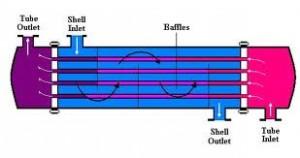
-
MVHR with extract only mode
jack replied to MikeGrahamT21's topic in Mechanical Ventilation with Heat Recovery (MVHR)
If you're serious about it, I have some closed cell PE tubing left over from our MVHR installation, which might be of use as an outer housing for a tube-based unit. I think I have a length of 180 and another of 200 or 220. Happy to send it your way if of interest. -
Or alternatively, it probably isn't possible to summarise 70,000 years of history while also sketching out a new general theory of humanity in a single book, without a significant risk of over-generalising. Yup, that rings a bell. And during that period, people were murdered for heretical theories based on simple factual observations. The scientific method has a lot of flaws, but it's still the best approach we have (one of those "it's the worst approach except for all the others" situations). If anything, the problem we presently have is that the general population doesn't understand or accept much about science. If they did, then they'd do a better job of understanding science's limitations, and potentially wayward scientists would be kept honest.
- 64 replies
-
- 1
-

-
- electricity storage
- battery
- (and 4 more)
-
Lawn watering system/sprinklers
jack replied to readiescards's topic in Landscaping, Decking & Patios
We're doing the same maths with our garden. We spent a lot of money on plants at the end of last Autumn. We lost a few to the odd warm-freezing-warm-freezing periods we had earlier this year, so spending some money on water to get us through this hot dry period makes good financial sense. Most of the plants should be well established by the end of the summer and shouldn't require much watering from next year. It's also spurred me to start planning rainwater storage to be installed before the end of Autumn. -
Lawn watering system/sprinklers
jack replied to readiescards's topic in Landscaping, Decking & Patios
Do you know what your water pressure's like @Temp? -
MVHR with extract only mode
jack replied to MikeGrahamT21's topic in Mechanical Ventilation with Heat Recovery (MVHR)
If they quoted 89%, it's counterflow. Anything with more than about 70% real world efficiency will necessarily be counterflow. Incidentally, counterflow is 180 degrees. It's crossflow that's 90 degrees. -
MVHR with extract only mode
jack replied to MikeGrahamT21's topic in Mechanical Ventilation with Heat Recovery (MVHR)
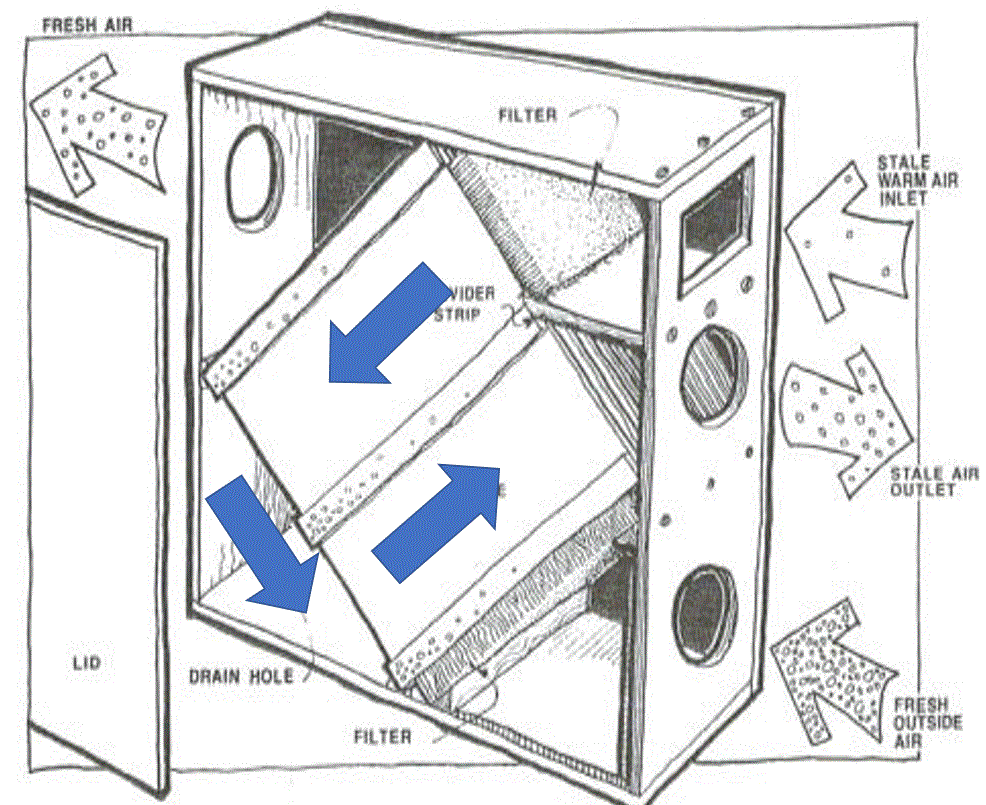
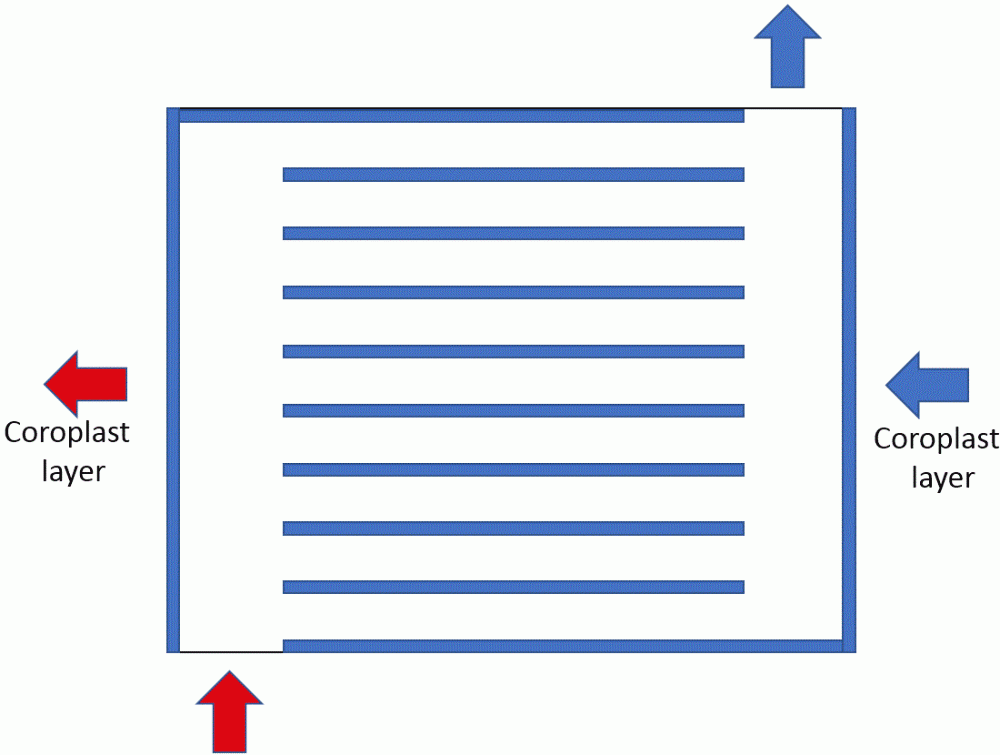
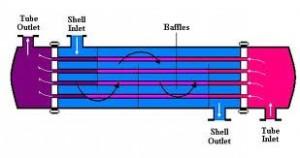
The first two drawings here show the difference. In a counterflow arrangement, the fluids move in opposite directions. Theoretical efficiency is 100%, although more than 90% in the real world is doing well. Crossflow means the fluids move at 90 degrees to each other. This simplifies the connections in a device like that shown above, but theoretical efficiency drops to 75%. A parallel flow, where both fluids are moving in the same direction, is at best 50% efficient. The one linked above is crossflow, but with a double-back path (blue arrows) that will tend to bump the theoretical efficiency up from 75%: To turn this into a full counterflow unit, you would change the divider strip layer to look like this, with the parallel dividers being parallel to the coroplast tubes: I'm not sure that a lack of sealing in the channels is likely to be a big issue, but I agree about the thickness. You could always use flat sheets of thinner material and alternate the pattern above with the pattern below: The problem is that anything thin enough isn't going to be very rigid, so might be annoying to work with. Some sort of jig would help, and once the first few layers are done it should stiffen up and make things easier. Sounds like a lot of work, but hey, it's not like you've a bathroom to finish @Onoff Another diy option is to make something like this, using thinwall plastic tubing: Make the (white) plates out of something like XPS (perhaps melt holes through). To be honest, I love thinking about this sort of thing, especially when I have a big bit of horrible work that I'm trying to get done today(!), but I'm less sure about relying on diy solutions for bringing fresh air into my home long term.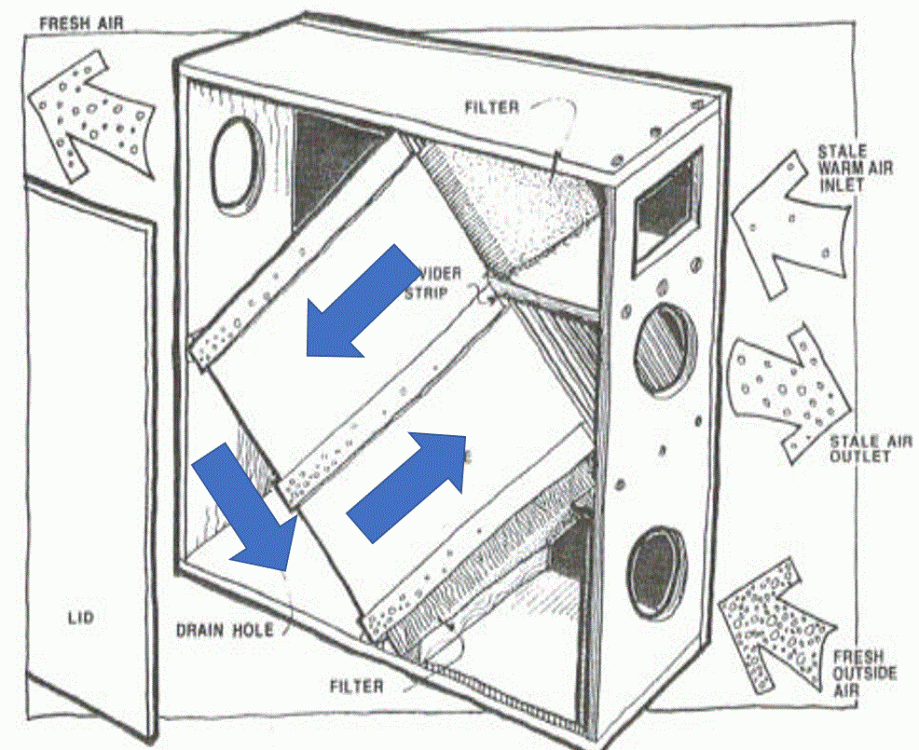

-
Lovely, lovely stuff.
-
MVHR with extract only mode
jack replied to MikeGrahamT21's topic in Mechanical Ventilation with Heat Recovery (MVHR)
Bear in mind that this is a hybrid counterflow/crossflow design (more the latter than the former). I'm not sure how you'd calculate efficiency, but I imagine you'd be lucky to get 60-65% in the real world. Not much needs to be changed to turn this into a counterflow exchanger, which would likely be at least 10% more efficient. -
Lawn watering system/sprinklers
jack replied to readiescards's topic in Landscaping, Decking & Patios
I did quite a bit of research on sprinklers systems recently, and the Caber Colibri system looked decent for lawns. Jeremy has their drip irrigation system and spoke highly of it in my earlier thread. It's one of the options in PeterW's link above. -
I'm on a break from this book. I got (from memory) about halfway through it last year after my wife raved about it, but eventually put it down because some of the generalisations and conclusions annoyed me. I may to get back to it one day.
- 64 replies
-
- 1
-
-
- electricity storage
- battery
- (and 4 more)
-
Lots of potential reasons: Because they can afford to (ie, extra costs make no difference to their lives). Virtue signalling. Genuine desire to encourage and support wider adoption - if there are no early adopters of a new technology, it'll never take off.
-
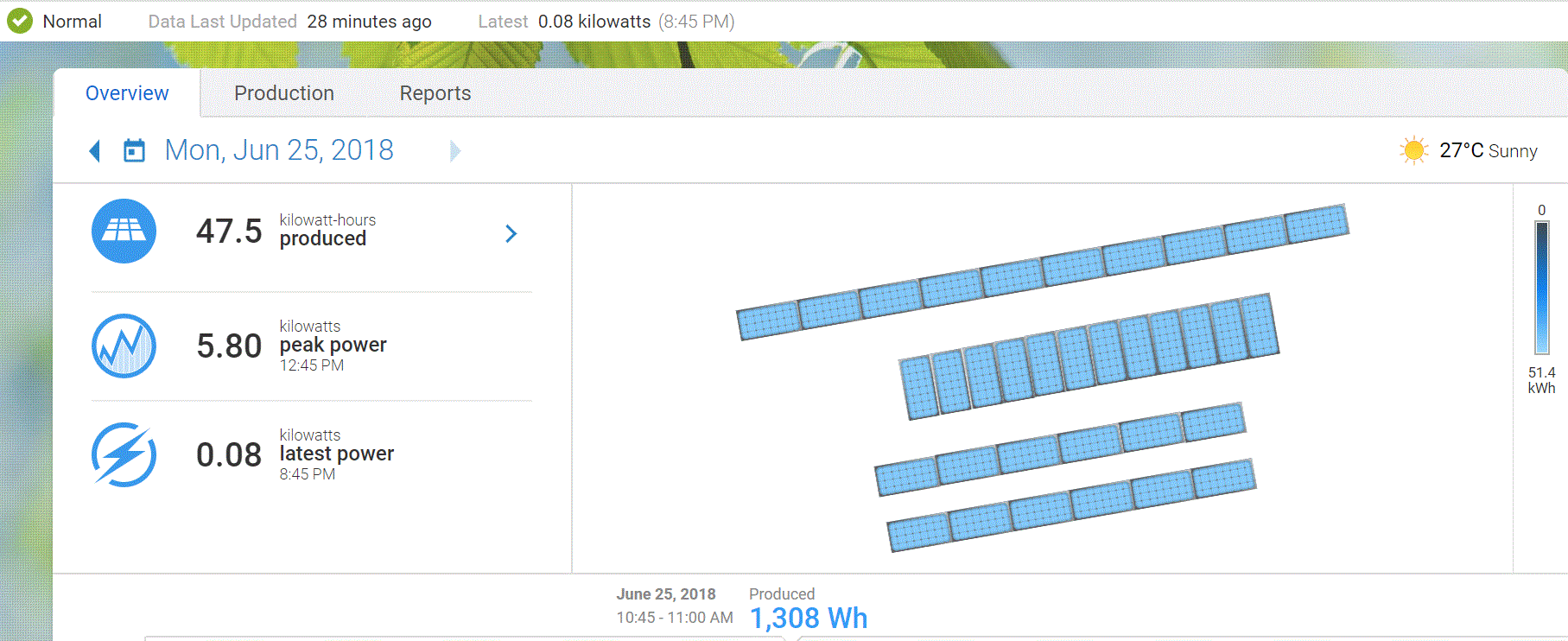
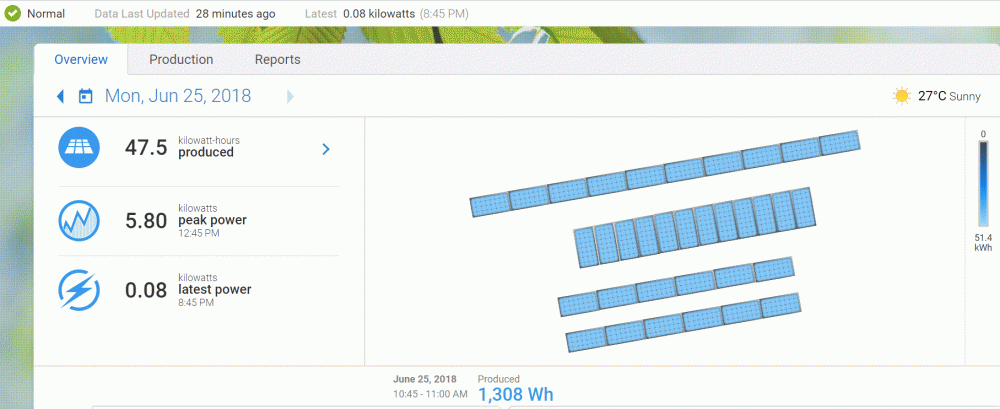
The Enphase microinverters that we have used to allow per panel reporting (I think) but that function's been cut back. I believe installers and Enphase can still see it. You can still see which panels are producing more power than other panels in real time, based on their colour. This was last night at 8:45 - very little power being produced per panel: You'll also get an email if there appears to be a fault. We had that when it snowed earlier this year - the system was expecting the panels to produce power, and when they didn't do so, itsent me an alert. I watched over the next day or so as they individually woke back up as the snow cleared from them. Our microinverters have a 20 or 25 year warranty. Of course, this is only as good as the company that backs them, but Enphase seems to be pretty solid. There's also the issue of longevity of the system itself: what happens if in 10 or 15 years one of them stops working - will they be in a position to provide a drop-in replacement? Having a flat roof means that we can access them pretty easily, as long as the company's still around and replacements are available. As for why we went with this rather than a regular two string inverter, we have various trees shading parts of the roof at different times of the year. The company we used spent quite a bit of time standing on our roof mapping out the surrounding trees, and then modelled the output of the course of a year. The microinverters were a clear winner over the standard inverter approach. I think another thing they do is produce a bit more at the start and end of the day - from memory, it's something to do with the minimum string voltage required for the inverter to turn on in a regular system.
-
Genuine question: if it's permitted development, don't you need to wait until the house is built and signed off before you can exercise this option? Otherwise you'll be trying to get something signed off that differs from the plans. If it's not gong to be finished until December, how far along are they with the garage? Seems crazy to have to another builder in to knock bits down and rebuild afterwards.
-
What an utter ballache - really sorry to hear about this. Let's see how well they respond this time - keep us advised.
-
Any special measures for a hot weather concrete pour?
jack replied to epsilonGreedy's topic in Foundations
It makes the original post even funnier if you go back and read it. In the least creepy way possible, I'd like your wife to make me a G&T. Was it a pint? -
You've identified about the only advantage I can find for having a flat(ish) roof with parapet wall - no scaffolding needed to replace a microinverter!
-
Bang tidy mate!
- 95 replies
-
- 1
-
-
- stairs
- homemade stairs
- (and 2 more)
-
That's it, I've had enough. I'm buying some. Which?
jack replied to ToughButterCup's topic in Tools & Equipment
If reflections are an issue, go for polarised. I prefer polarised for driving, for example, as a lot of the brightness is reflections from cars. -
Any special measures for a hot weather concrete pour?
jack replied to epsilonGreedy's topic in Foundations
Beat me to it. Obviously someone had a good time at the festival! -
No-one will ever talk me back into a petrol chainsaw for occasional small-medium tasks around the garden. A decent electric provides more than adequate performance, with none of the drama if you don't use it all the time.
-
Oh, I agree. But as a matter of principle, I'm even more against local councils ignoring the law when it suits them.
-
There's a town-centre development near us in a place called Farnham (west of Guildford, and south of Farnborough). According to family friends who've lived here since the early 90s, this development has been a political football for over 25 years. The current scoop: http://farnhamherald.com/article.cfm?id=127472 "WAVERLEY Borough Council has been accused of handing Brightwells developer Crest Nicholson “a licence to kill” - after councillors agreed to relax measures safeguarding a colony of protected pipistrelle bats set to be displaced by the redevelopment of East Street." At least they aren't GCNs, eh @recoveringacademic?
-
MVHR with extract only mode
jack replied to MikeGrahamT21's topic in Mechanical Ventilation with Heat Recovery (MVHR)
I don't like leaving windows open overnight due to insects. If I were building again I'd spec insect screens on at least the bedroom windows. We open everything up first thing in the morning and close up once the outside temp warms up. Peak temps are much lower than if we'd kept everything shut up. -
@JSHarris is your man, having been through this in some detail. He details some of what he did in various posts on his site, such as: mayfly.eu/2016/07/part-forty-two-water-treatment/