Mike
-
Posts
1565 -
Joined
-
Last visited
-
Days Won
9
Everything posted by Mike
-
Fair price for new 4 bed house electricity wire?
Mike replied to markharro's topic in Consumer Units, RCDs, MCBOs
I recently had a similar quite for a 1 bed apartment - albeit it's well specced. So I'll be doing all the prep - putting in all the ducting, wall boxes etc. - and buying almost all the kit, other than the cables, so the electrician only has to pull the wires through, fit the consumer unit and make the connections, similar to a rewire. Although you still need to know what you're doing to get everything in the right places. -
I don't use a bath, but in winter I like my showers at 42°C. Cooler in the summer.
-
tap flexible connector fitted with a loop
Mike replied to Question's topic in Bathrooms, Ensuites & Wetrooms
+1 A flexi is that last thing I'd use anywhere. I've changed too many burst ones in the past. -
It depends on your objectives and in what way are you think it may be overkill. FWIW I'm planning to install a Zehnder ComfoAir200 in a 40m² apartment, which you could call overkill. However it's suitable for several reasons: I can minimise noise by keeping the fans pretty slow under all normal conditions, it's one of the best performing units that I can fit in the limited space available, and I need a good intelligent summer bypass. Plus, by shopping around, I can get it for an acceptable price. I'll be feeding it with 125mm ducts - you don't have to use 160mm with Zehnder if you don't need the extra airflow. You can find independently evaluated performance figures for the Zehnder unit in the Passihaus List. You can't do a you can't do a direct comparison with the Vent-Axia unit; they haven't had units evaluated so as you're reliant on their own figures.
-
M regs cloakroom: toilet by the door is less private
Mike replied to dontyouworry's topic in England
You can't do that in Example 1.4B above either, so no. -
I think that's your solution. No doubt a sparky will be along to confirm.
-
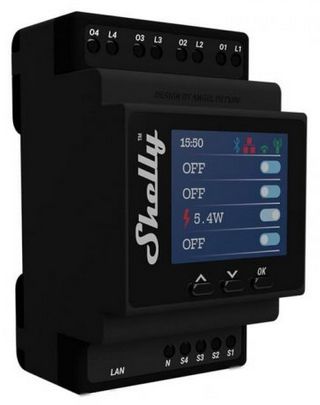
I ran a Pi for several years non-stop without problems - though only converting BBC DASH audio streams, not writing to the card. I'm currently planning to use one again, this time for monitoring and enhancing the control of UFCH (in conjunction with a Shelly Pro 4). For me, the advantages are the ability to easily mount a Pi on a DIN rail in a consumer unit (more-or-less essential for this project), and the availability of the PiJuice to bridge short power outages and handle associated shutdowns and restarts (though I've not tried it yet), without worrying about heat. I may upgrade from an SD card to an mSATA SSD using the Geekworm X850 (or similar) shield to add robustness. In other circumstances I may choose a different option, so I'm watching this discussion with interest.
-
You can wire your power outlets in 6mm² (if the wires will fit) and plug in a 13A plug, but the regs don't permit you to reduce the cable size between consumer unit and outlet except via a fused connector.
-
Not a sparky, but AFAIK you can't reduce cable size unless you have a fused connector to separate the different cables. +1.
-
M regs cloakroom: toilet by the door is less private
Mike replied to dontyouworry's topic in England
No, you're not. If the basin doesn't project further forward than the door, you can enter the room without obstruction and get 750mm unobstructed frontal access. -
If your layout allows it, route them through an attached garage. It avoids the visual clutter outside while keeping them easily accessible.
-
Calculating ducting size
Mike replied to jayc89's topic in Mechanical Ventilation with Heat Recovery (MVHR)
An easy way to do this - but only once you've learned the software - is to use the English version of the Aldes Ventilation Conceptor. You'll need to register at install stage (it's cloud-enabled). You'll need a few hours to play with the software and learn the interface. There's an into (in French) that gives a few graphical clues to get you started at https://www.youtube.com/watch?v=IJJ2PFOtWbY Naturally it's designed for use with their products, but if you choose comparable items the design should be reasonably sound. -
If you really mean 'directly', don't do that. If the top of the pipe will be within within 300mm of the underside of the floor slab, you should replace it with a new portion encased in concrete so that it's held rigid as an integral part of the floor slab, with flexible jointed 'rocker pipes' to accommodate any movement where it emerges from beneath the building. Take a look at the Hepworth Clay Technical Handbook. Your BCO will need to inspect this.
-
Also consider whether you can concrete something else at the same time to boost the load size. Foundations for kerb stones, garden path, duck pond?
-
Another stupid question: can a radiator be too tall?
Mike replied to Garald's topic in Central Heating (Radiators)
That's a huge height difference. Convected heat from a low radiator will also tend to convect up to the ceiling before descending, so it may make less difference than expected - but the turbulence air in the room would be a factor in that. Of course the radiated heat won't be directly affected by that. As long as it's adequately sized and has a thermostatic valve, I wouldn't be too concerned. -
Thanks @Carrerahill, that very helpful :) Sounds like it could well be the way to go.
-
The page you linked to suggests the fail-safe answer - If you have previously specified or purchased WBP (weather and boil-proof) or Exterior quality plywood for construction purposes, you should now purchase plywood to comply with EN636, Class 3. If you're using a vented cold roof construction then Class 2 could be used, but personally I'd stick with Class 3 for the extra margin, especially if there's a risk that it could be exposed to the weather for a while during construction.
-
Running water and power sockets..
Mike replied to puntloos's topic in Bathrooms, Ensuites & Wetrooms
Sadly, people like these: https://duckduckgo.com/?q=electrocuted+in+bath+mobile+site%3AUK -
Running water and power sockets..
Mike replied to puntloos's topic in Bathrooms, Ensuites & Wetrooms
So you can use things like shavers (they don't have a special plug so fit standard sockets), hair dryers, washing machines... Rather than banning sockets from bathrooms, it seems that it's... ...baths that should be banned. Yes, the top cause of bathroom electrocutions in France seems to be using a plugged-in mobile phone in the bath. There are a reports of the same happening in the UK too, it's just that you have to use a longer extension lead. -
Running water and power sockets..
Mike replied to puntloos's topic in Bathrooms, Ensuites & Wetrooms
In contrast to the UK, in France it's illegal not to have an (earthed) power outlet in a bath/shower room. There are some restrictions outsize Zone 2, but it's much more relaxed that the UK. -
Hi @Carrerahill - I'm reawakening this thread as I like the idea! Do the Tridonic modules clip in place using a standard spring clip (similar to the type normally used to retain GU10 bulbs)? Or at least can they be changed from below without disturbing the fitting? I ask because I'm planning to use some plaster-in downlighters, so removing them to fit or change a light engine would be... very problematic.
-
Well it looks like I may be choosing Crydom after all. After checking the wiring information for the Siemens units, only selected models are suitable for use with MCBs, and they can only be driven by 0-24V DC, or 4-30V DC (models ending -1DA06 & -1DA44; 3RF2330-1DA06 for example). Their other models require fuses, which aren't permitted in domestic installations...
-
Upgrading original crittall windows with vacuum glazing??
Mike replied to selfbuildrookie's topic in Windows & Glazing
Yes, the frames are a huge problem. You may, perhaps, be able to fix thin closed cell insulation tape to the inner face of the frame, but it may not look so good even if painted. The glazing itself would help, but may not be cost-effective, and you need to check that the hinges seem strong enough to take the extra weight, if you have opening lights. Personally I'd probably choose secondary glazing; depending on the window design you may be able to get something made up to align with the metal frame. And weatherstripping is definitely a good idea. I've seen silicone bead weatherstripping work reasonably well - where you extrude a silicone bead along the edge, put a bond breaker tape on it, shut the window while the silicone cures to a 'custom fitted' profile, then remove the tape. -
@TerryE thanks again for your feedback - it's good to have someone looking over my shoulder and pointing out potential problems. Enclosures are still plastic on this side of the channel, so WiFi will probably work, however the Pro range of Shellys also have Ethernet ports, so I can hook up to that if it doesn't. The Pi and network switch will be in the (mandatory) Communications Cabinet directly below the consumer unit, so it would only need a couple of patch cables. Keeping the DoC to hand is certainly a good idea; I'd like the electrician and inspector to be as equally disinterested as yours was! The French system is stricter than Part P, in that no electrician can sign off their own work. On the other hand - if you live in a detached house and don't sell it for 10 years after certification (to sidestep other legal issues) - then it's still possible to do a complete DIY installation over here, provided it meets the standards and is signed off by the inspector.
-
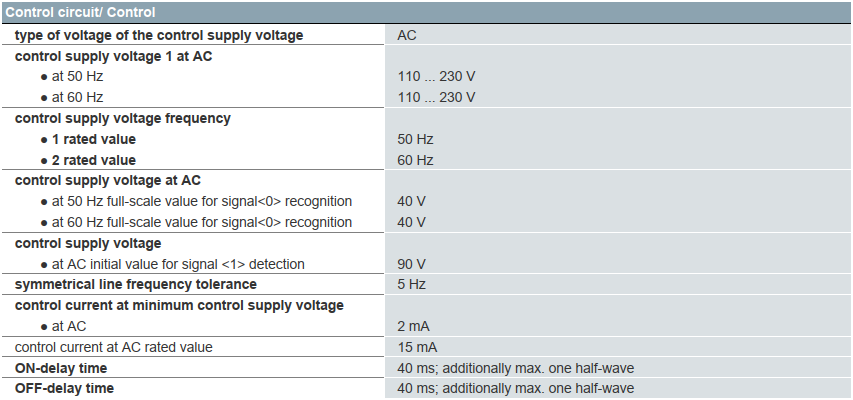
Thanks for checking, and for the warning! Having read the Siemens datasheet more closely, the section on the control inputs does seem unclear to me - I've posted it below. There's a line for "control supply voltage 1 at AC" of 110 ... 230 V ; I had read that as meaning a voltage in that range switched it on - and a lower voltage off, which is as far as I'd got. There's also a line for "control supply voltage at AC... at 50 Hz full-scale value for signal<0> recognition" of 40V - meaning below 40V switches it off? And another "control supply voltage... at AC initial value for signal <1> detection" of 90 V - meaning over 90V switches it on? Are you able to add any illumination? I'm not used to analysing electronics specs in depth, as you may have spotted As for my intended voltages, I was planning to indirectly switch the SSRs at mains voltage. That is, I'm planning to use a Raspberry Pi + MQTT + NodeRed for control, but to switch a Shelly Pro 4PM, which outputs 230V to drive the SSRs. The Shelly's in there for a couple of reasons. Partly because it could be used to control the SSRs directly, either via the manual control buttons or the Shelly app, or its onboard access point (which also allows the setting up of weekly programmed schedules) - so a good fallback if there's ever a problem with the Pi. And also because it doesn't rely on a 'DIY solution', so I hope will not perturb the electrician or the inspector; being France all new installations have to be signed off by a national electrical inspectorate before they'll turn on the supply! In fact, it's slightly more complicated that the above. The Shelly will actually switch the SSRs via a load-shedder, which can temporarily shut down the SSRs & which also operates at 230V; in France your standing charge depends on the mains supply current that you subscribe to, so shedding the load from low-priority circuits at times of peak household demand has a short payback period, and flattens peak demand on the national grid. BTW, although I need 230V control, other Siemens models, such as the 3RF2330-1AA44, can apparently control using 4 to 30V DC (perhaps switching on at 4V and off at 1V, subject to the correct interpretation of their datasheet).