


Bitpipe
-
Posts
4118 -
Joined
-
Last visited
-
Days Won
53
Everything posted by Bitpipe
-
I don't like wasps (who does) but managed to overcome a phobia of them (and bees) when we had the kids as I didn't want to pass it on. Not that bothered now tbh and the more I learn about them the more impressive they are. Their nests are really beautiful structures - when empty that is
-

Internal door linings and door fitting - newbie!
Bitpipe replied to ollie's topic in Doors & Door Frames
Looks like you have something close to metric door openings vs the alternative UK imperial sizes. Have you sourced your doors yet? Howdens do metric linings and Stairbox will do any size as custom. It may be worth looking into buying pre-hung door sets - bit more expensive but less labour to fit the lining, then the door, then the ironmongery. On our build (MBC timber frame) I underestimated the amount of labour required on first fix joinery (used linings from Howdens) to fit linings ahead of plastering and then hang the doors. Would have been better off going for the door sets from the same firm. Our joiner built a jig to prepare each door for hanging - many are FD30 so pretty heavy and needed 3 hinges each. I'm not sure door hanging is a great job for inexperienced DIY as there is plenty to get wrong - maybe get a joiner in for a day to hang some and see how they do it - my experienced joiner was doing 3-4 a day but they were quite expensive and delicate doors (from FSN) so he was being very careful not to damage the veneer etc. If your doors are a bit more robust then you should probably do more than that per day once you get the hang of it. -
My experience was I didn't need to present anything to draw down more money, they will give you what ever you ask for (by email or phone) whenever you need it no need to bother your solicitor once the mge has been set up.. We did 3 chunks of 50%, 25% and 25% of the loan value - should have pulled down a nominal amount early on to start the 2 year clock but we were using our own cash for the first bit and wanted to avoid running up interest but ended up on their mge for 3-4 months longer than we needed to be. However we got an as built SAP A rating (just) so that made the last year a but cheaper (think it was 0.75% discount). Ecology were so nice, when their surveyor firm was backed up with work, they let us find a local one that could do the job quicker and even refunded the difference between their fee and the amount allocated in the offer! Remortgaging off Ecology to a high st brand at a lower rate was easy - their surveyor asked if we had a warranty (answer, yes but technically it's not active as we don't have BCO sign off yet) but never asked to see it.
-
Extended Rest Bends: when to use .... ?
Bitpipe replied to ToughButterCup's topic in Waste & Sewerage
Yep, last spring I cleared out a patch next to the house paving to sink some clay pots to build a little herb garden. A full foot depth of compacted MOT1.Took me most of a week. I find a pickaxe is the best way to get through it and loosen it up, alternating between the pick and blade. Spades and shovels are very hard work as they just keep pinging off the rocks - much easier once the pick has loosened it all up. -
Very economical and practical. However the other 99% stand under the shower for as long as they like. My teenage son is a prime offender, I've now taken to going into plant room and killing the hot water supply so he gets a blast of cold to remind him to get out.
-
When we moved in to our old house on site, we found 1500 unused imperial bricks from the 1960s stacked up. I cleaned them and put on pallets. Called the local reclaim merchant and he said that sadly there was no market for them, just to use for hardcore on site. His view was that there had been industrialised hand demolition of old brick buildings in eastern europe and the market was flooded with very cheap vintage bricks. You may be local in finding a local buyer if they're unique to the area but its a trade off of your time in hand salvaging materials and storing safely vs smacking the whole lot down. Quite a bit of demolition 'cost' is the removal of spoil. This is inevitably crushed and you buy it back as Type 1, paying twice. One load we had was full of pipes, wiring, taps etc so had obviously come straight from another building site. That said, I looked into crusher hire and to get a decent size machine that wouldn't jam easily was not that cheap either.
-
Small house MVHR Design Critique
Bitpipe replied to karesz0304's topic in Mechanical Ventilation with Heat Recovery (MVHR)
No problem - if you visualise how the air goes from supply to extract and try to maximise that for each room then you should be ok. In the bathroom, try and locate the extract close to the shower or bath. Given the extracts are fewer in number and usually have a double run of ducting, they will extract at a much higher rate than the supplies deliver air so not as critical to have them in the far corners. Not sure that dining room supply will do a whole lot to be honest. -
Temporary accommodation on site - when access is tricky
Bitpipe replied to Tom's topic in General Self Build & DIY Discussion
Wouldn't work - X marks our plot, and the bollards are in red - lots of mature trees etc either side, so it would have needed craned up and over everything. Bollards also higher than the loader deck. As an aside, those bollards are the preferred parking location of our regular speed check - it's quite a busy road as it is at the end of town and runs to the next village. We had a 13yr old lad knocked down and killed there just before xmas, so needed more than ever.
-
Small house MVHR Design Critique
Bitpipe replied to karesz0304's topic in Mechanical Ventilation with Heat Recovery (MVHR)
You'll potentially have a 'dead zone' along the back of the living / dining room. I would move the extract so it's near the cooker hood - I assume this is re-circulating vs extracting to outside? That way the MVHR can remove the extract from the cooker hood and also create a cross draught for the whole run of rooms. For the two end bedrooms, I'd extend the supply ducts into the far corners of each room as otherwise the fresh air will go straight under the door to the nearest extract. -
Temporary accommodation on site - when access is tricky
Bitpipe replied to Tom's topic in General Self Build & DIY Discussion
I looked into craning as a main road runs 100m from our house (separated from ours by bollards, all used to be the same road years ago). Crane hire was not that expensive but both van movers and crane operator warned that the van could twist and be destroyed. -
Temporary accommodation on site - when access is tricky
Bitpipe replied to Tom's topic in General Self Build & DIY Discussion
By an amazing coincidence, this appeared on my FB timeline just now - three years today since it left the site...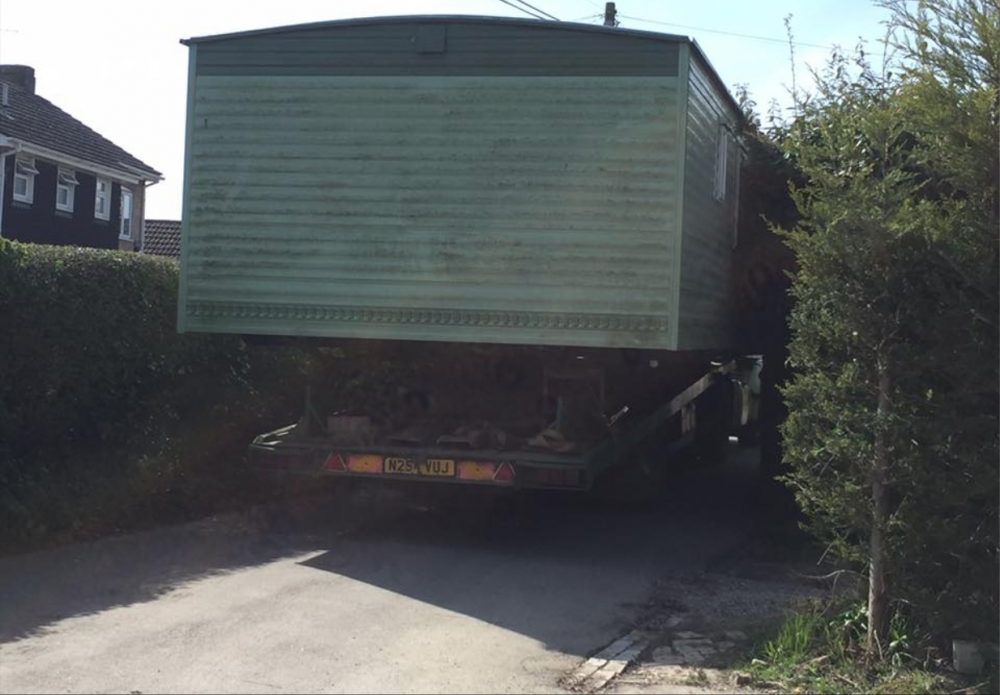
-
Temporary accommodation on site - when access is tricky
Bitpipe replied to Tom's topic in General Self Build & DIY Discussion
Agree - the wheels on a static are only really good for getting them into final position and on and off the transporter - even then you need to use mats or ramps if on anything other than hardstanding. -
Temporary accommodation on site - when access is tricky
Bitpipe replied to Tom's topic in General Self Build & DIY Discussion
We live on a narrow lane and bought an end of life 40ft x 12ft caravan off a local park and their regular guy got in on site, and off a few years later. Was very tight but they knew what they were doing and they had the appropriate articulated transporter. I did look into other options, such as craning etc but a) expensive (though not helicopter expensive) and b) good chance of destroying the van as they're not that robust really. We needed to widen our access and rip out some hedges, both times I had to get neighbours to move parked cars and a few trees lost a few branches but we got there. So if an experienced transport guy says it can be done then you're good, equally if they say you can't then you probably cant. Living in one is not that bad, we had two pre-teen kids at that stage and we all muddled along. Summer is harder than winter to be honest. If it's a non starter then maybe you can look at a large flatpack summerhouse style building (or two)? -
I'm with you on that problem. I started pulling ivy out of our neighbouring hedge as it had got top heavy with growth but little on the sides. Managed to get 4 builders bags to the green waste dump before it closed on Monday. Have now filled another 4 bags - don't really want to burn it but may do in a few months if dump does not re-open. H
-
From memory they specced a system from my planning approved floor plans for free and from that created a parts list to build a quote from. There was enough wriggle room in the supplied materials (mainly the rigid and flex ducting) to allow some variation from the given plan on where everything went and I did end up with leftovers but less than £100 on a £2000 order (not including the unit itself). It's also handy to take their plan and check that you've made provision for duct runs in the joisting and any steels. While the individual flex ducts are easy to run in pozi joists, you do need a bit of space when they start to come together at the manifold, also the rigid duct to outside needs some room especially as it needs wrapped with insulation too.
-
What kind of push plate are you using? We got fancy ones that sit flush with tiles and after tiling two rooms realised that there was a chrome backplate that we didn't have that went behind the tiles. Managed to source and fit for the untiled rooms but had to swap for the clip over version - still look good but could have done without the stress!
-
Warm Air Hand Dryers - Anyone Used?
Bitpipe replied to Ferdinand's topic in Kitchen & Household Appliances
I think it was the puddle of water that collects at the bottom of the dryer, I recall someone tested that at a service station and it was pretty grim. -
Idiots guide to mvhr.
Bitpipe replied to Russell griffiths's topic in Mechanical Ventilation with Heat Recovery (MVHR)
A further benefit Also, if you are sensitive to pollen etc then you can get higher grade filters to trap this. Downsides of MVHR - running cost :should be minimal but they're not free to run - noise : If not properly located, the larger units can give off vibration noise and you may get a slight drone through supply vents, although these can be minimised by incorporating a silencer. - maintenance : the filters do need regular cleaning and occasional replacement and the heat exchanger benefits from a good clean twice a year. - installation: can be fiddly getting the duct from each room back to the manifold / MVHR location and you need to consider how to get the larger bore insulated ducts from the MVHR to an outside wall or use roof vents. Good design early on will minimise the installation complexity and it's definitely something you can DIY and save a few grand on installation. Keeping the unit central will equalise duct runs and make it easier to balance the system but this is not always practical. Ours is in basement plant room on one side of the house and works fine. -
Idiots guide to mvhr.
Bitpipe replied to Russell griffiths's topic in Mechanical Ventilation with Heat Recovery (MVHR)
I really don't understand where this MVHR mandatory 'sealed box' perception comes from. It's all about giving you options, not imposing anything. Our house is passive standard with full MVHR and we open doors, sliders and windows year round as we please. The point is we don't have to open doors and windows to get fresh air or expel stale air as the MVHR is always taking care of that. But we can if we want, at the small cost of energy efficiency (i.e. re-heating the warm air that has escaped in winter). N.B. if you open a single door or window then as the rest of our house is airtight then there is little air movement you need to open two to get a cross draught. Actually being able to keep doors & windows closed is most useful in summer. At night we open one slider a crack (in a locked position) and open the Velux at the top of the house - cools everything down nicely. During the day we try and keep everything shut to minimise warm air from outside making the house uncomfortable. We don't have an active cooling system like some here (air or slab) so really need to watch overheating in summer. Even if every door and window is open, the MVHR extract will still work fine - you just loose some efficiency on the heat recovery side. You can configure the system to do what you want - most of us here have balanced it and figured out how to meet BR standards and then dialled it back down to a comfort level. For us this is 30% fan for comfort and 50% for boost. We have PIR sensors in each bathroom which trigger the boost mode, also triggers when a bathroom light is turned on (and doubles up as the trigger for the DHW re-circulation pump). -
My electrician ensured that all conduit ran at a down angle from inside out and then filled with silicone before placing the fitting over it co it could not be seen. Where this was not possible, he fitted an IP65 box over the conduit and ran cables from that to the fitting.
-
frameless glass balustrade for juliet balconies
Bitpipe replied to kaye's topic in Windows & Glazing
I recommended Elite on the original thread - just to say they ceased trading last year but look to have emerged pheonix like from the ashes as a supply only company.? I was more or less done and their work was decent but one piece of external glass was not correct - was able to claim back from the credit card firm and planning to get it sorted at some stage. The independent fitter they used was great and was left high and dry when they folded. I'm using him to do the replacement work - he's based up north but travels length and breadth of UK. When we designed the house, I made no allowance for the balconies so needed to go for a system that used an aluminium deck on top of the GRP roof with the glass attached to that. I'd expect that if you provide a generous area of load bearing brick / timber in the area where the balcony will be fitted, you'll be fine. -
Maybe but I'd say the govt have a higher chance of successfully prosecuting you than you have of successfully prosecuting them
-
What other insurance do you have in place - have you moved to a standard buildings policy yet or are you still on self build insurance? Do you have a figure for the 'make good' cost? May be worth talking to MBC now and seeing what their part would be, ditto your plasterer. You'll probably do your own painting again but get a quote anyway. If you've not had BC signoff then your warranty is probably not active (although they are quite useless anyway). Irrespective I think you need to take steps to establish your legal position. Do you have any legal cover in home insurance? If not, you can still get a consultation with a solicitor and then kick off some legal correspondence.
-
My understanding is that fixed rate mortgages are not that sensitive to the central bank rate as the money that backs them comes from other institutions - i.e. mortgage provider 'buys' a chunk of cash at a given rate and sells it as a fixed rate product. When the money is sold, they buy another chunk at the going rate and repeat. Trackers obviously do move up and down in line with the BoE rate but are not normally good value. Let us know what you find out,
-
Yep, I pulled that trick on Teresa May last year



