


Bitpipe
-
Posts
4118 -
Joined
-
Last visited
-
Days Won
53
Everything posted by Bitpipe
-
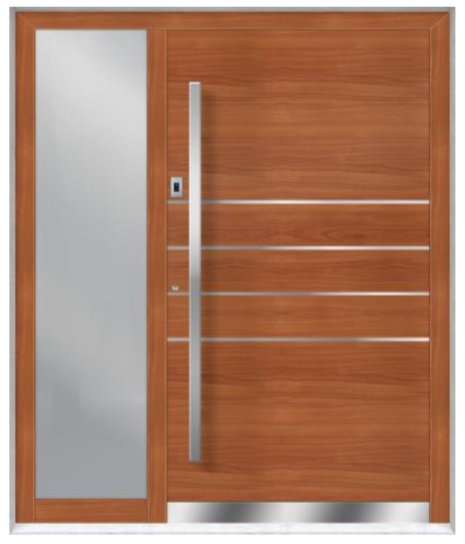
My RK door was quite expensive - about £5k and £500 to install, but we had the scanner and fancy 180o hinges as an upgrade so they added about £1k extra. It fills a 1650mm opening and the door itself is about 900mm wide. I did cock up the order though as I intended the door to be wider (1100mm) with less glass on the side but it looks fine. Also the wall construction next to the door somewhat impedes the door opening to about 100% but the concealed hinges look nice anyway It's U value is 0.67W/m2K and it's passive standard, lots of seals etc.
-
Maybe. Mine works by vertically sliding the hand down with an open palm, with the relevant finger on the sensor - like yours it has a horizontal line that forms the scanner. This is hard to do for thumbs as the rest of the hand ends up at a 90 degree angle.
-
You get to make your own!
-
When the door is open, there is a control panel in the internal face that closes into the wall. Bit of a faff but you add a new user and then add each finger one at a time by swiping down 3 times per finger and you get a confirmation that it's been successful. You can add from 1 to 8 fingers per person and I believe 99 people Easy to delete people also. Fingerprints survive over a power cut as they're written into non volatile memory. Everything is contained in the door and all you need to add is power - ours came with a long multi core cable and a DV converter. During plastering, the cable got severed but we got a replacement and managed to get it all hooked up again. There is definitely provision to patch it into a home automation system but as we don't have one, not an option for us. Also the newer version has wifi and bluetooth I think to enable remote opening, not something I'm keen on from a security perspective so don't miss it.
-
We've had a fingerprint scanner on our RK door for over four years now. Back in 2015 it was a £500 option but I think it has been well worth it. I've programmed on 8 fingers for each of us (doesn't do thumbs) and it's worked great - far more sensitive & reliable than the phone fingerprint scanners. Only real issue i've had is when working with blocks etc and my fingertips have been abraded - I've only needed to re-program my fingers in once in that time, everyone else has been fine. I always carry a key for emergencies but the kids have never had a key to the door and therefore have never been in the position of forgetting or loosing them and getting locked out. We can also pop a neighbours fingerprint on if they're looking after the place while we're away and then delete it on our return.
-
Fitting the box is the easy bit once ducts & manifolds are in place - bolt to wall, use the concertina insulated hose to hook up to the four vents, attach the condensate drain and turn on. Commissioning is also a DIY job. Like many here I did it all myself and have very basic DIY skills. Three years in I've not suffocated so must have done something right
-

Stroma EPC / FSAP software questions
Bitpipe replied to Ferdinand's topic in Energy Efficient & Sustainable Design Concepts
Do you have PV? From memory, that makes a significant difference. I remember discussion aeons ago about other heat recovery gadgets that could add a point or two - separate issue as to whether they were a good return on investment. -
You can pant wrestle @jack to get the credit back This is the clever way to do it. Yep, I remember going to our solicitor after the initial draw was spent and asking what the process was for more. He said - just send them an email, nothing to do with me. Was as easy as that.
-
Ah well, have the credit anyway
-
Once they commit to the offer everything is signed and the drawdown is available I don't think they can withdraw.
-
All credit to @jack who did the early draw down thing and alerted me to it after the fact
-
I remember that there was a delay with their surveyor so I found a local one who they agreed to use and they even refunded me the difference between their fee and his fee!
-
I recall that one of the active members in the eBuild days spent a fortune doing belt & braces acoustic insulation including resilient bars, rubber mats on floors etc and he was disappointed at the level of noise that still transmitted - its very difficult to eliminate. We used blue soundblock (which was twice the density of normal plasterboard board) on the basement ceiling, ground floor ceiling and around all the bathrooms and plenty of noise still comes through.
-
Advantage of a DIY approach is that you can play with variables and see how they impact the outcome, however you do need to put a bit of work in to get to that point. If you're using a 3rd party, would be good to see how they could help you achieve the required score. Ultimately, the Ecology requirement is based on trust - they can't make you build to any given spec or recall the funds etc. All they can do is withhold the post build discount for the remainder of the term (which will be based on your final 'as built' SAP score). One tip on using Ecology, it's worth pulling down a nominal sum immediately to start the clock ticking on the 2 year minimum term. We made the mistake of burning through our saved cash first thinking we were being clever in not accruing interest on the drawn money but then had a few months extra on their higher rate before we could remortgage with a standard high st lender. Obv. depends on your build schedule and whether you have fulfilled the criteria to move off a self build mortgage (usually a completion certificate or active warranty).
-
As a previous Ecology customer (rate them very highly BTW) I had to provide a SAP assessment of the predicted build - obviously as it's not built yet. I used @Jeremy Harris Stroma model and the free PC s/w to do this and it was accepted. You can only really get an official SAP assessment once the house is built, although I suppose some assessors could do one from plans and proposed windows, heating system etc. My completed build came in at 90% so just squeaked a SAP A rating, even though it would also have qualified as a passive standard house so some quirks in the SAP rating system.
-
Oil Prices nearly 30% Down
Bitpipe replied to Ferdinand's topic in General Self Build & DIY Discussion
Reading that it's down to a spat between Russia and the Saudis (Opec +) over an agreement to keep the price up through limiting production. Russia reneged so Saudi's punishing them by making the price plummet, which always hurts Russia more. Good opportunity for the Govt to sneak in their fuel duty increase though. As our at pump price is dominated by tax & duty, movement of the underlying crude price does not make a huge difference. -
Welcome - can you post a few pictures? Always helps. I find that if I take them on a phone and access the forum on a mobile browser, it's much easier than transferring them to a PC and uploading them that way. We had a similar challenge, I just left mine untouched until the external skin was on and the external hard landscaping was complete. I trimmed mine and applied a perimeter of 20mm thick EPS to tidy the outside insulation envelope, tucking the DPM under it. I have a strip of Ubiflex (artificial lead flashing) to apply at some point to finish it off.
-
I suggest you chew toilet roll (admittedly can be hard to find these days but worth a look) and insert it in the gaps. The saliva acts as a harding agent but retains flexibility.
-
Our local Waitrose is empty of loo paper and pasta I can only imagine that people can only sustain this level of hysteria for a short time before they have a house full of loo roll and have not dropped dead. I also think the last few years have tainted the impact of government information campaigns. The 'Get Ready For Brexit' one that ran last year was laughable - when you went to the web page it had vague advice such as 'you may want to prepare for changes in export processes' but obviously could not advise what was changing as no-one knew, and still don't know. Which begs the question, why have a super expensive information campaign? If people get their info from social media influencers, then give them the correct facts and let them share.
-
Conf calls are good for established relationships but face to face is important too. For one thing, at least you can see if you have everyone's attention and how they are reacting to what you are saying - I know that on a conf call, the majority of attendees are multi-tasking and not paying attention. Side conversations are often more productive than the meeting itself. Depends what you're trying to achieve I suppose. I think the business lunch, dinner & drinks culture is on the way out though. I do think the conference industry is in big trouble - I used to attend MWC (mobile phone industry) in Cannes and then Barcelona for over 10 years and now the Mrs goes with her firm. While a few of the big players (Google, Apple) pulled out years ago, it was still a big deal with over 150,000 attendees from companies big and small congregating. After this year's cancellation (and dozens of other similar events), the accountants will be very happy, as will many of the attendees. Sales will likely not show an impact so it will be harder to justify next year and so on... Fully how people are told to travel less for the sake of the environment and they ignore it, cant possibly happen etc. Tell them they may get a virus and it stops dead.
-
All my London meetings for next few weeks are now conf calls as almost every client is asking 'have you travelled to these X countries, or been in contact with anyone who has etc..' and if yes, you can't visit their offices. As my colleague was skiing in Italy at half term, we're on the exclusion list. Can't say I'm really bothered but can't help thinking that if you did an exhaustive spider web of connections, you'd quickly exclude most of the UK population, especially as the virus has a foothold in UK now.
-
Really sorry to hear this, let me know if I can help out in any way. I have to take my hat off to MBC here, they were equally helpful when I had the render issue - sending Brendan to site for half a day to work with the contractor to get to the root of the issue two plus years after the house was built.
- 48 comments
-
- 2
-

-

-
- roof
- rooflights
- (and 2 more)
-
We have a suspended timber deck ground floor (over basement). 22mm OSB glued & screwed on pozi joists and installed as part of the MBC package. Before decking, I* laid alu spreader plates and the 16mm UFH loops. They decked over this (leaving out a strip of OSB where the loops had to cross over the joist). On top of that went 12mm ply and 9mm ply, both glued and tacked. On top of that went a 6mm rubber crumb matt and then 6mm of resin topcoat (should have been 2mm but failed to cure properly twice so was redone). So it's almost 50mm of solid substrate between the UFH and floor surface, still heats up just fine when needed. Like Jeremy, I have nothing else heat wise in upstairs bedrooms but do have electric UFH mats under the tiles in the bathrooms plus wet towel rads. Rooms are perfectly comfortable, even in depths of winter and worst case, 5 mins with a Dyson hot / cold fan will get an unused room up to comfort temp. *I started laying the spreader plates as soon as the joists were in but MBC politely took over and put everything else in perfectly in a fraction of the time I would have taken. UFH pipe too.
-
Passive raft vs traditional (strip/trench) costs assesment
Bitpipe replied to SuperJohnG's topic in Foundations
You're welcome, just sharing my own experience. I don't think there is a right answer here as it's a function of how tight your budget is, where your confidence level is and how experienced you are (these two do not necessarily go hand in hand ) and how much your own time costs. Some people find it reassuring, and can afford, having the architect alongside them for the whole journey while some never use one at all. Personally, I'd let the architect complete the planning process if you're already along that path and see what's coming back from the frame companies based on the initial design - that should give you the data to see where there may be duplication on the professional services or where the gaps may be. I'd also take a look at the building warrant process and see what you need above and beyond what you'd get from the frame suppliers - may help you decide if the £3500+VAT is money well spent or something you could take care of yourself. -
Passive raft vs traditional (strip/trench) costs assesment
Bitpipe replied to SuperJohnG's topic in Foundations
I don't know how it works in Scotland but in England, BC are not interested in seeing electrical or plumbing design - they just want the electrics signed off by a qualified electrician and likewise the certifiable parts of the plumbing. Timber frame vendors, who supply and erect as a package, tend to design in house from your planning drawings, including calcs etc so you need to understand what value your architectural technician is adding. Most electrical & plumbing contractors will do their own competent design and will likely nod & smile at any that you provide, aside from position of fixtures etc. As ever, you should get quotes from potential frame suppliers once you have planning. You should not need detailed drawings to get a quote (we didn't) however they wont give you detailed designs to satisfy BC until you commit & pay deposit. Check what is and isn't included in their package - it can very considerably and some will/won't include slabs, internal non structural walls, erection, crane hire, fall arrest, scaffolding etc. Then you make you can make some effort as to 'normalise' quotes and see which ones offer the best value. Your architect may well continue to add value in this process but don't take it for granted and make sure you know what you're paying for - could be you value their oversight and 'hand holding' which is fine.