Bitpipe
-
Posts
4118 -
Joined
-
Last visited
-
Days Won
53
Everything posted by Bitpipe
-

Examining the 'house sandwich' - working with 8250mm
Bitpipe replied to puntloos's topic in New House & Self Build Design
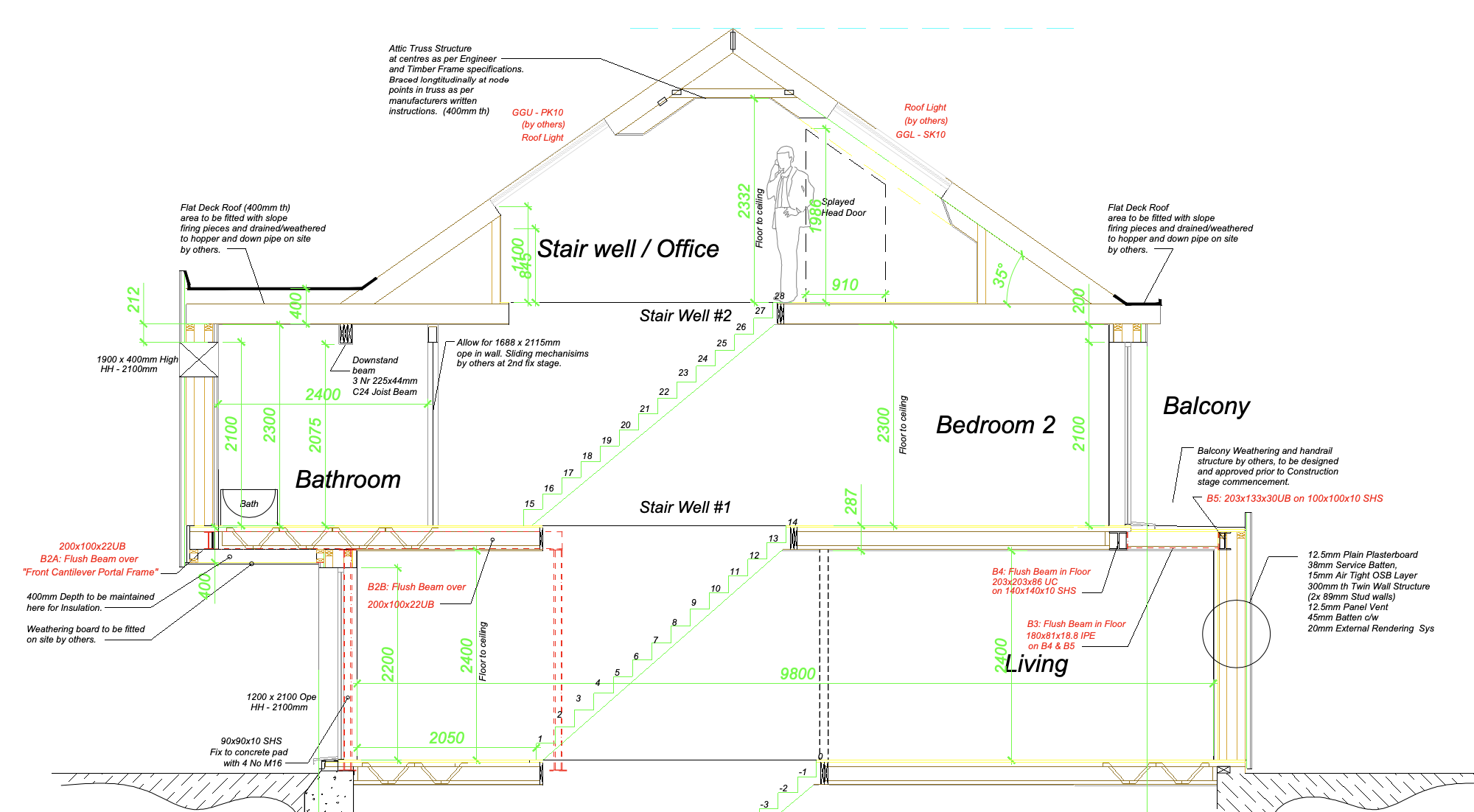
We had a similar challenge - first planning app rejected and one of the reasons was the ridge height exceeding the previous dwelling. Our planning solution was to have ground floor at 2400mm, first floor at 2300mm and make the best of the room in roof space, which was 2330mm. When we got the detailed drawings from MBC, we were still 100mm off as the floor decks were thicker than anticipated. We solved that by just going 100mm further down with the basement / foundation - the limits there were governed by getting the necessary foul drops from the downstairs loo to the street sewer - lots of calculations on the invert levels for each IC but we made it ok. Could have tried to get away with it but decided not worth the risk. Was worried that @2400mm the GF ceiling would feel too low but it's fine - as its all open plan and lots of floor to ceiling windows, it's never bothered us. Just to add, as we're effectively a 4 story house (basement, GF, FF, RIR), every door that opens onto the hall / stairway from a habitable room (i.e. excluding bathrooms) is FD30 rated with fire strip. We have a nice glazed 926mm door into the GF hallway and it got very expensive as the glass needs to be FD30 also. We did not need to use fire rated PB (pink) as standard 12.5mm with a skim is considered to give 30min protection. Basement also needed independent means of exit so there is a separate door there that opens to stairs up to ground level.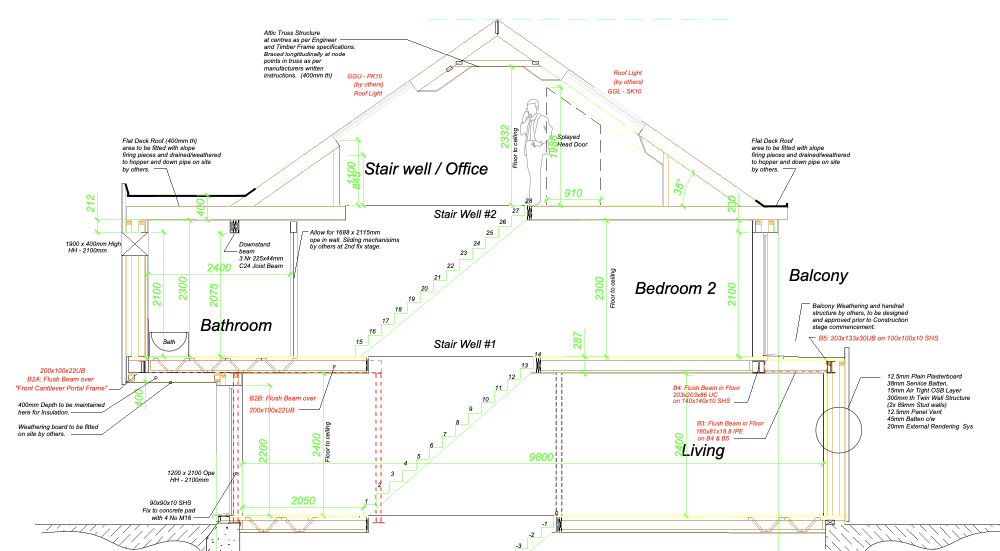
-
So did I, was the rest of the family that hated it
-
Can't help with the log build but can offer some moral support wrt living in temp accommodation ! We lived 18 mo in a 40x12ft static in garden with two kids who were late primary school age then. Was pokey but we made the best of it. My top tip is to use a dehumidifier to reduce moisture in the caravan and to provide a bit of background heat, if you use gas heaters you will get a lot of water vapour which will condense out overnight and will leave a cold and damp floor the next day. When you move into your new house, you'll look back on the caravan and cabin and wonder how you ever survived it
-
Appreciate your frustration but if the contractor did not price for it then you're not being charged for something that's not been delivered. If the tender had those extra few thousand in it at the start, would you have noticed? Agree that you should consider render if the money is just not there now. We had many self inflicted disappointments on our build that caused sleepless nights - I screwed up the front door order and instead of a 1100mm door got 900mm with extra glass to the side - £5k so not trivial. However now I'd be hard pushed to notice or care.
-
Welcome! Where in the country are you and what are your plans for the barn? Tell us more
-
'Feature window'.
-
Yep, @PeterW explained it well. Garage ACOs drain direct to soak as does overflow of the RWH tank. House and garage roofs drain to RHW inlet. As we have the basement as a full footprint, there is no need for drainage around the house as it's one giant French drain. Land drain at external perimeter of basement which also goes to soakaway.
-
Architect Technician - Required During Build?
Bitpipe replied to soapstar's topic in Surveyors & Architects
Agree with above, depending on the service you will get from your 'builder' (i.e. may be TF firm, etc..) you may decide that your architect's continued services are duplicative and not required. However, per @the_r_sole - you need to understand the implications of ceasing that relationship and what remaining obligations they have. You can rely on goodwill for the occasional query but don't be upset if you don't get it as this is after all a commercial relationship and they may be unwilling to provide anything if they feel uncomfortable professionally doing so. In our case, our architect designed a beautiful house for us and secured planning over some LA and neighbour objections on the second pass. As our thoughts turned to low energy construction methods and then, more specifically passive timber frame, they admitted that this was not an in house skill set but they would re-interpret drawings and do the building control and planning conditions submissions for a sizeable fee. As the TF firm was producing their own detailed drawings & calcs - I checked with the independent BC firm that they would be satisfied with those and when they agreed, we politely parted company with the architect and did our own planning conditions submission together with supplying the BC with what they needed. It all worked out fine and we saved a sizeable chunk of money, however we did not go back to them for any professional advice thereafter but did stay in contact wrt progress as they were interested in the end result. -
Is it just me but I can't get the videos to play. Well done on the demo - I got my 3 bed detached taken down in SE England for £5k from the contractor who was doing the basement - as their whole package was £120k, was easy enough for them to discount to win the business. I looked into recycling but no-one was interested - materials were not that special and I was not even able to give away 1500 unused 1950s bricks that I found on site from the original build.
-
The SE who did my basement now works here https://www.buildcollective.co.uk looks like they cover a range of services so maybe worth a call also.
-
Is it the one with the German sounding name? That's the firm our underwater friends used and they were very high quality but not cheap and they don't do groundworks. They do use a precast waterproof panel, seal the joints and then apply a very robust membrane. Our friends have had no issues. Their economics did not work for us and for the price of the basement only they quoted us we got the whole job done inc. demolition, excavation and re-instatement.
-
Greetings, just up the road from you at J8/9. Personally, I would not get too fixated on a build system until you have a design that works for you and your plot - and planning! Pretty much any build system can work with any design whether it's trad brick and block, SIPs, timber frame or ICF. There are cost/time/performance trade-offs between all approaches but I'd work on that as the second step once you have a design, and planning. Post planning, we went round the houses on ICF, SIPs and TF before settling on the latter for above ground as we could guarantee airtightness and insulation with that particular contractor. Basement was cast in situ concrete. The only caveat to all that is if you are planning to do the majority of construction yourself, in which case ICF is probably the best system for 'DIY' (however still a lot of skilled tasks required there).
-
That may be good enough for the SE providing they are deep enough and don't show wild variation. Boreholes don't usually measure the load bearing strength of the ground though, we had lots of dynamic probing - basically a small rig progressively whacks a metal rod into the ground up to 10 m deep and measures the resistance for each whack. Some of these are then bored to about 4m to get the soil analysis. You need both sets of data to really know what you have going on, plus a desk survey to understand what's been there before. We waited until after planning was achieved before commissioning SEs etc and we got quite a few related conditions that were addressed in the subsequent GI report (mostly relating to soil contamination reporting etc.).
-
Do keep in mind that the SE need never come to site and can be based anywhere. They just need the necessary data - detailed site survey, ground conditions report (best to ask them in advance what they need to see in it) and the detailed design of the above ground structure, point loading etc. and the below ground layout from your architect. You can use one SE do do the whole house design or use one for above and one for below ground. If you're doing a timber frame package, they will provide their own SE for that bit - in the MBC case, they also use the same one for their slab design. The challenge with basements (and groundworks in general to be fair) is that you don't know the actual cost and whether you can afford it until you know what's under your feet and that will involve spending money, some of which may be a bit speculative if the final numbers don't work in your favour. However that is much cheaper than the alternative of committing to the project and having an unpleasant surprise mid construction.
-
We went straight to the SE specified comprehensive GI survey, boreholes & dynamic probes. Historical maps showed that we were on the edge of an old landfill site so potentially made ground (which would have meant piling). Old house was also in situ so we needed to pick areas right next to it that were representative of the basement footprint. Was not cheap and we could maybe have done better with another contractor but we got there in the end. We were also clay over gravel over chalk the latter can be like Swiss cheese (as its soluble) and it bulks up crazy when excavated. When you understand your ground water conditions, you can decide on the waterproofing strategy. 3 options really, 1) External membrane - works but needs to be carefully applied and protected during backfill. If you get a leak then will be hard to find out where it is. 2) Waterproofed concrete, water bar on joints etc (we used this system) - reliable but should come with an insurance backed warranty, ours was Sika and their rep was onsite regularly checking quality of work. Works well with ICF but you can't see the quality of the pour due to the insulation. 3) Internal membrane with sump and pump - needs a good backup strategy if pump fails (sometimes dual pumps are used), power cuts etc. Best practice is to have two of the three but as our water was low (6m) we just went with option 2 and have had no issues. Backfill is also key - we used clean stone (fist sized) with a land drain to soakaway at the bottom - means any rain or surface water won't hang around.
-
Do you have a detailed SE design, based on ground investigation, to base these quotes on? I I.e. do you know the bearing strength of the ground exactly where your basement will be, ground water levels, any potential soil contamination that would complicate muck away? If not then you're getting 'best scenario' quotes but reality could be quite different - useful for budgetary considerations but risky to assume that they are not subject to change. Both the basement design (amount and type of steel & concrete plus waterproofing strategy) and groundworks will be highly dependent on ground conditions. Different soil types bulk up by different ratios and this drives the muck away cost (as it's per 20t truck but also by volume). Tricky access can also drive up costs as it just slows everything down. Some soil conditions can necessitate sheet piling instead of just battering back the ground and poor ground conditions can necessitate piling to support the slab. Bottom line is you won't know what you're dealing with and what the cost is (and whether you can afford it) until you have that ground report and it's always best to get one specced by the SE so you get the data they need. You then shop around to get the best quote for that work and when you have the report the SE can do your design - you'll know quickly if you need under piling or sheet piling to support the ground. When you have a full design, you can shop that around to get a comprehensive quote and can see if splitting the GW and build is cheaper. So, sadly you need to commit some ££ before you know for certain you can afford it. You can take a chance but if you hit issues, you'll have one very expensive hole in the ground. We went through all of this and had the pain of the GI company screwing up and having them to come back (at our cost) to get the necessary data, but we got through it ok in the end. Friends nearby discovered before the dig they had a stream 3m below their plot and had to pay for expensive dewatering during the build, however would have been a disaster to find that out mid dig.
-
Back in 2016 we bought a load of Skovby oak furniture direct from a Copenhagen showroom vs a uk supplier as even after the transport and exchange rate (just after Brexit) was still 30% cheaper. MrsB insisted on communicating with them in Dutch via google translate and was confirming the order and discussing 'shipping fees' to UK. This went back and forth unsuccessfully until she finally called them (they spoke impeccable English). They were helpful but were quite concerned that the furniture would not be suitable for a ship and would be better in a normal house.
-
Good for you, many wouldn't. I share your frustration - I bought a lot of build stuff from Germany (Megabad etc) and found the email and phone comms tricky but always with the right intention. A little bit of school boy German always helped (although ran out very fast).
-
Nice and polite, did you apologise for your little rant then?
-
Did you type your reply in fluent German then? English as a second language is notoriously blunt. I have Roma blinds on my Gaulhofer windows and they are excellent, however I have never been able to deal with them direct and always have to go through Ecowin who go through Gaulhofer. Like many large manufacturing firms, they will only sell through a reseller network and obviously don't have one in the UK as I expect they see little demand as external shutters for domestic residences are very rare here but extremely common in mainland Europe.
-
Totally clueless and overwhelmed.......help!
Bitpipe replied to Joannteg's topic in Introduce Yourself
That's because bad builds make good tv. Our build would have been very dull watching Wow, fair play to you both! Do start to get quotes for services and 'preliminaries' - everything you need to achieve site wise before starting the build itself. This will make your budget for the build itself a lot more honest. You can still be ambitious and defer some things (like internally finishing some spaces, grounds etc) to later in life. Some people even forgo the dream kitchen initially just to get in and then upgrade later. As a new self build, you'll be zero rated for VAT for most elements (with some exceptions) more or less until you move in so that can impact decisions on what to build when. Even if you're handing the whole project to a contractor, you should still stay deeply involved as it keeps everyone honest and increases the chances you get what you want at the price you can afford. -
Welcome! Before you plough into heating systems (which, as a NI native I know is close to everyone's heart) have you thought about modelling the performance of the house as a whole (including how it performs in summer), hot water requirements etc to understand what you actually need? If you're going for a good level of insulation you should think on airtightness and also ventilation strategies plus think about how much glazing you have, what the orientation is on the plot, natural and designed in shading etc. Risk is you could get uncomfortably warm when the sun is shining (even in spring / autumn) even it it's not that hot outside. Even in winter, you may not need as much heating as you think.
- 23 replies
-
- 1
-

-
- heating system
- heating
- (and 3 more)
-
Totally clueless and overwhelmed.......help!
Bitpipe replied to Joannteg's topic in Introduce Yourself
+1 on the budget, although I found some architects can breeze through this as they can have unrealistic expectations of what build costs can be. However if you're firm from the outset, then this can keep everyone grounded. You normally work to a price / m2 of internal area and it can vary hugely depending on area, size, design and how much is DIY vs hands off involvement. Rranges on this forum from £1000/m2 to £2000+ / m2. As your site is green, you will need to factor in the boring stuff like access (i.e. how you get from the nearest main road to your site, will need to work for the build itself), services (power & water, telecoms, sewage etc), etc.. There's also hard external landscaping (driveways, patios) and soft (lawns, gardens etc.). This all comes out of your budget before you've laid a brick, as does professional services (architect, engineers, building control) not to mention warranties, site insurance and all that necessary stuff. The Home Builder's Bible (the one book you should buy) does a great explanation of how design influences cost - a square is cheaper to build than an L as you need more wall to enclose the same area. There's a lot to get your head around but don't be put off as you need to challenge as you go to ensure you get what you want and what you can afford. All worth it in the end! -
Totally clueless and overwhelmed.......help!
Bitpipe replied to Joannteg's topic in Introduce Yourself
Welcome! We too started on the selfbuild journey having never built more than an Ikea wardrobe. You can be paralysed by choice initially but looking at other builds is invaluable, especially before you get too deep with the architect. Try not to confuse traditional style with modern methods of construction - you can have an old style stone cottage that is highly thermally efficient or a modern box that's draughty and hard to heat or keep cool. Whatever design you land on, no reason why it can't be built to a very high and future proof standard for more or less the same cost as 'traditional' methods. That's part of the benefit of being a self builder - the build quality is as good as the aesthetic design. This is why I built a basement It is hard to see beyond the stage you're at right now when you have kids but if you have a flexible design that allows them to be close and then further away then you'll really be future proofing. Teenagers like to socialise and a tip my older sister gave me long ago is, for better or worse, try and make your house the one they want to gravitate to as you'll see what's going on! So think about teen friendly social spaces, where you can still have peace and quiet, for the years to come - may even just be a garden room etc. -
Sounds steep - what did you have before that they got through? Our RK Passive door which is aluminium, triple glazed etc was £5k and is 160mm wide inc side glass, fingerprint entry etc. Are all the rest of your entrances suitably secure?