Bitpipe
-
Posts
4118 -
Joined
-
Last visited
-
Days Won
53
Everything posted by Bitpipe
-

Mvhr official testing
Bitpipe replied to Simon Brooke's topic in Mechanical Ventilation with Heat Recovery (MVHR)
If he comes back with anything other than a 'yes' then ask him what professional qualifications a MVHR 'commissioner' needs and ask to see the bit of the regs that defines that. Good luck! -
Mvhr official testing
Bitpipe replied to Simon Brooke's topic in Mechanical Ventilation with Heat Recovery (MVHR)
I think that's the correct approach. Not sure a high ceiling makes that much of a difference aside from physically getting close enough to the vent to measure the flow. The cross sectional area of the measuring device is the key input parameter in the spreadsheet I used (which I believe came originally from @Jeremy Harris). I made a cone from stiff card that was taped tight to the measuring unit on one end and was a bit larger circumference than the ceiling vent at the other. I topped that edge with with soft foam to ensure I got a good seal on the ceiling when measuring. Still needed to be on some steps as the cone was only about a foot long. Other top tip is to avoid unintentionally triggering boost when measuring - as we have PIRs in bathrooms to do just that, I had to cover them up. You will get some exercise running around the house a few times to balance the vents, remember that whenever you adjust one, the airflow in all the others will alter as well so you need to keep measuring them all to get a consistent view. Good luck! -
Mvhr official testing
Bitpipe replied to Simon Brooke's topic in Mechanical Ventilation with Heat Recovery (MVHR)
Do you mean a) you're happy/ confident to do it yourself or b) you want their advance permission that you're ok to do it? I would just tell them that you will provide a report that confirms MVHR commissioning & compliance to the regs. I would not view this as an 'asking permission' scenario as, unlike electrical or plumbing test certs there is no professional qualification or equivalent in existence for MVHR. If you do ask, what's the plan if they say no? -
Mvhr official testing
Bitpipe replied to Simon Brooke's topic in Mechanical Ventilation with Heat Recovery (MVHR)
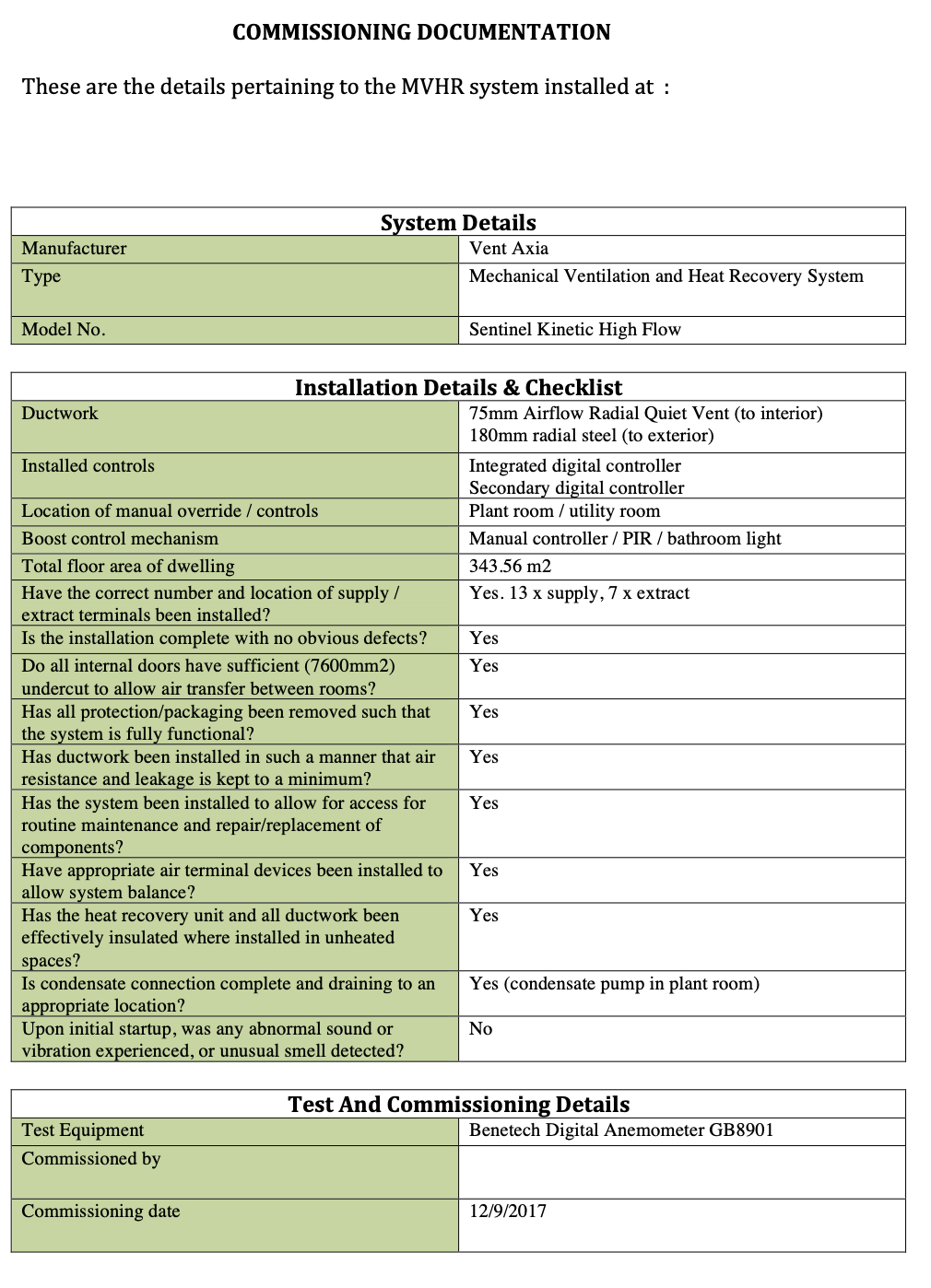
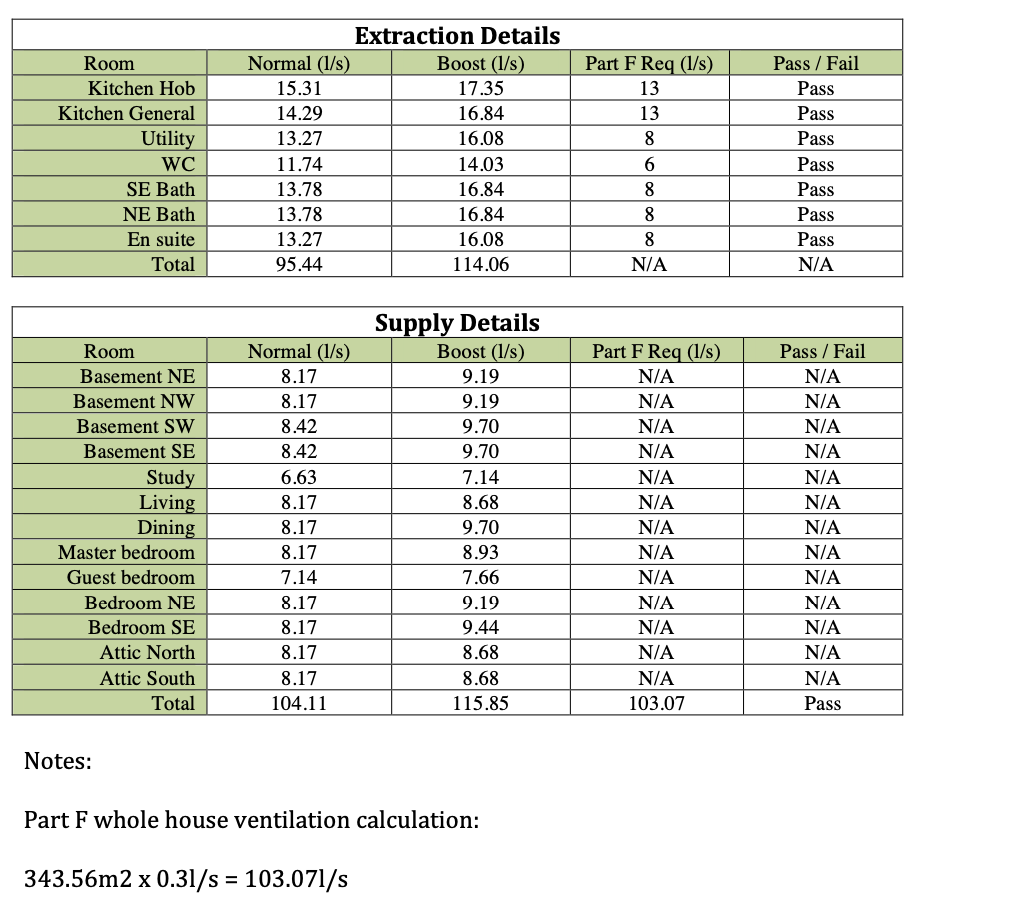
There is a minimum whole house ventilation rate that is presented as 0.3l/s/m2 So, like others, I calculated my total internal floor area in m2 and multiplied it by 0.3. I then calculated the total supply rate in l/s by summing all the flow rates as measured at each supply terminal and tweaked the fan supply speed until it met or exceeded the whole house ventilation figure. From memory, first pass at the default 30% fan speed was about 0.25l/s so I cranked the fan up to 40% and that did the trick. Once that was established, I turned it back down to the 30% comfort level. Note that on my system (like many) the flow control is at each terminal so there is no alternative to running around and measuring each one every time you tweak the unit fan speed. That said, it only took a few hours to do the whole measurement exercise once I'd figured out how to get correct measurements. TBH - this is the last test you want to do as prior to that, most of the effort was tweaking the supply and extract to balance the system (which should remain balanced irrespective of unit fan speed). The extracts were all double ducted so easily exceeded the min extract rates. To summarise, the only thing that BR cares about wrt MVHR is: - has system been properly installed and checked - there is a tick list for this. Includes ensuring system is balanced. - are min extract rates met for bathrooms, kitchens etc? - can min whole house ventilation rate be met? (up to you if you keep these settings or revert to a lower comfort level). This is what I included in my test report to my BC independent inspector.
-
Mvhr official testing
Bitpipe replied to Simon Brooke's topic in Mechanical Ventilation with Heat Recovery (MVHR)
Agree - for me, 'something' was needed to tick the box. Doubt it was ever looked at but it was sound. I just used the numbers in the regs as the target to be hit vs anything that came from the supplier - i.e. min extract rates for kitchen/bathroom, overall balancing of intake and extract and the whole house ventilation rate (which for most of us was achievable but not comfortable - noted required settings and then dialled fans back to comfort level). -
UK Power Networks survey visit; what questions do I need to ask?
Bitpipe replied to Thorfun's topic in Electrics - Other
Usual form is to make sure they split out contestable work i.e. things you can sub out vs them doing it such as trenching, road crossings etc. When I had a similar OR survey, the local guy encouraged me to get my own people to do it as their sub contactors were over generous in their billing. -
When we did our basement excavation it was a hole about 12m x 13m at the bottom (3.5m down) and about 2m wider all round at the top to allow for the battering back. Soil was clay on gravel on chalk so not super stable but it was end of summer in SE England so quite dry. Based on the ground investigation report, the SE specced the hole 'design' but ultimately the excavation was up to the groundworks contractor and it was their crew who were working in the hole. I applied the EPS to the outside wall (at my own risk) and was more than happy when it was all backfilled with clean stone. So I'd leave it to your groundworking contractor - if you install something and it fails... well, you don't want to be in that position.
-
This was our setup. Sparky used fairly big core SWA as the run was long (30-40m) and plan was to re-purpose as garage feed, which worked fine until it got damaged when the drive was laid:) One of those moments you're glad there's a run of duct under the very expensive resin driveway that only has a low voltage lighting cable in and just enough room for a new run of 16A SWA.
-
(wired) Home automation market is a bit cr*p
Bitpipe replied to gc100's topic in Networks, AV, Security & Automation
I've been outed You can take the man out of Derry etc... https://www.thedailymash.co.uk/news/society/man-puts-big-light-on-again-20161012115195 -
(wired) Home automation market is a bit cr*p
Bitpipe replied to gc100's topic in Networks, AV, Security & Automation
I really like the master on/off function and would be great to do that from bedside (especially when teenagers finally come to bed and a passing 747 mistakes our house for LHR T5). Aside from that (and maybe it's just me) I've never really felt the need to tune lighting scenes that much. We tend to have three states in our living area - lights off (daylight), soft lights on (watching TV), big lights on (something has been dropped on floor and needs found). -
I'd expect the value a basement (or any specific element of a development - room in roof, garage, swimming pool etc) delivers to a dwelling is really tied to what function it has, what value a future purchaser places on that function and how it works with the house as a complete design. The overall m2 increase obviously helps but if it costs you a small fortune to build and is a bit of a 'meh' (or worse) to a future purchaser then you won't recoup that investment. On the flip side, if it makes you happy to have a place underground to hide stuff and you can afford it then screw the return on investment and do what you want. Big inherent advantage of a basement is that it can deliver valuable dwelling space on a smaller plot, but only makes a good ROI if the area ceiling values can support that. We have friends who bought a tumbledown cottage in a highly desirable local village but were restricted to maintaining more or less the same footprint and massing. No restrictions (other than cost) on going down and they created an amazing contemporary home and even the significant cost of their basement (underground stream basically flows through their plot to the Thames) the ROI stacked up given relative property values. For many of us on here who have built low energy dwellings, even passive, we're more than aware that our SAP A rating is of little interest (and value) to a potential buyer and may even put them off. Location, street view, aesthetics, nice kitchen, bathrooms and whatever layout is in vogue will ultimately sell the house. I think looking at what dwelling size and property ceiling values your location will support etc is a very sensible way to proceed. Our street has houses that range from £350k bungalows on small plots to £1.5M detached on 1/2 acre. Given our plot is about that size, we could justify a 400mm2 dwelling with six beds & full basement etc as the plot and street value will carry it. Our basement is habitable functional space, occupied the whole footprint and represents about 28% of the whole house floor area ex- currently two teenage dens / tv rooms / music rooms etc plus a gym and a book / craft room (still figuring that one out) plus a 3x2m plant space with all the gubbins in there. We built it for ourselves but given it also acts as the building foundation and complements the other spaces in the house so should add value and appeal to a future buyer if we ever have to. Planners also did not blink, were only concerned with the above ground massing and volume increase. If you're solely using it for 'stuff' you'd put in the garage then I'd think carefully about your ROI. Do you mean plant like MVHR, etc? That may be more of a justification if it keeps other parts of the house uncluttered. Garden rooms (log cabins, shepherd huts and the like) are usually allowed under PD providing they meet the requirements (height, 1m separation from boundary and % of land occupied etc). Do a basement now or forget about it, they are horrifically expensive to retrofit and only make sense in areas (like west London) where the per m2 property values can justify them. Yes, foundation cost would disappear as your basement would take that role. Only a SE, after analysing the ground investigation report, could advise whether a centrally located basement would complicate the foundation and slab design massively. I'd guess the concern would be that your basement box moves independently of the rest of the house, so you'd likely be looking at a raft foundation tied to the basement box so its one contiguous structure. Proximity to neighbours is indeed is a complicating factor (party wall and site logistics) but if you're doing classic foundations in clay then I'd expect you'll hit many of the same issues. What convinced us was when next door had to go down 2.5m when doing a modest side extension and we realised that worst case (we are clay over gravel over chalk) we'd do the same and a basement was really just scooping out the bit in the middle. This was before we discovered raft foundations but they can still need piling if there is risk of ground movement. Think I've covered it all above - no expert other than have done it once and learned as I went BTW, architect thought we were crazy - predicted a damp space, rarely used and a horrific risk of cost overrun. It is warm (no heating), spacious, came in bang on budget and is the feature of the house everyone wants to see. He did admit afterwards that he was wrong and now wonders why everyone doesn't do them
-
We did pretty much everything described above but in our case we were moving supply from the still occupied but soon to be demolished house to a new kiosk and also running power to container / site office and caravan. Kiosk is now jam packed with CUs and fused switches to house and garage, external sockets and drives gate controllers and lights etc. Sadly it's not in an optimal location now we've removed the trees that were behind it (planned to keep them but they died) and have landscaped around it. Just need to plant a shrub either side of it now so we don't need to look at it
-
MVHR condensation drain
Bitpipe replied to Pocster's topic in Mechanical Ventilation with Heat Recovery (MVHR)
My MVHR condensate joins the gas boiler condensate in a chamber pump in basement plant room and is then delivered to foul drain at ground level. Airtightness and cold bridging aside, I know that external condensate pipes are prone to freezing in winter and this is a frequent cause of gas boiler failures. Easy to fix by warming the external pipe if you remember that this is the issue. Question is whether a MVHR would be similarly impacted. -
Get planning first, drawing a basement sized box on your plans will not cost anything. However, you will need to specify any basement elements that connect with the outside street scene such as light wells, exits etc. You should understand from your architect how the basement will meet regs on fire etc - if you do not have an independent exit to street from the basement then you'll need to budget for suppression (i.e. sprinklers) and also plan ventilation in there. Also be clear what it it being used for - or more importantly what it's not being used for (bedroom). Storage is usually a good label I commissioned our SE work after planning but we had a gap while we waited for our old house to sell so it's really up to you. Google, Yellow pages, etc. Groundworkers vary from one man and a machine to large operations and many will take on smaller jobs just to keep plant and staff utilised while the rest are off on bigger jobs. If you're going to be self building a house you'll need to practice this still at finding trades and getting them to want to take your work ? They will take you more seriously when you have drawings and specs they can price off but no harm in understanding basic availability and rough cost (with a million assumptions). Sounds decent enough. Why is your basement so small if your house footprint is so large? That is quite a compact space and you're going to pay a significant premium for it. An equivalent 'garden room' would be a fraction of the cost and not require PP. What is the plan for the rest of the floor and foundation structure? You don't want an isolated box floating around in the ground under your house and not have it tied to anything else structurally. This is why basements usually occupy a significant portion of the house footprint. Also economies of scale. Get your plasn out and work out the party wall calcs - all about intersecting lines at 45 degrees. SE will help you understand what that means structurally - never to early to start talking to a few, should give you a bit of time for free to understand the project and if you can both work together - you also need to know if they have any experience in this area. Remember they never need to come to site so can be at the other end of the country if needs be. That's fine but see other comments above on how useful that will be and how it works with the rest of the in ground structure.
-
(wired) Home automation market is a bit cr*p
Bitpipe replied to gc100's topic in Networks, AV, Security & Automation
We have quite a lot of LED strip, drivers are tucked away in ceiling voids (easily slide out of a 70mm downlighter hole) or fixed in crawl spaces. We've had one or two fail since moving in 4 years ago so want them to be easy to get to. However, would not put them in a cabinet - really don't see what that would achieve. -
(wired) Home automation market is a bit cr*p
Bitpipe replied to gc100's topic in Networks, AV, Security & Automation
In a concession to automation, I bought a Tapo plug (from TP-Link) this week to 'persuade' the teenager's basement TV to go off and a sensible time. Quite pleased with how easy it was to setup - BT from app to plug and then put plug on wifi network, set up schedule etc. Plug is hidden in a media cabinet that has a single mains connection so this scheme is predicated that he does't try and figure out how the magic is happening -
(wired) Home automation market is a bit cr*p
Bitpipe replied to gc100's topic in Networks, AV, Security & Automation
I think there is little choice as there is little demand. Only a tiny fraction of new builds in UK are self build and many of those are turnkey commissioned by clients. The volume builders have zero interest in proper automation, maybe a few niche high end players. I expect the majority of automation demand will be from the retro-fit and based on WiFi and BT vs wired ethernet in the wall so that's where the supply focus and innovation will be. Even though me & the missus are both grad electronic engineers and work in technology industry, neither of us were persuaded to do any automation in our new build as the first fix cabling was an irreversible commitment either way (trad radial vs hub & spoke) and we could only see issues with extra cost, vendor obsolescence, sparing for h/w failures etc. I'd also worry about potential resell issues in the future if your setup is seen as too 'funky'. -
I commissioned a PM very early on in our project - he was recommended by a potential contractor when we were going down the iCF route. Decent bloke and knew his stuff, we paid him £1500 to do a detailed cost plan for both ICF and timber frame options plus a PHPP analysis. This was before we'd discovered this forum's predecessor. He also wanted a % of build cost (thinkand his QS cost projections were at the high end, but thorough. His rational was that he'd 'save' us the cost of his fee through efficient management of the budget. At that point I'd decided to go the TF route and gained enough confidence to PM it myself as the two main works packages (demolition/ basement & timber frame) got me to a fairly advanced stage and it was easy enough to schedule windows, roofing and render while the scaff was up to get weathertight. First fix followed that (already had an electrician on standby) and was not that hard to schedule the finishing trades thereafter. Only work I did myself was MVHR installation and general tidying up really. I consider the money we spent on the PM for that initial planning aspect worthwhile as it gave me confidence and structure to move forward - no doubt I could have got both bits a good deal cheaper if I'd known which way was up at that point A decent QS derived cost plan is essential as you can then use it to benchmark against quotes, track savings and make decisions on over / under spending. I reckon we came in 15-20% under the original plan without changing the spec.
-
If you want a sensible basement quote, talk to local (ish) groundworkers who build underground structures all day long. Not much difference in an underground carpark and a basement other than the finish. They will manage heavy plant, excavation, muck away and reinstatement - likely they will sub out the concrete works and build whatever spec your SE has designed. They will also do all your services work, laying fouls, rainwater, fresh water, ducting for power and plant, site access, etc. A general builder will likely not have underground experience beyond standard foundations, which they may well still sub out to a groundworker. A basement company will certainly inflate the price, most of these firms specialise in basements under existing dwellings which is a different thing altogether. If you have a clear site with decent access, a sound understanding of the underlying ground conditions and a sensible design from a SE then you should be able to approach most GWs for a quote. Make sure BC are happy with design inc. access and emergency exit / fire protection. If you don't have a separate exit from the internal stairs then you will need fire suppression such as sprinklers. Expect prices to increase /sqm if the basement is small, access is difficult, neighbouring properties are close and you have challenging ground conditions such as weak ground, high water table or radon gas etc. When you have the finished basement shell with house on top, you fit it out with the rest of the house. I found very little of the 'domestic' building services (builders, architects etc) confident to deal with basements. However once I tapped into local GWs then I had lots of options. Tip - if there are any large public works going on near you, see who the GW contractor is. But before you do ANYTHING - get a decent ground survey designed by a SE as that will drive all costs as you move forward. Maybe you spend the money and decide you can't afford to proceed but that's better than starting the job and finding nasty surprises that mean you can't afford to finish it.
-
The base of my basement excavation was lined with 150mm deep of 'type 1' - in excess of 20m2. After it was laid and compacted I had a look and managed to fill a wheelbarrow with taps, pipes, wood, cable and other miscellaneous 'stuff' and that was just from the surface. Looks like they just got a load of fresh crush from a local yard - i'd swear the there were probably bits of the original house that was pulled down a few weeks previously in it.
-
Yep, that's what is being proposed. 100m is the specified max run end to end for cat5e (and Cat 6 by the looks of it). Not that expensive - https://www.amazon.co.uk/gp/product/B009U810UW You'll need to consider how to protect the cable from accidental damage though, would not take much of a knock to short the internal pairs. If it's 300m point to point, this does not give you a lot of wriggle room for ducting etc.
-
It was a fun project but i've had quite a few 'weepy' leaks from the IBC pipework and had to replace a few fittings. have drained it again to dry out and try to sort one last stubborn leak. The pump also failed last summer (got a refund) so need something more powerful - I know Jeremy recommended some so will look into that once everything is watertight. Totally agree with @PeterW - not the best solution for something that is large and mission critical such as fire suppression.
-
Can I just say the mega quoted response makes it a bit hard to respond in context but I'll do best! I'm just down the road from Tony in Berkshire, he did the work himself and is very knowledgable so you'd be pushed to get close to his numbers using contractors. Your SE will dictate how the build conditions determine the structure but my understanding is that with clay, you need to keep going down until you hit something solid enough to take the load without future movement. May need piling - SE will tell you. While you need your own customised ground report, you can sometimes find historical surveys logged on the British geological society website and do a guess what you may be on. Not sure what you mean here. Our basement slab sits on 300mm of EPS 200 which extends out beyond the slab edge. Then there is 200mm EPS applied to the exterior of the basement wall. This meets the insulated layer of the MBC passive frame with the load bearing leaf sitting on the top of the basement wall. Our 'wooden floor' is a steel web socketed into 100mm pockets on the basement walls. Between steels are pozi joists. On that is 18mm OSB, glued & screwed. On this is cross laid 12mm and then 9mm marine ply, glued & nailed. On top of this is a rubber crumb and then a poured resin floor. Not creaky. Be wary of using basement space for sleeping accommodation, I think this further complicates either building or planning regs. You'd also need bathroom facilities down there which complicates things. Basement shell - the concrete structure minus any finishes or services inside. Cost of excavated material depends on what it is. If it's easily removable with a big enough machine (i.e. not rock) then the cost is usually per M3. However getting rid of it (muck away) depends on what the Waste Acceptance Criteria testing says (you want inert, anything else is very expensive) and how it bulks up as the 20t wagons are also limited by volume. Chalk is worst (bulks up 3:1), clay is about 2:1 and stone, gravel etc is 1:1 Your contractor will also have to excavate a working area of 1m from the face of the external wall and batter back the sides for stability. This can lead to a very large hole and if close to neighbouring properties you may need to sheet pile. Your spoil may not be suitable for backfill (ideally you want something non compressible with good percolation like large (fist sized) stone.
-
Yes, got quotes for a passive slab - £20k + the groundworks which would have been £5k probably including stone etc - not sure, never priced that side up. So additional basement structure cost was £75k. That said, the suspended timber floor was extra (steel, joists and OSB deck). We could have created a six sided box and probably used the same amount of concrete and steel (as walls would have been 200mm vs 300mm. I didn't mention waterproofing above - another key consideration based on your ground conditions. As we had GW at 6m and the basement excavation was 3.5m we were allowed to just have warrantied waterproof concrete so that was quite cost effective. External tanking membranes or internal pump & sump all add cost and complexity.
-
Deep breath So we decided to have a basement and as the plans evolved it grew from 1/4 to 1/2 to full footprint. Planners didn't blink - represented about 50% extra floor space. As we're in clay / gravel / chalk we anticipated that the foundations would need to be deep anyway (based on a next door's extension, he had to go down 2m of clay) so the cost of the basement structure could be offset against traditional foundations / slab. From a design point of view we originally made it a big open box. Decided on suspended timber floor vs concrete lid as we wanted the basement to be part of the passive envelope and to have wet UFH under the suspended timber. Basement costs are variable and can't be assessed until you have done ground investigation - best if the scope of study is defined by your SE otherwise you may not get key info you need. The ground conditions are the big question - what are you sitting on, how hard will it be to get it out, how much will there be to get rid of (different things bulk up differently) and how will it impact the basement design. Site conditions are next most important -- how tight is your site, how close to neighbours, ease of access to plant etc. If you get PP, your neighbours cannot stop you building a basement, but you will need to respect the party wall regulations. If you are close to their properties, you'll need to take necessary precautions and may have to resort to sheet piling etc which all add ££. Function wise, ours is about 110m2 internally. It's been chopped into four rooms, two are TV /music rooms / dens for the teenagers and the other two are a gym (more boxes than gym kit) and a craft room (full of junk and tools) and then the plant room for MVHR, UVC, power distribution & gas boiler. We were reluctant to put loos etc down there, there is a WC on the GF so not a hardship to come up to use that. We put our old fridge freezer and a cabinet freezer down there and handy for xmas and during the lockdown. Don't want to use any of it for bedrooms per se, but it is classed as habitable space by BC and complies with the necessary fire regulations as it has an independent exit to outside. Cost for the shell was probably £100k - was part of a £120k package for demo of existing and services, fouls etc. Fit out was not that much in grand scheme - electrics, plastering & joinery. We were prepared to defer that if the budget got squeezed but we were ok - economies of scale helped as there are 2.5 floors above the basement that all needed the same. Really happy we did it - gained us 50% extra floor space for maybe 20% additional spend.