

Ed Davies
-
Posts
1674 -
Joined
-
Last visited
-
Days Won
1
Everything posted by Ed Davies
-

No Condensate from MVHR?
Ed Davies replied to Timpal's topic in Mechanical Ventilation with Heat Recovery (MVHR)
Yes, the leap year comment was a joke - I assume that site fails for one day every four years (except…). I don't think it's the forum software; the 301 Moved Permanently redirect comes from waermetauscher.paul-lueftung.de. outlook.office365.com then 404s. -
No Condensate from MVHR?
Ed Davies replied to Timpal's topic in Mechanical Ventilation with Heat Recovery (MVHR)
That link redirects to an office365 URL which doesn't work. It's not a leap year yet so I don't know why. -
AAV: air admittance valve: lets air (and any other fluids to hand) in. Also… AAV: automatic air vent: lets air (but not water) out. If @jamieled wanted either it'd be the second but they wrote “air release valves” which could be AAV(2) or could just be a manual valve opened to let air out until water comes out too.
-
Do you like your kitchen sink?
Ed Davies replied to Bored Shopper's topic in Kitchen Units & Worktops
I take the opposite approach. You can empty the bowl and put it (at an angle) upside down so it drains and will get properly dry after a few hours whereas a sink in daily use never really dries out so is more likely to be a breeding ground for wee beasties.- 71 replies
-
- 1
-

-
- kitchen sink
- kitchen
- (and 1 more)
-
No Condensate from MVHR?
Ed Davies replied to Timpal's topic in Mechanical Ventilation with Heat Recovery (MVHR)
Why would you want humidity recovery like that in the UK? In, say, New Mexico it'd be a really good idea but not here most of the time. -
Do you like your kitchen sink?
Ed Davies replied to Bored Shopper's topic in Kitchen Units & Worktops
Isn't that what washing up bowls are for?- 71 replies
-
- 2
-
-
- kitchen sink
- kitchen
- (and 1 more)
-
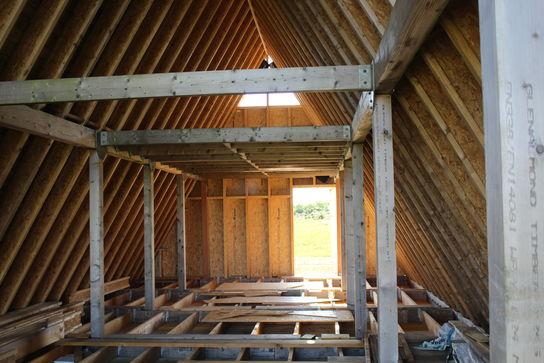
I love the way he walks under the barely fixed beam to get his helmet.
-
New house - trying to understand underfloor heating
Ed Davies replied to RichardS's topic in Underfloor Heating
Could just be that the pump has seized. If it has I think it's probably on its way out and will need replacing eventually but you might be able to get it going for a while: -
New house - trying to understand underfloor heating
Ed Davies replied to RichardS's topic in Underfloor Heating
Following on from @MikeSharp01's question, what sort of heat source do you have (gas or oil boiler, I'd guess)? Is it running? Does it do hot water as well? Is that getting hot? -
It's taken about 3 years for my registration to complete!
Ed Davies replied to DamonHD's topic in Introduce Yourself
Hi Damon, good to see you around again. How have the house insulation retrofit and TRVs gone? -
No Condensate from MVHR?
Ed Davies replied to Timpal's topic in Mechanical Ventilation with Heat Recovery (MVHR)
Any idea what the indoor RH was the first winter? I'm thinking it might have been a lot higher than this winter as the fairly newly built structure was drying out. Also, have you checked what the exhaust air (from the exchanger to the outside) temperature is? Technically it ought to be condensing but not hugely. Rough rule-of-thumb calculation says condensation should start at about 13°C from 22°C, RH 0.55. PS, welcome to the forum! -
Failed septic tank & soakaway - replacement issues!
Ed Davies replied to Caroline E's topic in Waste & Sewerage
Bit like a French drain: pipe with perforations surrounded by gravel or whatever to allow mixing and dilution of waste water with surface water and to generally slow the flow down. Allows a certain amount more treatment of the water as a backup to the treatment plant.- 29 replies
-
- 1
-

-
- septic tank
- soakaway
- (and 4 more)
-
MVHR is Largely Bogus
Ed Davies replied to DavidHughes's topic in Mechanical Ventilation with Heat Recovery (MVHR)
Did it work? 50 Pa is only a head of just under 5 mm (unless I've got the arithmetic wrong). -
MVHR is Largely Bogus
Ed Davies replied to DavidHughes's topic in Mechanical Ventilation with Heat Recovery (MVHR)
@ProDave, what are the pipes taped bottom left of your cardboard? Field-expedient manometer? -
Failed septic tank & soakaway - replacement issues!
Ed Davies replied to Caroline E's topic in Waste & Sewerage
In my limited experience SEPA will want some sort of filter on the output of the treatment plant as a sort of belt-and-braces thing. For me they want a 50m rumbling drain, @ProDave needed a bit less. I'm not sure how that'd work combined with any pumping.- 29 replies
-
- 1
-
-
- septic tank
- soakaway
- (and 4 more)
-
MVHR is Largely Bogus
Ed Davies replied to DavidHughes's topic in Mechanical Ventilation with Heat Recovery (MVHR)
Making a test rig to help find leaks is pretty easy - quite a few people have done it including a few on this forum. Car fan, bit of MDF and some sticky back plastic. Some pressure measurements to compare before and after leakage is a bit harder but quite doable. Getting actual flow rate measurements to a sufficient level of calibration to be confidently comparable between houses or against standards (building regs or Passivhaus) is a bit trickier I think. -
The basics of waste-water plumbing… how many stacks?
Ed Davies replied to Dreadnaught's topic in General Plumbing
Why would you have a stack in the house at all, rather than just AAVs? I'd think saving the roof penetration by keeping any needed stack outside would be well worthwhile.- 10 replies
-
- 1
-
-
- plumbing
- waste water
- (and 1 more)
-
Possibly not a well-founded assumption when they specifically mention Northern Ireland BC.
-
It can, once in a very long while, be useful to have the blade on a hacksaw teeth up, of course.
-
Is that a conservatory from the planning/building regs point of view? I thought they needed more glass in the roof to count.
-
MVHR is Largely Bogus
Ed Davies replied to DavidHughes's topic in Mechanical Ventilation with Heat Recovery (MVHR)
There's a lot more to the perceived temperature than just the actual temperature of the air. Drafts and humidity make a difference as does the radiant temperature of the walls, ceiling, furniture, windows, etc. The radiant temperature is about equally as important as the air temperature so if say, at work you have a large window which is a couple of degrees cooler that'll make quite a difference to how warm it feels whereas at home in the evening you'll likely have the curtains closed at this time of year and feel the effect of the windows a lot less. What confuses me is that they say that higher humidity makes you feel cooler but I'd think the increased evaporation from your skin in drier air would make it feel cooler. Odd. -
MVHR is Largely Bogus
Ed Davies replied to DavidHughes's topic in Mechanical Ventilation with Heat Recovery (MVHR)
My view - the reason Passivhaus requires airtight houses in the first place is to reduce heat energy waste through ventilation in two ways: 1) through not overventilating when it's windy or there's a large stack effect and 2) through recovering heat for the ventilation which is needed to keep the house comfortable and healthy. -
Labour is zero VAT, though. Bit difficult when the labour is offsite: I think the point is that labour done on the house has to be for the particular house by its nature whereas materials supplied could, for all the supplier knows, be fitted to some other house so materials can only be zero VATed if the supplier bolts, glues or whatever the thing in place.
-
MVHR is Largely Bogus
Ed Davies replied to DavidHughes's topic in Mechanical Ventilation with Heat Recovery (MVHR)
OK, so why don't you use trickle vents? Maybe ones like those in Fakro windows which automatically open and close to keep the airflow relatively constant as the wind and stack effect, etc, changes the relative pressures between inside and outside. Even at Fakro list prices they'd be cheaper than MHRV. Because they don't do heat recovery. I was, for a while, intrigued by the sort of passive heat-recovery ventilation used at BedZed (with the wind cowls on the roof) which actually needs a windy location to some extent. I'm still intrigued, to be honest, but it's too out there for a first pass on a self-build. Something to experiment with once the house is built and done, maybe. This is a simple matter of emphasis: I think we're all pretty much agreed that both good ventilation and heat recovery are important, it's just a matter of outlook as to which you think is the reason for a mechanical ventilation system and which is a helpful by-product. Obviously, if you didn't need ventilation at all (e.g., something like Biosphere 2) then there'd not be much point in a ventilation system just to recover heat you wouldn't be needing to lose in the first place so heat-recovery is secondary ventilation in that simple sense. Assuming a ventilation system of some sort is required, though, the question is whether heat-recovery is the main reason for choosing a centralised mechanical one over something more distributed and passive. I think it is. -
MVHR is Largely Bogus
Ed Davies replied to DavidHughes's topic in Mechanical Ventilation with Heat Recovery (MVHR)
That's why I write MHRV, not MVHR which sounds awkward to me. It's heat-recovery ventilation which happens to be mechanical. You can also have passive (non-mechanical) heat-recovery ventilation. A minor advantage of a mechanical system (as opposed to most forms of passive ventilation which tend to be distributed around the house (in windows, etc)) is it's just one switch to turn it off until the neighbour's bonfire has gone out.
