

Ed Davies
-
Posts
1674 -
Joined
-
Last visited
-
Days Won
1
Everything posted by Ed Davies
-
Note, @Charlie, @Charley and @Charly are distinct accounts. ?
-
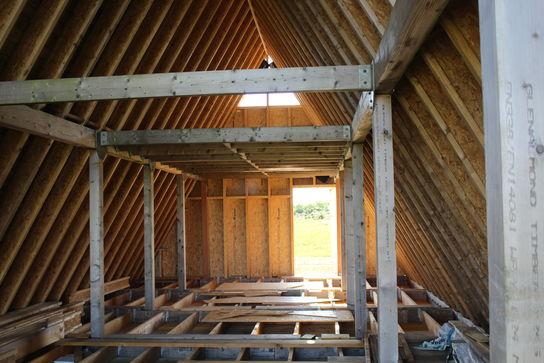
It'd be interesting to know what the temperature of the rafters is. It seems to me that if the loft is only a few degrees cooler than the house then there must be massive thermal bypass of the insulation between the ceiling joists (assuming it's actually there - has that been verified or it just a matter of assumption which can't be checked because of the chipboard?). Most likely that's down to air leakage through the ceiling in which case it seems likely there's warm moist house air in direct contact with chilly rafters which seems like a poor idea. It'd be worth checking the temperatures of the tops of the rafters with an IR thermometer.
-

What's your biggest DIY calamity?
Ed Davies replied to Mulberry View's topic in General Self Build & DIY Discussion
Saturday, 15th of June this year was not a good day. -
One thing about the IM360, though: I bought it for the lithium battery (so less messing around with charging) and on the assumption that by the time I was done with it that'd mean a better resale value. Downside being they use different nail packs as the gas cylinder is different from the IM350 and there are clones of the IM350 packs available at about half the Paslode price but weren't for the IM360. List price the IM360 was more expensive than the IM350 by enough that I wouldn't have bothered except the place I got mine had them on introductory offer at quite a lot off making the actual gun slightly cheaper although by the time I'd bought a couple of nail packs it worked out slightly more expensive. My assumption was that clone nail packs for the 360 would come along eventually. However, since then Paslode have bought out a lithium version of the IM350 (lithium battery but, AIUI, same nail packs as the NiMh 350) so cheaper nail packs for the 360 seem less likely now. Bummer.
-
Dunno anything about blockwork but I've been pretty happy with my IM360. Not used any other type of nail gun for comparison, mind you. It's advertised as being able to drive 90mm ring nails where most others can only manage 75mm ring or 90mm smooth. It does comfortably when it's just OSB or whitewood but they need tapping in the last few mm when there's a significant amount of ply involved.
-
Full Fill Cavity insulation. 0.036 vs 0.032
Ed Davies replied to Triggaaar's topic in Heat Insulation
I'm not sure if that's a typo or a misunderstanding: 0.032 W/m·K is better than 0.036 W/m·K as less conductivity (greater resistivity) is what you want. -
That's for versions of Celotex specifically intended for floor insulation with a deformation of 10% so probably not even remotely applicable to other versions at sane levels of deformation.
-
Depends what you mean by the “North of Scotland” - to me that starts once you're north of Tain but some people think it's everywhere north of the central belt. It seems to me that in general in Highland both land and houses often turn over very slowly. People tend to hang on for a high [¹] asking price waiting for somebody who particularly wants the property to come along. Still, houses turn over quicker than land, I think. [¹] Compared with what the local economy can support, not UK-wide prices compared to which they're still very cheap.
-
When I went to speak to him the highways chap was very helpful about their requirements for doing my access. Their requirements were: a contractor with a minor works licence and appropriate third party insurance and needing to check with Openreach, SSE and Scottish Water that they don't have services there. My experience: SSE were great, they emailed a PDF map of their services in the area the morning after I sent an enquiry. Openreach took a week or two to get somebody up from Inverness with a metal detector thing to check their cable really was buried on the other side of the road. I was there for that survey and had a good chat with the chap about the options for getting a cable to my site. Going via the official channels on their web site Scottish Water were an expensive pain. So I went to their local offices and had a chat with an engineer who brought up their maps on his computer, confirmed that they didn't have any pipes immediately affecting my land or its entrance. We also discussed what would be involved in getting water to my house if I wanted it (I don't) or the other plot I have (which somebody might want water for). Moral of the tale, it's worth going to talk to a) highways, b) Scottish Water.
-
MVHR, solar & heat pumps
Ed Davies replied to Cognis0's topic in Energy Efficient & Sustainable Design Concepts
As has been said, the need for space heating in a passive-like house is small, small enough that it's not worth doing anything complicated particularly if you're on mains electricity (if you're off grid it's a bit more involved). As @SteamyTea mentioned I did look into the trade offs of solar thermal vs PV quite a few years ago. For heating to DHW temperatures in weak sunlight (e.g., low sun in winter) my conclusion was that PV is actually more cost effective than solar thermal. That's not to say that solar thermal isn't cheaper for space heating or cheaper than DHW when you have bright sunshine but if you're designing a system to work well in the worst conditions then the best bet is PV. The prices of solar thermal have come down a bit since I wrote that page [¹] but not as much as for PV. That's purely on a watts/£ of actual panels basis and there are other considerations as well: inverters and pumps ought to be taken into account but they'll probably cancel out roughly speaking but, more importantly, there's the question of excess energy in summer: extra hot water is a nuisance to get rid of and actually potentially dangerous whereas excess electricity can be left in the panel or used for better purposes (e.g., charging a car). For an on-grid house now I'd go for a simple MVHR with no actual heating or cooling beyond the heat exchanger with water UFH. Heating would be either all direct electric (optimized to use the output of the PV panels where that made sense) or from an ASHP. It's right on the edge for the ASHP on cost (against direct electric) purely for heating so it really depends on the cooling requirements. PV panels would be steeply mounted (much steeper than a typical 35 or 40° house roof) to optimise winter generation accepting that that reduces summer generation a bit. If you're badly shaded that would change things of course but I'm assuming the OP isn't. [¹] E.g., the 20-tube Navitron evacuated tube panels now have a VAT-inclusive price about the same as what it was VAT exclusive then. -
https://en.wikipedia.org/wiki/Knapping
-
The DS1920-F5 needs the reader connected to it all the time to get the data - it doesn't have any internal memory (or battery). The DS1921G-F5 thermochron does have some memory (for 2048 samples) and an internal lithium battery (so a limited life, not sure how long as I couldn't find the info in a quick scan of the datasheet). Using that thermochron, for example, you could set it up for a “mission” [¹] with sampling every 5 minutes (so lasting 5 * 2048 / 60 / 24 = 7.111 days) then go round with your laptop every Saturday morning to read them all. On the other hand, at £25 each other solutions might be cheaper and less hassle depending on the power supply available on site. E.g., Raspberry Pi Zeros with DS1820 temperature sensors. Also, consider that an internet connection is not needed for Wi-Fi. [¹] their word
-
No, unfortunately, there isn't a simple conversion. It's not just the volume that matters but also the surface area; the conversion factor will be different for a nice cube-shaped house (low area to volume ratio) or a long thin house (high area to volume ratio) or one with an uneven outline (dormers or the like).
-
Which "m2" do you count, in cost per square meter (sqm)?
Ed Davies replied to puntloos's topic in Costing & Estimating
Wookey, on another forum, was mostly joking when he suggested a house with no windows, just cameras and flat screens, but what you say is only true up to a point. There are lots of reasons for windows: light, outside awareness/aesthetic pleasure, means of escape… but relatively small windows will cover those requirements and it's arguable from an energy point of view that beyond that size PV or solar thermal panels are a better net investment considering the extra heat loss through windows, etc. AIUI, PHPP used as intended doesn't allow you to explore that trade-off. Indeed, a citation is needed. If cost in £ is considered as reflecting cost to the environment then per m² PV panels are cheaper than windows. For net energy harvested, I'm not so sure as that'd be very site and user-behaviour [¹] dependent. [¹] E.g., whether or not insulated blinds are used behind the windows when there'd otherwise be a large heat loss. -
Which "m2" do you count, in cost per square meter (sqm)?
Ed Davies replied to puntloos's topic in Costing & Estimating
Indeed, almost impossible to define sensibly. But it's worth remembering that m² is really just a proxy for people kept comfy. One or two people living in an enormous house is likely wasteful even if it's a creditably low W/m². On the other hand, the W bit doesn't make much sense either. For example, sunlight coming in through a window is counted as free energy but sunlight falling on a PV panel, converted to electricity used to heat water (for space heating or DHW) does count which seems totally arbitrary to me. I get that sunlight in July shouldn't offset electricity in January but sunlight in March which is used instantly shouldn't be included in you W/m² All reasons why getting too precious about which m² count is not overly productive. -
No, pigeon.
-
Which "m2" do you count, in cost per square meter (sqm)?
Ed Davies replied to puntloos's topic in Costing & Estimating
@SteamyTea, I think you want to have another look at your units there. Perhaps W·m⁻² or something. But W/peep would be my preference. -
That's what I have in mind, mainly so that it's easy to make changes like moving lights from one switch to another or putting them on centralized DMX controllers.
-
An additional advantage of a warm roof (vs cold loft) is that it's much easier to make the insulation and airtightness layers continuous at the wall/roof junction.
-
A very useful read. Nothing I found particularly revolutionary but filled in a few gaps in my understanding.
-
On another forum I've seen both “cold loft” and “cold roof” used for the same thing and confusion result, hence my suggested clarification.
-
@Sensus, good explanation, thanks. But something to be clear about: when you write “cold roof” do you really mean “cold loft”? The way I've seen these terms used before: Warm roof: roof where (more than half of) the insulation is above the roof structure (rafters, etc). Intrinsically a warm loft. Cold roof: where the roof structure is on the cold side of (more than half of) the insulation. Warm loft: where the insulation is in the roof (might be either a cold or a warm roof). Cold loft: where the insulation is directly above the ceiling. Intrinsically a cold roof though I doubt anybody would bother to call it that.
-
AFAIK [¹], they're just called 100 mA RCDs. Made for circumstances where the connected kit has lots of capacitance to earth such as inverters and racks of IT equipment. [¹] I.e., not very far.
-
Sure, but wouldn't want the OP to read his manual, see it says 100 mA RCD, and think that's a ludicrous solution for the fixed wiring in a loft or where ever. Of course, 30 mA would be better but 100 mA RCDs are manufactured for good reasons.
-
Dunno about ludicrous - that is (or was - while since I've taken much notice of the subject) a common requirement for PV inverters. It might well be what the OP finds if he reads the fine manual. Doesn't give quite the shock protection that a 30 mA RCD would give but still gives decent protection against supposedly earthed things being at a higher than ideal potential better than no RCD.


