

Ed Davies
-
Posts
1674 -
Joined
-
Last visited
-
Days Won
1
Everything posted by Ed Davies
-

How far are current Building Regs from Zero Energy House?
Ed Davies replied to Ferdinand's topic in Boffin's Corner
That's entirely the problem with this “net-zero” thinking: exporting to the grid does not sequester anything (unless excess power in the grid is used for carbon capture, which it isn't); it might reduce other people's emissions, which is of course a good thing, but it doesn't counteract the emissions you cause at other times. If the country was made up completely of houses just like yours then there'd still be emissions. -
How far are current Building Regs from Zero Energy House?
Ed Davies replied to Ferdinand's topic in Boffin's Corner
12 to 44 ~= 3.67. 1 mole of carbon has a mass of roughly [¹] of 12 grams and 1 mole of oxygen 16 g so 1 mole of CO₂ has a mass of 12 + 2×16 = 44 g which contains 12 g of carbon so 3.67 tonnes of carbon dioxide emissions is 1 tonne of carbon. It's not quite as widespread as kW vs kWh confusion but still pretty common to see people confusing tonnes of carbon vs tonnes of carbon dioxide. Most often, what people call a number of tonnes for “carbon emissions” is actually a mass of carbon dioxide. [¹] ignoring the minor isotopes. The standard atomic weight of carbon is 12.0096 and that of oxygen is 15.99903 g/mol. -
How far are current Building Regs from Zero Energy House?
Ed Davies replied to Ferdinand's topic in Boffin's Corner
Fair enough. But it's not sustainable in that once the carbon sequestered in those trees is “used up” you won't have space for more unless you can find something to do with the wood which keeps it out of the cycle longer term. -
Anybody willing to offer any advice.
Ed Davies replied to Big Jimbo's topic in General Construction Issues
The airtightness is key, I think. The trouble with small volumes is that it doesn't take much of a leak to get a high air-change rate: area proportional to L², volume to L³, etc. Personally, I'd prefer to avoid all combustion in that size space [¹] though I was glad of LPG for hot water and cooking when I was staying in a static caravan during a 36-hour power cut at a time of high winds and sleet showers. [¹] In any size space, really, but particularly a small one. -
Correct installation of Willis Heaters
Ed Davies replied to Jeremy Harris's topic in Other Heating Systems
Big Sunamp to store 30 or 40 kWh. -
But the mantra is fabric first, not fabric always. There will come a point when simply adding more PV to compensate for the losses will be more economical than adding more insulation. Even on the 2G/3G decision it's not completely clear cut though I think 3G is probably the better option for various reasons. PV has a limited life but so do glazing units (for similar reasons). Still, more PV to compensate for winter losses gives you more electricity in summer to charge your car or whatever.
-
What accidents have you had while DIY'ing?!!
Ed Davies replied to mike2016's topic in General Self Build & DIY Discussion
While unloading the steel from my van to the container I tripped over a bit of rope and landed face down gravel ruining a pair of glasses, leaving a cut in my forehead which bled quite copiously and hurting my wrist enough that my GP (who was also the small-fractures specialist at the local hospital) wasn't sure if there was a fracture or not. Fortunately I just had time as as I fell to chuck the bracket I was carrying rather than plant my face on that but didn't have time to get my hands back properly. For the first year working on the house I seemed to cut or bruise my hands pretty much every other day. Since then almost never (touch C24) - probably a combination of getting the hang of stuff a bit better and collecting better tools. -
Correct installation of Willis Heaters
Ed Davies replied to Jeremy Harris's topic in Other Heating Systems
Why would you need to stop the Willis heater short cycling? -
Wow, I see why you're reluctant to buy a replacement until you're confident it's what's needed - those are about 3 times more expensive than I'd assumed.
-
That seems to be somebody's cart with zero items in it but a total of £4961.67 (or their software is particularly flaky when the appropriate cookies aren't present). Anyway, not a blending valve.
-
Right, so we're all agreed that a 60 mA fault current to earth could trip the upstream 100 mA RCD, leaving the downstream 30 mA one untripped?
-
I thought the rated trip current of an RCD was the maximum at which it must trip and typically they'll trip at something a bit more than half that current. So if you had a 60 mA fault current the 30 mA one would be more likely to trip first, I imagine, but it's not guaranteed.
-
If you're heating the extension to normal room temperatures around 20 °C and have any reasonable amount of insulation underneath then the tiles will be within a degree or so of that temperature anyway. They'll still feel cool to bare feet or through socks because of the conductivity of most ceramic tiles. To make ceramic tiles not feel cool like that they have to be noticeably warmer in which case they'll be heating the air and the rest of the room so your air-to-air heat pumps will be a bit redundant (apart, maybe, from quick initial heating if you let the temperature fluctuate a lot). Wouldn't it be better to use less conductive flooring?
-
AFAIK, as long as you like but the thermostat won't be operating (you've overridden it) so eventually the room will get too warm.
-
I'm puzzled by this. AIUI, the test buttons on many RCDs work by switching in a resistor between line on one side of the coil and neutral on the other to create an imbalance in the coil. AFAICS, this should just look like a normal load to any upstream RCD so shouldn't cause it to trip. Is that wrong or are there other ways the test buttons can be wired that really unbalance the line and neutral. Do normal RCDs in consumer units even have an earth connection? Through the DIN rail clips?
-
Trying to install linux on a VERY old laptop
Ed Davies replied to ProDave's topic in Boffin's Corner
You're right - the copied file was a tiny bit smaller according to du though ls showed them the same size. I didn't realise it was actually creating a sparse file on the destination rather than just doing a sparse copy. Root does on its own system but permissions on the network drive will be different depending on how it's set up and authenticated. -
Trying to install linux on a VERY old laptop
Ed Davies replied to ProDave's topic in Boffin's Corner
Because you're running dd under sudo so running as root which might not have permission to access that particular network drive? If it's that then something like: sudo dd if=/dev/sda | dd of=<whatever>/zorin.img would be my first thought. Exactly that would still be copying 120 GB, though. -
Trying to install linux on a VERY old laptop
Ed Davies replied to ProDave's topic in Boffin's Corner
I tried that on a 1GB disk image I have for a VM on my SSD and it came out exactly the same number of bytes which didn't surprise me given what the man page says about conv=sparse. How about just compressing the output? dd if=/dev/sda | gzip -c - > zorin.img.gz The -c switch to gzip tells it to write its output to stdout. The lone “-” parameter means to use stdin as the input file. dd just copies its input byte for byte. When given a block device like /dev/sda it'll do as it's told and just copy the blocks not taking a moment's notice of the file system involved. If you've got a fairly fresh disk (or one you've zeroed before formatting it with the file system) then the empty blocks which haven't been used will be all zero and should compress well. If the disk has had a long and hard life then the unused blocks will still have fragments of old files, directories, etc, in them so won't compress so much. I used dd/gzip on the image file mentioned above: $ dd if=max.raw | gzip -c - > max.img.gz which gave a compression of ~7:1, -rw-rw-r-- 1 edavies edavies 138077740 Jan 28 20:03 max.img.gz -rw-r--r-- 1 edavies edavies 1073741824 Sep 25 2018 max.raw Restore with something like: gunzip -c zorin.img.gz | dd of=/dev/sdb or whatever. The alternative would be some utility which understands the file system and only copies the directories, files, etc. But it would also have to understand the partitioning and copy the partition table with the flags to make the right partition bootable and what have you. Such a utility wouldn't be entirely mad but I don't know of one. But then, I don't know what Partclone is either. -
Also, with a cylinder you can feel the water temperature drop a bit as the thing discharges whereas a PCM store should hold its temperature right up until it's nearly empty, giving you little warning of it not having been recharged.
-
Also, fluorescents are less than a good idea if you have any power tools which which might be moving back and forwards at multiples or sub-multiples of 100 Hz because the strobe effect of fluorescents can make them appear stopped which could lead to an accident.
-
I'd think that was at least part of the problem - making the wall colder but not keeping the water vapour away from it.
-
G3 or G4 filter?
Ed Davies replied to cwr's topic in Mechanical Ventilation with Heat Recovery (MVHR)
Do the higher grades of filter cause significantly more resistance to the airflow? -
@Simon Brooke, do you have a separate control unit or one of the newer Sunamps with the control unit in main box?
-
How far are current Building Regs from Zero Energy House?
Ed Davies replied to Ferdinand's topic in Boffin's Corner
Exactly. If you burn fossil fuels [¹] at all you're not zero carbon unless you're actually sequestering carbon in some way. I don't know anybody who is sequestering much carbon. [¹] including using electricity from the grid as it now is. PS, a net-zero carbon emissions house can easily cause higher emissions than one that's net positive. -
Temporary heat source for UFH: Willis heaters
Ed Davies commented on oranjeboom's blog entry in Kentish RenoExtension
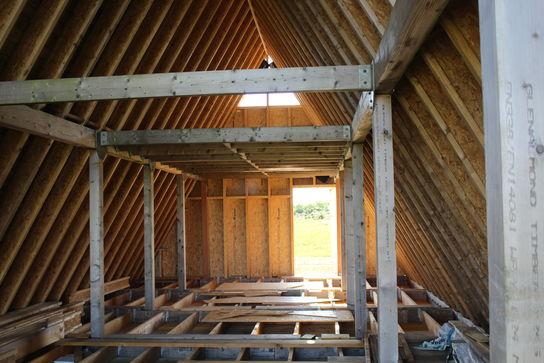
So why did they put the writing on sideways? If you wanted to give people a big hint as to which way round it has to go you'd orientate the writing to match unless, of course, you were a not-very-good industrial designer which is not entirely uncommon. My only interest in this is that I'm thinking I might have a couple of these in the hot water system for my house (largely as PV diversion loads) which will be in the bottom corner of the A-frame on the south side of the house so will have quite a bit of volume available but not a lot of headroom. Mounting the things horizontally would help as you then don't need the extra height to be able to get the element out.

