
Ed Davies
-
Posts
1674 -
Joined
-
Last visited
-
Days Won
1
Everything posted by Ed Davies
-
Yup Another (largish) telehandler I had on site later had just driven up the road from another job where it had moved another 20' container. In that case they hadn't been able to get at the side pockets so put a spreader bar across the top and hung the container from strops off that. IIRC, that one wasn't empty, either.
-

VCL on inside of all insulation or in between
Ed Davies replied to Drew1000's topic in Heat Insulation
By “behind”, do you mean the OSB is inside the house relative to the VCL? Otherwise, doesn't that penetrate the VCL? -
Measuring RH and CO2
Ed Davies replied to MarkyP's topic in Mechanical Ventilation with Heat Recovery (MVHR)
The CDM7160 is the sensor used in my vAir monitor. AFAICS, it doesn't need calibration though the documentation does talk about doing it. £37.90 from SOS Electronic. -
AIUI, these are the same sensor: the Netatmo; there isn't a VentAxia sensor. Max values for the previous week (dotted line) are without mechanical ventilation, Feb 4th (solid line) is with VentAxia MV.
-
Vaillant high(er) temperature ASHP?
Ed Davies replied to Nick1c's topic in Air Source Heat Pumps (ASHP)
It seems to be a mixture of propane and isobutane. -
From the OP's introduction thread they've been in 2 years so change to heating or something could well be the trigger for the change. How about getting rid of the cement render then putting on EWI (external wall insulation) then a more breathable render over that? I.e., if replacing cement render with lime render is practicable then putting in some EWI in between is not that much of an extra step. With thatch I'd think that the extra thickness at the top wouldn't be much of a problem, moving the windows out might be a bit more tricky.
-
That's on the inside of the brick wall?
-
Trying to install linux on a VERY old laptop
Ed Davies replied to ProDave's topic in Boffin's Corner
A genuine error message I have seen: “No keyboard connected, press F1 to continue”. -
Adding a bit more detail for background: on the AC range the meter will sample over the whole waveform and take an average which best represents the overall voltage, both positive and negative. Effectively it squares the individual voltage samples (so both positive and negative come out positive), averages those, then takes the square root. This is called the RMS value: root mean square. Our standard 230 V AC peaks at about 325 volts but the meter shows the average magnitude of 230 V, or whatever, not the peaks or overall average which is obviously zero over periods much longer than a 1/50th of a second. On the DC range it just takes samples and displays those, probably with a bit of averaging so it's likely that the AC will average out to zero.
-
Cool Energy ASHPs'...............any good?
Ed Davies replied to selvbygg's topic in Air Source Heat Pumps (ASHP)
Having read through the manual I think they're separate, too. Yes, that's a puzzle. I think there's some connection missing from the manual somewhere. -
No, I think the SM-1 is just the motor. The list price for the SM-1 is £12, a head will be nearly three times the price.
-
…including the steel box.
-
Solar DHW with UniQ and PV Diversion
Ed Davies replied to DamonHD's topic in Boilers & Hot Water Tanks
I think what you're looking for is the house's thermal time constant. -
Design of offgrid provision for Elec/DHW/CH
Ed Davies replied to Rendall's topic in Boilers & Hot Water Tanks
Which is cheaper, a spare hydro turbine and misc repair materials for the penstock, etc, or an oil boiler and tank? A spare turbine on a shelf in a dry room needs less servicing than an oil boiler that's not being used much. It can also be 26 kW because, sadly, lots of people use BTU to mean BTU/h. -
Cool Energy ASHPs'...............any good?
Ed Davies replied to selvbygg's topic in Air Source Heat Pumps (ASHP)
There's that dashed connection of some sort between the remote programmer and the heat pump itself. I'd assume that's representing a pre-wired multicore cable giving more nuanced control over the HP. If the two programmers on opposite sides of that diagram are actually the same thing then it's pretty easy for it to do all the temperature setting, etc. The “interlock” connection would then just be signalling to the HP that the zone valves have operated properly (or, at least, that one of them has). -
Cool Energy ASHPs'...............any good?
Ed Davies replied to selvbygg's topic in Air Source Heat Pumps (ASHP)
So you have to synchronise the programmer's own timer with the main CH/DHW programmer or are the programmer/timer on the left of that diagram and the heat pump 24 hr remote programmer on the right the same thing? If the second that's a pretty misleading diagram. It's quite poor anyway: e.g, I'm only guessing but I doubt the cylinder stat, etc, are in the wiring centre. -
Measuring RH and CO2
Ed Davies replied to MarkyP's topic in Mechanical Ventilation with Heat Recovery (MVHR)
That's only some folk. -
Measuring RH and CO2
Ed Davies replied to MarkyP's topic in Mechanical Ventilation with Heat Recovery (MVHR)
3000 ppmv, ouch! I've said it before on here but I'm a bit sceptical about those MH-Z19s as they calibrate by assuming that the CO₂ will go down to 400 ppmv at regular intervals. I'm not sure that assumption is sound. Here's the CO₂ level in my bedroom since the beginning of November. I was away for a long weekend at the beginning of that month and the CO₂ did get down to about 410 ppmv then but hasn't really done so very often or for long since. You can turn off that calibration (the HA software referenced above does that) but then you need to take it outside once in a while to calibrate it. I'm not sure how long a while is OK and what effect temperature has on that. Assuming 400 ppmv as the baseline is not something which is likely to be valid long term, either. My data was measured with a vAir monitor containing a CDM7160 sensor which, AIUI, is similar in principle to the MH-Z19 but has a separate internal path through a calibration chamber to compare against.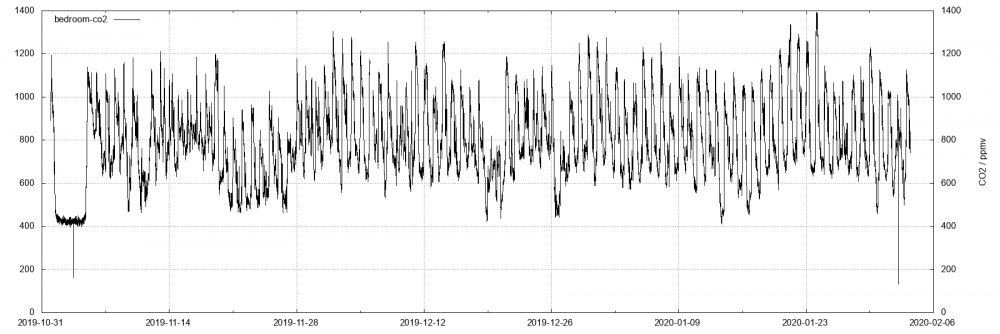
-
ASHP questions about install and costs of 'bits'
Ed Davies replied to Roz's topic in Air Source Heat Pumps (ASHP)
Ah, yes, not just inhibitor. -
Smoke/heat alarm for large kitchen?
Ed Davies replied to MJNewton's topic in Electrics - Kitchen & Bathroom
As in combined heat and smoke detectors? -
ASHP questions about install and costs of 'bits'
Ed Davies replied to Roz's topic in Air Source Heat Pumps (ASHP)
Why? I'm not sure what the point of the coil is in this case, you could just as easily pipe directly into and out of the tank. I suppose it might save on inhibitor, though. More significantly, directly connecting the heat pump to the manifold allows immediate heat to the UFH when the system is starting from cold. Only when the demand from the UFH drops off would you then allow the HP to keep running and heat the tank avoiding short cycling. That way you don't need to keep the tank hot throughout the heating season; particularly in the shoulder months you can allow it to cool off during less chilly spells when there's less need for the UFH. -
Ages ago I was browsing around about photosynthetically active radiation (the bits of the light spectrum which plants use for growth). There was one site which was being very specific about how the red and blue bits had different effects which I thought was odd as surely it'd depend on the species. Took me a while to twig that they only had one species in mind. Well, it didn't say that anywhere, did it? ?
-
ASHP questions about install and costs of 'bits'
Ed Davies replied to Roz's topic in Air Source Heat Pumps (ASHP)
Wouldn't Octopus Agile be better with something a bit more sophisticated than a timer? Obviously, just keeping out of the evening peak would go a long way but it'd be a bit disappointing to heat your DHW or slab in the night if the wind's going to build up and the price is going to go down the following morning. -
Neat integrating the bench like that.
-
How far are current Building Regs from Zero Energy House?
Ed Davies replied to Ferdinand's topic in Boffin's Corner
Right. But better to not call it “sequestering” at all. There's already enough muddled thinking about all this offsetting stuff. It's easy for a net-positive emissions house to cause less emissions than a net-negative one but many would assume otherwise.