
Ed Davies
-
Posts
1674 -
Joined
-
Last visited
-
Days Won
1
Everything posted by Ed Davies
-

How does Carbon Dioxide increase global temperatures?
Ed Davies replied to SteamyTea's topic in Boffin's Corner
Nope, it's the same distance as always, on average. Yes, maybe agriculture caused a bit of warming though I'd like to see some references that say it was due to methane rather than carbon dioxide. It's controversial whether or not the next dip in the Milankovitch cycles would cause an ice age. The consensus now is that they won't for quite a while: https://en.wikipedia.org/wiki/Milankovitch_cycles#Present_and_future_conditions “Earth's orbit will become less eccentric for about the next 100,000 years, so changes in this insolation will be dominated by changes in obliquity, and should not decline enough to permit a new glacial period in the next 50,000 years.” Most importantly, our current CO₂ emissions are way greater than anything needed to hold off the start of any new ice age for quite a while. -
How does Carbon Dioxide increase global temperatures?
Ed Davies replied to SteamyTea's topic in Boffin's Corner
Sorry if you got the impression that I meant that was the main mechanism but it is part of what happens. If there were no greenhouse gasses in the lower atmosphere there would still be the greenhouse effect as heat would be transferred to the layer of greenhouse gasses in the upper atmosphere both by direct radiation from the surface and via convection and conduction in the otherwise transparent layer of gasses in the lower atmosphere. Look at it another way: the effective radiative temperature of the Earth as seen from space (e.g., an astronaut on the Moon pointing their IR thermometer at the Earth) is set by the amount of solar radiation absorbed by the Earth (in turn derived from the solar “constant” and the albedo of the planet as seen from the direction of the Sun) and the emissivity of the effective radiating layer in the atmosphere (which is smeared out in height due to radiation randomly making it past higher layers and being of wavelengths which aren't absorbed so much, including wavelengths which are directly radiated to space from the surface). The temperature of the surface is then set by the temperature of that effective radiative layer increased by the effects of the lapse rate below the layer down to the surface. My point is that the effects of adiabatic cooling dominate in determining that lapse rate and radiation backwards and forwards between layers in the lower atmosphere is a secondary consideration. Nope, remember that the emissivity of a material is equal to its absorptivity, you can't have one without the other. Professor Mike Merrifield is probably better at explaining this than, particularly with the advantage of animations and gestures. -
How does Carbon Dioxide increase global temperatures?
Ed Davies replied to SteamyTea's topic in Boffin's Corner
That's true as far as it goes but such a tiny part of the story that stating it like that is wildly misleading, so it's a pity it's such a widely used explanation. The dominant mechanism for heat transfer up through the lower atmosphere is by convection of sensible and latent heat. This can be seen because the lapse rate (the rate at which temperature decreases with height) is set by the dry or wet adiabatic lapse rates (i.e., the rate that dry or saturated air cools with expansion). Eventually the heat transferred up from the ground has to go somewhere and, because space is pretty good at stopping convection and conduction, it has to go by radiation. It does this by being radiated from greenhouse gasses from fairly high up the atmosphere. Obviously radiation to space happens from all sorts of layers but it's helpful to think of it just radiating from one average layer. As the concentration of greenhouse gasses in the atmosphere increases this effective radiation layer rises in the atmosphere though stays at the same temperature to maintain the constant radiation power. There's now more atmosphere below it for the adiabatic lapse rate to work over so the surface temperature increases. This way of looking at it was first published by Nils Ekholm in the Quarterly Journal of the Royal Meteorological Society in January 1901 in a paper titled “On The Variations Of The Climate Of The Geological And Historical Past And Their Causes”. -
AFAICS, we can generate plenty of electricity without messing up the world too much but with the snag that its availability is hugely more variable which will need mechanisms at all sorts of levels to even out. E.g., batteries, grid to gas to burn in power plants for times when it's not windy. But that sort of thing is expensive and inefficient so it still makes sense to modulate demand as far as possible to match the cheaper generation. Again, this can be done at all sorts of levels but still domestic demand for heating and BEVs, etc, can often be time shifted to help. So, there needs to be a mechanism to signal to households when to use electricity for various purposes and when not to plus a motivation for them to take notice of this signal which can either be some sort of a legal requirement or via price. We get to chose.
-
Funny how we have a society which is obsessed with doing things through ”the market” which can't get a grip on the idea of deciding when to move energy around based on a market.
-
They know today what the wind will be doing on February 25th?
-
Known to whom? How is it known?
-
How does that help if you don't know when to buffer? What would your motive to buffer be if electricity isn't cheaper when there's more to spare? The simple notion that electricity is cheaper overnight won't work if a substantial portion of the supply is coming from variable sources. Last night electricity might have been a lot more expensive than tonight, partly because of increased new year consumption but also because tonight is forecast to be windier than last night (at least at this end of the island, maybe different at the south end).
-
How does Carbon Dioxide increase global temperatures?
Ed Davies replied to SteamyTea's topic in Boffin's Corner
Yes, it's well understood that water vapour is a greenhouse gas and causes a bit more than half of the existing greenhouse effect, depending on how you count. What's there to get out of, exactly? -
E7 was created on the assumption of fixed generation capacity and simplistic variation in demand: nothing more sophisticated than time clocks. That's history so E7 is doomed. What we need to do is vary demand to match available generation as far as possible. It's reasonable to have doubts about the current implementation of smart meters but something of the sort is necessary.
-
Simple calculation says 60 TWh/year is 6.9 GW or 105 W/person. It's not so simple to work out increased generation capacity needed as it's hard to say how well BEV charging would fill in low points in demand. Optimistically, it could be as little as 0 extra generation capacity needed with good use of smart meters, etc. Whatever, in the grand scheme of getting rid of fossil fuels it's a relatively minor blip.
-
For you I'd think some verbal agreement would be sufficient. If I was the neighbour, though, I'd get something in writing, just an email or whatever, about not damaging anything or putting right any damage done. When I was about 6 or 7 the “new” house in this row was built. We lived in the house immediately down hill of it. My parents gave their builders permission to put up scaffolding in our garden so long as they didn't damage any of the plants. First thing they did was cut a big bush almost down to ground level. Caused a lot of ill feeling though we were eventually friendly enough with the people.
-
How does Carbon Dioxide increase global temperatures?
Ed Davies replied to SteamyTea's topic in Boffin's Corner
Yep, amazing how people who take no interest in the subject for decades can suddenly know better than 10s of thousands of scientists almost any of whom could disprove an important theory with a simple lab experiment on a Friday afternoon but for some reason none of them do. In a similar discussion in the past I just said I wasn't sure of the details but thought it was all to do with molecules having three or more atoms being able to bend and rotate in modes in that matched that general frequency range. It seemed sufficient then to allow us to move on to more interesting topics. Or you could invite them to breath air with the “tiny proportion” of 270ppm hydrogen cyanide gas. -
How does Carbon Dioxide increase global temperatures?
Ed Davies replied to SteamyTea's topic in Boffin's Corner
Surface pressure is about 100 kPa (1000 hPa = 1000 mbar). So 1 m² of surface has 100 kN weight of gas above it or about 10.2 tonnes mass. Ignoring the trace gasses and odd isotopes and rounding a bit for easy arithmetic it's made up of 20% O₂ with a mass of 32 g/mol and 80% N₂ at 28 g/mol so an average of 28.8 g/mol. Over a m² there will be 10.2 t / 28.8 g/mol ~= 354167 moles of gas. CO₂ currently makes up just over 410 ppmv of the atmosphere so 354167 × 410 / 10⁶ = 145.2 mol/m². One mole of an ideal gas has a volume of about 22.71 litres at standard temperature and pressure so that's equivalent to a layer of 3297 litres/m² or one 3.297 metres thick if you could persuade all of the CO₂ molecules to move together to the bottom of the atmosphere at one time. I'm in awe of anybody's physical intuition to tell if that's significant or not. John Tyndall showed it was in the 1860s and if anybody's proved any different since you can probably find them quickly enough by looking in the list of Nobel prize winners. -
Ah, yes, good point. But maybe the granite is more emissive so a) loses more heat to the window but b) appears slightly warmer to the IR thermometer. Try measuring the surface temperatures with a bit of masking tape or something on them. Once you start measuring closer than about +/- 1 °C the notion of “room temperature” gets quite slippery.
-
Well, yes, that was the first thing that came into my mind: is the position on the granite worktop closer to a window?
-
How does Carbon Dioxide increase global temperatures?
Ed Davies replied to SteamyTea's topic in Boffin's Corner
What, exactly, don't people believe? Why would it be any more surprising that some gasses are transparent to thermal IR but other gasses tend to absorb it than it is that steel is opaque to visible light but glass is transparent? This video might help. Edited to add: if people don't believe in the greenhouse effect at all (never mind the human influence on it) then get them to explain why the atmosphere gets cooler with height. If there's no absorption or emission of thermal radiation by the atmosphere, and particularly, no emission from the upper atmosphere to space then a simple 1-dimensional model would result in the whole atmosphere quickly reaching the same temperature and convection stopping. The real world has differences in elevation, surface absorption and, most importantly, latitude so there'd still be advection and convection going on but it would be very different from what we actually see. -
Switchable power to every room?
Ed Davies replied to puntloos's topic in Networks, AV, Security & Automation
A figment of a confused imagination. As is a “lighting ring” (usually). A final circuit is typically either a radial or a ring. Rings are so common though that many refer, incorrectly and potentially confusingly, to all circuits as rings, even when they're not. E.g., lighting circuits are typically radials but often referred to as rings. -
How does Carbon Dioxide increase global temperatures?
Ed Davies replied to SteamyTea's topic in Boffin's Corner
It can be either. For short-wave radiation (UV, visible light, near infrared) I think it's mostly a matter of bouncing electrons between energy levels in the shells around the nucleus so “within the atoms” whereas for thermal infrared it's more about making various modes of the molecules vibrate. Short-wave is a lot shorter wavelength than thermal IR. Visible light centres around about 0.5 µm wavelength whereas thermal IR in the atmosphere is nearer 10 µm. Energy is proportional to frequency and frequency is inversely proportional to wavelength (in mediums like a vacuum or air where it's not slowed down much) the ratios of the photon energies are something like 20:1 so it's not surprising that the behaviour is so different. -
How does Carbon Dioxide increase global temperatures?
Ed Davies replied to SteamyTea's topic in Boffin's Corner
CO₂ (subscript) I'm a bit vague and hand wavy about this, too. First search result for “co2 radiation absorption” seems a reasonable place to start: https://scied.ucar.edu/carbon-dioxide-absorbs-and-re-emits-infrared-radiation linking to https://scied.ucar.edu/molecular-vibration-modes -
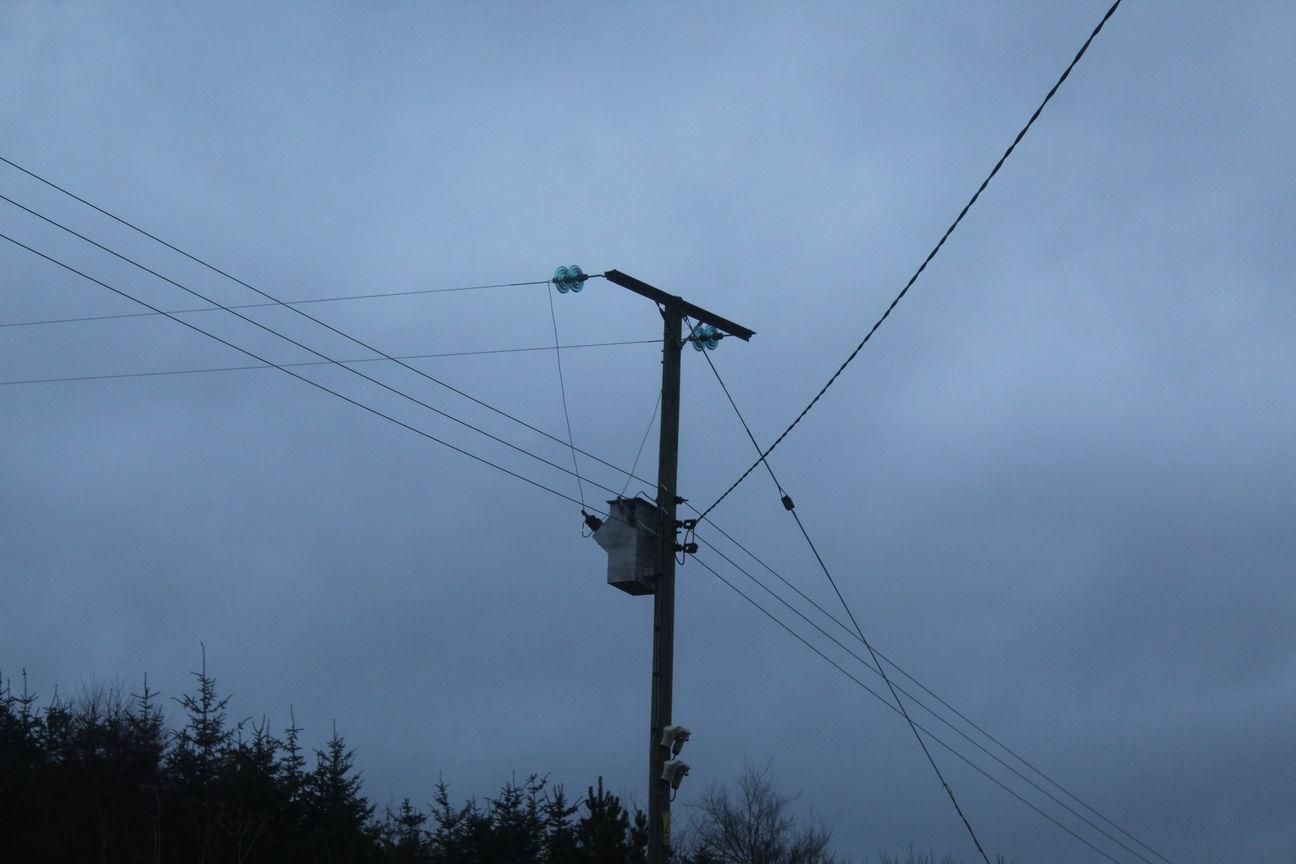
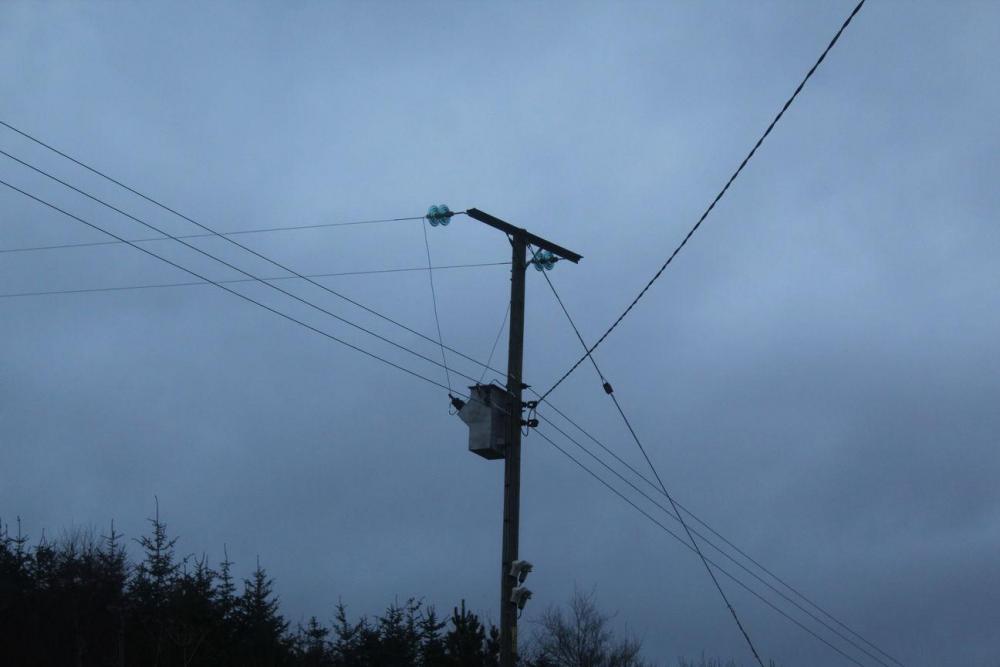
I think this could be misleading. Here's the transformer outside the kitchen window of the house I'm renting with the single-phase supply into the house. I think what's happening here is there's a single-phase 11 kV supply coming down the hill (tapped off 3-phase the other side of the main road). This is transformed down to LV (230 V) and put on those three wires going horizontally along the back of the small row of houses here. My supply then taps off the lower pair of those. Given that the input is only single phase there can't, I don't think, be proper three phase on those three LV wires. I suspect it's a 230-0-230 V setup (i.e., two phases 180° apart). You could also label it, I imagine, L1-PEN-L2. I also assume the two blobs further down the pole, just above the line of the trees, are the isolators for each of those phases.
-
Switchable power to every room?
Ed Davies replied to puntloos's topic in Networks, AV, Security & Automation
Had a frantic couple of days [¹] earlier in the month trying to work out why my background energy consumption had increased from about 22 W to about 30 W. Tried switching all the circuits off and unplugging things. I was just on the point of popping up to my site to get my generator so I could run my CurrentCost meter “off-grid” to make sure it was not itself consuming the extra power when I thought to check the alkaline cells in the sensor box (current transformer clipped round a meter tail). Indeed, they were down to 1 volt each. New cells, all reading sensibly again. In retrospect I should have noticed the apparent power consumption of the shower creeping up from a bit over 7 kW throughout November. [¹] I exaggerate slightly - more like dabbing at the problem on and off for a week or so.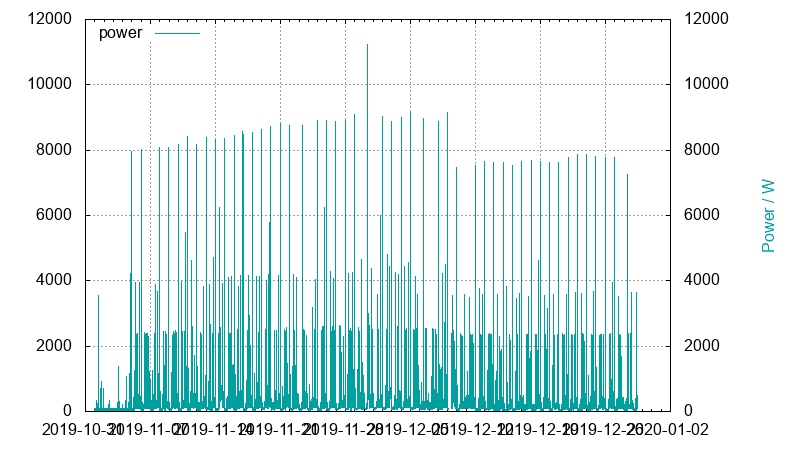
-
Normally gasses come out of solution in water when the water is warmed (i.e., warmer water holds less gas). However, I suspect they come out on freezing as well. Salt (partially) comes out of solution on freezing; sea ice is a lot less salty than the water below it.
-
Indeed, but, just in case anybody gets the wrong idea, you do need to tell the owner you're applying for the permission (or at least you do in Scotland but I think it's UK wide).
-
No Condensate from MVHR?
Ed Davies replied to Timpal's topic in Mechanical Ventilation with Heat Recovery (MVHR)
When the outside air is cold and dry (low RH) an enthalpy recovery exchanger will do noticeably better. When the outside air is near saturation anyway a standard exchanger with condensation happening will do nearly as well, won't it? If not, why not?