
Ed Davies
-
Posts
1674 -
Joined
-
Last visited
-
Days Won
1
Everything posted by Ed Davies
-
We've had previous discussion of using PV panels in roof as a replacement for tiles or slates but I wondering about using them on a wall in place of the cladding. Currently the wall is JJI timber I-beam studs and dwangs (noggins) with 9mm OSB3 over. Next calm days, if ever, I'll put Protect TF200 Thermo breathable membrane over that with staples and 38x12 counter battens. According the planning permission I was going to put a site-built low yield solar thermal collector over those (deliberately didn't specify whether that meant warm air or warm water - hadn't decided then) but with the price of PV coming down I was having second thoughts about that even at the time the PP application went in and now I'm pretty sure that extra PV (beyond the planned ~6 kW PV and 6 or 8 evacuated-tube solar thermal panels on the roof) would be a better bet. I'm assuming this will be easy to organize as a non-material change to the planning permission, together with a couple of other tweaks found along the way. The wall in question faces a bit north of east compared with the main roof which is a bit east of due south; the idea is that the extra PV might well pick up early morning sun before sea-air has clouded out the main roof. Probably pretty useless in deepest winter, when the sun's way south all the time it's up, but a helpful addition in the shoulder months. @ProDave might well have a source of cheap panels which would be good for this application, the main issue being getting them to the Highlands economically. Anyway, what I'm wondering about is the mechanics of using the panels as cladding, particularly sealing between them. Though the wall would be exposed to driving rain the glass-fibre in-roof trays seem like overkill for this application, not least because the trays are about as expensive as the panels. What I'm thinking is a second layer of membrane immediately behind the panels (over the counter-battens and battens) then Compriband between the panels and between them and the infill T&G timber cladding in the corners of the wall. Maybe something a bit stiffer which wouldn't be affected by wind so much? Thoughts?
-

DIY Heat Exchanger
Ed Davies replied to Onoff's topic in Mechanical Ventilation with Heat Recovery (MVHR)
Just caught up on this thread. A few posts here are a bit concerned with the conductance (thickness and/or conductivity) of the separator material. My conclusion is that typically the resistance is dominated by the boundary layer resistance so the material doesn't matter all that much: https://edavies.me.uk/2014/03/mhrv-area/ , the hard part is making the area large enough in a compact and cheap way. -
ASHP it is then . . .
Ed Davies replied to canalsiderenovation's topic in Air Source Heat Pumps (ASHP)
ASHPs are PD in Scotland (Class 6H) though the conditions are worth checking: “MCS Planning Standards or equivalent standards” whatever that means. https://www.gov.scot/publications/guidance-householder-permitted-development-rights-9781780456836/pages/8/ 6.19 -
Mini-splits are used as the primary heating source in a number of new-build well-insulated houses in North America, particularly in the NE which is a lot colder (though sunnier) than the UK in winter. In the US NE, of course, their ability to cool in the summer is more useful than it is most of the time in the UK. It's something I'd seriously consider for an on-grid UK new build apart from the point that they don't help with domestic hot water which tends to be a significant portion of the heating requirement.
-
Exactly. AIUI, BCOs got to know individual door closers as they moved from house to house being signed off.
-
Don't think so. It's described as “width (mm)” and they look like they're supposed to go in fairly thin sheet metal, not something 20mm thick or whatever.
-
Oh, useful, would be handy to replace the lock on my post box which is a PITA to open sometimes. What does the dimension refer to, the hole size or the length of the cam?
-
But normally you'd put the pump, if one's needed, after the accumulator, wouldn't you? If so, would you have to have something to stop the pump running when the accumulator is empty, to prevent sucking the mains input then?
-
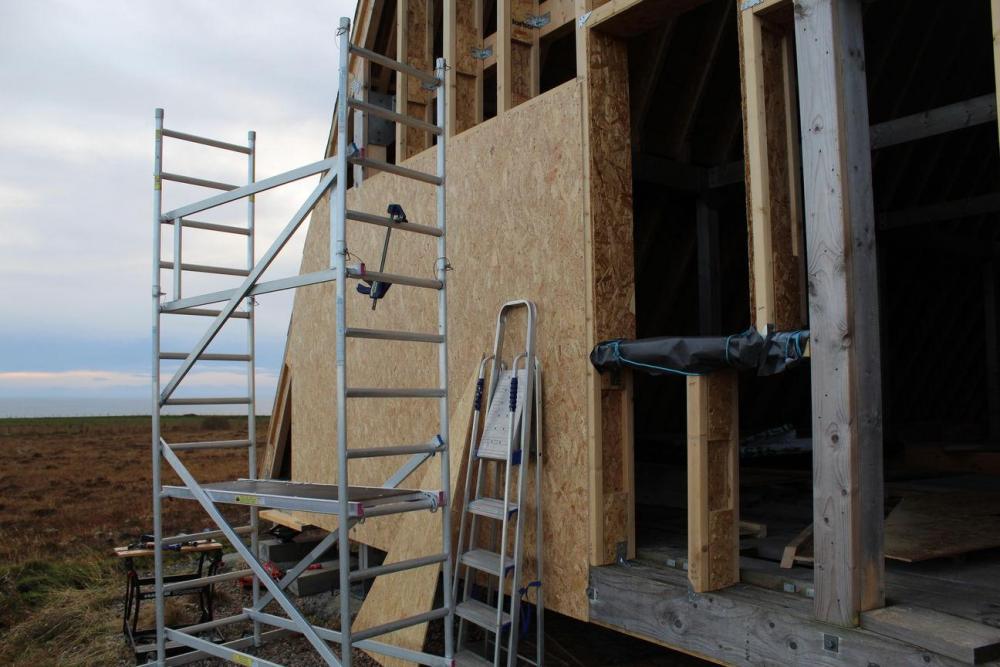
As @joe90 but aluminium scaffold tower. Deck at any height from just off the ground to 5 metres in increments of 250 mm. Handrails both sides at height, usually just one side as convenient when low down. Decks have a trap door to climb up through when high up but when low down (metre or so) it's easy to just clamber on or step off a step ladder holding on to the scaffold itself. Set up a bit oddly but only photo I have of it with the deck at one metre attached. The posts are each a one metre section on top of a two metre section. The top one metre is only really there 'cause that's how I'd had it set up earlier.
-
What do people have their thermostats set at?
Ed Davies replied to Pete's topic in Underfloor Heating
? It's a rental house which I really hope this is my last winter in it. I've had a quick scan through the EPC and I'm sure the estate office would let me have a copy if I asked but I doubt the assessor had any better idea of the insulation and actual U-values that I have (i.e,, very little). I'm doing monitoring for short-term comfort at minimum cost (oil burn) and to have tools to hand for tuning when I move into the house I'm building. -
What do people have their thermostats set at?
Ed Davies replied to Pete's topic in Underfloor Heating
Wot @TerryE just sed: if one room's at 21 °C and 50% relative humidity and another room is at 11 °C then any air that filters through from the warm room to the cool room will just about reach its condensation level. Rough rule of thumb: the equilibrium vapour pressure doubles (halves) for each 10 °C increase (decrease) in temperature.- 23 replies
-
- 2
-

-
- heating
- thermostat
- (and 1 more)
-
This is something I've wondered about, too. Anybody?
-
What do people have their thermostats set at?
Ed Davies replied to Pete's topic in Underfloor Heating
My bedroom temperature drops more than that overnight without the heating on and is clearly on the way further down when the heating comes on in the morning, but then even a well-built Victorian or Edwardian (not sure) house is not likely to compare well against a modern one. More interestingly, any idea if your house had stabilised at that temperature or was still cooling? I'm guessing that any bright days would have kept it at something not far below that temperature just by solar gain alone. -
What do people have their thermostats set at?
Ed Davies replied to Pete's topic in Underfloor Heating
This is for the house I'm renting during the build, not what I'd choose for myself. It's an oil boiler direct to radiators. DHW is from a conventional vented cylinder. My landlord had the oil boiler replaced in the summer and the system was converted then to S-plan: two zone valves, one for the CH and one for the DHW indirect coil. The programmer is set to heat the DHW cylinder for an hour or so in the late afternoon and generally does so in half an hour. That gives plenty of hot water for the washing up in the evening and general washing evening and morning. The shower is electric (presumably to get mains pressure) so, except for the occasional bath, there's always more than enough hot water. Graph of relevant data for Friday and Saturday attached. Room temperature (red) on the left hand scale. All other variables on the right hand one (arbitrarily labelled humidity). Humidity is percent RH, power (pale blue/cyan) is in hundreds of watts (so the two big spikes just before the midnights are my showers, 7 kW electric shower). Boiler state is derived from the temperature of the radiator (so doesn't include DHW heating). It it were my house I'd add a couple of relays hung off the wiring centre to monitor the calls for heat by the CH and DHW tank but don't want to mess with my landlord's wiring. The blibs of power overnight and while I'm out are the fridge running. Sometimes the power monitor picks up the start current spike from that. When the heating is stabilised the boiler just runs for 15 minutes or so in each hour to a fairly regular pattern, controlled by the living room thermostat. When it's cold and windy the runs get closer together. When I've left the heating off while I'm out or overnight it initially runs continuously for 20 minutes then, once the circulating water is all up to temperature, short cycles for a while till the living room thermostat stops calling for heat. What's not obvious from just eyeballing the graph is how much is actually saved by letting the house cool down overnight and while I'm out then heating it back up. Just looking at the graph it seems like it's a bit of a wash hence my attempts to measure more accurately. Intuitively, any time the house is cooler it should be losing heat more slowly so the net amount of heating should be less but I speculate that there are other factors which mean there's less difference than you might expect.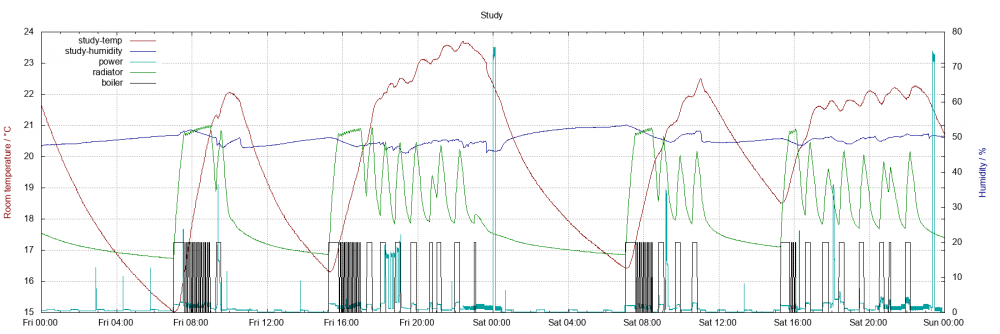
- 23 replies
-
- 1
-
-
- heating
- thermostat
- (and 1 more)
-
If you haven't already, I'd recommend you read this blog post and the comments below it: Testing, testing. PS, welcome to the forum!
-
What do people have their thermostats set at?
Ed Davies replied to Pete's topic in Underfloor Heating
My preference when sitting still is anywhere between 21 and 23 °C. That's wearing a thickish sweatshirt and a pullover. I keep to that in the spare bedroom which I'm now using as a study, the rest of the house is at various cooler levels though the bathroom's about the same. The kitchen is usually a bit less than 18 °C which if fine for cooking and eating. Bedroom surfaces are various temperatures from about 14 to 17°C. I don't use the main living room except for storage, and only have one of the two radiators in there turned on, which makes temperature control awkward as the main thermostat is in there. I'm doing a little experiment to compare running the heating on a timed cycle vs running it continuously (just letting the thermostat do its thing). Mostly I've had it timed to run from 07:00 to 23:00 then switch it off manually when I go out but with it set to switch itself on again late afternoon. Did a week of continuous the week before last and this afternoon set the programmer to do it again for this week. Comparing just that one week of continuous with the rest of November so far there's no obvious difference. It'll need comparing against the weather, of course. Quick plots showed little correlation with outside temperature but a bit more with wind. I'll need at least a few more week's of data and some thinking about how to deal with “windchill”. -
But, he just wants to switch a light off. ?
-
It'd be excess carbon dioxide (or other trace gases) rather than lack of oxygen you'd notice. Two reasons: 1) there's quite a lot of oxygen in the air compared with other gases, except nitrogen, so respiration will make a huge proportional increase in CO₂ for a tiny proportional reduction in oxygen (e.g., the human race has increased the proportion of CO₂ in the Earth's atmosphere by forty something percent but only made a barely measurable decrease in the amount of oxygen present) and 2) human bodies are very poor at detecting a lack of oxygen anyway; we just didn't evolve the need for it. The feeling of gasping for breath when holding your breath is due to excess CO₂ in the blood and lungs, not lack of oxygen. The second of these is why anoxia on aircraft or up mountains is so insidious; it causes no real sensation other than that you do silly things, fall asleep then die. There are secondary clues like fingernails turning blue but you'll probably miss those because anoxia is interfering with your judgement to start with. It's why they say to put your oxygen mask on first before helping others in an aircraft depressurisation (“pick your favourite”) as otherwise you're likely to not help the other person or yourself while still thinking you're doing OK.
-
Indeed, while @Onoff was posting I was failing at web search for 3 A outlets. What are they? But when you say these outlets are switched, do you mean with a switch on the outlet (as 13A outlets usually have) or switched from a wall switch like most lighting circuits? I think the second but I'm not sure.
-
Fixing joists to the wallplate
Ed Davies replied to ToughButterCup's topic in General Construction Issues
Yes, I do that. Strong-tie specification says 30mm twist nails but when I'm nailing into the engineered timber I used for some of the floor structure (in place of C24 to easily get lengths longer than 7.2m, with the SE's OK) I found 30s went in alarmingly easily so I use 40s. Ditto when nailing into OSB. 40s also help with softer wood as the nail has to go in further to get established so having a bit more to hold helps. Into proper structural timber (C16 or C24) then whichever of those I have to hand. Into the flanges of JJI beams always 30mm as I fear them splitting. For the floor I did a lot of the nailing wearing gloves (“Beast from the East” time) so held the nails with a pair of long-nose pliers while getting them started. Also usually do that if the nailing is at all awkward, e.g., doing the the corner nails on angle brackets, particularly if there's a bit of a restriction on swinging the hammer. -
Isn't there something about cooling being made more awkward to get at somehow to comply with RHI?
-
Fixing joists to the wallplate
Ed Davies replied to ToughButterCup's topic in General Construction Issues
What I did for my joists was to clamp a stick to the top of the joist to rest over the header. If the stick is stiff enough and the clamp is tight this ensures that the top of the joist lines up with the top of the header and still allows a bit of movement for the bottom of the joist to get the best compromise on verticality of the joists (some of mine were a bit twisted so it wasn't possible to get both ends completely vertical).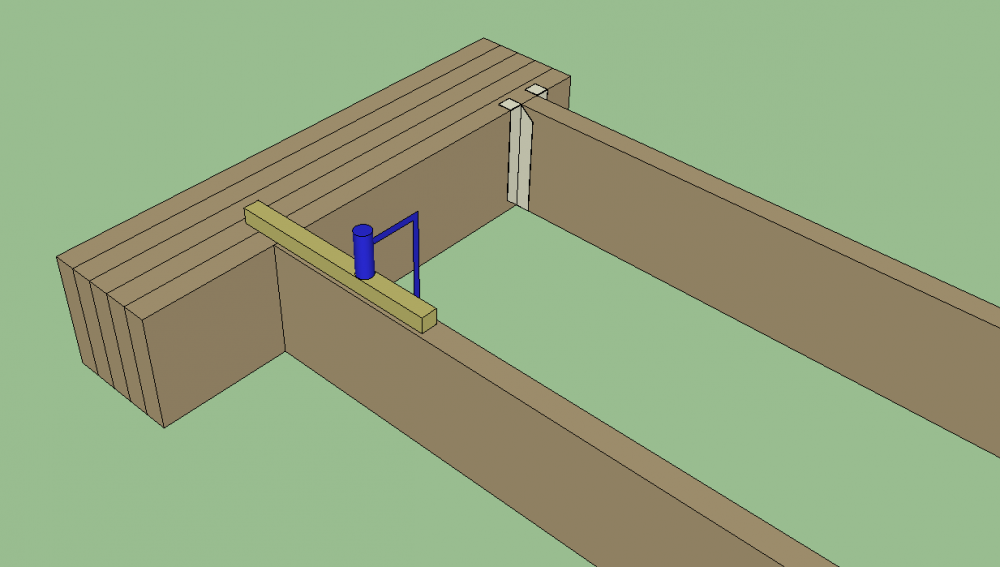
-
Thanks @TerryE, getting there but I'm finding the code a bit puzzling. I take it t15 is the nominal 3pm temperature derived from today's measurements? So what's TARGET_T, the set target temperature which is only adjusted very occasionally? But the temperature of what? Some sort of nominal temperature of the slab after a day's heat delivery to the room? Should onTime1 += 0.5; be onTime1 += sign * 0.5;
-
As you say, he uses a room (hall) stat so he's not controlling the slab temperature alone. @TerryE could you say how your system currently works? AFAIKS in this thread you've said a couple of times various ways it doesn't work but not actually spelled out how it does other than saying it measures the slab temperature and uses that to adjust the amount of heating overnight (and in the afternoon). Is it that it looks at the drop in slab temperature or what?
-
As @JSHarris and others have found, it's rarely the LED that goes; almost always the electronics in the back. Out of curiosity, were many of those in recessed fittings? I have a strong suspicion that many LED failures are a result of being in fittings which cause them to overheat.