

Ed Davies
-
Posts
1674 -
Joined
-
Last visited
-
Days Won
1
Everything posted by Ed Davies
-

Fabric vs bling
Ed Davies replied to Ed Davies's topic in Energy Efficient & Sustainable Design Concepts
I'm not asking anything; I'm replying to Ferdinand's points which I disagree with, slightly. -
In another thread , which it would be a pity to derail, @Ferdinand wrote: I agree about GSHPs; the only use case I can see is an existing largish house in the countryside which is difficult to get up to a decent standard of insulation and so uses enough heat that the savings of a GSHP can be worthwhile. But, I don't see what the building fabric has to do with rainwater harvesting. If you're on mains water then RWH is only every going to be, at best, marginally useful economically but you might still reasonably choose to do it for ecological reasons, particularly if you use a lot of water for gardening or whatever. Off mains water makes it more worth thinking about, of course. But that decision is quite independent of the building fabric choices. In a well-insulated house complex control systems are not so useful from the heat distribution point of view but, conversely, the long time constants of such houses mean that there's more flexibility to grab the energy when it's available at lower cost. E.g., from E7 or PV. If you have multiple uses (space heating, DHW, car charging, …) then a moderately clever system probably is needed to make best use of what's available in varying circumstances.
-
What type of boarding above rafters
Ed Davies replied to Moonshine's topic in Roofing, Tiling & Slating
It's not a matter of which wind zone the house is in, is it? -
Does lagging DHW pipes really make much difference, if you're not circulating water? It depends on the pattern of use, of course, but even unlagged pipes take quite a while to cool down so if more water is used quickly it'll still be warm. But often it's many hours between uses so even with lagging the pipe will be cold on the next use so it's only a relatively narrow period of time where it'll make much difference. E.g., I only normally do one lot of washing up a day, in the evening, so lagging on the pipe to the kitchen sink will make absolutely no difference (other than maybe raising the temperature of the delivered water by 1°C or so).
-
ASHP- struggling to warm house in the cold weather
Ed Davies replied to Jude1234's topic in Air Source Heat Pumps (ASHP)
The classic is sheets of foam insulation in a cavity just floating around lose, with no sealing at all. Sort of thing a thermal imaging camera might help with if it's @Jude1234 's problem. -
ASHP- struggling to warm house in the cold weather
Ed Davies replied to Jude1234's topic in Air Source Heat Pumps (ASHP)
Absolutely. What Tony on GBF christened a plasterboard tent, where all the insulation is bypassed. One of the many reasons why airtightness tests are to be taken with a pinch of salt. We've had this discussion before but basically the airtighness layer really needs to be much further out in the insulation. My working hypothesis is that a lot of the disappointment with insulation in new builds over the last few years is because of air getting past the insulation layers due to slapdash installation. I haven't seen a convincing contradiction yet. -
ASHP- struggling to warm house in the cold weather
Ed Davies replied to Jude1234's topic in Air Source Heat Pumps (ASHP)
If a thermal imager isn't to hand an infra-red thermometer can help a lot. Just takes a bit longer to scan around looking for cold spots. -
Most nuclear waste was not radioactive before it got bombarded by neutrons. If there was only what's left of the original uranium to deal with the problem would be a lot simpler.
-
… and vertically alongside corners (convex or concave). Guess how a friend found an oil pipe running in the back of skirting board? House smelt of oil for months.
-
I'm with @Russell griffiths, from both a practical and moisture safety point of view I think it would be better to treat the granite as just a rainscreen, with the usual ventilated cavity behind it, which helps keep most of the wind and water off the main structure. Then you're just left with the fairly minor puzzle of building a conventional timber (or steel) wall with insulation but not being able to put insulation or sheathing on from the outside.
-
What type of boarding above rafters
Ed Davies replied to Moonshine's topic in Roofing, Tiling & Slating
AFAIK, the only objection to Panelvent is cost. Long time since I looked but, IIRC, it was about twice the price of OSB. -
How would the PUR relate to the granite wall? Would it be stuck to it or would there be an air gap? Is the granite flat enough to stick it?
-
Which hub do you have? BT has manuals for quite a few. It'd be tedious to read all of them.
-
This forum message says that the router log will show port forwards being set by UPnP. Might be worth a look.
-
Not as I understand UPnP. I'm a bit vague about it but my understanding is the point of it is to allow applications on computers, phones, etc, to open ports for access from outside. I wouldn't be at all surprised if WhatsApp uses it if it's available. Yep, that's a bit more concerning. Usually there's a setting in the router configuration to enable/disable this. I have a vague memory of some routers not being very good in that they allowed remote logins even when they were supposedly disabled.
-
Could a tenant's computer have, quite reasonably, added a port forward via UPnP?
-
What does that do? Stop drying out through the ends so that it dries more evenly along the length?
-
What type of boarding above rafters
Ed Davies replied to Moonshine's topic in Roofing, Tiling & Slating
As @JSHarris says, they're equally “breathable” both ways; the point is that they let vapour through while blocking liquid water. There are a few “intelligent” membranes which are supposed to be in some sense one way. AIUI, they vary in their permeability depending on the vapour pressures with the idea that they'll let water in the roof/wall out more easily than they'll let it in. I don't understand the details beyond that but they aren't relevant to this discussion anyway as they're used on the inside except that their existence does support the notion that normal breathable membranes are two way. -
General drainage for airtightness
Ed Davies replied to EverHopefull's topic in General Self Build & DIY Discussion
Any problems with those drying out? Do you common any of them up to share a water trap? -
What type of boarding above rafters
Ed Davies replied to Moonshine's topic in Roofing, Tiling & Slating
Good question. I'm confused: https://edavies.me.uk/2014/04/osb_vapour I'm not the only one, see the update link at the end to: https://www.greenbuildingadvisor.com/article/is-oriented-strand-board-as-impermeable-as-they-say I (pointed in that direction by @A_L., IIRC) and they independently came to the conclusion that it's the surface layers which provide the resistance to vapour. Having read all that I've put 9mm OSB3 on my gable ends with Protect TF200 over it. It'll then have cladding over that but with a good ventilated gap in between. On the other hand, @SteamyTea 's house has OSB on the outside with render directly on to it. It's been up since 1987 and hasn't rotted in the mean time. No idea of the thickness or flavour of his OSB (he didn't build it, not sure if he knows, he didn't mention it in e-mail). -
How about a Raspberry Pi running Node-RED?
-
What type of boarding above rafters
Ed Davies replied to Moonshine's topic in Roofing, Tiling & Slating
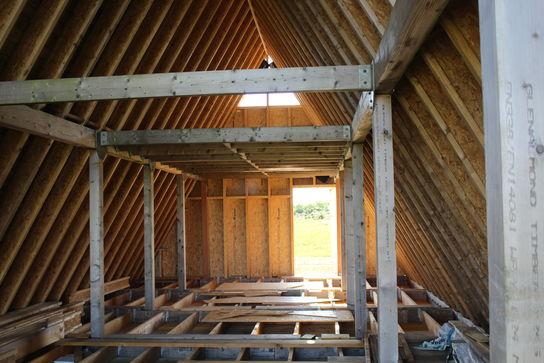
Another option is traditional sarking boards. 150x22 treated softwood. Not as much racking strength as OSB or ply and a bit more nailing but on a roof which is too steep to walk on it can form its own ladder for installation. https://edavies.me.uk/2018/01/sarking/ I'm not sure about the permeability of OSB. It seems to vary in odd ways between products and thicknesses so I think sometimes there's a surface layer which is impermeable with the inside of the produce being more permeable. Sarking boarding, because of the way it's installed and shrinks as it dries out has gaps between the boards of a mm or two so is intrinsically very vapour open. -
Groundbreaking 'spinning' wind turbine wins UK Dyson award
Ed Davies replied to Square Feet's topic in Wind Generation
PV will have a capacity factor around 10%, i.e., averaged over a year it'll produce about 10% of its “peak” output. A wind turbine will do a bit better but in the south of England I'm guessing not much more than about 20% so to match 10 kWp of PV you'd want a turbine around 5 kW. The one that springs to mind is the 6 kW Proven, now sold by Kingspan. -
When people say “thermal mass” just read “heat capacity”. Saves on the blood pressure. My guess would be that the house @PeterStarck is talking about was not, by the standards of this forum, well insulated. Sort of a re-run of the 1970's mass&glass vs light&tight controversy when now we know the truth (?) mass&tight (with maybe a bit of glass). Still, going back to the OP's question, the tight bit is more important than the mass bit; the mass only helps if you have some intermittent form of heating like sunlight or E7 electricity. If the heat source is directly and easily controllable all the time the mass matters a lot less.
-
Comfort cooling MVHR
Ed Davies replied to AliG's topic in Mechanical Ventilation with Heat Recovery (MVHR)
With hindsight [¹], would you still bother with A2A heat pump in the MVHR or would you just use the ASHP? A heating/cooling plate in the MVHR supply duct connected to the ASHP circuit? On a house with PV, at the times when the ASHP is needed for cooling running it will be essentially free. Opening windows when the sun's heating the house too much might not be a good idea because of insects, security, etc. [¹] We're going to be sick of “hindsight” puns by this time next year.

