

Ed Davies
-
Posts
1674 -
Joined
-
Last visited
-
Days Won
1
Everything posted by Ed Davies
-
For a single string of panels you'll get the sum of the voltages of the panels but, more or less, the lowest of the currents (OK, maybe a little bit more but not much). Sadly, the main effect of shading a panel is to reduce its current, the voltage only decreases a small amount. So, if one panel is shaded to reduce its current to half the full sun value then the whole string will produce half the current so half the power.
-

Groundbreaking 'spinning' wind turbine wins UK Dyson award
Ed Davies replied to Square Feet's topic in Wind Generation
But a) do you really need the 6 kW? and b) the “fitted” probably includes a lot of concrete in the ground that you could probably do yourself/get done a lot cheaper. -
Groundbreaking 'spinning' wind turbine wins UK Dyson award
Ed Davies replied to Square Feet's topic in Wind Generation
The classic robust off-grid turbines are the Provens, now sold by Kingspan. The smallest is 2.4 kW (branded as 3.6 kW or so by Kingspan, I think). The next larger one is the 6 kW. (They then tried to stretch it to a much larger one, 15 kW, I think but had a problem with the manufacturing of the shaft which basically sank the company. The MD, Gordon Proven, died of a heart problem and Kingspan bought them out.) When they were Proven the problem with them was that they had so many agents around the country that none did enough business to be able to afford to stock spares and Proven wouldn't deal with end users directly. I don't know how this has changed since Kingspan took over. There are examples all over the Highlands, one 6 kW which has been running for years just down the road from my site. Paul at the end of the road swears by them - I've lost track but I think he has two. Further down the size scale it gets a bit harder to find reputable designs which are suitable for windy sites. The two I've had my eye on are Futurenergy and Leading Edge The best I can say is that both have been around for a while and have been used with reasonable success. Futurenergy had a good reputation for customer support though I haven't been in touch with any users for a while. -
2 DHW tanks, 2 heating zones, 1 set of controls
Ed Davies replied to Miek's topic in General Plumbing
I like that. You don't even need to put the DC through the microswitches. OK, it's a tiny current so won't affect the contacts but it's still nicer to keep the wiring as separate as possible. House 2 is a normal 2-zone S-plan except that the line (or switched line) which normally goes to the boiler instead goes to a socket with a 12V (or whatever) output wall wart. Wires from that go through to house 1 to the 12V coil of a relay. House 1 wiring is also standard 2-zone S-plan except that the normally-open contacts of the relay are wired in parallel with the valve microswitches. A minor advantage of doing it this way is that the DC supply is only turned on when house 2 is calling for heat. -
2 DHW tanks, 2 heating zones, 1 set of controls
Ed Davies replied to Miek's topic in General Plumbing
Yes. House 1 (with the boiler in it) wouldn't actually need a wireless transmitter, it could be connected direct to the boiler, of course. -
It's only been two days that I've had to stop a bit early because the batteries ran out. For the price of that charger I'd probably be better off buying an extra 5 Ah battery which would likely solve the problem. My other option would be to run my mains Makita charger off my 1200 W pure sinewave inverter or off my inverter generator.
-
One thing about the Makita cordless circular saw: it eats the batteries. It's not surprising given the power it must be consuming but worth bearing in mind. I have 11 Ah of batteries (1x3 Ah and 2x4 Ah) and have used up the lot in a day with the circular saw but never with the other tools.
-
2 DHW tanks, 2 heating zones, 1 set of controls
Ed Davies replied to Miek's topic in General Plumbing
Wire the old house up as normal for a 3 x 2-way valve S-plan system except that the third call-for-heat input comes from the paralleled-up microswitch connections on the new house's wiring panel, either directly or via a relay or wireless connection. -
Yes. Mine are all Makita: small and big combi, SDS drill, circular saw, multitool, jigsaw and angle grinder, except the Paslode nail gun. I burned out my original small combi drill but that was doing something silly (drilling concrete). The rest have just worked. People moan about the batteries but I've had no problems with them (touch C24): I run them flat then fully charge them and use them in pretty strict rotation so the issue of them getting unbalanced because one cell gets discharged by the internal electronics doesn't affect me.
-
Pecking out for a treatment plant doesn't have to be expensive if you have a big digger on site for a couple of days anyway. Just needs one with the right hydraulic feed and long enough reach. The chaps who did my site access and prepared the house area did it in less than half an hour, just in passing while they had the appropriate digger to hand. It'll need excavating fully later but a smaller digger can do that now the rock's broken up.
-
2 DHW tanks, 2 heating zones, 1 set of controls
Ed Davies replied to Miek's topic in General Plumbing
I'd agree with @ProDave, convert to S-plan. Keep the wiring for the two houses as separate as possible. It'd save some theological arguments about earthing, etc, if each house's pair of two-port valves were in their own house and the call-for-heat signal from the new-to-the-system house was passed to the old house via some wireless mechanism or other. Avoids having a wiring centre needing to be isolated from two separate supplies to be safe to work on. Remember that the two houses might not now, or in the future, be on the same mains phase. -
Bottom of: https://www2.gov.scot/resource/buildingstandards/2017Domestic/chunks/ch05s09.html My emphasis: Electrical fixtures - outlets and controls of electrical fixtures and systems should be positioned at least 350mm from any internal corner, projecting wall or similar obstruction and, unless the need for a higher location can be demonstrated, not more than 1.2m above floor level. This would include fixtures such as sockets, switches, fire alarm call points and timer controls or programmers. Within this height range: light switches should be positioned at a height of between 900mm and 1.1m above floor level standard switched or unswitched socket outlets and outlets for other services such as telephone or television should be positioned at least 400mm above floor level. Above an obstruction, such as a worktop, fixtures should be at least 150mm above the projecting surface Where sockets are concealed, such as to the rear of white goods in a kitchen, separate switching should be provided in an accessible position, to allow appliances to be isolated.
-
From the start of the OP, my emphasis:
-
They would be in a safe zone if they go to a row of network or AV sockets just above the floor. Do the rules about heights of sockets apply to those? Edit to add: at least in Scotland they'd have to be at least 400 mm off the floor (“…and outlets for other services such as telephone or television…”).
-
Yes, there aren't safe zones in the ceiling as such but for cables installed in the ceiling the rules are pretty much as per being in safe zones in a wall so it's a reasonable short-hand to say the whole ceiling is a safe zone. Differences, I can see: a) cables going though joists in the ceiling need to be at least 50 mm in & b) cables in wall safe zones need to be RCD protected (but that's hardly likely to matter as the cable's likely to need to be RCD protected anyway). As written the regulations seem to require network cable in the safe zones not in conduit to be RCD protected but I'd have though the coils in an RCD would make all the bits dizzy and useless.
-
Wiring in sloping surfaces
Ed Davies replied to Ed Davies's topic in Regulations, Training & Qualifications
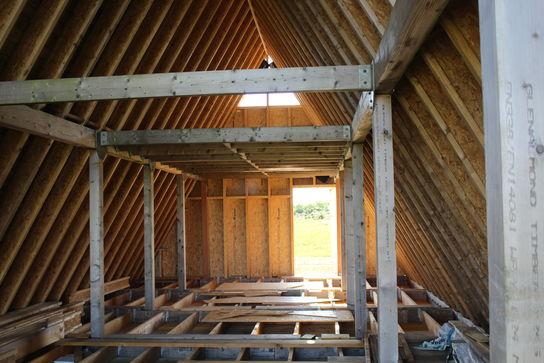
Yes, 45° skeiling would be one case. To be safe, I suppose, you'd not want to lay cables in the safe zone at the top of the vertical part of the wall just below where the skeiling starts but, at the same time, you'd not want to go banging nails in there, either. I was actually thinking, though, of the 60° sloping roof on my A-frame house. For the most part I envisage wiring dropping straight down from the lofts above to any fittings on that roof but there might be a few odd cases where whether it needs to be treated as a ceiling or a wall might matter. -
From the wiring regulations point of view of prescribed (safe) zones, at what angle does a wall become a ceiling? I.e, what are the rules for skeilings, A-frames, etc?
-
Single screw brand for a whole build.
Ed Davies replied to epsilonGreedy's topic in Tools & Equipment
TIL Phillips (two Ls) screws don't come from the Dutch electrical/electronics company Philips (which only has one L), as I'd previously assumed. -
Also, a tracker gives the greatest improvement in summer because in winter the sun's only in one direction, really. Summer is when the extra energy harvested is least valuable.
-
Yes, there was a fad for combined PV/solar thermal panels a few years ago. Not sure how many actually used heat pumps, which seems the obvious step for low-grade heat like this. AFAIK, they've never really caught on, I assume because the cost of PV came down enough that it just wasn't worth the hassle.
-
Off the shelf non vented roof windows
Ed Davies replied to vivienz's topic in Skylights & Roof Windows
That is, at least, consistent: 2.49 W/m²·K = 0.438537… BTU/h·ft²·°F. -
Do you have skirting boards? Could you arrange the join to be at the bottom level with the top of the skirting boards so they line up. It'd look odd to people who think about it but visually it'd make it unnoticeable, I think.
-
Don't knock east/west panels too much. Each panel will obviously produce less than a similar one facing south but if you're limited by roof space E/W can produce more over the whole year because you can probably fit twice as many panels producing about 3/4 of the energy each. They'll also tend to produce for a longer period of the day getting into the morning and evening peaks for the better half of the year which can help with self-consumption. The downside of E/W is that they're even more biased towards the summer months than south facing.
-
BTU = British Thermal Unit, so called because it's mostly used by Americans these days. Strictly, it's a unit of energy (not power). There are various definitions but 1 BTU ~= 1055 joules. Often, though, it's used as a unit of power with an implicit /hour bit omitted. 1000 BTU/hour = 1'055'000 J / 3600 seconds ~= 293 watts ~= 300 W.
-
Wouldn't it better to wait an hour? It looks like the reading is about an extra 300 litres per day so around 12 litres per hour so to see it for sure on a meter working in 10 litre units…

