

Ed Davies
-
Posts
1674 -
Joined
-
Last visited
-
Days Won
1
Everything posted by Ed Davies
-

good video on net zero energy home
Ed Davies replied to scottishjohn's topic in General Self Build & DIY Discussion
Yes, very good video for Colorado. It''s worth remembering, though, that the whole of the contiguous US is south of the whole of Great Britain (by at least 60 km) and that Colorado's winter weather, though a lot colder and snowier than most of Britain's, has much more reliable sunshine so the emphasis on passive solar there makes a lot more sense than it might in the UK. In the UK it's often said that south facing glazing is a net gain of energy in winter. It might well be, averaged over the whole winter, but I'm sceptical about it being so over the darkest fortnights (of which there are usually two or three in a winter) which brings us back to our net-zero discussion. A house with a large amount of south-facing glazing might well import less energy over the whole winter but it'll likely import more during the darkest bits so pushing the grid towards less efficient generation (assuming electrical heating of some sort). This might be fine if a lot of that power's coming from wind or a limited but dispatchable source like geothermal or large-scale hydro, but still a lot doesn't. It seems to me that passive solar with a lot of “thermal mass” works well if you're dealing diurnal variations resulting from at least a bit of sunshine most days. If you have to deal with longer timescales of multiple days to weeks then the temperature swings involved mean that it's probably better not to try to live in your solar collector. -
Spatial planning of renewables system
Ed Davies replied to Rendall's topic in General Alternative Energy Issues
You're still getting this wrong. Please have a read of this. I agree with the others, 500 W continuously, even if only during the winter, would be very valuable. It would reduce the size of both batteries and PV required significantly and mean so much less generator use that you could get away with a relatively cheap petrol or LPG one rather than needing a beefier diesel. -
Spatial planning of renewables system
Ed Davies replied to Rendall's topic in General Alternative Energy Issues
Where will the batteries be? In or adjacent to the house? Normally off-grid PV arrays are run at significantly lower voltages than on-grid ones - the maximum input voltage to an MPPT charge controller is typical 150 or 250 volts whereas grid-connected ones usually work around 600 volts or so. This means you usually want the PV array quite close to the battery otherwise you need a lot of copper wire; low voltage means higher current so thicker wire for a given amount of power transferred. Alternatively, you can AC-couple your system. You have a normal on-grid style inverter by the PV array then connect it to the house and battery via 230 volt AC lines, typically SWA buried in the ground for this sort of system. At the battery you then have an inverter/charger which establishes the 50 Hz mains frequency for your mini-grid and can even tweak the frequency up and down to control the amount of generation the PV's inverter puts out depending on the loads the house is taking and the state of charge of the batteries. There are not a lot of AC-coupled systems around. Paul at the end of the road has one. -
good video on net zero energy home
Ed Davies replied to scottishjohn's topic in General Self Build & DIY Discussion
It's a matter of definitions, really. Unless a house is actually sequestering carbon (making coal in the cellar or something) it can't really have a negative CO₂ emission rate, all it can do is produce energy which results in other people emitting less carbon. In the (not so) long run [¹] we need to get pretty close to zero emissions in total. When that happens any energy exports from the house will no longer be negative emissions as they'll only be displacing zero-carbon energy production at another place or time. That might well be a good thing to do but it'll not be negative CO₂ emissions. Suppose you have a house which doesn't export any energy at all but imports a small amount of electricity, say 1000 kWh evenly spread throughout the year so causing (going by my recent SSE bill which indicates above-average emissions per kWh) 300 kg of CO₂ emissions. If all the 25 million houses in the UK did that total household emissions would be 7.5 Mt. The house next door imports 3000 kWh during the winter but exports 4000 kWh in the summer so it's “net negative”. Still, if all the houses did that there'd be total emissions of 22.5 Mt during the winter (or a huge investment needed in technology (electricity -> gas, perhaps) to save the spare energy from the summer for use the next winter which will result not insignificant emissions in itself). So, yes, this “negative emissions” scenario does result in greater emissions. [¹] A lot less than the lifetime of houses we're building now. -
good video on net zero energy home
Ed Davies replied to scottishjohn's topic in General Self Build & DIY Discussion
It's entirely possible for a house which is net positive energy/carbon to cause less emissions than a house which is net zero or negative. -
That's not a clue, is it? As in, could the ploughing have caused it to become blocked at the far end of the 50 mm pipe.
-
I've just re-read my posts on this thread and I don't think I've said that here. I might have said it on another thread a while ago, before becoming aware of the localised PCM cooking issue. I agree, given restriction it's better not to use the immersion if you want to control the behaviour of the Sunamp as part of a wider system which the SA controller is not aware of. The sketches I have for my own house would put any electrical input to the Sunamp via a Willis-type heater into the low-power circuit. AIUI, with that you just have to make sure you don't feed water in which is too hot.
-
30"? 760 mm? But, yes, that's the sort of difference I was expecting. The differences in air leakage between a round hole and a long narrow slot of the same area are similar orders of magnitude.
-
Yep, it's not obvious. I'd just be a bit cautious about using a fixed velocity irrespective of the shape of the opening. It's something I wondered about back when I was thinking of doing my own MVHR exchanger but didn't come to any useful conclusions.
-
10²? But won't the allowable flow velocity be lower with a long narrow opening than, say, a round pipe?
-
Scary info about air quality
Ed Davies replied to richi's topic in Mechanical Ventilation with Heat Recovery (MVHR)
CO (carbon monoxide) and CO₂ (carbon dioxide) get you in very different ways. Carbon monoxide's problem is that it takes up the place in your haemoglobin which you'd much prefer to be taken by oxygen resulting in your tissues not getting that oxygen. We (most (all?) mammals (animals?)) have not evolved to detect that condition, or other causes of hypoxia, as it so rarely happens in nature that there's been no selection pressure for it. You have to go out of your way to look for particular symptoms to detect it, e.g., the reduction of colour vision that tipped off @JSHarris. You're not likely to notice those if you're asleep. Increased carbon dioxide, on the other hand, mostly gets you by preventing you getting rid of waste CO₂ generated in your body so that it builds up in your blood steam. This is the quicker effect of not breathing so it's what we've evolved to detect. The “lungs bursting” feeling you get if you hold your breath too long comes from excess CO₂. CO₂ also bonds to haemoglobin a bit at a different site from that used to carry oxygen but which does have the effect of reducing its oxygen carrying capability but, AIUI, that's a more minor effect. -
What boiler to go with Solar thermal and wood burner
Ed Davies replied to geoffdg's topic in Solar Thermal (ST)
I can't do it accurately but I can get an estimate from my log of a radiator temperature once a minute to get a reasonable approximation to the boiler run time. More details. From 2019-02-01T17:00 to 2019-02-08T17:00 my software estimates the boiler ran for 175'897 seconds (29% of the time for the 7 days) which, assuming the same 19% overestimate of oil consumption I got lost autumn, would imply burning 85.5 litres of oil. Using the assumptions I made on that page that would be 904 kWh. So that's a tad over three times @ProDave's heat requirement assuming his 95 kWh gets converted to heat with a CoP of three. My last oil delivery was 44.75p + 5% VAT per litre so just over £40 for that week's space heating. -
There's a lot of confusion in the world about kilowatts and kilowatt hours. Here's an attempt at an explanation. The SI unit of energy is the joule (symbol J). It's quite small. Power is the rate at which energy is generated, moved around or used up. The unit is the watt (symbol W). One watt is one joule per second (1 W = 1 J/s). Because the joule is quite small the watt is also not large. It's typically used for relatively low-power devices like lights. The watt is a rate in much the same way that the knot is a rate (1 knot = 1 nautical mile/hour). Talking about watts/hour is about as likely to be wrong as talking about knots/hour (i.e., they're not normally used but could be meaningful in a few odd cases: watts/hour for the output of a PV factory, knots/hour for the acceleration of a supertanker, perhaps). For things like heating the kilowatt (kW) is typically used. 1 kW = 1000 W = 1000 J/s. IMHO, there'd be less confusion if we measured quantities of energy in joules and its multiples. E.g., it'd be better if electricity bills were in MJ (megajoules). But we don't. Instead it's common to use the watt-hour (Wh) and its multiples. One watt-hour is the amount of energy transformed by a power of one watt for one hour. 1 W is 1 J/s and one hour is 3600 seconds so 1 Wh = 1 J/s × 3600 s = 3600 J as the seconds cancel. One kilowatt hour (1 kWh) is one kilowatt for one hour, or 1 watt for 1000 hours or whatever combination multiples to the same amount. 1 kWh = 1000 J/s × 3600 s = 3'600'000 J = 3.6 MJ.
- 55 replies
-
- 3
-

-

-
- acronym
- abbreviation
- (and 4 more)
-
What boiler to go with Solar thermal and wood burner
Ed Davies replied to geoffdg's topic in Solar Thermal (ST)
Which days were those? I'm just curious to do a like-for-like comparison against my oil burned here. -
Woke up in a cold sweat: underboarding too early?
Ed Davies replied to ToughButterCup's topic in Heat Insulation
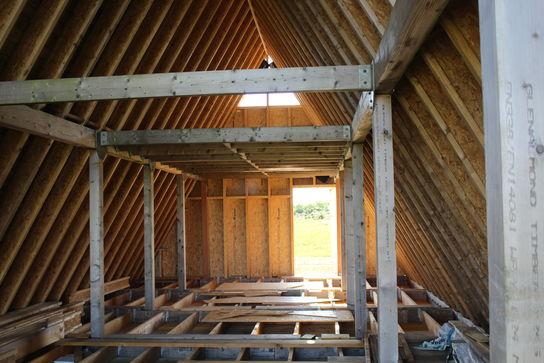
My plan's about the same as @Oz07's: JJI rafters with mineral wool between, VCL, underboarded with 90mm PUR, battened service void then cladding appropriate to the area (OSB, plasterboard or wood). Battens screwed through PUR and VLC to rafters. PUR will be a continuous layer, not stopping at room partitions. Where the internal walls meet the roof I'll substitute CLS for the battens and use somewhat beefier screws through to the rafters. But, mine's an A-frame over post-and-beam so most of the stud walls which meet the roof will only be small triangles outboard of the posts so won't be subject to much force. -
Scary info about air quality
Ed Davies replied to richi's topic in Mechanical Ventilation with Heat Recovery (MVHR)
https://en.wikipedia.org/wiki/Lake_Nyos_disaster http://news.bbc.co.uk/onthisday/hi/dates/stories/august/21/newsid_3380000/3380803.stm From the BBC article: “Most of the victims died in their sleep” but a) that's probably sufficiently second hand to be of questionable reliability and b) though the main problem was CO₂ there was also a lot of hydrogen sulfide and sulfur dioxide causing injuries. Probably it didn't occur to most people to run away from the problem - that doesn't normally work when you feel ill. Still, a room would have to be pretty small and well sealed to get to life-threatening levels overnight. It'd be much more likely you'd wake in the morning with a horrid hangover. -
What boiler to go with Solar thermal and wood burner
Ed Davies replied to geoffdg's topic in Solar Thermal (ST)
No. Please find out what a watt is; you clearly don't understand and you're just reinforcing an all-to-common confusion.- 97 replies
-
- 2
-
-
-
- solar thermal
- wood burner
- (and 1 more)
-
ASHP- struggling to warm house in the cold weather
Ed Davies replied to Jude1234's topic in Air Source Heat Pumps (ASHP)
Thanks. That seems like the key point. I guess to some extent it's a matter of the hysteresis on the buffer tank thermostat. If there's a wide hysteresis then the return temperature, at least for most of the “burn” will be lower allowing the HP to put more power into the water. But then, if you have, say, a 10 °C hysteresis when you want a minimum of 30 °C to mix accurately into the UFH you finish up at 40 °C anyway. -
ASHP- struggling to warm house in the cold weather
Ed Davies replied to Jude1234's topic in Air Source Heat Pumps (ASHP)
What's the point of running the ASHP more than a few degrees above the UFH temperature? Say 30° rather than 40° which would, I suppose, improve the CoP at least a bit. I realise that @JSHarris also uses the buffer tank to pre-warm DHW before raising it to full DHW temperature via his Sunamp so a slightly higher temperature in the buffer helps there but is there any other reason? Just to keep the buffer tank small without cycling the ASHP too much? -
That's a thought, is there any chance 3-phase would be, overall, cheaper in this sort of case?
-
100x50 timbers doesn't limit the insulation to 100mm. Could be another 100mm of EPS stuck on the outside, for example. Worth understanding, though.
-
But naively taking the angle is a bit misleading because you get one tread for free, there's one fewer treads than rises as the ”bottom tread” is part of the lower floor (or the top tread is part fo the upper floor ?). From Scottish regs and TennentSlager's link 2800 mm height with a maximum rise of 220 mm gives at least 13 rises of 215.5 mm each. That means 12 treads for 240 mm going each to comply with the 42° angle requirement (well within the minimum 225 mm going) so a total horizontal length of 2880 mm from the nose of the top floor to the nose of the bottom tread. 14 rises of a nice round 200 mm gives you 13 treads of 222.12 mm which is more than the minimum 220 given in that guide but less than the 225 given in Scottish regs so you'll need to check for where you are in the UK if you went for that. Well worth putting roughly where you are in the country (e.g., which county) to help with answering this sort of question. Just using 42° would give an distance of 3109.7 mm.
-
Scary info about air quality
Ed Davies replied to richi's topic in Mechanical Ventilation with Heat Recovery (MVHR)
Having re-watched the video, when the CO₂ was up to 6370 ppmv (15 times normal) the oxygen was only down to 19.7% from the normal 20.95%. As @JSHarris points out, that would be imperceptible. -
Scary info about air quality
Ed Davies replied to richi's topic in Mechanical Ventilation with Heat Recovery (MVHR)
? -
Scary info about air quality
Ed Davies replied to richi's topic in Mechanical Ventilation with Heat Recovery (MVHR)
As a percentage, the reduction in O₂ is tiny compared with the increase in CO₂. Normally the atmosphere contains about 400 ppm of CO₂ and about 21% O₂ which is 210'000 ppm. If the CO₂ is increased to 2000 ppm (increase of 1600 ppm) then the O₂ will decrease by the same amount, to 208'400 ppm, a decrease of 0.762%. Unless I've got the arithmetic badly wrong you get the same reduction by rising 61 metres. I haven't heard that living higher up tower blocks causes symptoms similar to 2000 ppm CO₂.