


MikeSharp01
-
Posts
5693 -
Joined
-
Last visited
-
Days Won
16
Everything posted by MikeSharp01
-

Modern housing estate living
MikeSharp01 replied to flanagaj's topic in General Self Build & DIY Discussion
I think the Judge is worried about incarcerating him because he will still need his security detail! -
Although it is what it is, the EPC system, but doesn't that make a laughing stock of the whole EPC panjandrum.
-
How did the SAP assessor 'see' the Willis heater - others on here have said it really hit their SAP outcome having direct electric heating?
-
We went strap as well but I wrapped the pipe with strips of sponge carpet underlay to be sure I isolated any vibration.
-
I am being told I may need one for the defrost cycle but as far as I can see it's only about ensuring that there is enough water no matter what the secondary pipework volume is depending on settings IE in my case when the DHW coil is shut - OR the UFH is closed so it's only needed because the ASHP's are not designed to take command of those valves to ensure enough volume is engaged for defrost. In the case of rads I guess it's that for ASHP systems and for boilers the cycling problem to be sure any uncontrolled TRV rads don't limit the water volume too much.
-
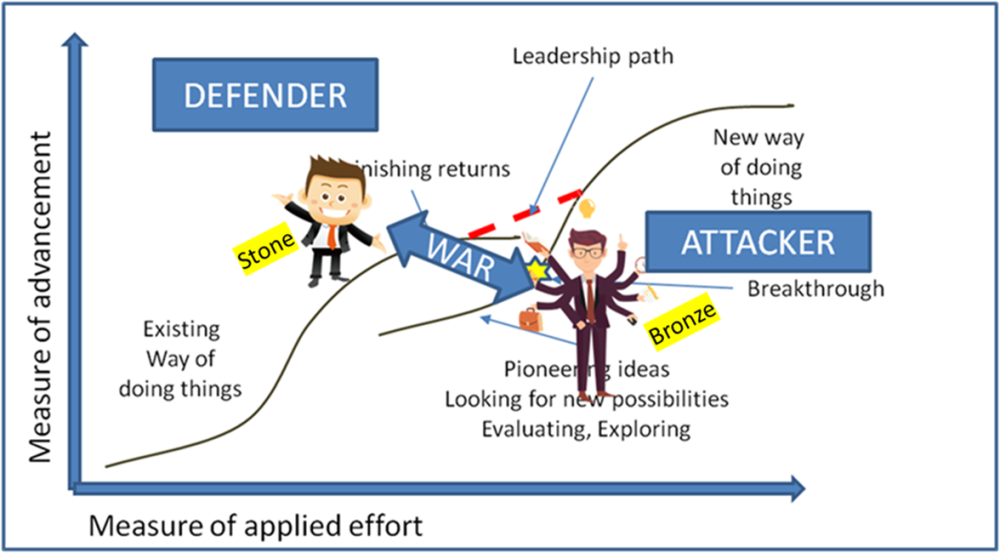
I Guess we are saying the same thing to increase the delta you either have to lower the return temp or raise the flow temp. I am not a dedicated follower of the KISS approach to controlling these things, although the simpler the better idiom I do agree with - where we make it as complex as it needs to be to make it better while controlling the complexity. We have access to a vast array of controlling technologies which should enable us to do amazing things with ASHPs including data science, machine learning & internet of things (IoT) and we are really only up against the physics in the corners of this. I tend to think of it as being akin to internal combustion engine management systems development, so, in my mind, we are at a stage of about 50 years ago emerging from the era of the K-Jetronic with Lambda from 1976 as things are. Therefore my conjecture is that we are just at the bottom of the S curve with ASHP technology, @ the breakthrough point, where more understanding, better controls, improved materials and better design all round will precipitate a much more rapid growth of capability and uptake. The only thing we risk at the moment is failure because we, the innovators / early adopters, give up on it because without us trying everything the future is bleak. Naturally some political backing may be needed here even if it really wasn't in the development of engine management until the emissions came to the front.
-
Or you need to reset / adjust the delta T or turn it off for a period so the next run will be longer.
-
Welcome to THE forum for people like us - good luck, we stick built our frame under the careful instruction of our Structural Engineer.
-
Welcome to THE forum for people like us - wherever they may be.
-
Yes - I was thinking of just getting all the databank one place and doing some data mining to see if there were any correlations, interesting stuff in it. Suppose we had columns for: Quote value Area of house Number of floors Heat demand Size of ASHP recommended Make of ASHP recommended DHW volume Number of people in household Space heating scheme ufh / rads ufh+rads Number of Zones / Rads Control system included Control level simple / WC / full automation. Etc
-
Wonder if @SteamyTea might be up for trawling through all the quotes we have had and doing some analysis to see if it's a y=mx+c and if c = £7500 or just how it scatters.
-
Which heating and hot water solution(s) in 2024?
MikeSharp01 replied to Jane W's topic in Other Heating Systems
Surely the tundish can just vent into an internal drain or is an outside vent obligatory? -
The problem with using the heatpump (HP) to heat the water via PV is that a HP needs to run for long periods. So you may get long periods of sun but you may get a cloudy day and the PV generation is going up and down so causing intermittent availability for the HP which you don't want to be turning on and off all the time so you will end up importing.
-
To me this seems complicated - choosing solar PV
MikeSharp01 replied to MikeSharp01's topic in Photovoltaics (PV)
I am hopeful! -
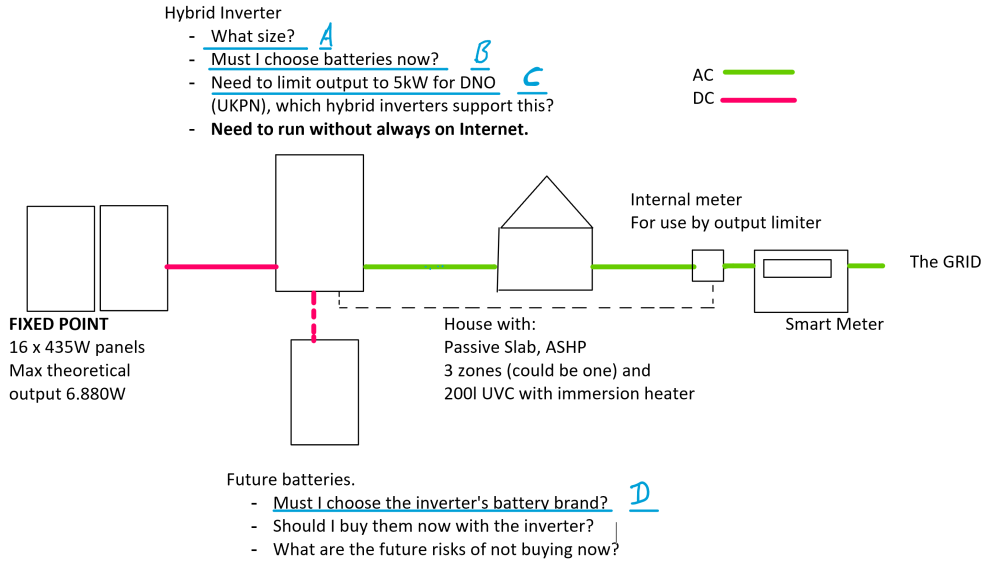
It is time to fit the solar system and the interplay between choices one could make is interesting to say the least. We have one fixed point - the solar array 16x430 panels from Eurener. The rest is now to be decided and that leads me to four main questions perhaps 3 if you combine the 2nd and 4th with a few more supplementary ones on the side. Here is a picture: A. What size inverter I assumed bigger than 6kW but I am being told that 6kW will be OK. B. Must I choose batteries now - economics really yes we can afford them but the value does not quite seem to have topped out yet? This is somewhat mixed up with D below as well. C. Our DNO says they will allow up to 5kW after limiting so given we have, in theory, 6.9kW we will need a limiting inverter but as yet I have not found a hybrid that says it does limiting out of the box. D. Once you get a hybrid inverter what technologies are available for charging batteries is it all proprietary - IE limiting choice of batteries to those from the inverter supplier or generic, which I suspect it can't be wholly be but maybe it can.
-
Yes but the losses may or may not be significant depending on the nature of the setup, personal views on the value / scale of the lost percentage. Solaredge have a couple of briefing papers on it and the use of module level MPP (Maximum Power Point) trackers to wring the last few percent from an array with some shading likely. https://knowledge-center.solaredge.com/sites/kc/files/se_technical_bypass_diode_effect_in_shading.pdf and the theory of module level MPP trackers https://knowledge-center.solaredge.com/sites/kc/files/moving_forward_to_module_level_power_optimization.pdf
-
Yes they have two types I think, both really press connectors just like JG, and others, stuff.
-
Why would someone build this here?
MikeSharp01 replied to Adsibob's topic in New House & Self Build Design
Is it flats or offices - either way won't it need car parking spaces? -
No I would not expect to - I would hope the tiles are all flat so as long as we start flat there should be no lipping anywhere.
-
Is this a common idea, we have 100m2 of large format tiles to lay and am somewhat terrified of lipping but thought the self leveling kits would sort it.
-
So it's a shoulder month job is it?
-
Ah now I get it - sorry.
-
What!!!!@@@ the EPC is related to income! Surely it's just based on what you have not what you can afford? (Although I appreciate that what we all have is related to what we can / could afford.)
-
Didn't know that, might have a play - I want to test the water for going over the 16A limit as I would rather not need to buy a limiting inverter or go for 3 phase, even though the pole with it on is in our land and right next to the meter cupboard, and our projected usage pattern will mean that we would be better off if we can export more. Reading around it looks like it is usually NO but can sometimes be YES.
-
Interesting - gives me another opportunity to trot out the 'everything is connected to everything else' bumper sticker. So essentially as more of us get PV the utilities costs go up because they pass less energy across their network on which to make a profit. So costs standing charge goes up for everybody and those left have to pay more for their electricity - even though some of it might be coming from just next door!


