


MikeSharp01
-
Posts
5693 -
Joined
-
Last visited
-
Days Won
16
Everything posted by MikeSharp01
-
would have thought that one 50mm AAV would be enough, its the vac cum you want to break after all. If you are working with building Control you could check with them what they deem acceptable.
-

Neighbour's energy usage
MikeSharp01 replied to SteamyTea's topic in Environmental Building Politics
Yes AND having fluffy towels does not preclude you from complaining about your energy bills BECAUSE, after all, you are entitled to cheap electricity so you can waste it fluffing up your towels. -
Termostatic shower trouble since Heatpump installed
MikeSharp01 replied to Sols's topic in Air Source Heat Pumps (ASHP)
Was your old boiler a combi or did it feed the cylinder? So essentially what has changed? -
Short term fix needed. Any suggestions?
MikeSharp01 replied to TheMitchells's topic in Electrics - Other
Does the dual ring system not need to switch the power to the second ring so there must be a contactor or some such controlled from the meter not sure if a smart meter has an output for this so not sure how it works the once then never again! Maybe I missed something though it is beer o'clock. -
Thermal bridge calculations?
MikeSharp01 replied to Alan Ambrose's topic in New House & Self Build Design
You can do it with Therm. Here is a natty video on how it could be done. -
If its a well insulated slab and a large area then you have enough output area for the whole house, if you do the sums, 180m2 slab, with UFH gives you 180m2 of heat output to warm the house. We have tall vertical multi hollow pipe rads here, they are good for output area but if you have a 10 pipe version of these 3m tall (ours are 2m) you only have about 5m2 of heat output or approx 3% of the slab area per rad. Ask your plumber to install towel rads in the bath rooms so they can keep the towels cosy and that should be enough. With that much PV you can retro fit some electric heaters but you won't need to.
-
Can you build a quality home for £1500 per sq M in 2024?
MikeSharp01 replied to ScottishPete's topic in Costing & Estimating
Sounds like a great project in a truly wonderful place - building in a national park must add some small costs but is neutral in most dimensions assuming labour can be locally sourced. Are there any caveats around affordable housing etc for the build - are they for local people or will the wealthy coves from Edinburgh and Glasgow rush in a snaffle them up for holiday homes? If they are able to do that it would raise the base price, and hence your headroom, albeit at some disadvantage to the local people. -
Sorry I perhaps was not clear. The reason we will have an ASHP is more nuanced than the AECB approach (was a member for about 5 years but have let that lapse.) On our original plan, 2018, we had a gas boiler - no problem getting PH requirements. We decided we didn't want gas for all the reasons we now understand so well. As I was quite taken with the work @TerryE had done with the Willis heaters that was, until late last year, our plan. However, when you go direct electric heating everything else needs tightening up to meet the energy limitations for the house which we did but now as we are further into the build the room for maneuver is limited. Then we noticed that the EPC system trips in and you cannot get a good EPC, see discussion elsewhere on this forum, with direct electric heating! So although we could get PH certification, just, the EPC would have been rubbish and as we feel the need for both we will adopt an ASHP to make it all hang together again - PH certification possible and a, hopefully, better that 100 EPC. For us the spin off will be very low heating bills and a warm airtight home that matches our personal 'machine for living in' requirments - certificate or no certificate. So no different to anybody else really. SO I will now jump down from the head of this pin. Is that the annual cost?
-
Tend to agree, although, it rings a bit hollow having spent yesterday at a graduation ceremony for 600 Engineering and Science students all of whom got a certificate telling other people what the students and the staff already know so sometimes it is for other peoples consumption and holding it has a personal value. I also happen to think that the Passive House standard is now getting better understood and much more widely talked about so we may well be heading the way of more acceptability of the certificates value among buyers.
-
We did set out to build a certified Passive House (PH) and we are very close now to doing it although we may not certify as we now have other priorities. For us the lower impact on the planet, in the long term, was/is the key driver. I do tend to agree with: while I think any impact is worth while and we will use a lot less of the local generation than many in our all electric house. Can't see how it could be done any other way really. The costs are higher and the challenge more technical, my life partner - wife says she might have thought twice had she known just how technical is has become, because you are working with a bigger number of constraints which often result in difficult compromises. For instance - we, our situation, cannot now get PH certification without an ASHP in the mix - so we will fit one. As a self builder, who did not employ a PH professional at the design stage or an experienced PH Architect there were additional challenges. Instead I did a course on PH and the PH Planning Package (PHPP), read loads, worked with our architect and structural engineer to take their outline designs through the PHPP and make sure it would pass and once the design was finalised we have stuck to keeping the PHPP model up to date and building as close to as designed as we could. I feel that the Cold bridging element is the toughest aspect because the PH certified standard needs evidence of any cold bridges being worked through which we did twice because we changed the windows system during the build. (Went from Rationel to Norrsken) So things have changed a little. We also dropped the gas boiler idea early and changed the insulation from frametherm to blown cellulose which made the overall balance go a little awry, the insulation's U value goes from .35 - .38, but we brought it back by adjustments elsewhere. This, incremental change approach, is quite hard once the house is under way hence the ASHP became a requirement to get us down into the energy demand zone.
-
Welcome to THE forum for people like us - but you already knew that.
-
Cornish Cottage Renovation and Extension
MikeSharp01 replied to Aggierockdoc's topic in Introduce Yourself
So in this context size, or perhaps volume / form factor, is everything. -
Cornish Cottage Renovation and Extension
MikeSharp01 replied to Aggierockdoc's topic in Introduce Yourself
Very true the problems though seem to come from the Engineering rather that the physics so the machine is more complex, has more things that can go wrong and so costs more and therefore has a longer payback in pure £. Not sure on the embodied carbon side of the equation, or the availability of; support - ASHP's don't have much good support and reliable installers. We chose not to have one because of space. -
When I think about it the CCC report just assumes we are trying to get to net zero - something we agreed to a long time ago. So all they are doing is looking at the road map and assessing our progress. We also might conjecture that switching over to renewable is sensible anyway, we will need them eventually unless Einstein was wrong, because we will run out eventually after all.
-
If it fires when you push it against the target woodwork then the thing is basically working. It maybe that the the depth setting is at max and this is making it hard to push down to trigger point.
-
Change of mind re planning approval for double garage/annex
MikeSharp01 replied to Deejay's topic in Planning Permission
So is there another owner with the land surrounded bt the red / blue portions ? -
I am sure I don't know. Isn't that what the trick membranes are for in the modern era?
-
This whole topic is frightening - only thing that let's me sleep nights is the wufi analysis we paid for. All technical membranes high / low vapour permeable materials makes my head spin.
-
Just Finished - Thanks for all the Help and Advice !
MikeSharp01 replied to bob the builder 2's topic in Introduce Yourself
Great work Bob. -
Airtight detailing at vaulted roof eaves with propassiv
MikeSharp01 replied to SBMS's topic in Ventilation
Yes we did blow it in ourselves and there were not any voids when we did it for 8 months, then we had heat wave and I noticed the bulges getting worse and found the voids at the top. So we added the intermediate battens - chamfered the edges to avoid damage the membrane and then refilled the voids. No problems since. -
Airtight detailing at vaulted roof eaves with propassiv
MikeSharp01 replied to SBMS's topic in Ventilation
We used intello plus as it has strengthening strands for exactly that - but it didn't work as expected we had bulging much more than expected on the first pumping. We put additional supporting vertical battens under the horizontal battens that hold the plasterboard, at 300mm centers to keep it in check. (Main studs are 600mm. This bulging gets worse when it gets really warm as the plastic stretches and we got some slumping on the tall.columns. So I let it slump and them filled any gaps with more cellulose when I found the voids with an IR camera / strong torch- if you put a bright LED against the membrane you can see holes. Attached is a pick of a roof section the 300 centers.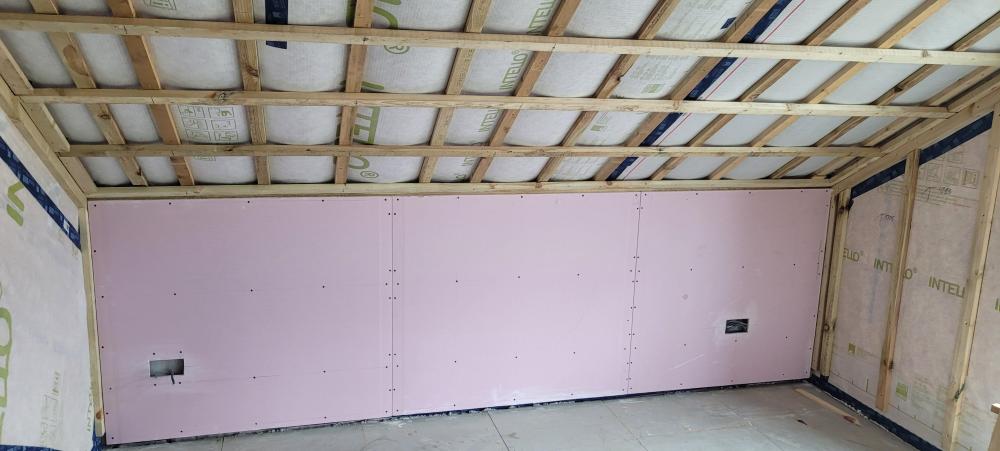
-
Make a podcast and let's make it go viral - but no more than 7.5 minutes (5 minutes if like most users you speed it up when watching). Nobody watches an hours worth of Youtube / Tic Toc / anything these days.
-
In case you want to be depressed like me have a swift read of the summary (press release) of this here: https://www.theccc.org.uk/2024/07/18/uk-off-track-for-net-zero-say-countrys-climate-advisors/ or the full document here, executive summary will either have you head in hands or head in wine cooler: https://www.theccc.org.uk/publication/progress-in-reducing-emissions-2024-report-to-parliament/ For us, here on the progressive forum that Buidhub is, much of this won't come as a surprise but when seen in the round and at scale you get the impression that there is a lot to do and the mistakes of the past, including quite recent choices by HMG, need to be sorted and reverse. Here are few headlines needed for 2030 to get us back on track: 10% of UK homes need to be fitted with heat pumps (1% today) we have discussed this already on here. Sort planning and give me the £7500 if I can show my install meets the broad criteria - IE heats my home but only once I can show it is working. Offshore wind needs to increase by a factor of 3 times. Stop making noises that put companies off bidding for new wind farms at auction. The market share of new electric cars needs to rise to 100% by 2030. Reverse the move made by one R Sunak 18 months back even if it does put all the manufacturers into a flat spin! They make some great recommendations about those and others that need fixing. " Make electricity cheaper. Removing policy costs from electricity prices will support industrial electrification and ensure the lower running costs of heat pumps compared to fossil-fuel boilers are reflected in household bills (R2024-011). Reverse recent policy rollbacks. Remove the exemption of 20% of households from the 2035 fossil-fuel boiler installation phase-out, address the gap left by removing obligations on landlords to improve the energy efficiency of rented homes and reinstate the 2030 phase-out of new fossil-fuel car and van sales. The damage of these rollbacks can be limited by quickly reinstating these policies (R2024-016, R2024-017, R2024-029). Remove planning barriers for heat pumps, electric vehicle charge points and onshore wind (R2024-015, R2024-032 and R2024-019). Introduce a comprehensive programme for decarbonisation of public sector buildings (R2024-013). Effectively design and implement the upcoming renewable energy CfD auctions. Ensure funding and auction design for the Sixth and Seventh Allocation Rounds are appropriate to deliver at least 50 GW of offshore wind by 2030 (R2024-007). Accelerate electrification of industrial heat. Strengthen the UK Emissions Trading Scheme to ensure that its price is sufficient to incentivise decarbonisation and that support is available for a rapid transition to electric heat across much of industry (R2023-080, R2024-012). Ramp up tree planting and peatland restoration. Tree planting must be scaled up in the 2020s for abatement to be sufficient for later carbon budgets and Net Zero. There must be no more delays to addressing the barriers to delivery (R2023-192, R2023-171). Finalise business models for large-scale deployment of engineered removals. Finalise and open to the market the business models for engineered removals (R2024-006). Publish a strategy to support skills. Support workers in sectors which need to grow or transition and in communities that may be adversely impacted (R2022-128, R2023-169). Strengthen NAP3 with a vision that sets clear objectives and targets and reorganise government adaptation policy. Adaptation must become a fundamental aspect of policy making across all departments and be integrated into other national policy objectives (R2024-030).[*]" ( (Climate Change Committee, 2024 progress Report to parliament, 2024 - https://www.theccc.org.uk/publication/progress-in-reducing-emissions-2024-report-to-parliament/) Any thoughts - I think I will go and eat myself into an early grave or, alternatively, hang on for this: https://www.bbc.co.uk/news/articles/cv2gr3x3xkno#:~:text=A drug has increased the,cancers than their unmedicated peers. to work itself out and see if I have the energy to help sort it - first get a final, reliable, reasonable quote for an ASHP! PS don't tell my pension plan!
-
Airtight detailing at vaulted roof eaves with propassiv
MikeSharp01 replied to SBMS's topic in Ventilation
That is how ours is done. -
Airtight detailing at vaulted roof eaves with propassiv
MikeSharp01 replied to SBMS's topic in Ventilation
If I have this right - the wall plate supports joists etc, you just need to tape the sheets, wall / roof, together before fitting the wall plate. Don't forget that blown cellulose is pretty air tight when pumped at high enough density - the sort of density you need if you want to avoid slumping.


