


MikeSharp01
-
Posts
5693 -
Joined
-
Last visited
-
Days Won
16
Everything posted by MikeSharp01
-
No one like this, that was a stylophone IIRC, and we won't even say what the bloke in the image was: Image ref : https://musicrhapsody.com/product/12-key-handcrafted-xylophone/

-
You are effectively wanting to build a set of chime bars or perhas a xylophone might be better to mechanically amplify a tiny amount of movement as you step on the stair to drive a small hammer that hits the tuned bar. And don't forget the tuned resonant cavity below it will you.
-

If I hadn't been there.....
MikeSharp01 replied to ToughButterCup's topic in Project & Site Management
Its OK Ian, we were, have been, here listening just nothing witty or helpful to say. -
Looks like at last they have decided to test the system instead of the core of just one part of it: http://www.bbc.co.uk/news/uk-40520596 not sure why it took them so long, there must have been a motive I am just at a loss to see what it might have been unless they wanted everything to fail.
-
Sounds daft on their part to me Peter did they say why this was the case?
-
Thanks all. I agree Ali is hard to weld and although I took a course is was 35 years ago! Thanks @Onoff for your offer I will PM you for the people in Hoo as I have go past every day. I need the frames to allow me to repurpose the windows of the old house in the garden room. They are only double glazed but are of goof quality they just don't open so the frame is to allow me to add a hinge etc and provide strength. I think that I may look at mechanical fixing, thanks @JSHarris for the insights there. In the end, when I get back to locomotive building, I will need a new welder but perhaps I should put it off until then.
-
No old Welder is fine, still going strong but only stick welds possible and current control awful but I like your thinking.
-
Well in a way yes, but I have been hankering after a new welder for a long time and this looked like the excuse to buy one - not so sure now.
-
Yes I can get my brother to do it but I thought I could buy the kit and have it for other work around the place. How about this one: http://www.ebay.co.uk/itm/Sherman-TIG-201-AC-DC-200Amp-Welder-Aluminium-Inverter-MMA-for-Garages-Workshops-/222087632380?_trksid=p2349526.m2548.l4275
-
Hi all. I need to create two frames from 2"x3" 10SWG hollow section aluminium (6082 T6). Am thinking I should weld them so I need to buy the kit to do it - need to update my 45 year old arc welder as well. I know the @Onoffspeaks well of this model which with associated TIG kit sounds like a working solution for under £300. Any other recommendations or thoughts?
-
Materials for the Consumer unit to be attached to
MikeSharp01 replied to MikeSharp01's topic in Consumer Units, RCDs, MCBOs
Thanks all, yes Ferdinand I think I will make it out of the OSB and line it with cement board, that makes perfect sense. -
Just making the panel into which the consumer unit will be fitted along with a 60A switch fused unit and a distribution block. Wondered if I can make this panel out of OSB / plywood or if it needs to be specifically flameproof. Reading the regs it looks like it is just the consumer unit that has to be metal but the 'and similar switchgear' catch all is a worry. Essentially it is a box in one of the internal walls that will house the CU accept the in coming cable and take the outgoing cables away. The switch fused unit is for the in-line water heater. Any insights?
-
Kick-starting the week
MikeSharp01 replied to ToughButterCup's topic in General Self Build & DIY Discussion
Classical thinking, yet to be overturned, is that we only progress through failure, be it of ideas - tossed aside along the path to the finished idea, or artifacts that are not as fit for purpose as they could be and sometimes not at all. Without failure we would be nowhere. -
The time has come to fit the wet room tray.
MikeSharp01 replied to MikeSharp01's topic in Bathrooms, Ensuites & Wetrooms
Yes thanks @Nickfromwales, the tray stays down it will be covered in tiles so once down that will be it. What I have done is fix some old plastic fairing in layers 6mm & 3mm thick under the trap on the concrete of the slab to support the trap so you cannot push it down but the way the trap connection works it can be slid out underneath along the channel as the two are connected together by a threaded section that drops through and screws into the lower portion of the trap. This is one reason why the grout fixing the tray down need to be right as it must end up with the trap sitting on the plastic spacers. The other approach I considered was to put the tray in attach the trap, test it, and then run an amount of slurry in the bottom of the void up to about 10mm above the base of the trap, which once cured will support it, this means I can be less worried about the fixing compound for the tray itself. I hope that once I am confident it is leak proof I won't ever need to move it hence the foam idea. Agree on the foam, I guess the little critters love it and I will find another solution to that one, I could back fill it with more slurry or create a very close fitting shroud around the stack and seal it with silicone. Fun this. -
Complete garden landscaping.
MikeSharp01 replied to daiking's topic in Landscaping, Decking & Patios
Have you not got one? My problem is finding the rocking horse droppings -
Do you remain convinced that you really wanted @Nickfromwales close by
-
The time has come to fit the wet room tray.
MikeSharp01 replied to MikeSharp01's topic in Bathrooms, Ensuites & Wetrooms
Actually the trap can be removed as the centre of the trap lifts out and you can then get at the outlet and the remains of the trap, you can then remove the connection at the stack end and withdraw it through the groove created in the slab between the trap and the stack. Once it is all in and pressure tested I will probably fill it with foam to remove possibility of vermin living in there. I was worried about casting the mould into the slab as it is does provide some interesting stress points in the slab that might lead to cracks propagating from the corners. In this slab its not a particular problem but in the house slab it is vital, in my view, that the mould has a continuous ring of rebar around the mould to prevent any such propagation. I hope the slab designer will build this in if not I will work with them to get it included. -
Kick-starting the week
MikeSharp01 replied to ToughButterCup's topic in General Self Build & DIY Discussion
Guys & Girls - it is Tuesday, if it takes two days to kick start the week then procrastination rules.....and you need to clear your spark plugs! -
The time has come to fit the wet room tray.
MikeSharp01 replied to MikeSharp01's topic in Bathrooms, Ensuites & Wetrooms
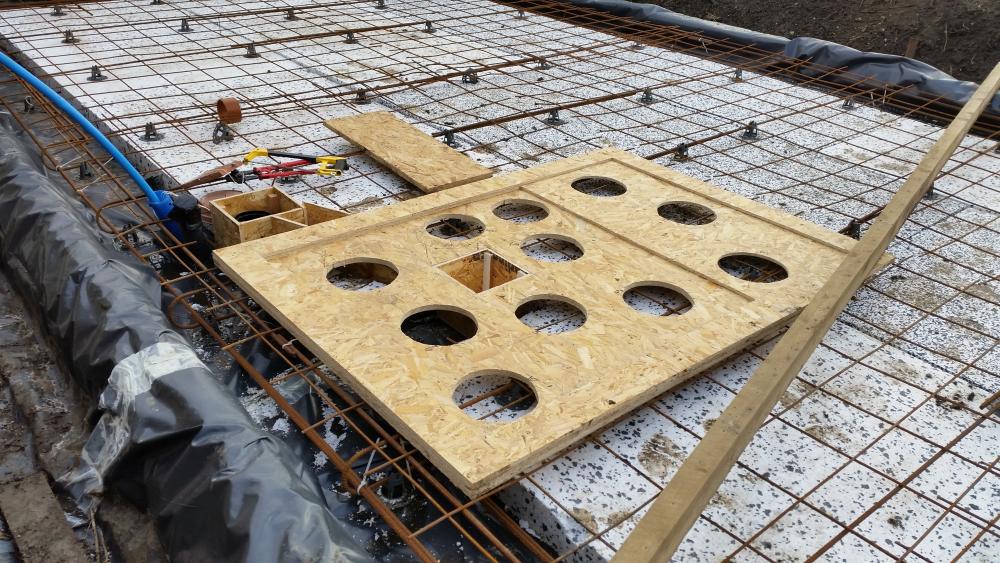
Yep Jamie here is the tray recess and associated tile recess just after I skimmed it over to smooth out the lumps and bumps. It was made using a former, second picture. (The concrete was poured through the holes that were then capped. Many thanks all, think I will go with @Nickfromwales suggestion as the non adherence of sand & cement seems to make good sense.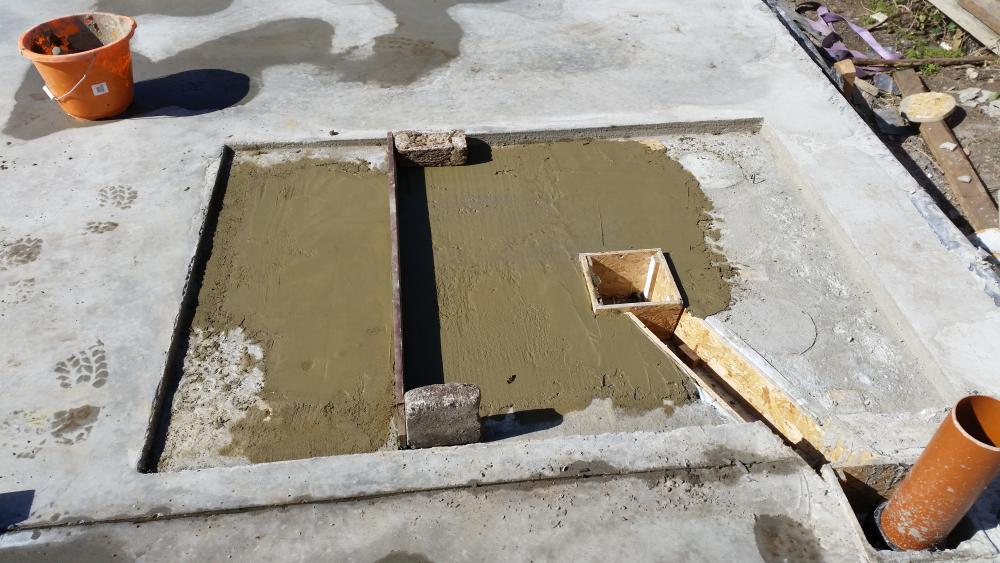
- 16 replies
-
- 1
-

-
- wet room tray
- level
- (and 2 more)
-
Steel lintel with granite heads
MikeSharp01 replied to DeeJunFan's topic in General Structural Issues
Der - I wonder how many mountains are held up by granite, must be erzatz granite as this link I think shows you can explode nuclear bombs in normal granite quite safely! Oh and take a look at here, because it says that Concrete crushes at 3T / in2 while Granite is at 10T /in2. All that aside if they say you cannot use it structurally and it fails then you cannot blame them. -
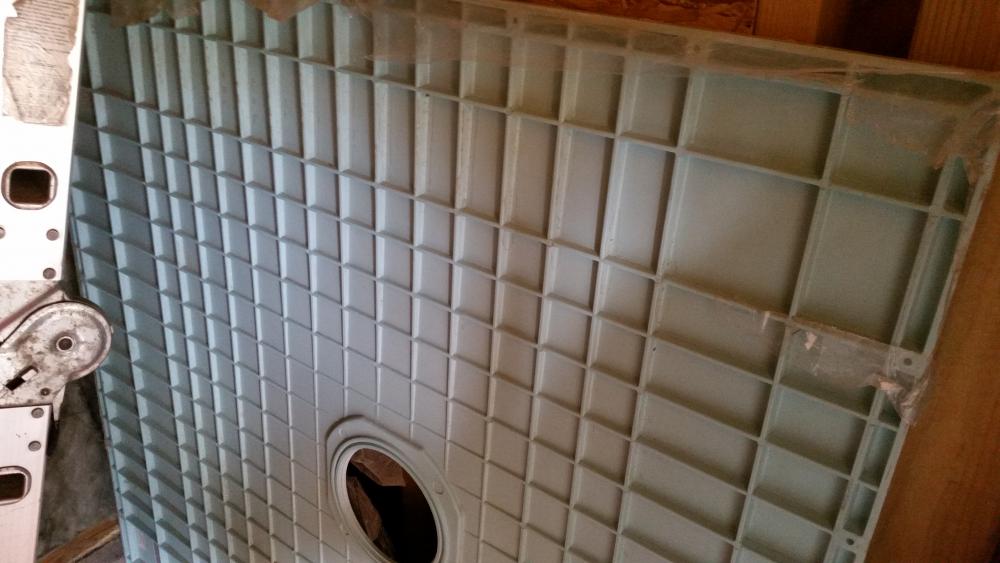
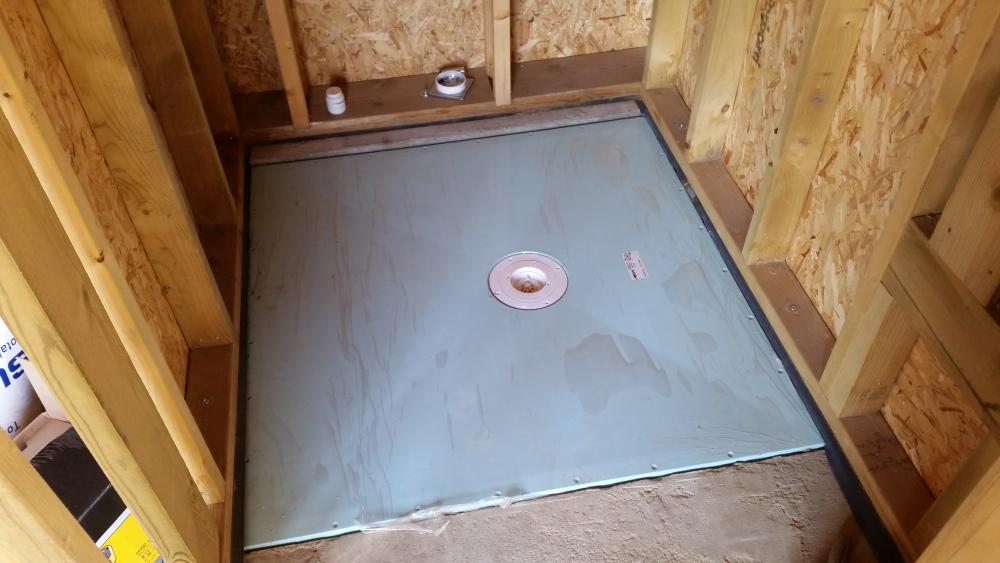
Well after a few months of work from laying the concrete around the mould / pattern or whatever the time has come to fit the actual wet room shower tray base and I am looking for ideas on how best to do this and what compound to use. The pic shows the underside of the tray with a lattice of ribs. The recess in the slab is flat bottomed and concrete. The tray fits into the recess in the slab perfectly but I now have to bed it down and I can see some possible issues. I have 5-8mm of height I need to make up so whatever I bed it down on has got to make that up or I will have very thick grout under the tiles. What would be a good compound to bed it down on. A sharp sand / cement mix or some such? My second concern is / are the air pockets that will form in the lattice structure and may make getting it to bed down a problem and indeed might cause it to move if the air expands while the bedding material is drying. I could fill the pockets with the bedding compound, whatever it is to be, before I lower it into position to cure that problem but whatever happens I don't want it moving off level while the compound dries. Any thoughts welcome.
-
Kick-starting the week
MikeSharp01 replied to ToughButterCup's topic in General Self Build & DIY Discussion
How do you go about controlling the scale of her to do lists? You know: Bring about world peace. Discover a new antibiotic. Make me happy. -
Kick-starting the week
MikeSharp01 replied to ToughButterCup's topic in General Self Build & DIY Discussion
PS just think yourself lucky that you are not the poor client who just got told on this otherwise glorious Monday that the project cost has just risen by £1.5 Billion (http://www.bbc.co.uk/news/business-40479053), oh sorry, just worked out that we are! -
Kick-starting the week
MikeSharp01 replied to ToughButterCup's topic in General Self Build & DIY Discussion
People say that when you retire there are no more Monday's! Don't you dare believe them, in several ways Mondays are bigger than before. For a start you are now fully responsible for what Monday brings. -
Building Regs / Construction drawings - what is needed?
MikeSharp01 replied to Weebles's topic in Building Regulations
For a timber frame sitting on a passive slab you will need the structural drawings and signs offs for both as well.


