


MikeSharp01
-
Posts
5693 -
Joined
-
Last visited
-
Days Won
16
Everything posted by MikeSharp01
-

Should I use conduit for cables in the service void
MikeSharp01 replied to MikeSharp01's topic in Electrics - Other
Ok, so, IF in a designated safe zone AND less than 50mm back AND protected by an RCD then mechanical protection NOT required. (specialized case) Is that correct it seems to be what the regs say if I read them right in light of this conversation. -
Should I use conduit for cables in the service void
MikeSharp01 replied to MikeSharp01's topic in Electrics - Other
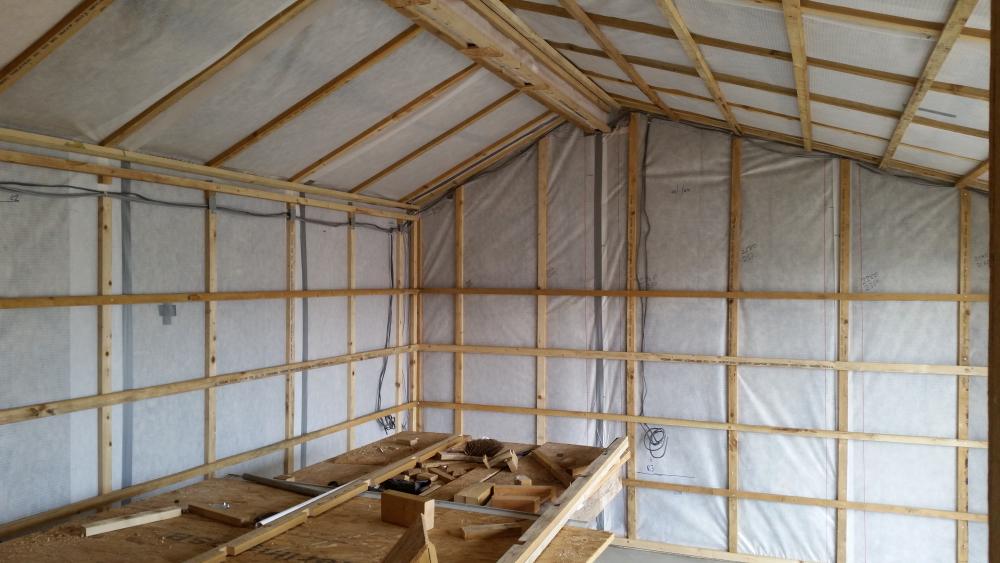
I agree it looks low but the ceiling in that area actually comes down onto the upper batten and after the thickness of the PB is taken into account the base of the slot is 130mm below the finished ceiling so should be OK even allowing for 'droop' between the battens. The VCL is 62mm back from the finished face of the wall so cables resting on it or, I guess, taped to it would be 50mm back, If I put them in conduit they won't but I guess that will be OK as they will be protected. Much thanks all, perhaps will get some conduit - see below. You guys already helped me out with the safe zones on the gable wall and I have been using the document at these links https://www.diynot.com/wiki/Electrics:walls and http://electrical.theiet.org/wiring-matters/54/cables-in-walls/index.cfm for my work although the second one is perhaps wrong in showing all the zones as the same when the drops from / horizontal runs between sockets need to be 50mm back or mechnically protected I believe and that one is from the IET although I am led to conclude that provided the circuit is RCD protected you do not need mechanical protection which is the path I was taking, not sure any more! -
Just been doing first fix electrics in the garden room and I am wondering if I should thread some conduit in around the drops to the sockets for the light switches, ring main and the network cables that run in the service void. You can see the drops in the photo. The wires will be 37mm back from the face of the plasterboard as they run behind the horizontal battens and if I use 30mm plasterboard screws that will be OK and given that they run vertically down to the sockets they should be in a safe zone. All the same I thought I would elicit opinions.
-
Simple scaffold cost guess-imations ....
MikeSharp01 replied to Pocster's topic in Tools & Equipment
Is that per week / month / year? -
Seems like we all have a lot in common - I guess Google could profile us. I made quite a lot of gear for packet radio, did some work with 2m moon bounce, still got the power valves somewhere, and spent a lot of time making steerable aerials for UoSat. Then I got into digital stuff, networks and the like so left the Ham stuff alone, still got the full setup in my workshop, turned it on just now seems to be alive!
-
What do you know..? got my licence in 1977!!! Not much action on the bands these days though
-
Yes but beware the links...you never know where an @Onoff link will take you.... .
-
Why is my phone telling me about exercises for my hips??? Blasted @Onoff links....Maybe the bathroom pace is being slowed by time dilation caused by excessive surfing spreading links....
-
Can't see why they wouldn't will see if I can dig out the GB'S ref.
-
Welcome.... Sounds like a great idea.
-
Cripes! I guess the old adage: Keep calm and carry on.. is about all we can say. Thinking of you!
-
Replace the top of the threshold with a fibre glass box section filled with expanding foam. This should take the load not already taken by the horizontal side fixings on the frame. Think GBS did this and we are using the same approach on our build.
-
Ours was submitted electronically as a set of PDFs all bound into one document. Sadly Milton Keynes is a bit out my way - I am in Kent otherwise I would have given you a hand for a day. I have a total station and have taught myself to use it so it ain't hard, I paid £650 for it but I was looking on ebay / gumtree for 6+ months before the one I wanted came along at a price I was prepared to pay.
- 18 replies
-
- 1
-

-
- surveying
- topographical
- (and 1 more)
-
Where aBouts are you!?
- 18 replies
-
- 1
-
-
- surveying
- topographical
- (and 1 more)
-
Yes I used to have a car like that!
-
Welcome to THE self build forum. The dreaded mortgage is always a good place to start. Lots here go to Buildstore I think, if its an eco home the ecology BS direct and some use brokers. If you just enter mortgage in the search box you will find many links to tales littered with wisdom and a few with woe.
-
Yes mine worked OK but there were some voids under it where the concrete did not get even though I had all those holes, suspect I lost concentration on it as well, and, although I have not got any cracking in the slab, I think I should have surrounded it with a ring, welded, of rebar as the slab is thinner there and so any stress will have a better chance of cracking the slab and I don't want them to get out. .
-
Work on perpetual motion cos I suspect Trump and Kim Jong-un will bring about world peace shortly - on the beach fashion sadly, but peace none the less.
-
Is your list hyperlinked? It might be a useful resource in itself!
-
I have only had one and I think it is M, I always go for M as it is my first initial!
-
Eh up Erwin. Looks great, remember if you need a hand that I am happy to return the favour you did us. Quick question, have you elevated the mesh or is that to be done, looks like it is resting on the insulation in the Pics.
-
We wanted to use Colourcoat Urban and every time I met a rep at a show they were great but the follow up was much weaker - sounds like they have gotten their act together by moving it to Catnic as its a great product but we have had to move on. I only hope the sales team minions I met were moved as well otherwise the poor bloody infantry get it again for poor leadership.
-
Ok CJ-Lithium then.... not quite star trek!
-
Oooooops.... If you had a square made of four bits of timber with a nail at each corner you could squeeze it quite easily into a diamond shape - that is racking. If you put a diagonal across the square, nailed at each end, it becomes two triangles and suddenly it is much stiffer you won;t be able to deform it to a diamond without bending or breaking it - so the diagonal gives the structure racking strength. Your steels, uprights and horizontal members are in effect the square. Once you fix them to the wall the wall effectively becomes the diagonal member and makes the structure stiffer. It may be that the SE has already specified diagonal members in the steel frame in which case the wall is probably not needed to do the racking unless they have designed the cross braces to do half the racking strength work and the wall the other half - which I doubt.
-
Just saw on the BBC that there is a company looking to extract the lithium from old Cornish mine water! What is the generic name for a Cornish man / woman because that will be the prefix for Lithium from Cornwall.
