


MikeSharp01
-
Posts
5693 -
Joined
-
Last visited
-
Days Won
16
Everything posted by MikeSharp01
-
 I think that is the max distance between drips, but if you use expansion joints you can go much further. I chose lead because it is easy to work, can be serviced and is one of very few 'metals' I could make it from an get close to a good life as close to the sea as we are. GRP is the only other option I think now.
 -
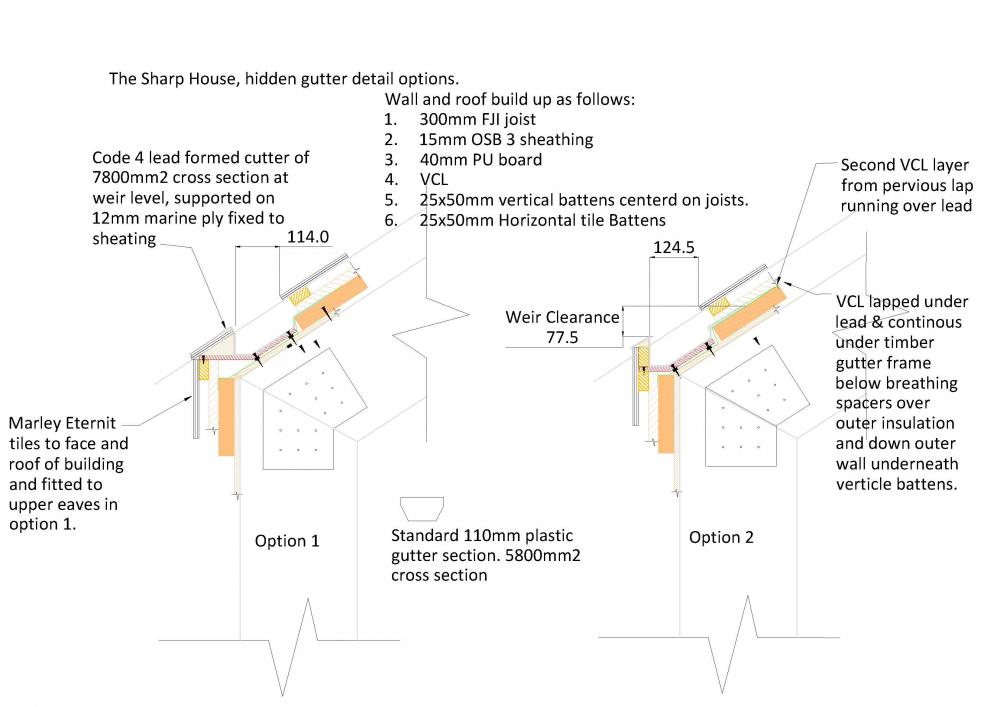
Thanks for all the feedback. I am not sure of the flat bottom issue, many gutters are half round and the one I chose to measure is as shown in the drawing - so I need to look into that but otherwise both the designs have a cross section much bigger than a standard plastic gutter 7800mm2 as opposed to 5800mm2 and the weir, so excess water pours over the top and runs down the outside of the walls, means overflow is dealt with if there is ever a problem with a down pipe so I am not sure capacity is a problem. I can deal with expansion, max run is 9m, by fixing in the middle and having falls both ways so limiting the fall total and the expansion at the ends. So expansion would be about 6mm per leg assuming a range between -5 and + 40 Deg C. The down pipes are in plenty of space so can move. Yes I will have to lean to solder lead but I can get that practice in. The essential challenge for me is the space I have available the there is a space of 90mm running round the main structure, which cannot be cut into, and this creates the space for the gutter. I will go back and see what I can do to improve things. The alternative is to forget the gutters and put drains under the walls and just let the water run down them.
-
After 8 months of going very slowly on the main house build, returning to work 2 days a week plus a bereavement has not helped, I am approaching needing the hidden gutter detail. The architect gave me some ideas but after a lot of discussion with some of my materials colleagues I have concluded that zinc / grp / powder coated aluminium wont cut it and I have decided to go for lead. It is a hidden gutter and having looked at loads I have come up with a couple of ways of making it happen, see section images below. I think I like option 2 as I don't have the phaff with very short roof tiled section at the eaves. Both have a slight problem in that cannot see a way of getting a through draft under the supporting marine ply. I also wonder if I should give up on the second, upper, over lap of the lead with the VCL and take the lead all the way up to the underside of the tiles, this saving a problem with an insect guard. Anyway thoughts appreciated.
-
When moving it in you need to look at the cold bridge again and make sure you take every opportunity to get insulation round the frame so there is no direct path other than those that cannot be avoided into the building. The outer cill is a place to look as it will be on the blockwork and the inner one also as you are already loosing some of the frame to the cill see if you can get some insulation in. Also when standing the frame on the interstatial insulation, as you will if you are moving the frame back, you make need some small structural rethinking.
-
I guess the accuracy ( & resolution) of the output of any model is some function of the model complexity but also the combinatoral complexity of the model and reality which you cannot see until the house is built. The PHPP is relatively complex when compared to 2013 so is more able to show the effects of critical variables. In the end they both suffer when put up against build quality and material selection which feels like it has a big effect while not being a model feature any where. So only once built can you assess the real energy in / out evelope accurately but once built you cannot be sure which bits of the fabric are doing what specifically only generally. Air tightness can be measured and modelled but it's much harder to model the actual effects of the build in its environment. As I believe @JSHarris found the micro climate has a big effect on the actual outcome and thus in turn effects the energy in / out equation. I think that this just means that we probably need to give the building a final rating after several years of use so as to have an accurate picture of the usage. However in the era of global warming we are probably getting incrimental wins from our homes which the models - based as they are on historic patterns don't account for.
-
Air Source Heat Pump vs Oil Boiler
MikeSharp01 replied to paulc313's topic in Air Source Heat Pumps (ASHP)
People who have been there and got the tee shirt will be along shortly but for me the issue is two fold. 1. The embodied energy / carbon in making the equipment which needs to be part of the equation and 2. The carbon created in driving the system EG from the oil in one case and from the grid / PV in the other. Once you factor these in to the total cost to the planet you may get a different answer. -
Some people are desperate to buy a developer new build ...
MikeSharp01 replied to newhome's topic in Housing Politics
Very Northern powerhouse - but I guess help to buy is all over the UK. -
Yes its interesting how the planting mix will effect the whole scheme. They also have interesting acoustic properties so might bugger up your listening pleasure! Auto watering feels like a must with some sort of feed doing system as well.
-
Just got inspired by seeing some living walls at the SFMOMA and wondered if, assuming you could get the light about right, whether you could get the rest of the environment sorted and maintainable in a passive or near passive house?
-
Amersham where to stay ?
MikeSharp01 replied to Pocster's topic in General Self Build & DIY Discussion
Do you know / ever met Ed (Reardon)? -
Can you build block work on polished concrete?
MikeSharp01 replied to MikeSharp01's topic in Foundations
Thanks I will tell him. -
My brother in law asked me a question I could not confidently answer today. Tomorrow he is laying a garage floor that he wants to polish and was asking if he can polish right to the edge and build directly on it. Looks like it's structurally ok but not sure if cement will stuck to the polished floor.
-
VHS or BETAMAX the battle of two technologies relived.
MikeSharp01 replied to MikeSharp01's topic in Boffin's Corner
Yes he used the difference in cost between his 3 year old diesel vans and an all electric fleet going into the zone every day. TBH the new vans are much smaller than the old ones but he and his team seem to have that sorted by being a bit more organised. -
VHS or BETAMAX the battle of two technologies relived.
MikeSharp01 replied to MikeSharp01's topic in Boffin's Corner
Can you even imagine what a new windscreen will cost when you crack it! -
Which side of the iron curtain was that then Herr Bosch!?
-
VHS or BETAMAX the battle of two technologies relived.
MikeSharp01 replied to MikeSharp01's topic in Boffin's Corner
I guess that is the essential point Steamy - PS good to converse with you again. -
VHS or BETAMAX the battle of two technologies relived.
MikeSharp01 posted a topic in Boffin's Corner
I had a conversation with my brother yesterday - he has just invested in some electric vans for his team to use in the new London low emmission zone (it appears a no brainer as the fleet hire and electric cost is less than the zone charges after about the first two weeks of the month - some incentive that!) Anyway we chatted about the vying power technologies and wondered if we are not in a VHS vs BETAMAX situation where the energy density by weight of Hydrogen (BETAMAX) was loosing out to the much less energy dense battery technologies (VHS) perhaps all because of the cost of producing the hydrogen by one or other of the routes available. Suffice it to sat that we concluded that both these technologies are dead now so we might as well go with the flow and hope we live long enough to see the DVD of car power systems. The good old S curve strikes again! ? -
Anyone used an electric stair climber?
MikeSharp01 replied to Jeremy Harris's topic in Tools & Equipment
Is it possible to ask why this 150Kg object needs moving or have I missed something? -
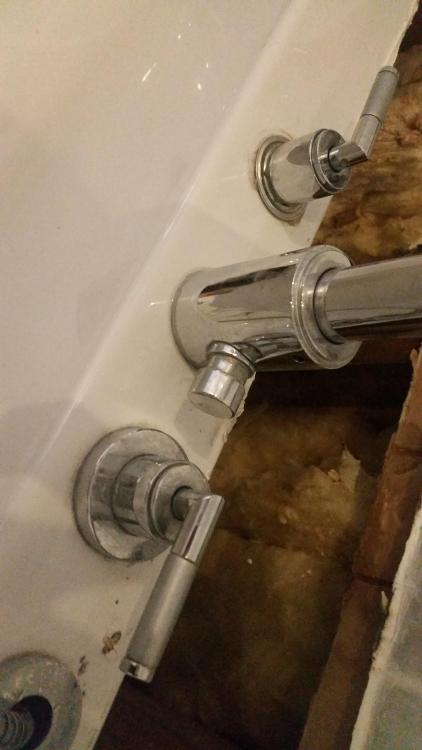
Spotted a leak coming out from under our ensuit bath last evening. Traced it to one of the taps being cracked open and a leak from the diverter valve that had found a hole in the silicone seal. Have got the bath out but before I take the diverter to bits I wonder if any body knows what I will find in there. The diverter button assembly looks to have a couple of flats on it so I assume it unscrews but I thought I would gather the collective wisdom before I tried.
-
Grand Designs at Graven Hill starts tonight on Channel 4
MikeSharp01 replied to ProDave's topic in Property TV Programmes
15 mins in not a mention of thermal mass so - single points only. -
Passivhaus certified roof lights with electric opening
MikeSharp01 replied to joth's topic in Skylights & Roof Windows
Both Fakro I hope ours open electrically as that is what we ordered and Velux supply ph rooflights with electric opening. -
A chippie's advice please ... tear - out?
MikeSharp01 replied to ToughButterCup's topic in General Construction Issues
It is tear out and it's down to the way the blade attacks the grain the rotational speed and the feedrate. If you look at the picture you can see that the right hand edge and the bottom edge are very tidy because the blade is moving into the grain the other edges look to be where the blade is lifting out and the grain is open and not dense. You need a much finer blade running fast, fed slowly and very sharp to achieve the best finish on all surfaces. Setting the blade depth to just a bit more than the thickness of the material will help as this optimises all the angles. -
Sorry day disappeared yesterday. I will pop in later - wonder if I can make it do emulsion suitably watered down.
-
Did it come with a viscosity cup? PS have not seen one in Lidl this week! (YET)
-
You should be able to add up all the ground floor areas of the building or 1.5 times the orgininal ( what it was in 1954 or as built if after) house. We are in London GB + AONB and both us and our neighbours have used one or other of these routes.


