


MikeSharp01
-
Posts
5693 -
Joined
-
Last visited
-
Days Won
16
Everything posted by MikeSharp01
-
Welcome to THE forum for self builders and their other halves. Not sure how we can help with your wife. You do need to tell her that this will be a big challenge and perhaps won't go smoothly - you can read any amount of tough news here and you need to be clear with her as there is no point in wrecking your relationship if it all becomes too much.
-
 Yes just get a demolition order and do a bit. That should trigger 'start' back at the council.
 -
+1 dont use kiln dried but there are loads of examples of oak external stairs - they do move and split but provided you get the grain going in the right direction they won't warp too much. It might also depend on the external environment a bit. If it's wet / wooded / north facing then it will very soon grow algi and get slimy which can be a problem. If open / south facing it should be fine. So if using steel with treads you need to watch out for this or buy a jet washer.
-
cold bridge would this help
MikeSharp01 replied to scottishjohn's topic in Structural Insulated Panels (SIPs)
There may also be structural issues with plastic which over time might 'flow' if under high and continuous load. -
Wood burning stove and flue install
MikeSharp01 replied to ProDave's topic in Stoves, Fires & Fireplaces
Tidy work, I wondered what the roof work was in one of your posts over the weekend ranting about the weather forecasts! -
That is interesting, I just took the house next door as an example of required drainage arrangements and used the part H rules for the BC stuff, seems I could have been much more refined.
-
How do you work out how many down pipes I wonder.
-
Impressive - house of the year next year.
-
Bluetooth 5. Experience anyone?
MikeSharp01 replied to ToughButterCup's topic in Networks, AV, Security & Automation
Maybe this will become the defacto standard for short range comms and larger meshe's in the consumer space but has its limitations. I am still wondering which will win bluetooth or wifi not sure who is attacking or defending given the space is relatively undeveloped. The bluetooth security in v5 might help but the extended range of v5 makes the security weakness of bluetooth even more of a problem. Lower power demand of bluetooth is always a plus but even v5 limits the data rate to 2mbps IIRC. -
Anyone ever used UPWORK for Architect/Structural Engineer
MikeSharp01 replied to Patrick's topic in Surveyors & Architects
You need to be clear on the professional indemnity insurance position here as, if it all falls down, you need someone to pick up the tab. -
Torx concrete screws: are they the same as framing screws?
MikeSharp01 replied to ToughButterCup's topic in Tools & Equipment
If, as I suspect, these are going to be mainly in shear, IE holding the plate on the wall, then a few M10 screws, provided they don't split the blocks, will have significant supporting capability. Typically in the order of 10Kn (appox 1000Kg) each. -
Torx concrete screws: are they the same as framing screws?
MikeSharp01 replied to ToughButterCup's topic in Tools & Equipment
My Experience with these screws is that the pilot hole is critical, don't use a worn out SDS drill, get a new one as factions of a mm make one hell of a difference to the torque you need to apply. Also once you start driving it in keep going until its fully in, stopping is also a problem I found, I did the last bit using a spanner rather than the impact driver. Good thing is they usually unscrew if required. -
Very neat combi @Alphonsox and the speed is great, funny thing though - I have a group of 50 Chinese Engineering students who cannot recognise the Chairman or Chief executive of Huawei from their pictures but can instantly recognise Steve Jobs from his - and he is dead while the other two are still alive (I believe).
-
What is the best pipework system for a life inside the wall?
MikeSharp01 replied to MikeSharp01's topic in General Plumbing
Ok, quick trial with a wooden former and I can get the pipe in with a 90 deg bend, so I will build formers into the wall and run it as one continuous length of HEP 2 pipe. PS Other air handling companies are available - but perhaps they don't give out free scale rules at exhibitions.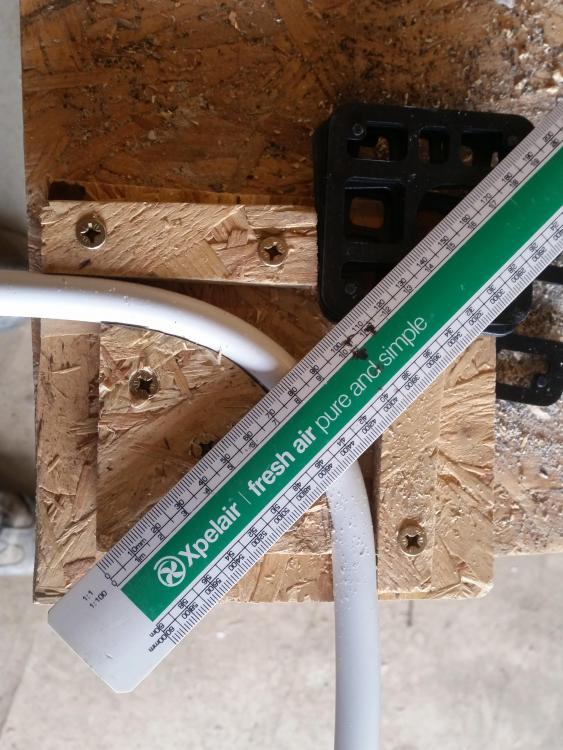
-
What is the best pipework system for a life inside the wall?
MikeSharp01 replied to MikeSharp01's topic in General Plumbing
HEP do supply a former, it can deliver 120mm radius, I wonder if I can squeeze it down a bit more, will give it a try later. Yes but will they pay the bill for the damage or the water used I suspect not. One of my former colleagues had a push joint fail and it wrecked his whole house, he was out for 6 months while they fixed it. It was a new build and the builders blamed their plumbing contractor but in the end his house insurance picked up the whole tab and are, as far as I am aware, 4 years later, still chasing the builder. Yes that is the way I wanted to go but its a pain to get in, and I will need soldered joints somewhere. If I can get a 90 deg bend into 80mm I will go with HEP I think otherwise - given my colleagues experience I will find a way to get the copper in there. Thanks all for you support... -
What is the best pipework system for a life inside the wall?
MikeSharp01 replied to MikeSharp01's topic in General Plumbing
What will he say I wonder - he is something of an evangelist for HEP as I recall it. -
What is the best pipework system for a life inside the wall?
MikeSharp01 replied to MikeSharp01's topic in General Plumbing
Great idea - I have not tried bending this pipe tight, I will look it up, but I guess I could and I have got about 80mm depth to turn 90 deg. -
What is the best pipework system for a life inside the wall?
MikeSharp01 replied to MikeSharp01's topic in General Plumbing
Makes sense will have to find a virtual 'attic' as we don't / won't have one here. -
I have to run some pipework inside the wall around one of our showers. I had decided on plastic (HEP / JG or some such) but I have to turn it 90 deg inside the wall and then another 90 deg to bring it out of the wall. I can get it 50mm deep and protect it behind a metal duct cover along the run and the wall will be tiled anyway. My concern is the two 90 deg bends and their reliability over the N years the house will be up. I wonder if I might be more sensible to run this in copper or use compression fittings on the plastic pipe for the 90 deg bends. (I will pressure test it once it is in and before the wall coverings go on naturally.) I have a load of JG push fit fittings that have held sound for 10+ years now back at millstone manor although I can get at all of them if needs be. Any thoughts?
-
Welcome to THE forum - looks like a great project.
-
I tend to agree that it might well be just a classical control theory problem if it were not for the fact that this deep learning stuff is disrupting classical theories across the piece. Although a vast training set it required in supervised networks for improved accuracy one might envisage a situation where an unsupervised network might learn from a number of houses which while being very different do have similar reactions to similar stimuli. Good to chew it over though.
-
Are not all icings carbs - well C6H12O6 like anyway, feel like a right onoff I do.
-
Welcome to THE forum for self builder. Seems like a very tight budget but might be doable. Perhaps the optimum route would be to find a derelict existing dwelling with a good foundation so you can build on that and get the VAT back, there are some rules on how much you can retain, although you will pay more for the plot all the services will be there and planning should be straight forward. The trick is going to be to draw a polygon around Dunstable with the periphery lying on a 1 hour travel (fast car / slow car / bike / train etc). That's quite a long way up the M1 (don't go south as prices get silly) but not as far across country. Then look for the cheapest areas and try and find a derelict building - auctions are good.
-
Welcome to THE forum for self builders.
-
The assumptions here need unpacking a bit perhaps. When talking about BSP we usually assume parallel threads because the technical extra P (BSPP) is assumed while NPT does what it says on the tin (National Pipe Taper) has a tapered thread. To get a correct 'mating' you would need to use another NPT fitting. Tapered threads are designed, among other things, to seal themselves as they tighten with minimal packing while parallel threads usually need some additional sealing such an olive, a sealing face or washer. If you try and get an NPT (male) to mate with a normal BSP thread (female) it only meets at one place so is very challenging to seal and can split the female fitting. There is a NPS (straight) form as well but you don't see that about much. All the details can be found here: https://www.valvesonline.com.au/references/threads/ from Oz but as it is talking about the standards of two other countries I think it can be relied upon.

