Iceverge
-
Posts
4384 -
Joined
-
Last visited
-
Days Won
31
Everything posted by Iceverge
-

Advice needed on electric UFH idea (outbuilding)
Iceverge replied to anarres's topic in Underfloor Heating
Well done on the insulation. You won't need much heating at all. A cheap second hand storage heater could allow you to shift all the load to a cheaper tarrif. UFH mats over a slab would be able to achieve this to a limited extent too. I think they'll be fine. -
Horizontal cylinder in the loft, good idea?
Iceverge replied to Post and beam's topic in Boilers & Hot Water Tanks
As close as possible to the kitchen tap as possible is best for a quick time to hot. Then run 10mm pipes to the basins for speed of delivery there. The warm up time doesn't really matter as much for showers and not at all for baths. -
Guage Pitch Length Alternatively (and I'd recommend this) sharpen the chain. The chainsawing experience is night and day with a sharp chain. I couldn't make any fair attempt of it until I bought one of these. Also sold as Stihl. I have a knock off and it works well too.

-
MVHR design help / feedback
Iceverge replied to Ola's topic in Mechanical Ventilation with Heat Recovery (MVHR)
@jon3 The house I grew up in was regularly 12deg overnight. Icy noses and fog from your breath, mould on the walls and everyone always had a cold. The only practical way I can see happening for a modern building is to make an uninsulated "storage space" in the attic, plasterboard it out and use it as a bedroom. Ensure you have a huge amount of ventilation however as it'll quickly get mouldy otherwise.- 18 replies
-
- 1
-

-
- extract / ssupply points placement
- cascade effect
- (and 1 more)
-
An introduction... Renovation + 1950s + subsidence = a challenge!
Iceverge replied to alfaTom's topic in Introduce Yourself
@alfaTom Welcome Welcome Welcome. Looks like a nice spot from the top pic. Excellent News. Have you considered burning it down? -
I assume that you'll be insulating from above with mineral wool? If so just cut an appropriate triangular shape of mineral wool and shove it up there, careful not to block eaves ventilation if it's required. ( I've forgotten your roof Construction) . Then use airtight tape and membrane to seal the window to the wall. Then screw in J beads into the window and slot in your plasterboard.
-
dMVHR suppliers list (not complete)
Iceverge replied to HughF's topic in Mechanical Ventilation with Heat Recovery (MVHR)
@JohnMo what did you use in the end? -
SIP strip foundation detail
Iceverge replied to Cormac Foley's topic in Structural Insulated Panels (SIPs)
Sorry I missed your reply. Here's one from another thread I drew up for a timber frame. Nope. PIR doesn't fare particularly well in these circumstances. EPS is best.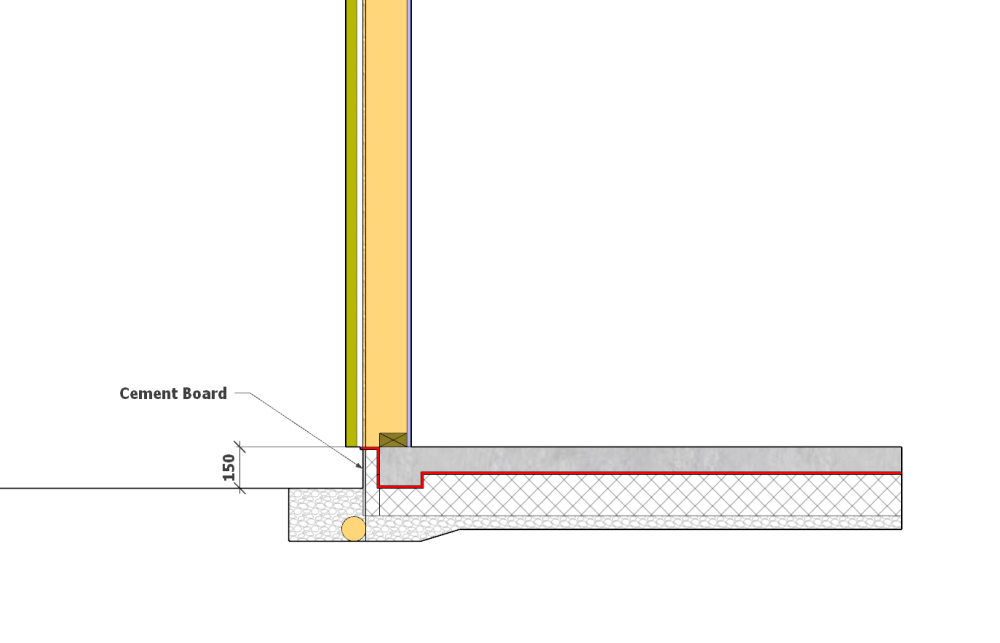
-
Weatherboard rather than brick, effect on U values
Iceverge replied to Post and beam's topic in Building Materials
Kingspan are playing tricks here. You have a ventilated cavity in both cases so bricks or weatherboard will make no difference to the U value in reality. They are simply there to keep the rain off the timber frame and maybe in the case of brick to add a little to the structural stability. Looking at their product which i assume is 140mm kooltherm between the studs and 40mm over the top just maybe scrapes a U value of 0.155 ish. Are you committed to their system? -
Paint it with some dilute PVA.
-
I wonder would wet UFH buried in the slab and a layer of electric underfloor heating just under the tiles for the summer be a worthwhile system just to de chill your feet. We don't have any heater in our bathroom but being in the bath with the air temp at 20deg can feel chilly when your skin is wet. I did put a cheapo fan heater in the shower room and it can get the room up to nearly 30 deg very quickly but it's a bit noisy. Maybe an IR heater just to warm your skin briefly when in the nip would be more pleasant. There doesn't seem to be any need to actually heat the room otherwise. @Nickfromwales I'm sure will have chapter and verse.
-
I would preferably something like this for a pitched roof. Much less wasteful of labour and material and cheaper by my calcs too. Better for airtightness and windtightness and heat protection also if done properly.
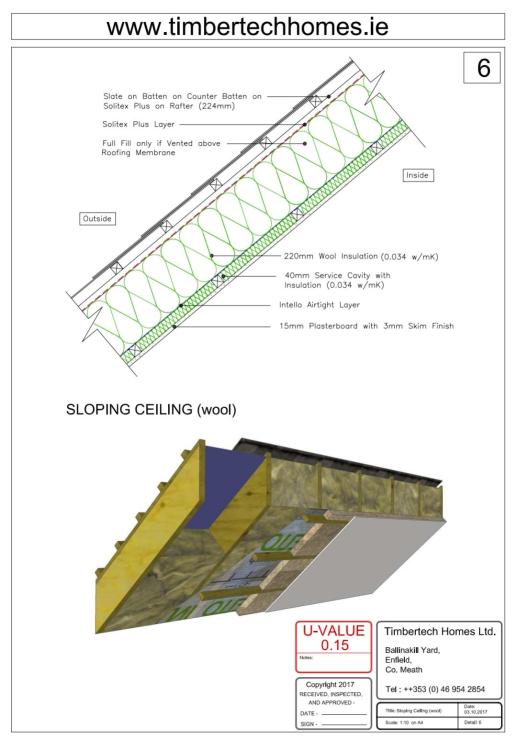
-
If you look for Walltite and Isothane closed cell foam there'll be some documentation. It's about 5 times the price of bonded EPS beads hence its rare use but it is an option.
-
Hard to say without knowing airtightness levels. Form factor (external surface area Vs floor area) is important too. Also glazing levels. Even the best windows normally only achieve a total u value of about 1.0 by the time you take into account thermal bridging due to install so even if they're the best windows they'll still be 6 times worse than your wall. If you have lots of windows...... HOWEVER. ......big houses have better airtightness scores and better form factor scores. Assuming you have MVHR I would think that 20w/m2 would be an adequate heat load for sizing the ASHP and 30w/m²/annum would cover the heating demand. So 508m2*20w ~ 10kW ASHP minimum. Add bit for DHW and mum maybe. Lets use gas first of all. And 508m2 X 30w/m2/annum ~ 15000kWh @10p/unit of gas =£1500 plus 1000kWh=£100 per person per year for DHW. With 5 occupants you would spend £2000. OR ASHP @ a COP of 4 for heating all done on a TOU( time of use) tarrif at say 15p/KwH would be €562/year. DHW at a COP of 2.5 half day rate half E7 or similar would be ~£500. Total ~£1100 per year. Your mileage may vary depending on the cost of your utilities. In any case install UFH capable of using a low temperature input buried in the slab so you can bank heat on an ASHP using TOU at a later date if you go with gas initially.
-
It can be done, it's only about 6 mixers. However..... I'd probably go for a volumetric mix or 1m³ delivered. It won't cost much more and it'll be a far more consistent pour. Concrete is heavy enough work without shovelling 2.5t of ballet and cement into a mixer on top of barrowing it in and shovelling it out too. No need if you're tidy with a hand float after the pour. No Yes. Yes. I would put. Hardcore. A minimal amount really say 50mm just to level the existing ground. The subsoil will be plenty stable under an existing house. EPS insulation direct onto the ground.( If nothing else it's far easier to cart in than hardcore) Say 100mm. DPM, lap it well up the walls and tack it there. It can be cut back later. 100mm of concrete. You could probably reduce this to 75mm with some fibers in the mix to reduce digging and mixing.
-
SIP strip foundation detail
Iceverge replied to Cormac Foley's topic in Structural Insulated Panels (SIPs)
EWI on PIR wouldn't be a normal detail. EPS is better for this. I think you're better off ditching the strip foundation and just making an insulated slab from EPS. -
What is it about solar thermal and solid fuel heated water. Completely outdated, expensive, require too much maintenance but none the less my inner schoolboy really likes the idea of playing with them.
-
MVHR design help / feedback
Iceverge replied to Ola's topic in Mechanical Ventilation with Heat Recovery (MVHR)
That's very cold. You'll be suffering from damp and very high humidity. 18deg is probably better IMO.- 18 replies
-
- 1
-
-
- extract / ssupply points placement
- cascade effect
- (and 1 more)
-
That sounds fine. It'll give you a U value of about 0.22.
-
I wouldn't bother. We did both and the one without is much better. Less bubbles etc. I think this is mainly due to the thermal coupling of LVT and concrete with underlay.
-
SIP strip foundation detail
Iceverge replied to Cormac Foley's topic in Structural Insulated Panels (SIPs)
What are the layers on the outside of the lightweight concrete block and the soleplate? -
Put a couple of these on it, take regular pics of it and save it to the cloud. Delay rendering until all movement has stopped.

-
I wouldn't worry about that. How long since it has been built?
-
Laying brick on a compacted base?
Iceverge replied to Tony K's topic in Landscaping, Decking & Patios
Your issue is differential settlement. You can tackle this by either having a very consistent strength of substrate to your foundation or else having a strong foundation that will ensure the whole structure sinks/moves evenly and prevents cracking. You are going for the first solution. Thinking out loud here. As a idea you could hammer some timber pegs to the point of refusal under the paving slabs and then trim them level with the hardcore. They would act as mini piles. Otherwise consider 2 layers of paving slabs with the joints crossed. Probably overkill. 99% sure if you build bricks straight onto the hardcore it would stay put. -
Pitched roof - PIR between+ above or under rafters?
Iceverge replied to low_and_there's topic in Heat Insulation
A sketch would be valuable here. Avoiding PIR between the rafters is best. How much roof thickness do you have to play with. U-Value is only one component of a house buildup. Don't forget airtightness, windtightness, decrement delay, fire performance, longevity, noise protection, material availability, cost, thermal bypass and condensation risk.