


Jeremy Harris
-
Posts
26430 -
Joined
-
Last visited
-
Days Won
360
Everything posted by Jeremy Harris
-

Can a Raspberry Pi run android software
Jeremy Harris replied to dogman's topic in Networks, AV, Security & Automation
I'm still playing with this, and have sort of got Android to work on a RPi 3, but frankly it's not pretty and is very slow when trying to display video. I have a feeling that this is a bit of a dead end, as there is a problem with the GPU driver. One of the main problems seems to be that Android on the RPi can't use hardware acceleration, due to the lack of a driver for the GPU, I think. As a consequence, it tries to do all the video processing in the main processors, and that seems to be very, very slow. I'm sufficiently interested in the idea of trying to do this, for my own use, that I'm going to try and get hold of a Rock 64, as that should be able to run Android with good video performance, I think. It's only around £20, so not much wasted if it doesn't work. They don't look to be available for a few weeks, though, so it may be a while before I get the chance to try one out. -
You can also use hyperlinks within a master document index as a way of finding things. I started doing this, but found it too tedious to maintain. The idea was to have an index, created as an ordinary document (I used Libre Office Writer, but Word or anything else should be able to do the same). This index had hyperlinks that led either to files stored locally, or to websites. It works well, and is easy to search, but maintaining it got to be a real pain, and I ended up just relying on memory as to where things were located. What I did find was that bookmarking websites wasn't always reliable. Manufacturers and suppliers, in particular, seem to regularly update their websites, sometimes making older bookmarks fail.
-
I've done much the same as @PeterStarck, but have to say that you do end up with a lot of data. My "House information" folder has around 30 sub-folders and is currently sitting at around 26GB. What I have found is that it doesn't take long to recall where stuff is using this system. I have sub-folders with names like "heating", "ventilation", "planning permission", "building control", "plumbing" etc, and that seems to make finding things reasonably quick. I dealt with the need for portability by having three 64GB USB sticks, which are synchronised with the main folder every night. That way I could be reasonably sure that I'd have the information I needed with me, or plugged into a laptop or tablet on site. My biggest problem was not having an internet connection on site. With no mobile signal I had to rely on having a local copy of any information I needed.
-
How many bricks a day can you lay?
Jeremy Harris replied to Jeremy Harris's topic in Boffin's Corner
I was taught to lay bricks when I was about 11, by the builder who was building an extension to our house, to provide a ground floor bedroom for my parents, plus a self-contained flat for my grandmother (I still have the bit of bent, galvanised, bucket handle the builder gave me to point up with). My father was a great fan of Churchill (the "S" in my name stands for Spencer, my middle name, and named after the great man). My first ever brick walls were for a curved, raised, rose bed, raised so my father could access his roses. I remember the summer I built those walls vividly. My father was sat in his wheelchair on the lawn, listening to the cricket, and reminding me every half hour or so that Churchill would have laid twice as many bricks in the time than I had.............. -
Sometimes nightmares are real: the insurance story
Jeremy Harris replied to ToughButterCup's topic in Self Build Insurance
The thought has crossed my mind, more than once, as I'll never recover the cost of legal action, simply because I don't think the web site owner has the money to cough up. -
It seems someone's come up with a robot that can lay over 3000 bricks a day, pity it can't point up afterwards:
-
Roofing questions for the brave!
Jeremy Harris replied to Pocster's topic in Roofing, Tiling & Slating
Interesting variations. We have 18mm OSB sarking, 50 x 25 counter battens lined up with the underlying rafters, membrane, then 50 x 25 battens for the slates. The counter battens allow the membrane to droop enough to form a drainage path under the battens. There's no doubt that sarking makes for a much more robust roof. In our case it's primarily adding all the racking resistance to the ridge beam hung rafters, but I like the fact that the insulation is retained by the sarking, too. -
Can a Raspberry Pi run android software
Jeremy Harris replied to dogman's topic in Networks, AV, Security & Automation
I can also add that my initial look-see doesn't look to be promising. RTAndroid is aimed at industrial machine control, and is far from user friendly, in terms of downloading and burning an image. It looks like building a custom image may be the only way forward, and frankly that's not something for the faint hearted (and it takes a fair bit of time). There is another Android project for the RPi3 that I've been looking at, but that's even less user friendly, as it looks to be essentially a "geeks only" project. There are other options, though. The very new Rock64 natively supports Android, and in its 1Gb form is cheaper than a RPi3 ($25), yet still has all the interfaces needed (HDMI, Ethernet, USB, but no WiFi or Bluetooth): https://www.pine64.org/?page_id=7147 As @PeterW says above, though, because you'll need one per TV this could get to be an expensive and slightly awkward way to do things. I'll carry on digging around, but my initial thoughts are that using a RPi isn't the right approach, as apart from anything else it looks very much as if the Raspberry Pi Foundation are very anti the whole idea of running Android, so won't offer any support. The view seems to be that supporting Android on the RPi would be counter to their educational aim, and would be focussed solely on consumers. Not sure I agree with them, but it's their toy set, so they can call the shots. -
Sometimes nightmares are real: the insurance story
Jeremy Harris replied to ToughButterCup's topic in Self Build Insurance
The web site is run by an RoI citizen (the same one that caused the demise of Ebuild), but is hosted by a US hosting company, and is using a .co.uk domain, so is clearly aimed at the UK market. So far neither the ASA or the ASAI have been able to help, the hosting company want me to pay them a $10,000 deposit to cover any initial legal fees they may incur (!) and the best advice I've had was to pursue it through the EU courts (which I'm doing). The problem is that I still get people contacting me, having seen the images and false description on that website, and I'm getting fed up with telling them that the information is wrong and that the owner is using images that are my copyright, without authority. -
Can a Raspberry Pi run android software
Jeremy Harris replied to dogman's topic in Networks, AV, Security & Automation
Raspberry Pi 3, as it has built in Wifi, HDMI out, Ethernet and four USB ports, so a mouse/keyboard can be connected. It also has Bluetooth, so you could use a Bluetooth combined trackpad/keyboard if you wanted wireless control. Power consumption is pretty low, typically under 1W when not doing much, increasing to about 4W when running near-flat out. In this application I doubt it would use a lot of power. You can get a neat case cheaply to house the thing. If it works (I'll have a go later today or tomorrow) then you'd need: Raspberry Pi 3 Case 5V power supply, capable of delivery a peak current of around 2 to 2.5A (the RPi3 won't draw this, but the peak current demand on power up can be high for a few tens of ms). µSD card, ideally around 8Gb (you can probably get away with a 4Gb one, maybe even a 2Gb one, I think - I'm not sure yet how big the RT Android image file will end up being). Total cost would be well under £50 for all the above, including postage You'll also need an HDMI capable display device and a standard HDMI lead, plus a USB or Bluetooth mouse or trackpad, and a USB or Bluetooth keyboard for the initial set up (not sure yet whether you can get away without a keyboard after everything is set up; the chances are you can, I think). . -
Sometimes nightmares are real: the insurance story
Jeremy Harris replied to ToughButterCup's topic in Self Build Insurance
Depends in which country the web site is owned. I've been struggling to stop a certain individual from giving false information and using photographs without my consent on his website for well over a year. I've been advised that I have to go to the EU courts to get it resolved, believe it or not, and so far the case has been sat there for a year, as they have a big backlog to work through. -
Can a Raspberry Pi run android software
Jeremy Harris replied to dogman's topic in Networks, AV, Security & Automation
I've got an HD Android app for controlling/viewing a WiFi security cam, so I can have a go and see whether that will run on a RPi with RTAndroid. The chances are that if that app works OK, in HD, then I think that IVMS may well also run OK on it, as essentially the operation of both will be similar. -
Can a Raspberry Pi run android software
Jeremy Harris replied to dogman's topic in Networks, AV, Security & Automation
Yes, with some reservations. I've not personally tried it, but there is a version of Android that does run on the RPi: https://www.raspberrypi.org/magpi/android-raspberry-pi/ I have a couple of spare RPis here, and if I get a couple of spare hours over the weekend I'll burn a uSD card and see how well it runs. -
Part 22 - Heating and DHW
Jeremy Harris commented on Stones's blog entry in An Orkney Build (in ICF)
250mm should be fine. This is the diagram from the MI's for ours, showing that 200mm is the minimum spacing off the wall: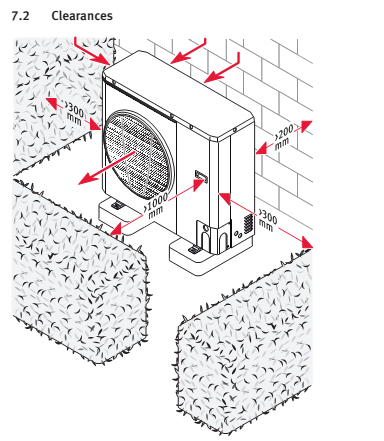
-
Another way to bond beads is using a garden pressure sprayer filled with diluted PVA. Just pour the beads in and spray the diluted PVA as you go. The PVA only needs to be thin, as the bond only has to be good enough to stop the beads flowing out of any holes that may be drilled later. I had a good look at the unit that was used to blow bonded EPS beads into the cavity walls of our old house, and it was nothing very clever. Just a centrifugal fan blower that pushed the beads from a hopper down a pipe that was around 25mm bore, with a nozzle on the end of the pipe that had the diluted PVA feed going to it from a separate smaller pipe, fed by a small pump. The beads are barely wet with PVA when they come out, but it's enough to hold them together when the PVA has dried out.
-
I agree that the outcome should have been the same, but I can't help but wonder if the building inspector really went out on the platform being used to fit this cladding and carefully inspected all the fire stops, intumescent strips, etc that should have been in place, and whether he/she ever questioned whether materials that were only certified to BS 476 Class 0 were suitable as a means of preventing the spread of fire. What is clear is that the cladding system (including insulation) was not tested to BS 8414-1. Had it been, it would have failed and should not have been installed. For whatever reason, the use of materials that only carried a Class 0 rating was taken as being compliant with the building regulations, so the big question will be who carries the greatest degree of liability.
-
The devil is in the detail as to what was actually tested, and to what standard it was being assessed, plus whether or not the certification requirements actually required a test. Mineral wool doesn't burn, but when tested to the requirements of BS 8414-1, the composite cladding without the fire retardant core, failed. The fire spread up the composite cladding, although it seems that the intensity of the fire was low. It failed because it still allowed a fire to spread from one dwelling to another, which is something the regulations are specifically intended to try and prevent. However, there wasn't a legal requirement for the cladding to actually be tested. Certification is allowed from a desk top study, and only needs to comply with BS 476 in order to be given a BBA certificate. That's what happened in this case; the aluminium composite material, even though it was intended to be used as external cladding, was only ever certified to Class 0 under BS 476, and was never tested to the BS 8414-1 standard for cladding. The people responsible used a loophole in the regulations to get away with doing this. They may have provided certificates showing that both the insulation and the cladding met the requirements of BS 476 Class 0, but I'm equally sure that they knew, or suspected, that neither would meet the requirements of BS 8414-1. Arguably the building inspector should have picked them up on this, and demanded to see evidence that the insulation and cladding installation was designed to resist the spread of fire, and that it met the requirements of BS 8414-1, as well as Part B, but that doesn't seem to have happened. My view is that a large part of the reason for this failure may have been the main contractors decision to do this work under a Building Notice, as they would have known that by taking this route they would avoid a detailed examination of the plans (they wouldn't have been required to submit detailed plans at all under a Building Notice).
-
That fits with my own view that the primary fuel source was off-gassing from the PIR. Right from the very start I felt strongly that the very thin PE core inside the aluminium composite sandwich cladding was unlikely to be the primary fuel source, given that many earlier fire tests, from years before the Grenfell Tower refurbishment was even planned, showed that PIR, with one face open to an air supply and heat source, burned very readily, and allowed fire to spread extremely quickly. The question now will be whether or not the people responsible for the design and specification of the Grenfell Tower external insulation and cladding should have been aware of the risk. I would argue very strongly that they should have. I had heard about, and read up on, the risk from EWI back in 2012, as a consequence of the thread on the AECB forum. That thread linked to reports of several facade fires, and there seemed to be a great deal of evidence to show that flammable external insulation systems posed a significant fire risk, and that the risk is much greater for taller buildings, where the chimney effect, pulling air in to the fire, is much more pronounced. This was a wholly preventable fire. The knowledge of the fire spread risk from using these materials was widespread. The deficiencies in the insulation material that used were well known. If I knew about it in 2012, as a complete amateur, unconnected with the construction industry, then there is absolutely no excuse whatsoever for all those involved in this project not to have known as well by 2014, when they were designing the Grenfell Tower installation.
-
Drawstring - polypropylene rope?
Jeremy Harris replied to Vijay's topic in General Self Build & DIY Discussion
I should have added that a screwed up ball of galvanised chicken wire would probably do the same job. I just happened to have some expanded metal left over from making the rodent barrier around our slab insulation. -
Drawstring - polypropylene rope?
Jeremy Harris replied to Vijay's topic in General Self Build & DIY Discussion
Get some expanded metal mesh, either galvanised or stainless, and roll it into a ball and stuff it down the duct. Tie a bit of fence wire to the end of the pull cord before you do this, and feed it through the ball of expanded metal. This will stop rodents, yet can easily be pulled out with the draw cord attached when the need arises. -
Not really, it took me two goes to get it to work! It was mostly good luck, discovering that the cheap pump spray used an 8mm hose, with a compression fitting where it attaches to the pressure bottle. I happened to have a length of 8mm LDPE pipe, and that fitted directly into the pressure bottle fitting. This 8mm LDPE pipe takes standard 8mm compression pipe fittings , as long as a brass insert is used. The rest was easy, just an 8mm to 15mm compression adapter, an standard 15mm NRV, and then a standard fill loop hose. To use it, you just fill the bottle with antifreeze/inhibitor, screw the filling loop hose on to the fill point valve, open the valve and start pumping. It very easily pumps our ASHP/UFH loop up to 1.5 bar, the only chore is stopping to refill the bottle every few minutes. In our case it's not a big problem, as it's only around 4 or 5 refills to get the system full initially. When I drained and refilled the system after working on it it was only a single bottle full, as the UFH loops remained filled, as I only drained as far down as the lower manifold.
-
Sometimes nightmares are real: the insurance story
Jeremy Harris replied to ToughButterCup's topic in Self Build Insurance
Exactly as @Barney12 as said. Just one well-crafted letter. If that fails, then by all means right it off as a lost cause, but my guess is that you will get some sort of offer, IF the insurance company believe that you are likely to pursue them further. It's a bit like playing poker; you need to make them think that you have a good enough hand to have a better than 50% chance of winning if it went to court. They know their costs in just the preliminary work, before going to court, will exceed the claim amount, and insurers are not daft when it comes to money. -
Another vote for deep flow. We made the mistake of fitting standard half round gutter, and we had overflows in heavy rain. I think the problem is that slate, and the IkoSlate we have, allows water to flow off faster, because it's so smooth, and this tends to increase the peak flow at the gutter in bursts of very heavy rain. I'm now waiting for the rain to let up so I can get up and replace the half round guttering - I wish I'd specified the deep flow stuff right from the start.
-
I have a few around, and they are just plain trenches filled with gravel, nothing on the bottom and no pipes, and they work fine.
-
Sometimes nightmares are real: the insurance story
Jeremy Harris replied to ToughButterCup's topic in Self Build Insurance
It's worth a go at the insurers, quoting the Durisol information, before writing off £1200. With my semi-professional, expert witness, hat on, if this were my field of expertise, and if I were writing a report for an insurer, then I would make it clear that the liability rested with them. The majority of my work is for insurance companies, usually trying to avoid paying out claims, and, in my experience, they are pretty canny when it comes to assessing the costs, when faced with someone that isn't going to roll over and accept liability. I've seen many cases where I've undertaken a couple of thousand pounds or more of work, on behalf of an insurance company, concluded that the insurer had no liability at all, only to find that the insurance company settles for a few thousand pounds rather than face going to court. I get paid either way, but the first few times this happened I did get a bit annoyed, mainly because paying out when they didn't need to encourages more dubious claims. If I were in your position I would contest the surveyors report and the insurance companies initial decision, provide the evidence from Durisol, provide evidence that both you and the builder were trained by Durisol, and state clearly that if they do not settle this claim you will consider taking it through the small claims track at the county court. I will happily bet you a pint that they will just cough up the £1200, or something close to it, rather than pay out for an expert opinion. Expert opinions are costly - I currently charge just under the CAA rate, £160/hour, with no VAT................
