Jeremy Harris
-
Posts
26430 -
Joined
-
Last visited
-
Days Won
360
Everything posted by Jeremy Harris
-

House to integral garage door - Security?
Jeremy Harris replied to AliG's topic in Garages & Workshops
A police officer friend told me a while ago that theft crime rates rocket in the month up to Christmas. The bastards know that there will be new, unopened, Christmas presents stored away, and they have a higher value than second hand stolen stuff. -
Down here I paid £80/day for a relatively inexperienced, but keen and hard working labourer, and £100 a day for an older chap who had a lot of experience, and was a dab hand at digging very neat trenches. The younger chap needed a fair bit more instruction, but both worked hard. The brickie I used had his own labourer, and I'm pretty sure was paying him around £80/day, based on the cost for the two of them, and subtracting what I now know to be the brickie's solo day rate.
-
Same here. One of the labourers I used was brilliant, a young lad that was a friend of one of the plasterers, built like a brick outhouse and bright, too. I had no problem trusting him because I knew the plasterers pretty well, so he came with a good (and deserved) recommendation. On the other hand, another labourer I used (again from what I now know to be a slightly cautious recommendation) turned out to have a serious drink problem. I kept finding empty half bottles of vodka in the skip, then found that the reason the labourer had to get a lift to the site was because he was banned from driving. The final straw was me catching him coming out of the portaloo and tucking a bottle of vodka back in his pocket. That got him off site straight away. The big worry for me is that he'd been carrying slates on the scaffold all morning, stacking them ready for the roofers...............
-
The synergy system is a variation on the standing column system, first used in North America, but it has been falling out of favour because of the poor efficiency. Here in the UK the EA have a potential problem with it, as they considered the pumped water to be abstraction when I asked, and that meant an abstraction licence and all the associated cost of ensuring that there was no potential aquifer contamination. I talked at length with the EA around 5 years ago about this, as I wanted originally to fit a small "shoebox" GSHP, run like this. The massive cost involved, together with the hassle, put me off. Our ASHP was less than 1/4 the installed cost, and performs better than a water source standing column heat pump. The main reason that the water source heat pumps have poorer performance, when used in the standing column/open configuration is the power needed to pump the water up from the source borehole. This will be between 500 and 1000 W, and so makes the overall COP of the system pretty poor. The down-hole collector systems do not have this level of primary circuit pumping power, as they are closed loop, so just have a much lower power circulating pump, that's about the same sort of power as the fan motor on an ASHP. The primary circuit filters are a minor cost for a water source heat pump, perhaps £50 a year, so pale into insignificance compared with the other running cost and regulatory hassles. If you need to have a borehole for water, and wish to spend a lot of additional money to have a GSHP running from a borehole, then the best way to do it, without question, is a system like that which @reddal has. At least 25% of the cost of a borehole is associated with the initial mobilisation and fixed cost elements, so boring two holes on site, one for water and one for a GSHP collector, is a better bet. The cost of drilling a hole, fitting a down-hole collector and grouting it in place will be lower than the cost of drilling, lining, grouting, fitting a submersible pump etc for a drinking water borehole. We've been living with a cheap (around £2200 DIY total installed cost) ASHP for a while, and it is very efficient, around an average COP through the year over well over 3. Had we fitted a GSHP with a down-hole collector in a second borehole then we would have been looking at an installation cost of over £10,000. The extra £8,000 or so would have never been recovered, and would have been a pointless expenditure. The annual running cost saving by using a GSHP, rather than an ASHP, would have been around £40 per year, at the most, for us so the payback time for the additional £8,000 capital expenditure would have been a couple of hundred years.
-
Sounds a very challenging set of goals, be interesting to see how you get on. I've been trying to buy some BIPV glazing for over a year now, with no success, as I want to add a BIPV glazed walkway down the side of our build. There's lots of "new product" guff around, but frankly it doesn't seem as if there is much in the way of a supply chain that's actually retailing the stuff, at least not at affordable prices. The second point is the borehole. We have one, and there are some pitfalls with trying to use the same borehole for both potable water and as a GSHP (more accurately a water source heat pump) collector. Obviously you cannot use a conventional down-hole collector, as that would make it impossible to also fit a submersible pump. That means looking at using a standing column collector, and there are several problems with that in the UK, not least of which the fact that there were no UK companies who had expertise with this technique - all were only familiar with down-hole collectors.. The first is that the EA classify a standing column collector as "abstraction", even though the water is going back down the same hole. That means getting an abstraction licence, as you'll almost certainly be pumping in excess of the 20,000 litres per day at times. The next is that you will have to convince the EA that there is zero chance of accidentally contaminating the aquifer with the pumped back water. I couldn't find a way around this, as they wanted certification that there was no way that the water to refrigerant heat exchanger in the heat pump could fail and contaminate the return flow. There is also the power that the water pump draws, in order to supply the heat pump. A standing column system uses a circulating pump on the primary that will draw around 500W or so, which hits the COP of the heat pump pretty hard when it's running. Then there is the issue of having to fit filters in the heat pump primary, in order to keep the input plate heat exchanger free from blockages by sediment, etc. These filters need regular (6 monthly) replacement, adding to the maintenance burden and cost. Finally, all the pipe work from the borehole to the heat pump needs to be frost protected, as it may be subject to sub-zero temperatures when the heat pump is off and the weather is cold. As someone with a lot of hard-won experience with boreholes, I would try hard to avoid having one if you can possibly get a mains water connection. There is a constant cost in maintaining and running a water supply borehole, that comes close to the cost of mains water, in practice. If the water company eventually decide to run a main down our lane then I will connect to it and abandon the borehole, for sure. The only reason we have a borehole is because the water company wanted £24k to run a pipe down the lane. For heating and hot water pre-heat we have an air source heat pump. Massively cheaper than a GSHP, and not significantly worse in terms of performance. I think I worked out that the extra capital cost of having a GSHP was many decades of ASHP operating cost difference.
-
I used to teach the C&G Radio Amateur Certificate back in the early 80's. Rather memorably my GP was one of my students. I stopped playing about with amateur radio many years ago now, when the whole thing was just becoming swamped with people buying, rather than making, gear, and most of the chat was a bit like the hifi fanatics, bragging about the latest super duper widget they had bought..................
-
It's here: http://forum.buildhub.org.uk/ipb/forum/47-market-place/
-
"mars bars" are pretty near indestructible, and can be broken into shorter lengths, as required: http://www.siteright.net/concrete-square-p-195.html or http://www.lemon-gs.co.uk/shop/concrete-square-bar-spacers.html
-
I've just pumped a litre of home-made ethylene glycol/sodium nitrite corrosion inhibitor into my cheap airless sprayer and stored it away in the workshop loft. Brilliant bit of kit, with the one reservation that it's a pain to clean out thoroughly after use.
-
Reading the info on the sprayable "plaster", it isn't really traditional gypsum plaster, as far as I can tell, but some form of thin layer polymer coating. My guess is that this takes away a great deal of the traditional skill needed with plaster, as there won't be a need to let the plaster start to cure before polishing it flat. It also looks to go on in a much thinner, single layer, plus the video shows waste stuff being re-used by scraping it back into the hopper. Do that with traditional gypsum plaster and it's guaranteed to make it lumpy.
-
MBC build- a year later
Jeremy Harris replied to dogman's topic in General Self Build & DIY Discussion
I was a bit taken aback by the sheer volume of warmcell that arrived to insulate our build. I think we had two trucks a bit smaller than that artic, as there wasn't room to store the stuff. This is what our kitchen/dining room looked like not long after the first truck load was delivered: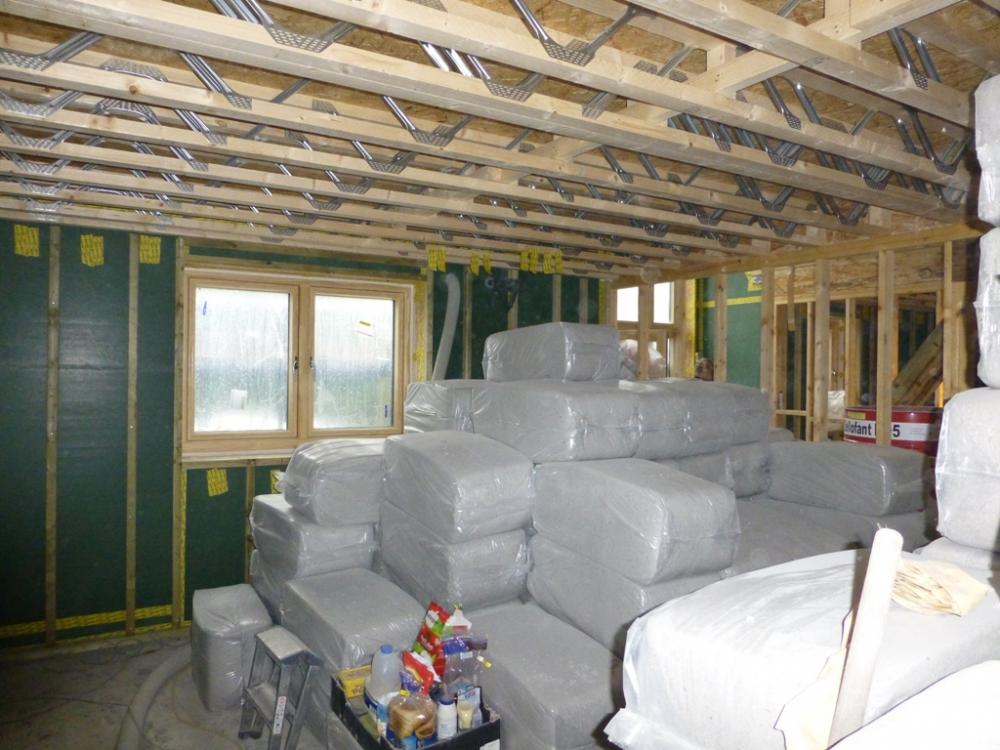
-
I used stainless steel pan scourers, bought in bulk from a catering supplier. However, there is a better solution that was suggested by @Temp, which is to use "Pestplug" ( http://pestplug.com/), or as @PeterStarck suggested in this thread, use the stainless wire wool intended for use in exhaust silencers:
-
I think your solicitor would be very wise to make sure that the right of access is enshrined in a legally binding form, so that there is little or no chance of someone later using the ransom strip technique to extract a lot of money from you. You need to positively identify who owns any land between your own land and the highway. Do not ever rely on the Land Registry Title Plans for this, as there are neither legally binding, in terms of boundary definitions, nor are they accurate (they are often very inaccurate, in my experience). I suspect that your solicitor will need to do a legal search to find the title history for the land, the road and the grass verge over which you want access, and then track down exactly who owns what. The latter can be a challenge. There is a strip of land alongside the stream that runs in front of our new build, between the stream and the lane on the opposite side from us, that no one seems to own. The parish council have been trying to track down the ownership for years, as it's overgrown with willow and alder and needs to be cut back to reduce the flood risk. The best they've been able to do is track down that it belonged to Lord Pembroke, but that when the Pembroke estate sold a lot of land (including the land our house is now on) in 1916, that particular strip alongside the stream was not mentioned, so there has been an ongoing legal struggle to determine if it still belongs to the Pembroke Estate (they say it doesn't!) or someone else.
-
I've been trying to track down the news story, to no avail. From what I can remember I think a part of the problem was that the land in question had had several owners, even though none of them actually knew they owned it, as successors in title to the original landowner. It was this trail that the company tracked down. I'm pretty sure the "access by prescription" didn't apply, but I don't know why. If it had then I'm sure the house owners would have tried to use it, rather than see to go to court. The bottom line is that no one should ever make any assumption as to access rights, unless they have it in some form of legally-binding agreement. Trusting a local authority to provide accurate information is usually unwise, in my experience, as they often don't seem to have a clue, and may well say things, or even write them in correspondence, that aren't correct.
-
It's a few years ago, but IIRC, adverse possession didn't apply because the owners of the houses hadn't had exclusive use of that strip of land, they had just driven and walked over it for access, and none of them had made any attempt to have that strip included within their boundary, I think because they assumed it belonged to the council. I do know there was a court case planned and they lost, or ended up settling out of court. IIRC, they settled with the company for less than the original demand (a figure of around £10k per house was mentioned, I think). It caused a stir, locally, as the residents were outraged than something like this could happen, decades after the houses were built.
-
I'm not sure. From what was reported on the news here, the company spent some time tracing the successors in title to the land, I think. The situation was that the landowner (a farmer, I think) had sold the building plots back in the 1950's or 60's. At the time of the sale, the same farmer owned the lane that provided access to these houses. At some point the lane was adopted, and the local authority then owned the lane, but not all of the wide verges on either side. The farmer died and the land he owned was presumably sold, but not the strips of grass verge, as there was an assumption that these belonged to the local authority, I assume. The company discovered this discrepancy, and somehow managed to buy the remaining strips of grass verge without either the residents or the local authority being aware. The first anyone knew of the new owners of the verges was when the company made the demand for payment in return for access rights.
-
Well worth making sure that the right of access over the verge is written into some form of legal agreement, I think. A few years ago there was a case near us, where a company discovered that the grass verges along a lane were not owned by anyone any more (the original land owner had died, and somehow the title had been lost). There were around 20 houses along this lane, IIRC, that all had driveways over a few feet of this verge. The company that had bought the verge issued them all with a demand, rescinding any assumed right to pass over the bit of grass verge the company now owned, and only granted an access right when each owner paid a fee equivalent to one third of the assessed value of their house. In most cases the fee was well in excess of £150k, I believe. The company involved was a specialist firm that goes around the country looking to buy land that is used for access, and where there is no legal agreement in place for that access. They then buy the land up for a price that the landowner cannot refuse and hold the people who use it for access to ransom. Often the land they buy belongs to, or used to belong to, local councils. Local authorities are strapped for cash, and if someone comes along and offers them money for some land they have no use for the chances are they will just sell it.
-
They were off ebay, Nick, and look like these ones: http://www.ebay.co.uk/itm/30W-Dimmable-R7s-LED-Floodlight-Bulb-118MM-200-Degrees-Double-Ended-J118-R7s-LED-/302261130979?hash=item46602ad6e3:g:OxwAAOSwTM5Y05ip
-
As a rough rule of thumb, 10 kW will raise the temperature of an incoming flow of water at 10 litres/min (pretty typical decent shower flow rate) by about 13 deg C. So a 30 kW combi will increase the temperature of a flow at 10 litres/minute by around 39 deg C. Incoming mains water is typically around 6 deg C to 8 deg C, and a shower will usually be between 38 deg C and 42 deg C. So a 30 kW combi should be able to deliver DHW at around 45 deg C at 10 litres/minute. Our Vaillaint combi can deliver around 28 kW, and we find that's fine for a decent shower (a bit over 10 litres/minute) at around 38 deg C.
-
There's no definitive answer, and leaving out the internal VCL and relying on decent workmanship to seal the PB is damned risky, unless you know for sure the relative vapour permeability of the whole structure and the quality of the workmanship. 99% of water vapour transmission is usually from outside, provided there is a decent and effective internal VCL, and the golden rule is to maintain a gradient of vapour permeability from inside to out, with the least vapour permeable layer inside and the most vapour permeable layer outside (or adjacent to a ventilated external cavity). As houses are built to better insulation standards, then vapour control becomes far more significant, especially if there are structural layers within the walls and roof that may be subject to damage from interstitial condensation. Some of the big manufacturers have got this detail seriously wrong in the past, and even a year or so ago one of the major SIPs companies was still going up the learning curve with regard to the safety of their floor to wall detail, something that they changed in the light of further analysis (and following a few strong hints from several here, when we were on the other place).
-
I converted a couple of 240V 400W work lights to LED, just because the heat output was way higher than we could stand (I had plasterers working in shorts and tee shirts in February, just because the halogen lights were getting the house up to around 30 deg C..........). I agree that most of the relatively cheap LED halogen replacements are nowhere near as bright. After several duff attempts, I did manage to buy some J118 compatible LEDs that were still not as bright as the 400W halogens, but were usable. They were rated at 30W, and uses 64 off 5730 LEDs. The light output was OK, and certainly a lot better than the fluorescent work light that the plasterers had.
-
Welcome, sounds an interesting project. We looked at Potton, but, to be blunt, we were put off by the relatively high cost and the relatively poor energy performance. We did try to persuade them to look at ways to improve the performance, but they didn't really seem interested in providing anything better than a "just meets building regs" standard. Having said that, I believe they have now built at least one passive house, so may be they are more receptive to the idea of making decent performance houses.
-
Our MBC frame also got thoroughly drenched, as we had a day of very heavy rain whilst the frame went up. No significant impact, other than some discolouration and a little bit of minor swelling of the OSB flooring at the joints when it dried out. The latter was easily sanded out, and there was no long term damage. I think it's just one of those hassles of trying to build in the UK - the chances are it will rain a lot at some point before you get the roof on............
-
It's OK behind the insulated PB, as the main thing is to position the VCL to stop vapour from inside the house reaching parts of the structure where it could drop below dew point, and so allow interstitial condensation from water vapour movement from inside the house.
-
If you replace an old driveway with a new one that's made of non-permeable material then you still have to comply with the SuDS regs, even though you may not need planning permission. It makes sense to try and combine the roof rain water drainage solution with the drive/path/patio one if you can, as that saves cost and effort. Unless you suspect that the water table may be quite high, then I'd not bother doing the water table test for the quick and dirty initial assessment, just the percolation test.