Jeremy Harris
-
Posts
26430 -
Joined
-
Last visited
-
Days Won
360
Everything posted by Jeremy Harris
-
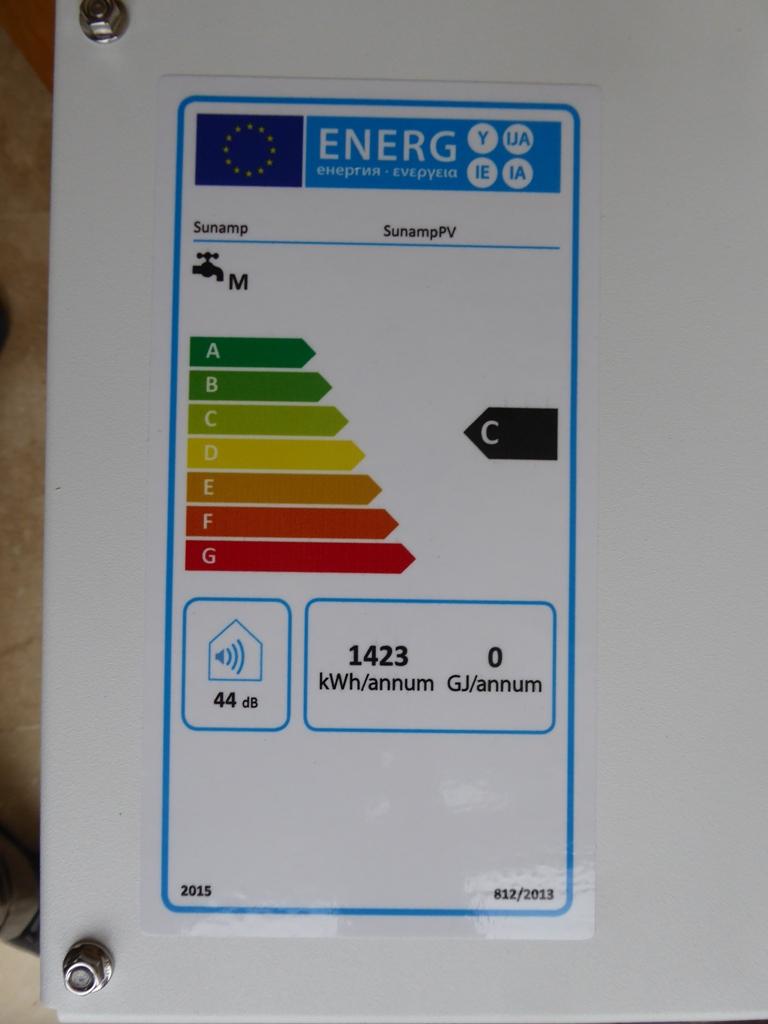
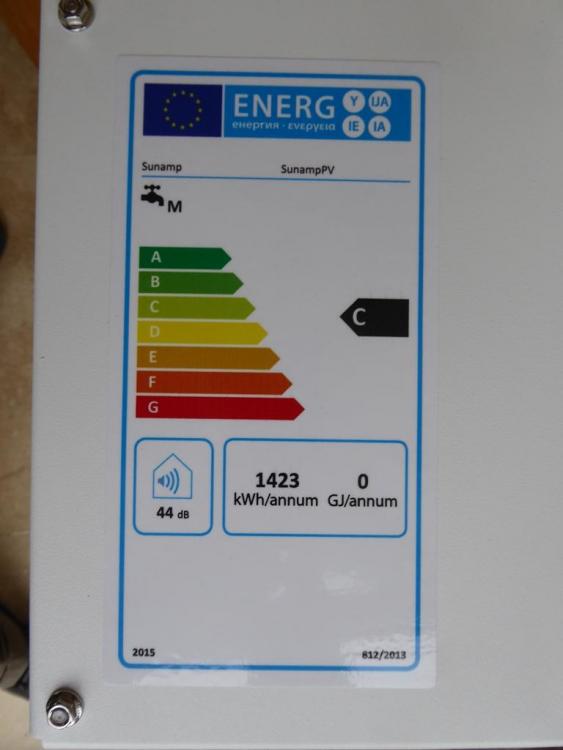
 The 44dB rating applies to the old Sunamp PV, which did have a variable speed Grundfos pump internally. I've no idea where the 42dB figure for the UniQ comes from, as it has no moving parts at all. I can only assume that it's another artefact of the test process, and may relate to the very slight crackling noise that a newly commissioned UniQ eHW makes on first being powered up from cold. In reality it never does this again after being commissioned, or at least I know for sure that ours hasn't, because even when we ran out of hot water a couple of weeks ago the unit was still warm enough to not go into cold start mode.
- 186 replies
-
- 1
-

-
- sunamp
- energy efficiency
- (and 1 more)
-
I believe that there was a bit of an issue with definition of the type of product that the Sunamp should be classified as when it comes to energy testing, as the Sunamp PV had a poor rating, that didn't tally with reality at all: This rating bore no relationship to the heat losses at all, and was spurious, as it resulted from the test method used being unable to deal with the type of product. IIRC it was treated as an electric water heater, rather than as a heat storage device. The Sunamp PV heat loss was around 0.6 kWh/24 hours, which equates to about 219 kWh/year, so nothing like the figure on that label of 1,423 kWh/year. Similarly, the UniQ eHW 9 has a heat loss of 0.738 kWh/24 hours, so would lose around 269 kWh/year, nothing like the figure on the label. Arguably, these units should be treated as thermal stores, and assessed in terms of their heat loss rate, much like any hot water cylinder would be.
- 186 replies
-
- 2
-

-
- sunamp
- energy efficiency
- (and 1 more)
-
That's very odd. Mind you, our UniQ doesn't have any energy rating sticker on it at all, for some odd reason. I thought those stickers were mandatory, too, and like you I thought it had an A rating.
-
Nice thing abut the internal bus bars is that they make the DIN terminals more stable, too. The "wobbliness" of some DIN connector blocks, even with tightly clamped end restraints, is a pet hate of mine, especially when trying to tighten up terminal screws.
-
IIRC, that's not that dissimilar to the default curve that ours came with, except I have a feeling that it went to even higher temperatures under those conditions, which inevitably resulted in it doing lots of defrost cycles. I've not seen ours defrost at all now I have it set to a constant 40 deg C; it seems that our system never puts enough load on the unit for it to reach the defrost threshold. Having a unit with probably three or four times the output we actually need for heating probably helps, as it means the evaporator is over-sized for our needs. This means that the fan and compressor tend to run at about their lowest speed most of the time. Heating isn't our biggest electrical demand, either, most days it's less than the hot water demand. What I need to do is systematically work through the low power, always on, loads, as they seem to be some of our biggest energy consumers. It's things like the ~1 kWh/day to run the treatment plant and the ~ 0.8 kWh/day for the water UV treatment unit, that push our background load up.
-
Spray PU Insulation
Jeremy Harris replied to Blob the Builder's topic in General Self Build & DIY Discussion
The process of making Warmcel is a bit more involved than just shredding old newspaper. The paper is shredded, then sort of fluffed into fibres, then treated with borax, then dried, before it's ready to be used. From the look of the stuff I'd say that it may well be a wet process used to break it up into fibres, as it is a fairly uniform grey colour, with just hints that it was once newspapers. I doubt that you could get the right sort of control of the final product by trying to make it on site, from old newspapers, especially as there is probably a fair bit of testing done at each stage to make sure that the product meets the specification. -
Yes, I double checked with a meter that all the earth DIN terminals were correctly connected together via the rail on mine, just to be sure all was OK, a bit like checking that all the screws were tight. Unless you're familiar with DIN rail terminals I'd guess they could make you wonder a bit though.
-
Spray PU Insulation
Jeremy Harris replied to Blob the Builder's topic in General Self Build & DIY Discussion
Our house uses dry blown cellulose, but should be much the same in terms of acoustic performance to the wet sprayed stuff, I should think. It is exceptionally good as acoustic insulation, especially when you consider that we have no masonry construction at all. The house is eerily quiet, especially at night, and any slight external noise that does get in seems to be via the windows and doors. I would imagine that if used to fill internal walls cellulose would out-perform rockwool as acoustic insulation by a fair bit. I think the only problem may be finding someone with the kit to install it, although it doesn't look to be a particularly hard job to do.- 18 replies
-
- 1
-
-
- spray
- insulation
- (and 2 more)
-
We do much the same as @ProDave, run the ASHP at a constant temperature and just use a normal room thermostat for control. Seems to work perfectly, with the house staying within about half a degree inside no matter what happens outside (and it was sub-zero again last night here).
-
MVHR running properly???
Jeremy Harris replied to joe90's topic in Mechanical Ventilation with Heat Recovery (MVHR)
@SteamyTea did some number crunching on data that both I and Damon Hart-Davis had collected, that included temperature, CO2 and RH, and concluded that there was a very close correlation between CO2 and RH when the house is occupied. The usefulness of this is that accurate RH sensors are pretty cheap, whereas decent CO2 sensors aren't (I have a few NDIR sensors bought surplus, but they retail for around £80 each IIRC). I suspect that just using RH for MVHR control would work OK, with one proviso. Our's boosts using an RH sensor in the extract, and I find I need to adjust the threshold between winter and summer to make it function effectively. I keep meaning to make a more sophisticated controller, that is able to use rate of change of RH to trigger boost. Making the same controller vary the MVHR speed, or turning it off when there's no one home, should be fairly straightforward. -
MVHR Performance
Jeremy Harris replied to ryder72's topic in Mechanical Ventilation with Heat Recovery (MVHR)
Our intake filter, in particular, gets absolutely filthy, and needs regular cleaning/changing to maintain performance. Someone here posted about their heat exchanger getting dirty, too, which seems to indicate that some MVHR units may not have that good a seal around the filter, or a filter that's not as effective as it should be. I've no doubt that a dirty heat exchanger may well impact on performance, but if the filter is fitted properly and doing its job the heat exchanger shouldn't get dirty. I took our heat exchanger out to clean it last summer, after it had been working for around 3 years, and found it spotlessly clean, so in our case it looks as if the filters do their job OK. Moisture inside the heat exchanger is an odd one, as there should be a condensate drain, with the heat exchanger arranged internally in a position where any condensation that forms can drain away easily. Condensation is useful, as it helps a fair bit with efficiency, as long as it can drain away having given up its heat to the heat exchanger plates. I think it's hard to get a clear picture of efficiency from just measuring the temperature differential between the two sides, as it's highly dependent on other factors, like the instantaneous airflow rate (which will probably change a fair bit from minute to minute if there's any sort of a breeze blowing) as well as humidity, with the latter having a significant impact due to the latent heat given up during condensation. -
Using UFH circuits for cooling
Jeremy Harris replied to Nick1c's topic in General Alternative Energy Issues
Yes, you can run a buried brine loop, essentially the same as a ground source heat pump collector, deep into the ground around the plot. This will typically deliver brine at around 8 to 10 deg C all year around, so would work well for summer cooling. The downside is the expense and disruption of burying a lot of pipe in the ground, and overall it may well be more cost effective to just install an ASHP and use that for heating and cooling. -
Using UFH circuits for cooling
Jeremy Harris replied to Nick1c's topic in General Alternative Energy Issues
Not sure how well that would work, TBH, as in the well-drained layer under the house heat conduction is likely to be fairly poor. I think the pipes would need to be arranged like a conventional GSHP collector, and buried more deeply in reasonably well conducting soil. If you have an ASHP, it's dead easy to just run it in cooling mode to keep the floor cool in very hot weather, -
Using UFH circuits for cooling
Jeremy Harris replied to Nick1c's topic in General Alternative Energy Issues
@Nick1c, the UFH pipes run inside the concrete of the slab, not underneath the insulation in the hardcore of a passive slab. We find that the cooling effect of running water at around 12 deg C through the floor in very hot weather works extremely well at mitigating overheating. It seems a bit counter-intuitive that cooling the floor works as well as it does, as there's no doubting that it does. If you have PV then this cooling is free, as whenever you need it there is a very good chance that you're generating more electricity than you're using. -
I believe that site investigation that is carried out as a part of the construction process, for example by the ground works/foundation system supplier as an intrinsic part of the construction of the foundation system, is zero rated, but stand-alone site investigation is treated in the same way as other site survey work and is liable for VAT.
-
They are right, VAT is payable on surveys, ground investigation work, etc. VAT is only not payable/can be reclaimed for stuff that actually goes towards the construction of the house, as a general rule. There is a fairly long list of stuff that you have to pay VAT on, ranging from professional fees (unless they are part of project managing the build), surveys, investigation work, equipment you hire etc.
-
It was one of the worst jobs in the build, stuffing that into the ceiling void. I wore a Tyvek suit, with the hood up and a mask on, plus I taped around the glove/sleeve joint and around my ankles, but the damned stuff still got in...
-
You have to wonder about the level of knowledge of someone like this. Not only is it very common knowledge that coated glass units must be fitted the right way around, practically evrey manufacturer puts a label on the glazing stating clearly which side faces in and which out. All these labels were still on our windows when they were fitted. The last job before I retired (in 2010) included coated glazing units, and roughly 50% of them were installed the wrong way around. As there was a large facade with around 50 odd windows in it you could tell just by looking from outside that roughly half were the wrong way around, as they look a different colour when the sun shined on them. In that case it was an Eastern European workforce who didn't read the English labels on the glazing. Cost a lot to put right, though.
-
Extractors: Gaggenau vs Bora vs Miele
Jeremy Harris replied to curly's topic in Kitchen & Household Appliances
I don't think that there can be a general answer as to whether an extractor is needed or not. We never, ever, fry foods, nor do we roast food, in fact I'm pretty sure we never use fat or oil when cooking (as in I can't find any in our cupboards). As such, water vapour and smells are the only thing the ventilation system has to deal with, and there's no sign of anything in the extract ducts at all, so far. -
As a tip that may or may not be useful, a 22mm pipe bending spring fits neatly inside 25mm MDPE. Dropping one down (tied to a bit of string) to where you want a sharper bend, then heating the pipe evenly and gently with a hot air gun, then persuading it into a tight bend, works very well. You just have to hold the bend whilst the pipe cools down, when it will retain the set bend near-perfectly.
-
That fits with what I'm observing with the Qontroller behaviour. When powered off and then on again I'm guessing it forgets about looking for a temperature drop, assumes the unit needs a warm start (assuming the temperature is above the cold start threshold) and therefore closes the contactor to allow the unit to charge. This explains why our unit reliably goes into charge acceptance mode when turned off and then back on again. All we need now is a firmware mod that automatically emulates the reset from turning the power off then on again and we'll be sorted.
-
No, that's one of the big advantages. When I decommissioned the old Sunamp PV I removed all the wiring, left it for a weekend to cool down and when I came back on the Monday to disconnect it I still had to run the tap for half an hour to get rid of all the heat stored in the thing, before I disconnected the plumbing, ready to swap it over with the UniQ.
-
So am I. I can confirm that the unit behaved the same this morning as yesterday. Turning the Qontroller off and then on again reset it and switched the contactor on, ready to receive any charge from excess PV that might be available (looks doubtful so far today - it's cloudy and the output isn't yet covering the house base load).
-
Extractors: Gaggenau vs Bora vs Miele
Jeremy Harris replied to curly's topic in Kitchen & Household Appliances
I fitted a bit of OSB behind the plasterboard in the ceiling, complete with a cable run ready to hang and connect up a cooker hood above the hob. I can't see any need to actually buy and fit one, as the MVHR does a fantastic job of both removing cooking smells and preventing condensation in the kitchen. Makes me very thankful that I didn't spend a lot of money on buying and fitting an extractor hood, as the wasted cost of just putting in the bit of timber and terminated cable is negligible. -
Joist Hangers: too many holes?
Jeremy Harris replied to ToughButterCup's topic in General Construction Issues
Talking of magnets on sticks, I have several pencils here with neodymium magnets glued on the ends. Buy some pencils with erasers on the end, pull out the eraser and glue in a neodymium magnet around 6mm in diameter in the end with a bit of epoxy adhesive (Araldite or similar). The pencils work as normal around the site for marking out, but will hold screws or nails for driving, without risk of hitting your hand, will retrieve dropped nails and screws, and as I recently found, will very accurately find buried plasterboard screws. On the same topic, but related to cleaning up the site, I glued and screwed a 50 x 50 batten to the bottom of a broom handle and screwed a row of countersunk neodymium disk magnets to it, the ones that are around 20mm in diameter and intended for door catches. I placed a heavy duty plastic bag over the end, with its neck tied to the handle, and had one of the young labourers drag it over the site for an hour or two. He collected a decent pile of discarded nails, which were easy to remove from the magnets just by pulling the plastic bag inside out and pulling them off into a bucket. This probably saved one or two tyre punctures I suspect.