Jeremy Harris
-
Posts
26430 -
Joined
-
Last visited
-
Days Won
360
Everything posted by Jeremy Harris
-
Sadly not. As far as I can tell, the water input versions use the same cell as the eHW, but without the electric element fitted in the base. They use the low power heat exchanger to charge the unit using hot water from a boiler, heat pump, etc. I had the option of either not connecting the low power heat exchanger pipes in my unit, or connecting them in parallel with the high power heat exchanger to give a slight flow rate boost. I chose to do the latter, but rather wish I hadn't now, as it would make experimenting with a DIY hot water charge system a bit simpler.
-
Mine already has the water input heating option, just needs to have the low power heat exchanger hooked up to a suitably well-controlled water heating system. That's non-trivial, as it would involve designing and building both a water heating system and a control system, pretty much from scratch, as Sunamp don't offer a product that will do this. I've no doubt that the charge circuit from a Sunamp PV could be pretty easily modified to charge a UniQ via the low power heat exchanger, though, but it would need some adaptation, and it's likely the the control circuit may not readily be able to be adapted, so a new one might need to be designed. Lots of plus points for having a separate "charging box", though, from being able to replace the immersion element (it's non-replaceable in the UniQ eHW) to being able to have a much better degree of control over the charge process when running from excess PV generation. The latter definitely needs doing, as my energy use figures for the past week show. I could have utilised around two or three times more of our self-generation last week had the unit been able to function as the old Sunamp PV did.
-
Welcome. There are a few of us here in the "passive house club", and I think many of us have struggled a bit with trying to get commercial kit to function as we wish for the particular demands of a very low energy house. Our build uses a similar 300mm thick insulation passive foundation system by the sound of things, but despite having the option to use the air-to-air heat pump that's built into our Genvex MVHR, we opted to fit UFH, which we've found gives a more comfortable form of heat, although our slab never really goes above about 22 to 23 deg C, and mostly sits less than a degree warmer than the room temperature. I'm not familiar with the Brink post heater system, I'm afraid, but if it's electrically driven it should be relatively straightforward to trouble shoot, I'd have thought. From your description it seems like a control system problem, do you have a wiring diagram for it we can look at?
-
The flow sensor (not detector) is there to measure the flow rate in the charging circuit as a way to provide closed loop control of the variable speed pump, in conjunction with the temperature sensors. This system was needed for the Sunamp PV because it shared the same hydraulic circuit for charge and discharge, separating the two by means of a cunning arrangement of non-return valves. Despite it's complexity, the Sunamp PV's design was quite elegant, as it allowed a single heat exchanger to both charge and discharge the cell, plus it coped with any type of PV diverter output, and there are a wide range of different control systems used for these, from simple phase control of power, through zero crossing modulated power, to the sub-1 Wh energy bucket system, with the latter outputting short pulses of power that may well be 30 seconds or more apart under low excess generation power conditions.
-
Not what's needed here at all, really. The key point is that the output flow temperature has be held within tight limits when there is a highly variable AC power input from a PV diverter. There needs to be an excess PV detect circuit (which needs to detect reliably for the whole range of excess PV diverter schemes, from simple phase control units through to zero crossing, long inter-pulse delay, pulsed power units). This needs a timer to allow the system to remain powered up after an initial PV input, in the assumption that more heating element power will be along within 30 seconds or so (to deal with energy bucket PV diversion) There needs to be a means of allowing the flow temperature to always be above the phase transition temperature, even when only a few tens of watts are available from the excess PV diverter. Finally, there needs to be means to control the power to the element, independently of the pump, to deal with the case where the flow temperature is close to the upper limit with the pump on.
-
No, it wasn't over-heating control that was the primary reason for this. The variable speed pump and ultrasonic flow sensor arrangement in the Sunamp PV was designed to do the opposite, allow the flow temperature to rise to the phase transition temperature when less than full power was applied to the heater from an excess PV diverter. PCM needs to be heated above it's transition temperature in order to change phase from solid to liquid and store the additional latent heat of that phase change. It would need some work, but I believe that a simpler control system could be designed. Using a Willis heater would allow the temperature in the "pot" to be maintained above the phase transition temperature, by switching the pump on and off. Preventing overheating could be achieved by modulating the power delivered to the heating element.
-
Cheaper simpler and more controllable to use a WIllis and pump, as controls need to be custom built to control the flow temperature.
-
Sounds like your requirement is exactly the same as ours. We originally purchased the Sunamp PV specifically because it did this, although it's capacity was the main limit, at just 4.5 kWh. In practice this didn't matter too much, as it would accept any charge that was available, so tended to top up pretty quickly. As an example, this is the data for the past week, the first week of energy monitoring that has included measuring the energy used to charge the Sunamp from the grid, the energy used to charge the Sunamp from excess PV generation and the PV generated energy we have exported to grid: Energy exported to the grid = 18 kWh/week ( mean ~ 2.6 kWh/day, but very patchy) Excess PV generated energy used to charge Sunamp = 6 kWh/week (mean ~ 0.86 kWh/day, but very patchy) Grid energy used to charge Sunamp = 28 kWh (mean ~ 4 kWh/day) The maximum energy exported in any single day last week was 7 kWh. Total DHW energy used for the week = 34 Kwh, of which 6 kWh came from excess PV generation. ~ 18 kWh of PV generation was "wasted" by being exported to the grid rather then used to charge the Sunamp. In terms of cost saving by using self-generation to heat our hot water, it looks like the Sunamp has only managed to use around 25% of our available self-generation, which is pretty crap. There may have been one day when it couldn't have absorbed all our self-generation, last Friday, when it would probably only have been able to use around 5 kWh of the 7 kWh we exported (it didn't utilise any self-generation at all on that day). Overall I think we could have utilised around 22 kwh out of the 24 kwh of excess generation had the Sunamp been able to do what it's supposed to do. This would have reduced our grid import for DHW last week from 28 kWh to about 12 kWh at a guess.
-
Making a charge unit that included a pump, Willis heater, some temperature sensors and a control unit wouldn't be hard. My inclination would be to not mimic the Sunamp PV system, which used a variable speed pump, flow sensor and fixed output heater to control the temperature of the charge circuit, but to control the heating element to do this.
-
If not scaremongering, then you're certainly adding a lot of confusion to something that is only an issue for one specific model. The accelerated testing has been rapidly heating a cell with a high power input, to full charge, within, IIRC, 7 minutes, then rapidly discharging the cell with cold water in, IIRC 5 minutes, so is very extreme. It's all in the public domain and has been published by Sunamp. That's what we were discussing earlier in this thread; using the low power heat exchanger in the cell to charge the cell using a Willis heater, pump and some temperature sensors.
-
This isn't needed, as there is no problem at all with charging units with heated water, from any state of charge. The old Sunamp PV used this charge method and worked very well, and I can't see any reason why using heated water to charge any size cell shouldn't work just as well. Worth remembering that the limited charge acceptance issue is only with one Sunamp model, the direct electrically heated eHW. None of the other models have this issue, as far as I'm aware.
-
No, not at all, what on earth gave you that idea? This is getting to be just scaremongering now, and I think we should stick to facts, not wild speculation that is way off the mark. The current accelerated cycle testing programme has run to well over 35,000 cycles with barely any detectable degradation at all. Put into context, and assuming two cycles per day (which is pessimistic) then 35,000 cycles equates to a life of at least 48 years.
-
Funnily enough I've just bought a cheap semi-rigid one for a single-use application. We're having blinds fitted to our big gable windows and I need to get a thin SELV power lead to where the blind rail will fit. We have a 50mm service void that runs behind the plasterboard right to where I need the cable to come out, and very luckily that's accessible from our under-eaves storage area, which already has a power outlet and room for the blind power supply unit to fit. What I need to do is take a look in this void to find the easiest way to run a bit of flexible cable conduit through it. I could try blindly fishing around with the flexible cable puller, but I'm sure it will be a lot easier if I can see what's going on in there as I do it.
-
One or two people here have already got the doubled up Sunamp PV system, as it's easy to do. The heater, flow sensor, control system and variable speed pump in the original unit is retained and a box with just two additional Sunamp PV cells is added and plumbed in in parallel. Sunamp offered this as an option, and I provided a base wide enough to add a second heat battery when I originally fitted our Sunamp PV, thinking it might be useful to increase the capacity in future. There's none of this 50% depleted stuff with a water heated cell, as used in the Sunamp PV. They accept charge as soon as they have any spare charge capacity. The same will apply to all the other Sunamp models other than the eHW, as it's only the direct electric heating control system that seems to have limited charge acceptance.
-
That's pretty clear. In the last week (which has only had two or three periods when we were exporting significant amounts of PV generation) we've only been able to utilise about 30% to 40% of our excess PV generation to charge the Sunamp at a guess. Part of this was one day last week where we were exporting and I first noticed that the Sunamp wasn't accepting charge, despite knowing that ~4 kWh had been used that morning. To be fair, when I investigated this, and sought clarification from Sunamp, I discovered that the Qontroller for our unit was set up wrongly, and wasn't accepting charge until the unit was 90% depleted. I fixed that on Friday, so now it accepts charge from the 50% depleted condition, but it still refused to accept charge during a sunny spell on Saturday, so we were still exporting energy that I'd have much rather went to charge the Sunamp, so we could use it. If I had to guess, I'd say that the best the current eHW models can manage in terms of excess PV utilisation may be around 50% to 60%. There's no way at all that they can always accept charge when there is capacity available, so they will force grid import when it shouldn't be required.
-
First off, I can't see Sunamp responding directly on here. Secondly, I'm not convinced there is anything underhand going on at all; having been dealing with them since 2015 I'm absolutely convinced that their focus is primarily on the technology, and sadly not product engineering now. That definitely wasn't always the case, though, the Sunamp PV was a very nicely engineered product, as I mentioned in this blog entry http://www.mayfly.eu/2015/10/part-forty-getting-into-hot-water-episode-two/ . My view is that the fairly simple control system that the current eHW product has is already known to be sub-optimal for the excess PV generation use case, but that they aren't so focussed on this model now, presumably for reasons to do with the largest market segment they currently have. Putting aside the case and top insulation design, which clearly needs some further work, the only identified operating issue is the inability to keep the eHW models topped up when charged from excess PV generation, as far as we know. I'm not aware of any issues with the other products in the range, so heating those from a boiler, ASHP etc should be fine. The difference between the models is that all except the eHW are primarily heated by hot water, very much like the original Sunamp PV. We have speculated, with some understanding of the probable issues surrounding the use of direct electric heating of the PCM, that the rational behind the eHW model having the selectable 90%/50% depleted charge acceptance threshold as being related to the use of a direct electric heating element embedded in the PCM, as it's only that one model that seems to have this limitation. This information is included in the installation manual supplied with the product, but was not available in any of the pre-purchase information that I read. Had it been made clear that the unit needed to be discharged to ~4.5 kWh remaining before it would accept any charge then I wouldn't have gone ahead with the change, as that's no better than the Sunamp PV I already had for our use case. A better option for us would have been to buy two more Sunamp PV heat cells to double the capacity of our old unit, whilst retaining the heated water charge system.
-
Good point. No, it's an assumption, but there is no doubt at all that the UniQ that I have now is far less capable at effectively utilising excess PV generation than the Sunamp PV we used to have. There has to be a reason for this, as the efficient storage of excess PV generation was the USP for the Sunamp range of products at the time I initially took the risk and chose to invest.
-
No, the case is the same gauge aluminium as the SAPV. I'm near-100% certain that this is down to a lack of proper production engineering. Remember this is a technology start-up, working in close partnership with academia. They have had a fair bit of seed funding too. I doubt they have really done a proper cost-engineering job on the product yet. If they had then the first lesson they would have learned is "right first time". That's a really fundamental principle, that every business needs to uphold to be profitable. Gaining a poor initial reputation from some fundamental production engineering and design problems would drive every bean-counter to distraction.
-
I agree 100% with this. It's very easy (and damned dodgy) to allow constant tinkering with the design, in order to try and experiment with different ideas, just because it's interesting. I've spent a fair bit of my career being allowed, even encouraged, to do this, but I was never required to produce anything for production. It shows in all the changes I've made to our home as I've gone along, as I find it damned hard to stop experimenting. I'm convinced that binning the direct heater, and fitting a separate hot water charge circuit would remove 99% of the UniQ eHW problems when used as a thermal store heated primarily by PV generation.
-
That would make it easy to just use a basic UniQ heat cell, with the low power heat exchanger being used for hot water charging and the high power heat exchanger being used as an instant water heater. It should be pretty easy to control the charge circuit temperature so that it is always above the phase transition temperature of 58 °C but under the maximum of 85 °C. Combining the functionality of excess PV generation diversion and charge control should be pretty straightforward.
-
 I'm not sure, as I've only used one inside as a replacement for a ceiling mounted PIR switch that turned on our utility room lights whenever we came in the back door or the door from the kitchen. I suspect that the microwave sensors might be more susceptible to nuisance triggering when used outside, as they sense any motion, not just the motion from warm objects. Their main advantages are that they aren't triggered by warm air movement (which is what I suspect may have been false triggering our utility room PIR) and they will "see" around corners, so can sense movement that's not line-of-sight to the sensor.
 -
An alternative option to PIR for auto light switching is doppler microwave sensors. I replaced the PIR ceiling switch just inside our back door because it was being nuisance triggered through the glazing in the back door (it would randomly trigger on for no obvious reason). The microwave ceiling sensor was a straight swap for the PIR and isn't line-of-sight, so will detect movement in a room even if it's around a corner. Might be an easy fix for your problem. We have PIR or microwave light switches all over the place, in cupboards, the walk in wardrobe, hall, utility room, downstairs WC etc.
-
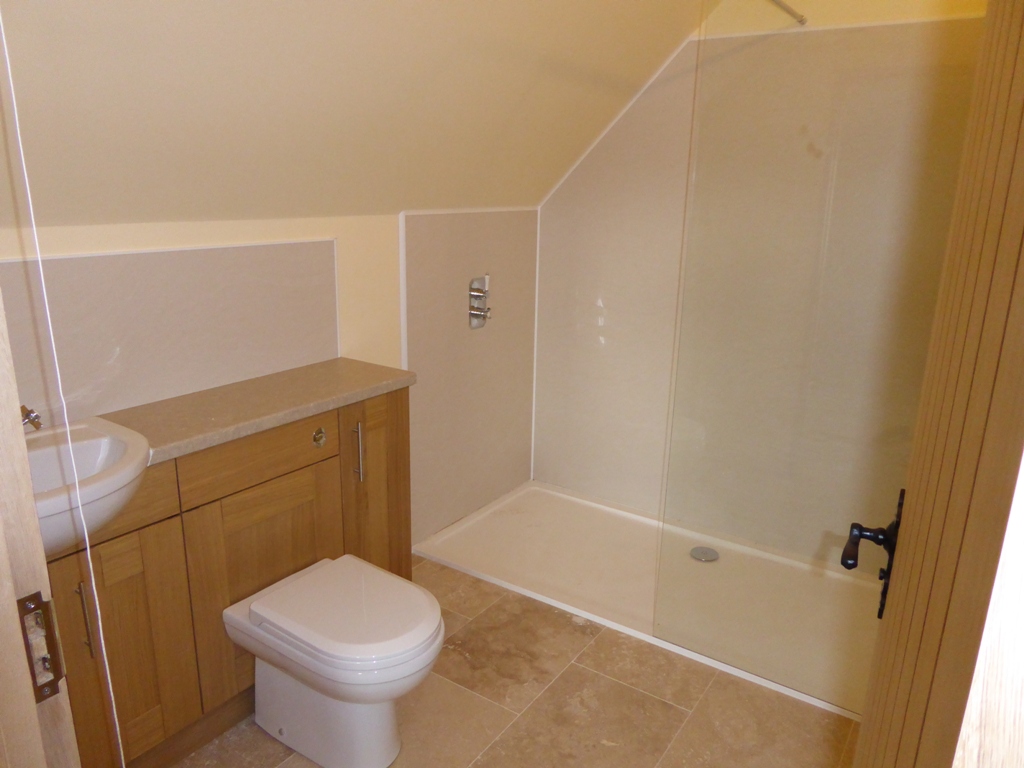
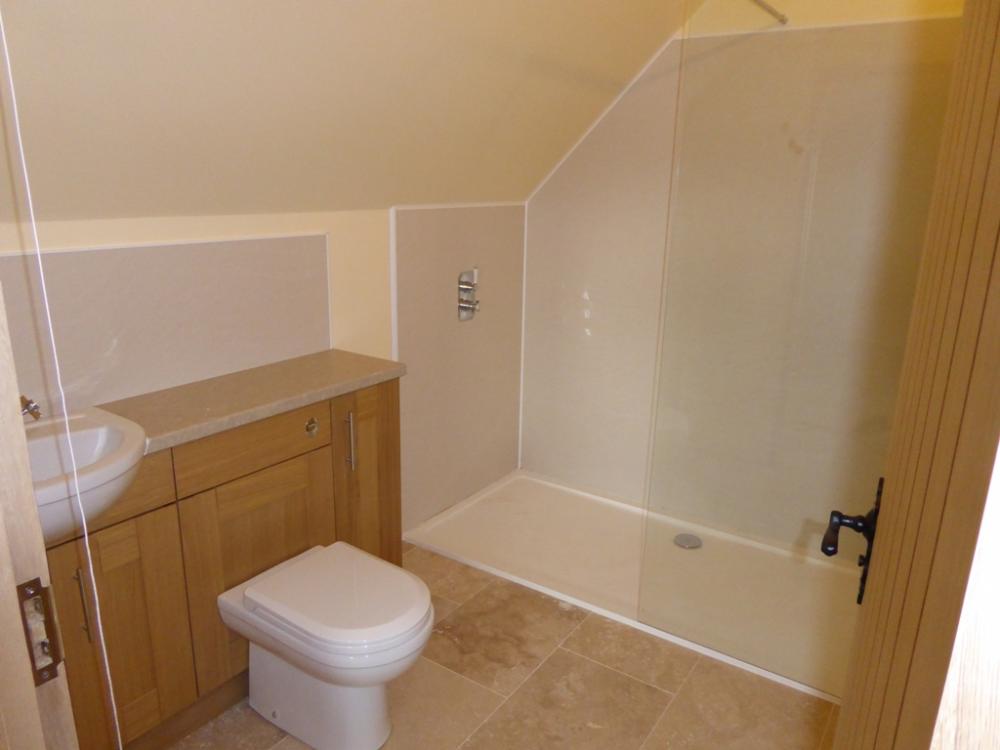
In our case the only place for a mirror was right where an internal light switch would have to be placed, so a pull cord was the better option. Our shower room sits under the eaves, so there's only a limited amount of usable wall space (you can see the still overly-long pull cord at the left of this photo):
-
There are two separate and unrelated issues around bulging cases. The most obvious and noticeable is the design flaw with the insulation at the top of the unit, which is too thick/too resilient to fit in the space available and pushes the lid upwards. The second isn't related to space, it is down to the flexibility of the case itself. The heat cell looks a bit like a plastic jerry can, and like a plastic jerry can it tends to bulge outwards when full, unless it is properly restrained. The Sunamp PV had cells with a similar construction, but also had an extremely rigid, bolted together, heavy duty alloy case. The Sunamp PV case was much more rigid than that of the Sunamp UniQ range, as its bolt-together design meant that there were flanges that stiffened it up a great deal. I commented on how robust the case was when our Sunamp PV was delivered: http://www.mayfly.eu/2015/10/part-forty-getting-into-hot-water-episode-two/ The Sunamp UniQ range have a single piece alloy case that is a lot less rigid than the Sunamp PV, and as a consequence it isn't stiff enough to stop the heat cell from bulging. Stiffening the case, as @Nickfromwales has mentioned, will fix this, i'm sure.
-
Using Flow Restrictors to achieve schedule G" of the BRegs
Jeremy Harris replied to TerryE's topic in General Plumbing
The washer type ( https://www.qssupplies.co.uk/bathroom-furniture-shower-taps/12664.htm ) aren't designed to be fitted at the tap outlet/aerator, they are designed to replace the washer in the tap connector; the junction between the pipework supplying the tap and the threaded portion of the tap to which it connects. If you have taps with flexi tails, then you just replace the washers in the flexi tails with the restrictor washers.