Jeremy Harris
-
Posts
26430 -
Joined
-
Last visited
-
Days Won
360
Everything posted by Jeremy Harris
-
I could lend you my old, and much tweaked, Airsporter. I know for sure that it has enough poke to take out street lights...
-
Years ago, when I was forever working on cars in my workshop, I made a waste oil heater out of steel scrap. It used a drip feed and a vaporisation plate that worked very well indeed. The thing was started up by chucking a petrol-soaked rag into the bottom, lighting it, then waiting for the plate to get hot enough before turning on the waste oil feed. The only snag with the thing was that as it heated up the oil in the feed would thin out and the flow rate would increase, so it tended to suffer from thermal runaway. The trick was to keep an eye on it for the first half hour or so and keep turning the oil valve down a bit as it warmed up. At full throttle the thing would get the 1/4" thick welded steel tube case glowing red, and it was all free heat from old engine oil. Saved having to get rid of the old engine oil, too, but it probably wasn't the most environmentally friendly way of heating the place.
-

Removing hardstanding up against a 3rd party wall
Jeremy Harris replied to Sjk's topic in General Self Build & DIY Discussion
The point I was making is that the Land Registry Title Plan is not a reliable indication as to where a boundary is, and neither is any plan associated with the old deeds. These plans have never been a legal definition of any boundaries, they are always just an indication only. The only way to define a boundary is by both parties agreeing that a physical feature on the ground is the actual boundary; maps and plans cannot do this. The first plot we tried to buy had a very large boundary error, that the sellers weren't aware of, but which we found when doing a survey of the site pre-purchase. The error was so large, and included the neighbour having (illegally) moved a public footpath, that we walked away from the purchase, as it was going to take at least two years to resolve, and the neighbour had almost certainly acquired ownership of the additional land by adverse possession. Our current plot had a large discrepancy between the Land Registry Title Plan and where the boundary was marked on the site, by a fence. The house that had PP could not have been built, as although it would have fitted with what existed on the ground, it would have been built partly over land marked as belonging to the neighbour to the North on the Land Registry Title Plan. The error was corrected by agreement between the vendor and the owners of the land to the North before we completed the purchase, but it was a long and costly process as it involved changing both the Land Registry information and the mortgage information for the neighbours (in effect their mortgage had been granted on the basis of a plot of land that was a fair bit larger than it really was). All told this meant we had a delay of around 12 months between the acceptance of our offer to buy and completion. The boundary is now clearly delineated on the ground by a concrete and stone wall, and the exact location of the boundary relative to that (the North face of that wall) is recorded on the boundary survey we had done, and copies of that have been lodged with the Land Registry as supplementary documents that are now referenced in the registration. -
You will lose a massive amount of heat into the ground, so UFH would be really inefficient, whether you use electric heating mat or a wet system. As you're already committed to using expensive electricity, I would have thought a much more efficient heating system, like panel heaters, or ceiling mounted infrared heaters, would be a much better bet, and would cost a lot less to run. UFH makes for a higher comfort level when it's on for long periods of time, but even with a lot of insulation underneath it there will always be some heat lost into the ground, so UFH is never the most efficient heating method, really. In a house, the loss of efficiency is OK, as the convenience of not having radiators on the walls, plus the added comfort level, more than compensates for the inefficiency, but it would not be a good choice for a workshop, IMHO. If you're going to be working in there in cold weather, then radiant heaters are a good choice, as they will make you feel warm pretty quickly, even though the air temperature in there may be a bit chilly. This is why warehouses and large workshops tend to use radiant heating; they don't need to heat the air up to a comfortable temperature in order for people to feel warm enough. Radiant heaters also have the advantage of being near-instant in their effect, useful for a workshop, where you want to feel comfortable shortly after turning the heat on. As an aside, we have UFH in our house, with 300mm of EPS insulation underneath it, yet it still loses close to 10% of the heat that goes into it through the ground beneath.
-
Whenever I've used PVGIS I've just copied the data from the tables into a spreadsheet and then done comparisons using that. That way you can do things like combine the predicted output for several arrays and see what the overall shape looks like. It's a bit tedious getting the data out of PVGIS and into a spreadsheet, as you need to do several PVGIS runs and then a bit of cutting and pasting of data from each, but once done you can play around with it far more easily. Right now I wish we had some East facing PV, as we have clear skies and sun from the East but are generating sod all, as our 45 deg pitch array faces slightly West of South. It's a nuisance, as I want to charge my car...
-
I panelled under our oak stairs for a hell of a lot less than that! IIRC, we paid a bit over £2k for the stairs and glass panels, and I think it cost me around another £200 to panel the underside. The stairs were designed with rebates under the side rails so that the panelling underneath could be fitted flush for a neat look. Took me around a day, at most, to panel it in and also build an oak under stairs cupboard, and I'm not a joiner... I finished our stairs with Osmo oil satin finish, expensive (around £50 IIRC) but easy to apply and it's given a very durable and easy to touch up finish.
-
We used Pear Stairs. Very good service and at the time, the best price we could get for solid oak with 10mm thick glass panels. They do custom designs via an online service, and send you a link to a 3D model of your stairs so you can see what they will look like before you commit to the order.
-
Basic advice of block construction and timber cladding please.
Jeremy Harris replied to Tony99's topic in Brick & Block
Triple glazing is significantly more comfortable than double glazing, we've found. The difference is more than the U value would suggest, as triple glazing can have two panes with an IR reflective coating and this means that when you're sitting or standing near it on a cold day you don't feel the heat radiating out through the glazing, as your own body heat is reflected back; about twice as effectively than with double glazing and its single low e coating. Triple glazing can have two panes with low e coating, as the coating has to be inside the sealed units, on the sides of the panes facing inwards, for protection from damage. -
Basic advice of block construction and timber cladding please.
Jeremy Harris replied to Tony99's topic in Brick & Block
Summer, or more often Spring and Autumn, overheating certainly needs consideration once you start to improve the insulation and airtightness of a house. Glazing is a mixed blessing, as the amount of heat that can come in via windows facing the sun, especially when the sun is low in the sky and so the heat penetrates more deeply into the house (hence the Autumn/Spring concerns). We have a large South-facing triple glazed gable and designed in a large roof overhang to limit the Summer overheating potential. However, we found that the main problems were hot days in Spring and Autumn, where the sun was low enough to come in under the shading. We ended up adding some (very expensive) heat-reflecting film to the outside of the windows to reduce the solar gain a lot. We've found that East facing windows tend to give a lot more solar gain in summer than those facing West, perhaps because on sunny days in summer the air can be clearer in the early morning, and with the sun rising well North of East there is a fair bit of time when East facing windows have a significant amount of solar gain. By late afternoon, the air often seems to be a bit hazy, and this definitely seems to reduce the amount of solar gain from the West, as even though we have some big windows facing in that direction we don't have overheating problems in those rooms. -
Basic advice of block construction and timber cladding please.
Jeremy Harris replied to Tony99's topic in Brick & Block
There's no such thing as thermal mass, hence the problem! There is a fair bit in that thread I linked to above that works through what people mean when they use the term "thermal mass", but as there are no units associated with it and no means of measuring it, my view is that "thermal mass" remains a bit of a myth. The closest approximation to what people mean when they use this term is probably the thermal time constant of the house - how quickly, or slowly, it responds to changes in outside conditions. Decrement delay is important, and this article gives a good insight into what it means in practice: http://www.greenspec.co.uk/building-design/decrement-delay/ -
Stiebel Eltron DHC-E 8/10 instant water heater
Jeremy Harris replied to ProDave's topic in Boilers & Hot Water Tanks
Bit like us having showers thinking that the Sunamp UniQ is charged right up, when in reality it may only be half charged, because of the daft way the Qontroller works... -
Removing hardstanding up against a 3rd party wall
Jeremy Harris replied to Sjk's topic in General Self Build & DIY Discussion
Neither the deeds not the Land Registry Title Plan will have an accurate or legally binding definition of the boundary, in all probability. The Land Registry actually warn that their Title Deed Plans should not be relied on as proof of where any boundary lies (been there, got the tee shirt, twice...). -
Stiebel Eltron DHC-E 8/10 instant water heater
Jeremy Harris replied to ProDave's topic in Boilers & Hot Water Tanks
I made the mistake of forgetting to specify a thermostat pocket on our buffer tank, but managed to make a small hole in the insulation, making sure it went at a tangent to the side of the tank and exposed a good length of the side of the copper. I then coated the end of the capillary probe from a simple mechanical thermostat with some thermal compound, along with a DS18B20 sensor, and pushed them both deep into the hole, sealing it up with low expansion foam. This seems to work fine, and although it may not sense the exact water temperature in the tank, it's probably within a degree or two, and the offset is pretty consistent, so the small temperature error doesn't really make any difference in terms of functionality. -
Love the idea of a concave mirror, carefully aimed to shine the light straight back as a focussed beam. Around here we have the "outside light police", as the AONB is trying to gain "Dark Skies" accreditation. As a consequence no one has any bright outside lights and everyone walks around the village with torches at this time of the year. I had to seek approval for our low power (10 W) outside lights from the bloke that polices the Dark Skies thing, but he was fine with them as long as they were all on PIR switched timers and pointed downwards. One really nice feature of having very dark skies here is that we get to see things like satellites and the ISS transiting overhead, as well as getting a good view of meteor events (when it's not too cloudy).
-
Basic advice of block construction and timber cladding please.
Jeremy Harris replied to Tony99's topic in Brick & Block
Might want to read this: https://forum.buildhub.org.uk/topic/16-the-great-thermal-mass-myth/ ? The key thing is really the thermal time constant and perhaps as important, choosing a high decrement delay insulation/structural build up. Mass doesn't come into it, as internal comfort, in terms of having a house that doesn't respond rapidly to outside temperature changes (like a caravan) is dominated by the insulation decrement delay and the heat capacity and thermal conductivity of about the first 100mm of internal structure - anything deeper doesn't really do much in terms of being able to work usefully towards buffering the internal temperature. Our build is timber frame, with no masonry, yet has a thermal time constant of days, very similar (but massively more thermally efficient) to an old granite cottage we owned about 30 years ago. One consequence of this is that the heating doesn't come on very often. Today was a bit milder than yesterday (around 7 or 8 deg C) so the heating hasn't come on at all yet. The rooms are sitting at around 21.8 deg right now and I guess the heating may come on for an hour or so tomorrow morning, but looking at the forecast my guess is that it won't need to come on on Tuesday at all, as there should be enough heat stored, plus incidental thermal gains, to keep the house warm (above the 21.5 deg C that the thermostat is currently set to). -
Stiebel Eltron DHC-E 8/10 instant water heater
Jeremy Harris replied to ProDave's topic in Boilers & Hot Water Tanks
Also, the hot water doesn't usually suddenly run out and turn cold as the tank runs out of capacity, it just gets too cool to be usable. Boosting it when it's at this "too cool" stage still allows it to be used for a short time, depending on the flow rate. For example, it would allow you to get a comfortable shower of over 40 deg C with the water from the tank only being at 30 deg C, even at 10 litres/minute. Interesting to look at the performance of electric showers, in terms of flow rate. For mains water coming in at 8 deg C (not untypical, that's about the temperature we used to get from the mains at our old house) then a 10 kW electric shower can only provide a shower at 38 deg C (about the temperature we seem to prefer) at a flow rate of about 4.75 litres/minute. Lots of people see to manage OK with showers that work at this low flow rate, we did for around 5 or 6 years, until we had the combi boiler installed at the old house. -
Stiebel Eltron DHC-E 8/10 instant water heater
Jeremy Harris replied to ProDave's topic in Boilers & Hot Water Tanks
In my case the idea was to just be able to boost when needed for the rare occasions when the Sunamp PV ran out of charge and we only had luke warm hot water. In practice this never happened, so the Stiebel Eltron sat there doing nothing at all, which is why I took it out when I fitted the Sunamp UniQ. As luck would have it, the only time we've run out of water for showers was after I'd fitted the much bigger Sunamp UniQ, for reasons associated with the poorly managed (IMHO) way in which it enables charging (or doesn't, as we found out). -
That's odd, as I've just had a quick look and there's no restrictions on your account that I can see, so you should be able to post in all the sections you can see. This is now in the heating section (I'm guessing one of the mods moved it), so if you can't post here let us know.
-
Stiebel Eltron DHC-E 8/10 instant water heater
Jeremy Harris replied to ProDave's topic in Boilers & Hot Water Tanks
The Stiebel Eltron is clever enough to not turn on (or at least not turn the heating element on) when the incoming water supply is above the set point. It then modulates from zero power up to it's maximum rated power depending on the temperature differential between the inlet and outlet, trying to raise the outlet temperature to the set point as the inlet temperature reduces below the set point. This is heavily flow rate dependent, so the maximum temperature uplift the unit will give is dependent on flow rate. Here is the graph I drew up from when I was planning on using the unit to boost preheated water up to about 45 deg (the dotted red line):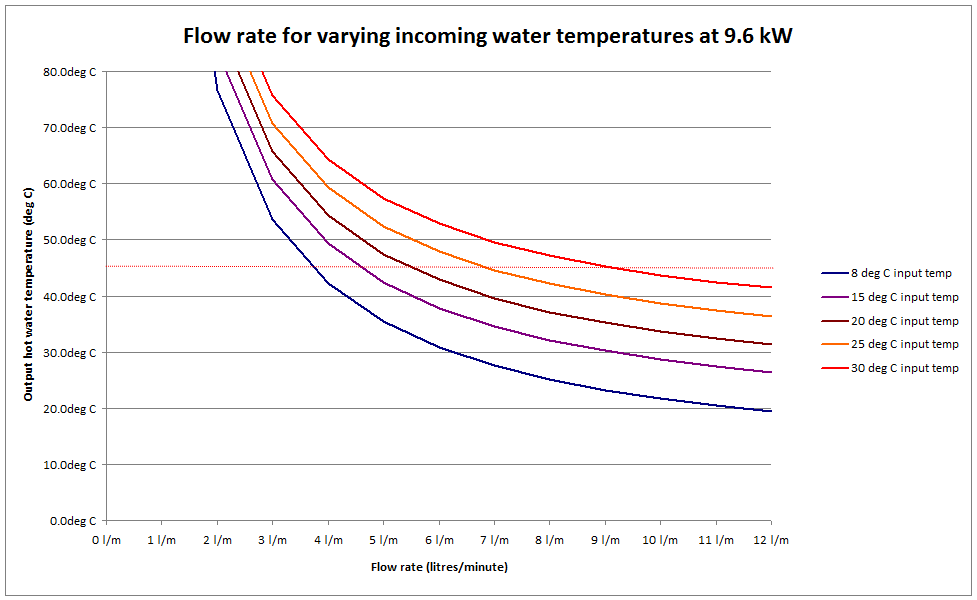
-
Stiebel Eltron DHC-E 8/10 instant water heater
Jeremy Harris replied to ProDave's topic in Boilers & Hot Water Tanks
Sorry, @ProDave, I should have warned you about the lack of space to fit a 10mm2 cable at the bottom of the unit. Another 10mm or so would make all the difference. I've not heard any noise at all from the flow restrictors I fitted, including the one that was in the shower pipe for a while. Our shower runs at around 10 litres/minute and seems fine. -
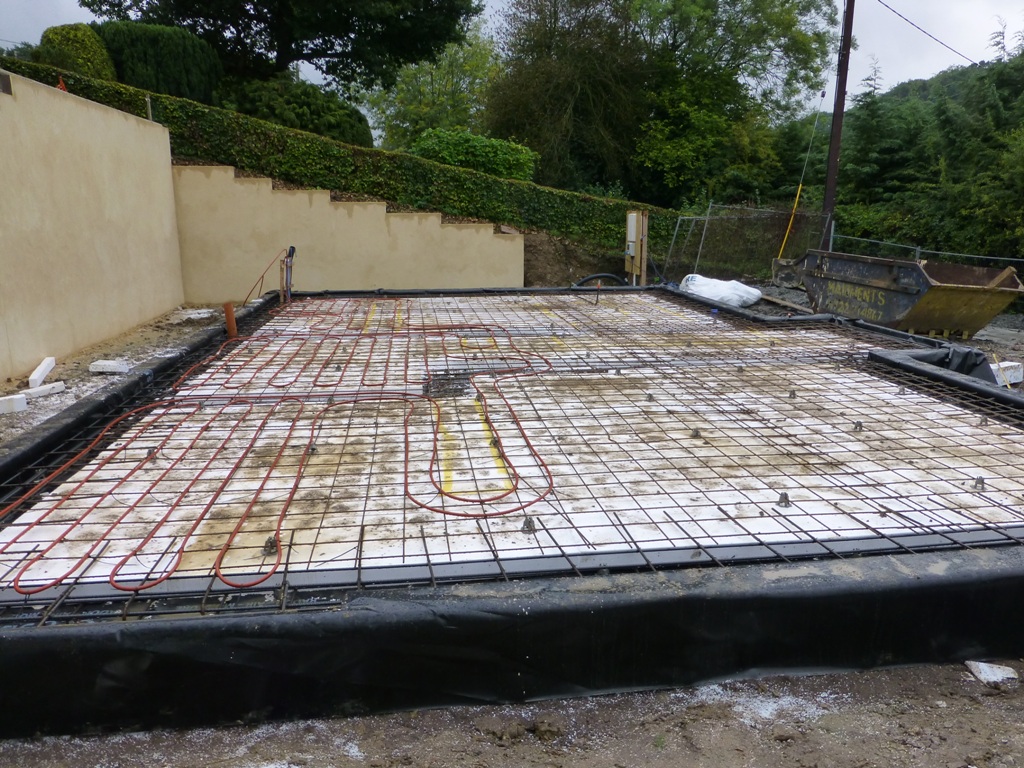
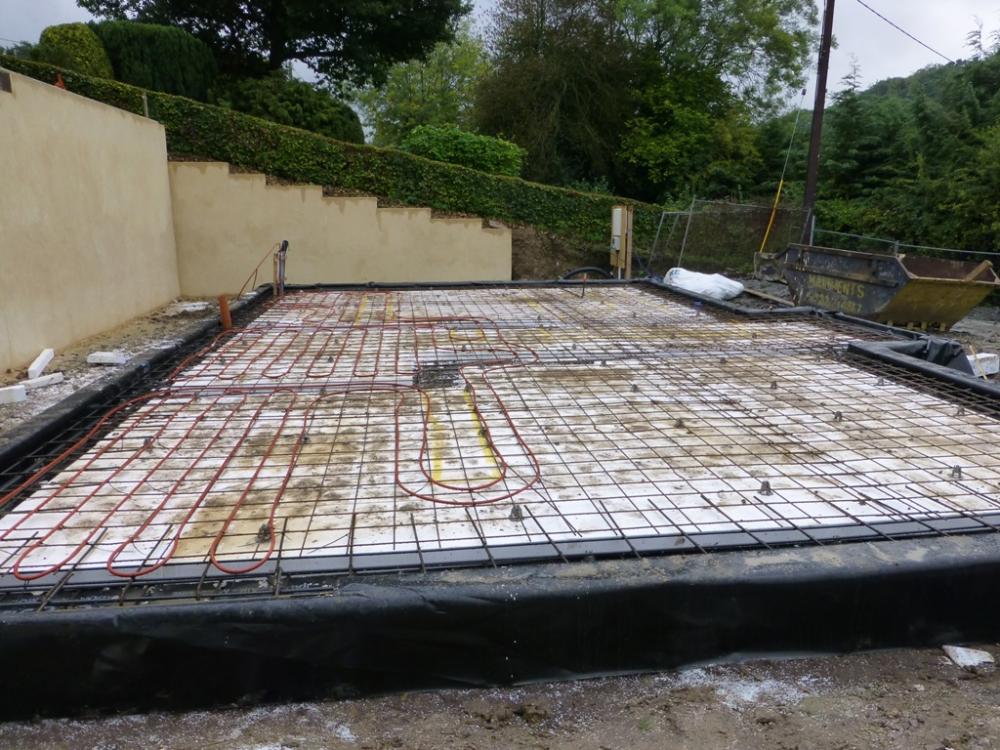
The pipe is standard 16mm UFH pipe. It needs to be above the insulation, plus the slab needs to have a minimum concrete cover over the fabric, so it's easier, cheaper, quicker and better to just fasten the UFH pipe directly to the fabric. Ours was done by the foundation team, as an intrinsic part of laying the passive slab, and didn't involve a UFH company at all. They left the pipes poking up out of the finished concrete, and when the house was up, I just connected the pipes up to an off-the-shelf manifold and pump set.
-
It's fundamentally different, as when putting UFH pipe in an insulated slab, the pipe only needs to be cable tied to the reinforcing fabric, so there is no need for clips, staples or whatever, just the pipe plus a big bag of cable ties. Here's a photo of our pipes, about half way through being tied in to the fabric:
-
Second hand solar panels
Jeremy Harris replied to Russell griffiths's topic in General Self Build & DIY Discussion
Sounds like a real bargain, and great news that they aren't as bad as thought. If I had room for another 25 panels I'd have taken a punt on some, but the most I could use would be around 10, if that. -
Sorry, my error, I blame getting older...
-
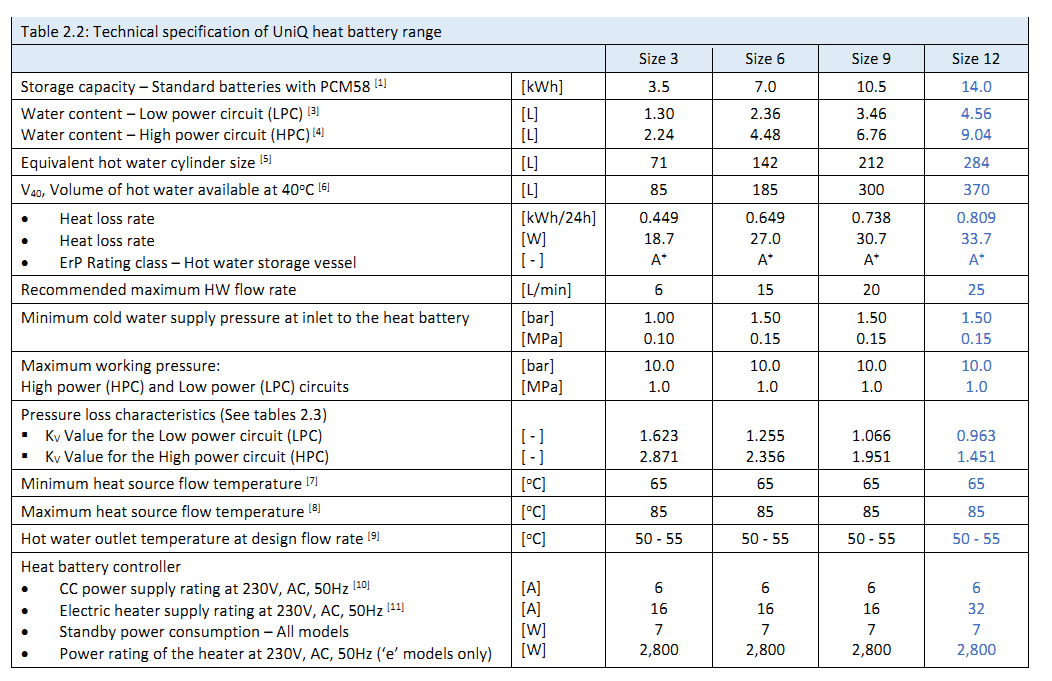
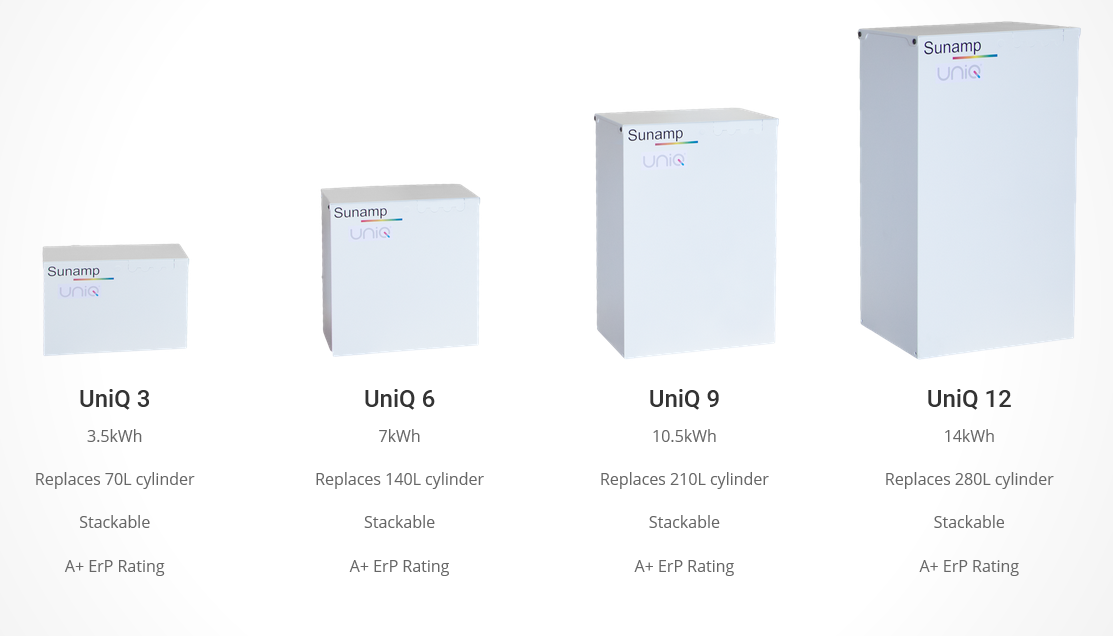
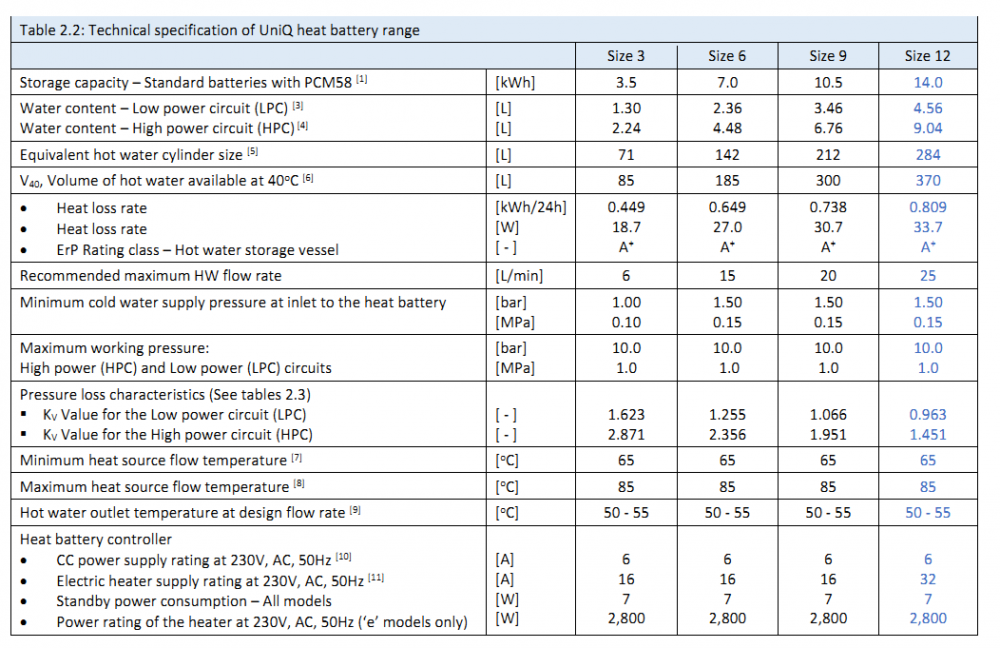
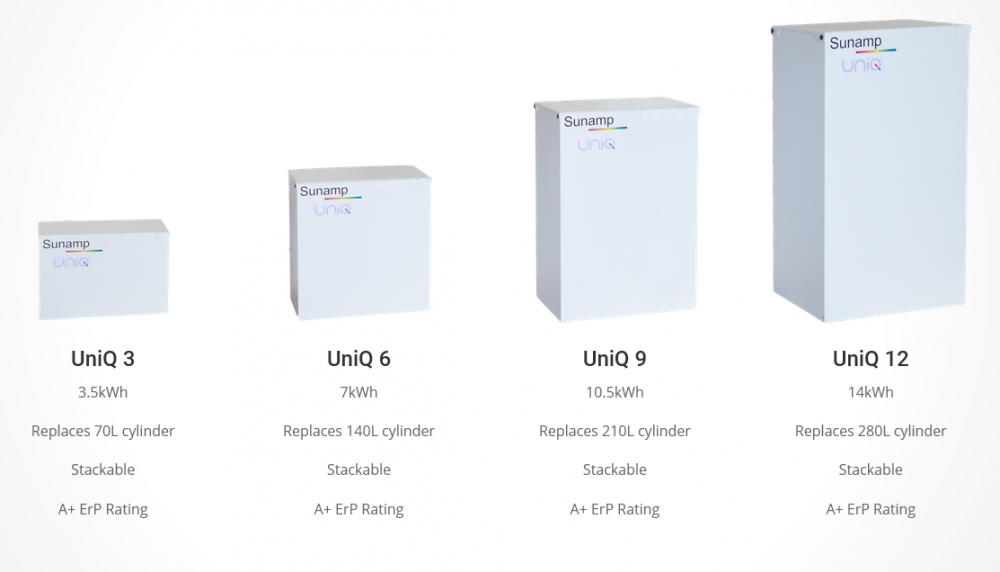
I've just tracked down the reference to the Sunamp UniQ range energy rating in the manual that was supplied with our unit: This clearly states that the ErP Rating class, as a hot water storage vessel, is A+, not C as shown on the label on the new unit that @Barney12 has received. The manual is accessible online, as well as being supplied with the unit, although I can't seem to find it on the Sunamp website, only on the website of one of their distributors: http://www.bublshop.co.uk/sunamp-uniq-e-heat-store-heating-only-model/p2039 Given that it seems that a hot water storage vessel cannot actually achieve an A+ rating, but can only ever get an ErP rating of C, it looks as if something is seriously awry here. Not sure it has any practical consequences, given the much lower heat losses that the whole Sunamp range have , when compared to hot water storage, but nevertheless the product literature should be accurate and not mislead potential customers into thinking they are buying something with a significantly better ErP rating than the unit actually has. Edited to add: This is the claim directly from the front page of their website, as linked to by @newhome above:
- 186 replies
-
- 1
-

-
- sunamp
- energy efficiency
- (and 1 more)