Jeremy Harris
-
Posts
26430 -
Joined
-
Last visited
-
Days Won
360
Everything posted by Jeremy Harris
-
No, none at all. The unit still delivers hot water in exactly the same way when powered off or on, as the Qontroller has no way of knowing that hot water is being drawn off, even when powered on, other than by monitoring three temperatures within the heat cell, near the bottom, centre and top of it.
-
No, I'd kept it powered up since it was installed, with the exception that I turned off briefly when I added the neon indicator to show when the charge acceptance relay is on or off.. It only occurred to me to turn it off and on again as an experiment this morning. I have a time switch sorted out now, so will turn it off for a minute and then back on gain every morning and see what sort of difference this makes to utilisation of PV.
-
This morning was close to the last straw About half an hour after two showers had run, I looked at the energy monitor and were were exporting about 3 kW. I rushed upstairs to find that the damned Sunamp wasn't charging (again). Not sure why, but I just decided to see what would happen if I turned the Sunamp off and on again. I didn't expect anything to change, so hearing the click of the main contactor coming on, confirmed by the "charge acceptance" indicator I fitted. I was overjoyed to see 3.5 kWh of free charge go into the Sunamp and top it up, be interesting to see how much difference this makes in the longer term. Ideally I'd like to get our winter export down to as close to zero as possible.
-
When it comes to supply and demand, which is in essence what we're looking at with building materials, then there are pressures from both the demand side, wanting materials at the best price, and also pressures from the supply side, from suppliers being keen to sell materials. Trying to predict how this closely interwoven trading system will work after any change, be it worries over financial stability, changes in the value of currency, changes in taxation systems, etc, is near-impossible. One significant issue is that the very act of trying to make a prediction alters the market conditions, as people start to react to what they think that prediction may mean, rather than what may or may not actually happen. For example, if the prices of imported goods were to rise, as a consequence of increased duty being applied, then whether that has a real-world impact depends very much on several other factors. Does the increase in the price of imported goods lead to UK suppliers taking advantage of an opportunity to compete, whereas before they may have been priced out of that market? Will suppliers choose to reduce their margins to lower the price of imported goods back to a similar level as they were before the imposition of additional import duty? Would our government intervene and decide to waive the import duty on key goods in order to maintain UK industry? Trade tends to be self-balancing to a large extent, with those involved, on both sides of the equation, having a strong desire to maintain profitable deals. For that reason alone I'm convinced that the reality of any perturbation, on a general (not personal) scale is likely to be modest and fairly quickly self-correcting. I believe the major issues facing everyone right now are the lack of certainty, the total and absolute incompetence of our government to address the impact of that uncertainty and the knee-jerk reactions that some organisations seem to have made at a time when they have no way of knowing for sure what's going to actually happen over the next few months.
-
Last week I reported in this post just how much of our excess PV generation the Sunamp had utilised as stored heat for DHW: We've now had a whole week of the Sunamp operating at the 50% setting, rather than the incorrect 90% setting, and these are the results for the last week: Excess PV generated energy exported to the grid = 19 kWh Excess PV generated energy used to charge Sunamp = 12 kWh Grid energy used to charge Sunamp = 17 kWh Total DHW energy used for the week = 29 Kwh, of which 12 kWh came from excess PV generation. in simple terms it looks like the Sunamp has managed to utilise around twice as much excess PV generation than it did the previous week, but it still allowed an estimated 8 to 10 kWh of excess PV generation to go to the grid, when there was almost certainly spare capacity within the Sunamp to have stored that energy. It's certainly an improvement, but still disappointing, IMHO. Next Monday I should have a full week of performance data with the Sunamp Qontroller being switched off for a short time every morning to "reset" it. It will be interesting to see how this improves its effectiveness at utilising excess PV generation; I suspect it will make a significant difference, probably a bigger difference than having corrected the erroneous Option 1 setting just over a week ago.
-
Thanks Nick, it will be very helpful to have some definitive news on both the case bulging and the failure to accept charge issues. Personally I'm not the slightest bit fussed about the case, as mine now looks fine, and the fact that the sides bulge out a small amount really isn't noticeable unless you put a straight edge across the thing. My main concern is being able to maximise the use of excess PV charging, especially during the winter months. If that means I have to adopt a means of turning the thing on and off ever day in order to get it to accept charge, then it's no great hardship, just a bit of a bodge. I'm pleased to say that our Sunamp accepted 3.5 kWh of charge from PV this morning and has now shut off as being fully charged. That means that me turning the power off and on again saved us a bit over 50p today, but that saving would add up over the year.
-
I have a very early plug-in car, a 2013 model, and it 100% protects the battery from the user. Cars even older than mine protected the battery to an even greater extent, and one thing that has changed a lot over the past few years (with the exception of the Nissan Leaf 40 kWh battery fiasco last year) has been that the usable capacity of battery packs has been gradually improving. My first hybrid, in 2005, only used about 60% of the available battery capacity, primarily because Toyota played very safe to ensure that battery failures didn't mar the reputation of the car. They got this right, as battery failures were practically unheard of, and the cars quickly gained a reputation for longevity, as so many were used (and still are) as taxis.
-
Yes, the immersion can heat up to a much higher temperature, as set by the thermostat in the immersion heater itself. Typically this would be set to around 65 to 70 deg C, I think. For further over-temperature protection, immersion heaters also now have a second, resettable, over-temperature cut out, to stop the tank from boiling.
-
I agree about needing a statement from Sunamp, it would help a lot if we knew just what is going on. EV's don't give a damn about how users charge them, BTW, they have a BMS that will always protect the cells in the battery no matter what the user does. I've been charging mine up to 100% twice a day, every weekday for about 4 1/2 years, and the battery range now is the same as it was when I bought it (if anything it's a tiny bit better now). I've also completely discharged the battery in my car many times, arriving home with less than 1 mile of range remaining on a pretty regular basis. The manufacturers build in to the BMS a bit of leeway when it comes to usable SoC versus actual SoC, so that the usable SoC range is often around 10 to 15% lower than the nominal battery capacity would suggest. Some models allow this capacity buffer to work as a sort of emergency reserve, by allowing the car to be driven at a low speed for a short time if the car runs out of usable battery capacity, rather than have it just stop.
-
I'm pretty sure the refusal to accept charge until below 50% problem is a side effect of trying to protect the PCM, but given that it can be bypassed by simply interrupting the power supply, something that must have been considered during the design stage, I'm inclined to think that it's just a nuisance factor that results from the control algorithm they are using. The PCM must be protected from over-heating, as it breaks down at around 125 deg C. I believe the unit limits the maximum temperature to something below 85 deg C to be safe. The case problem is unrelated, it's two separate issues. Firstly there is too much closed cell neoprene insulation in the top of the unit, and this physically pushes the lid up. This has nothing to do with the cell underneath, that seems to stay flat and doesn't move - it's just a design flaw that should be dead easy to fix (I've fixed it on mine by just trimming the insulation very carefully, so I know it can be done). The other slight case problem is just because the new units have a less rigid case than the old Sunamp PV. The Sunamp PV had a case that was bolted together, with return flanges on every edge, and was very stiff. The cells were also smaller, so there was less outwards force from the weight of the PCM within them. As I understand it (from a comment from @Nickfromwales) Sunamp are in the process of changing the case design to make it stiffer, so that it doesn't bulge. The side bulging has nothing to do with the operation of the unit, AFAICS, it seems to be purely a mechanical thing, related to the design of the welded box case.
-
Possibly, but given that the hot water system (assuming an unvented cylinder) is sealed, then it's very hard to see how any bacteria could get into the system in the first place, let alone multiply. As a safety precaution, wiring the immersion up with a timer to heat the tank to 65 deg C every couple of weeks would eliminate any risk. Personally I'm not convinced it's worth the hassle if you're on mains water, as the residual disinfection that the water companies leave in the water should deal with anything.
-
I think the good news here is that there's nothing inherently awry with the unit itself, just the way the Qontroller firmware behaves. My guess is that it may hold some form of state of charge (SoC) variable, perhaps not as sophisticated as this, in volatile memory. Turning the power off, then on again, causes it to "forget" whatever it's stored to indicate SoC, so it then reads the temperatures in the sensor string and starts again, assuming a "warm start". Adding a time switch to power the thing off then on again to reset it is a real bodge, but in the absence of any other fix it's an easy one to implement, and as it's external to the Sunamp should have no impact on the warranty; in essence it's no different to a short duration power cut and the unit should have been designed to deal with that scenario safely (I hope). Not a stupid question at all, and yes it is the same in principle as water turning from liquid to ice and back again. One reason that lumps of ice and snow hang around for a long time after the weather warms up is that it takes a lot of energy to melt ice into liquid water. This is much the same as melting the sodium acetate trihydrate mixture in the Sunamp, except the melting point is a lot higher, about 58 deg C. There's only a single cell in the new Sunamp heat battery, whereas the Sunamp PV used two small cells fitted side by side in the base. When partially charged I would guess that there is temperature stratification in the cell, with cooler solid PCM mixed with hotter liquid PCM. Once cold water enters the heat exchanger the hotter liquid PCM loses heat to the heat exchanger and turns into a solid again. We don't know for sure how this process works, but some of the papers I've read about it suggest that the formation of solid PCM within the liquid as it gives up heat may not be homogeneous, and there may be "clumps" of solid held within the liquid phase. I've no idea if this is actually the case with the Sunamp heat cell, though.
-
Not quite. The ASHP heats a sealed circuit, that may include the UFH loop, and that also includes the indirect coil in the hot water tank. This circuit is filled with antifreeze/inhibitor. You will probably have a three port valve as well to switch between heating hot water and running the UFH. The mains cold water fills the hot water tank, and that tank gets heated by the coil, and also by an immersion run from excess PV generation when it's available. The result is mains pressure hot water at around the maximum temperature that the ASHP can operate, typically 50 to 55 deg C, which is generally fine. @Stones has a set up like this, and has found it works well; it's worth having a read of his blog on here.
-
OK, I've just made an interesting discovery, that I think may get around the Sunamp UniQ eHW failing to charge until 50% discharged problem. Yesterday was quite sunny, and as luck would have it the Sunamp must have been a bit below the 50% state of charge point when we started exporting, so the unit charged up fully during the day; probably the first time it's done this from excess PV generation recently. We ran two showers off this morning, which would have used around 4 kWh worth of hot water at a guess, and this wasn't enough to trigger the Sunamp to charge. We have blue skies and bright sunshine now, and consequently we're generating around 3 to 4 kW, yet the damned Sunamp wasn't making use of this and charging back up (this really, really annoys me). So, as an experiment, I switched the power off to the Sunamp at the isolator, waited 20 seconds or so, then turned the power back on. Lo and behold the contactor clicked on and it's now happily charging. So, one bodge way around the failings in the Sunamp Qontroller may be to fit an additional time switch, that just turns the power to the controller off for a short time and then back on again, perhaps set to do this in the early morning, just after we've drawn off hot water for showers. Not ideal, but as I have a spare time switch I'm going to wire it in to the constant power feed to the Qontroller and see if it improves the utilisation of excess PV generation. Based on what I've just seen when I turned the power off and on again I'd say that it should make a big difference, but only time will tell. The other glimmer of hope here is that if turning the power off and on again resets the Qontroller so that it works as it should, then it should be fairly easy for Sunamp to change the code to do much the same (I hope!).
-

What a difference a nail makes.....
Jeremy Harris replied to ToughButterCup's topic in Tools & Equipment
Ours did. They wanted to inspect the frame whilst it was all still open and visible. -
Just in case anyone wonders about things like test leads etc that appear to have single insulation, then it's OK to have a single, thicker, reinforced layer of insulation for certain applications. Apart from test gear cables, the only other place you're likely to see single reinforced insulation in place of double insulation in a domestic setting are things like lighting circuits, where some types of, usually decorative, cable may be only single insulated, but have reinforced insulation that meets the regs for that application. We have an art deco lamp that has what looks like old cotton-covered cable, but which is really brand new reinforced single insulated cable with a woven covering over the outside to look the part.
-
Yes, any conductor inside an enclosure that needs tools to open, like a CU box, only needs to be single insulated. I believe that's the rationale behind needing two layers of insulation that aren't bonded to each other, but for the life of me can't find the relevant supporting evidence right now. IIRC it goes right back to the very first introduction of Class II equipment, which then led on to using two layers, or a single, thicker, reinforced layer of insulation on cables. This is about the time that the design of the BS1363 plug changed to include partially insulated L and N pins, IIRC. Things like meter tails, for example, just had a single insulation layer years ago, not two as they have now. The same went for cables used to supply incidental lights, or pendant drops, although these now have to use cable with either double insulation or thicker, reinforced, insulation.
-
As far as the regs go, being inside a box or cupboard is treated the same as being exposed, if the box or cupboard can be opened without the use of tools (and a meter box key doesn't count as a tool in this case). The principle is to ensure that there are two layers of insulation over any line or neutral conductor that is in a location where it could be poked with a small finger, in essence. I used heavy duty grey heatshrink sleeving to insulated the single insulated conductors, effectively making them identical to standard meter tails. The only thing to watch is to use a low temperature non-adhesive heatshrink, as the insulation on the cores will probably be PVC, that won't tolerate the high temperature stuff.
-
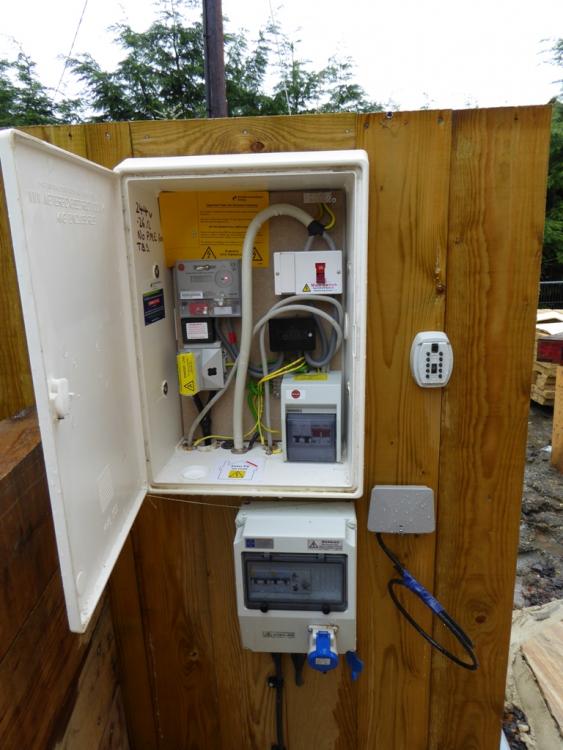
This photo of the 25mm2 SWA core running up inside our meter cabinet shows what's OK. We added a second layer of insulation (heat shrink sleeves) over the very short length of wire cores that were exposed where they went into the fused isolator to retain the double insulation that's mandatory: Accepted, but the intention behind the regulation is to ensure that there are two layers of insulation between the conductor and any area that could be accessed by a finger, without the use of tools. As such, heat shrink over a single insulated conductor is acceptable, as is the internal encapsulating sheathing under the armour of SWA. By the same token, the other end of that length of 25mm2 SWA is terminated in an adaptable box with a gland, and the cores were fitted with grey heatshrink before being run to the consumer unit and to all intents and purposes are every bit as safe and robust as double insulated meter tails.
-
As long as you don't strip the individual wires from the second layer of encapsulating insulation it's OK to run that as if it were T&E. It's still double insulated, and can be run from the SWA gland a short distance to another termination enclosure. You just need to ensure that any cable (except a CPC) that can be touched without the use of tools to remove a cover is double insulated, be that by retaining the encapsulating insulation over any exposed length of cable, or running it in conduit.
-
I know the area well, but from before the M25 was built. One of my school friends got his first job at Rank, back when it was still Movietone, making cinema newsreels. My father used to go fishing in the canal. We lived in Higher Denham, right on the bank of the river Misbourne, and I used to get a (steam) train from Denham Golf Club one stop down to Denham to go to school as a small boy. We moved to Gerrards Cross when I was about 11, and I lost touch with everyone I knew from primary and junior school, until recently, when I've tracked down some of my old school friends on the internet.
-
A friend of mine converted his single, basement, garage to a double by fitting a pretty simple looking lift for the second car. The same systems are getting popular in light aircraft hangars, as most hangars have plenty of spare height, so lifts allow almost double the capacity. Not sure how much the parking lifts cost, but the one I've seen looks very similar to the ones used on vehicle transporters. I'm planning to build something similar to lift my 5m long electric river boat up near the ceiling of my workshop, to give me more floor space, but I'll probably build a DIY system using an electric winch, much the same as a crate lifting winch I have to easily lift stuff up into the loft storage area above the garage/workshop.
-
My self-builder's zimmer has arrived!
Jeremy Harris replied to ToughButterCup's topic in Tools & Equipment
I just didn't think of getting something like this at the time. The knees got steadily worse through the build, with laying the flooring being the thing that I found really seriously knee-knackering. I have a selection of different knee pads and braces now, though... -
My self-builder's zimmer has arrived!
Jeremy Harris replied to ToughButterCup's topic in Tools & Equipment
Wish I'd bought one of these early on. I sort of bodged together a movable set of steps from the cheap scaffold tower I bought, but it was cumbersome to move around and the steps were too high. I also made a mistake when buying a hop up platform, thinking taller = better. It doesn't. Taller = knackered knees and bashing your head on things. -
Really because it's relatively easy to use, stretches a great deal (has to be stretched to make it work), never goes sticky or comes undone with age and can be removed without causing any damage or leaving any residue. Not great for big sealing jobs, but ideal for sealing the ends of smaller cable ducts, or conduit used as ducting.