jamieled
-
Posts
639 -
Joined
-
Last visited
-
Days Won
1
Everything posted by jamieled
-
EU spending has been audited and signed off every year. It doesn't take much effort to check this. Jacob Rees Mogg and the ERG tried to peddle this and were widely derided for it.
-
@LA3222 couldn't agree more. There is a current line of thinking that the vast increase in access to information over the last couple of decades has not been accompanied by an increase in the ability to critically analyse the source and veracity of it. Although even if these skills did exist I'd question to what extent they'd be employed - most of us exist in bubbles and reasoned debate, with an ability to alter opinions based on evidence is a rarity. There are good reasons to think that our political system needs a complete overhaul - if you haven't read it then 'Why we get the wrong politicans' covers some interesting points.
-
Evidencing self consumption post FIT
jamieled replied to ToughButterCup's topic in Photovoltaics (PV)
I couldn't quite figure out from your post if this is more about having the systems in place to ensure you self-use generation, or just a way of monitoring that you are? I have a similar setup for my PV, slightly different brand names but that's not important. Our heating and DHW is all-electric. I have a pv diverter (eddi) with a CT clamp on the supply cable and a CT clamp on the generation cable. It then tells me at a glance what I'm generating, using and exporting and I can scroll through recent days, weeks/year to look at historical figures. Apparently I can also hook it up to a hub/app to get the info on a phone or a computer but it's not a priority at the moment. -
Bad Airtightness Test Result
jamieled replied to AliG's topic in Mechanical Ventilation with Heat Recovery (MVHR)
@AliG although our house is on a much smaller scale to yours I have come to similar conclusions. Our air test was ~3.5m3/m2/hr which was a bit disappointing given the effort we went to in trying to think through airtightness. That said, we don't need a lot of heat to get it to temp and it stays warm for a while. Even on the windiest days I can't find any obvious draughts. So while I may try and work on this a bit more I think I'm at peace with it. Would second the recommendation for others re an air test earlier in the build. -
Interesting cost information for persimmon builds
jamieled replied to Moonshine's topic in Costing & Estimating
The build cost including land seems remarkably cheap. Unless my sums are wrong they can build for ~£1000/sqm including the land? -
I'll just add another experience to the mix here. We have a 33kv OH line running across our land. It's a pain in terms of managing trees. When we acquired the land, there was no wayleave or deed. It became pretty clear that the cost of the DNO either rerouting or undergrounding the cable was going to be very high and there was next to no chance of it happening due to the importance of the line to them. They would have not thought twice about a necessary wayleave. Anyway, my points are that 1) it might help to understand their costs and the importance of the line to them (which it sounds like you're doing) and 2) Get good legal/land advice. There are precedents for compensation where planning has been granted on a bit of land that a power line preventing the construction. Our experience is that professional advice has helped a lot and the DNO's often have a statutory requirement to pay for this.
-
After plasterboard, which I regret now. If doing it again I'd definitely do 2 tests, they don't cost much in the grand scheme of things. We did spend a lot of time going around the main structure on windy days pre plasterboarding but it obviously wasn't up to much.
-
Only a short update for now and a distinct lack of photos. I'll put something more interesting up in the next week or so. Suffice to say that combining work with trying to get to completion has been quite difficult. Throw into the mix that my other half is shortly due to have twins and you understand why I'm often getting comments like 'do you ever think you've maybe bitten off a bit more than you can chew?'. One milestone recently was getting our air test done. I've decided to write a bit about this as a) There seems to be a fair bit of interest in this on buildhub and b) our result is not quite as I'd hoped and so I thought a few musings on this might help others. I haven't had the actual test report through, but from the results I saw on the screen, we ended up with a value (no laughing please from the passivhaus crowd) of around 3.4 m3/m2/hr. This is fair bit higher than I'd hoped for, but as I'll explain below, maybe not too surprising. The guys who ran the test spent a bit of time wandering round trying to find leaks and allowed me to do the same. There were no areas of the house where they could find significant leakage, but one or two small leaks easily dealt with. This obviously leads to the question of where it's all going. For reminders, our house is built from 300mm I-beams, filled with cellulose and then boarded with OSB on the inside, with all joints taped. All the services are ducted in and the ducts sealed. Windows have expanding foam strips around them and are taped. I don't think I'll ever know where the weaknesses are, but my suspicion is now around either 1) the OSB itself and 2) Where the 1st floor joists meet the outer rim board (a detail I failed to think through before it was too late). If I look back on some of the build, I think that I probably didn't spend enough time figuring out some of the detail earlier on. That said, I had a distinct lack of housebuilding experience when we started, and so I spent a lot of time trying to figure out the basics of drainage, roofing, cladding etc etc... It's now quite clear to me that if I was to have done better on some of these small airtightness details, then I'd have had to either take a lot longer on the build or go down another route (perhaps buying a kit with a minimum guaranteed airtightness?). Anyway, disappointing thought it is, we're in November, it's about 2 degrees outside and the house is toasty and will keep its heat well into tomorrow. While there would have undoubtedly been some benefit in getting it more airtight, it's a lot better than anywhere else we've lived. Frankly, my disappointment was pretty short-lived as we have more important things to worry about. Final bits before I can apply for completion are the access ramp and some outside drainage. Oh, and then the twins might arrive...
-
There never was for solar PV.
-
Have a look at a smaller or more independent sawmill, most of them usually advertise on the web. We've cut and dried boards for all our cills and they look good in situ, worth the extra effort.
-
@Ralph when I was discussing our connection with SSEN they specifically said that if the accepted price turned out to be higher when they came to do the work then I wouldn't have to pay any more. They also said if it cost less, we'd be due a refund. While I know it has cost them less, as you might imagine, getting a refund isn't straightforward. I'll see if any of my paperwork helps.
-
Cladding details
jamieled replied to Russell griffiths's topic in General Self Build & DIY Discussion
I used Envirograph. There's limited choice and it was pretty expensive. If I'm being honest it's one thing I overlooked when planning and so not a cost I budgeted for but it's needed. I can't remember the exact name or gap that it fills but they do a few different products depending on the application. I reduced the gap slightly by adding an extra horizontal wooden batten as it worked out cheaper doing that than buying an intumescent product to fill a wider gap. -
Cladding details
jamieled replied to Russell griffiths's topic in General Self Build & DIY Discussion
We were vertical board on board, so slightly different. But in essence, the same detail as noted above - mesh trapped behind the vertical battens and stapled to sheathing, form a U then bring it round onto the front of the horizontal batten. Because we had board on board there were odd gaps to fill. We used 200mm mesh, I got it off ebay from some seller called something like mesh direct. @trialuser, the only way I know about (and what we ended up doing) was using an intumescent barrier for the horizontal firestop. -
Cladding details
jamieled replied to Russell griffiths's topic in General Self Build & DIY Discussion
What kind of cladding - horizontal, vertical, board on board or side by side? -
Architect - Making the maths add up...
jamieled replied to Mulberry View's topic in General Self Build & DIY Discussion
We used an Architect. Although we're not finished, overall I'm glad we did as he added a few ideas to our plan that in my opinion look good. We only ever planned to use him to get us through planning and building warrant and then we took it from there. I think your expectations are reasonable, maybe it's just finding the right Architect who's happy to only work up to the Building warrant approval stage? I did what you are thinking of and took a year out from work to try and keep some costs down. Re costs, my calculator reckons we paid about 3% of the likely build cost for the architect services. -
It's possible (depending on where you are) that it is your local authority who will dictate what the design standards now rather than bre. Some of them publish their drainage standards.
-
It's in my head ( sorry not helpful and it doesn't mean its correct). I just checked my work copy of the BRE digest which states the 10 year: Inflow to the soakaway I = A x R where: A = the impermeable area drained to the soakaway; R = the total rainfall in a design storm (a 10-year return period should be used); calculation of R is shown in the box below.
-
For soakaway sizing it is the 10 year design event.
-
I was asking sse and the openreach engineer if there was anything we could do to stop this happening again. SSE have at least put some insulation on their transformer which might stop contact from any other unlucky flying birds. I don't think there's anything else we can do in the house and the openreach guy reckoned it was just pretty unlucky and that given the large number of rural houses fed from a transformer it's not worth trying to protect their lines from an unusual voltage spike on the power network.
-
Openreach came out today to sort the master socket. Whatever happened, it melted a load of armoured bt cable and joints and popped stuff in the exchange ~2km away.
-
@joe90 there is a large scorch mark on the side of the cu where the bt socket went pop. Not sure a plastic cu would have been as robust.
-
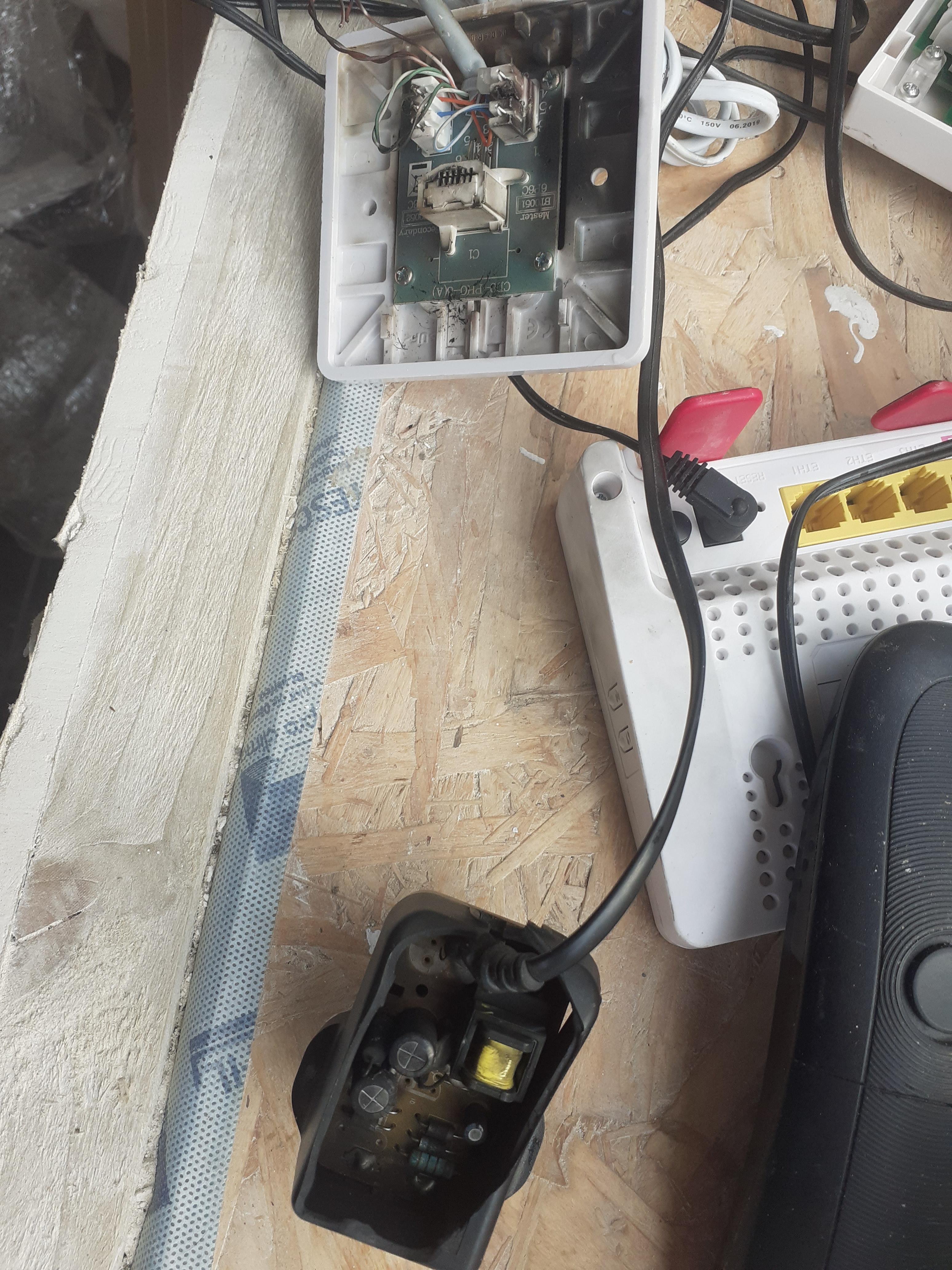
SSEN sent someone out last night to do additional checks and to arrange repairs. Apparently they do this all the time where voltage faults have caused damage. His working theory is that it was more likely the voltage spike came from a phone plugged into a socket elsewhere in the house. This then transferred into the cat5 connected to the bt master socket shown above. His reasoning for this is that the power plug on the phone was blown while the router power plug (connected to the master bt socket beside the cu) was fine. The base station for the phone also shows damage. He didn't seem that surprised by what had happened. Pic shows the phone 3 pin power plug and the back of the bt faceplate it was plugged into. I'm quite grateful that metal CU was in place. Not sure we'd have had the same outcome if it had been plastic.
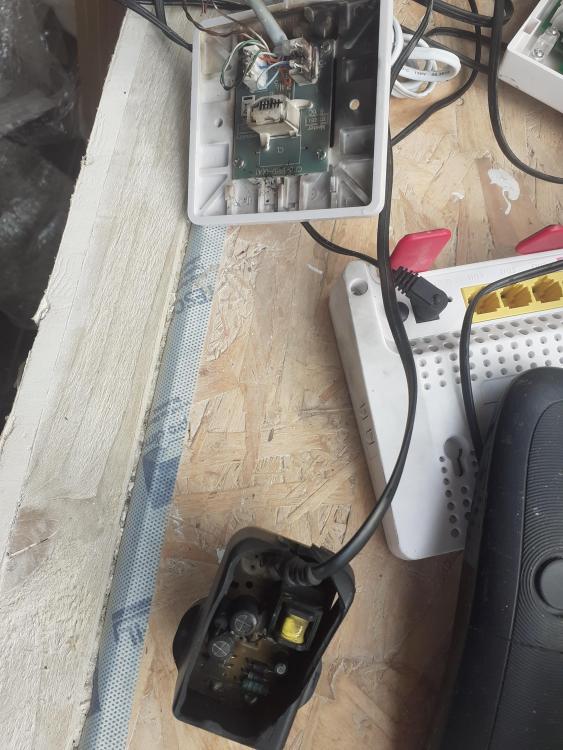
-
Don't think anything tripped in the house but I wasn't the first to look at the CU so could be wrong on that one. Earths were checked afterwards by SSE and the electrician and found to be fine. The power went off and on again immediately after the bang, but I think that was just the usual network operating process - it's done it in the past when a tree hits the line.
-
@Mr PunterI have left out the juiciest details to make sure nobody steals the film rights.
-
@ProDave Might just be my description! BT line comes into the house through the founds but the cable sits on the ground surface where it runs down to the junction box beside the road. The bt cable in the house looks like toast (both master socket and one other internal socket with phone connected). Couple of other bits of damage to electronic timer/boost switches. SSEN were out repairing the transformer last night as it blew some kind of fuse when this happened, normally designed to protect the transformer from lightning strikes apparently. Although I can't explain exactly what happened to the bird it seems too much of a coincidence that the transformer goes bang at the same time as the bird touches it and our bt socket also blows?