
Nickfromwales
-
Posts
31377 -
Joined
-
Last visited
-
Days Won
346
Everything posted by Nickfromwales
-

Controlling underfloor heating in passive house
Nickfromwales replied to dogman's topic in Underfloor Heating
The TMV then just becomes a failsafe device in case the Willis heater / its controller goes nuclear and tries to delivery heat to its infinity. So basically, you can't do away with the TMV even if you don't 'need' it . -
Controlling underfloor heating in passive house
Nickfromwales replied to dogman's topic in Underfloor Heating
That's the beauty of it, it doesn't need to 'pull' ( draw ). The TMV is just a gate which opens partially / fully to allow heated water to be introduce into the already recirculating, free flowing body of water ( between pump, manifold the Ufh loops ). That circuit allows the manifold pump to freely circulate regardless of the state of the TMV, e.g. open or closed the pump sees no real difference as the loops typically will have no motorised actuators per loop arresting flow. If the TMV opens partially then water will be forced down the return and subsequently back into the flow, and that will be gentle rather than a surge so basically linear with the required amount of heat input. It's a beautifully simplistic, self managing arrangement . -
I use foam snickers ones, and just bin them when they go 'flat'.
-
Controlling underfloor heating in passive house
Nickfromwales replied to dogman's topic in Underfloor Heating
Then you have to introduce antifreeze to the whole system . -
Controlling underfloor heating in passive house
Nickfromwales replied to dogman's topic in Underfloor Heating
I'd 100% be using the ashp for DHW uplift. Why have such a good resource and not use its full ( good CoP ) potential? A buffer with DHW uplift coil ( so actually a TS ) is a no-brainer afaic, unless you have a good PV array where the argument becomes less one sided. With a typical target 'set' buffer / TS temp of 40oC, and showering requiring 38-40oC max, most of your DHW production can then be from low grade / high CoP heat energy, rather than having the ASHP running in DHW mode, at 55oC, with zero or negative CoP. -
Controlling underfloor heating in passive house
Nickfromwales replied to dogman's topic in Underfloor Heating
Only 30mm -
Controlling underfloor heating in passive house
Nickfromwales replied to dogman's topic in Underfloor Heating
Buffer tank with a coil is best imo, but @JSHarris has made clever use of convection to preheat his PHE so there is little / no delay in producing cold mains uplift to his SAPV's which is exactly what I would recommend ( if the DHW manifold / distribution point is any real distance from the uplift buffer. Remotely mounting the PHE closer to the manifold location could also be negated by having a buffer in the airing cupboard and also locating the DHW manifolds there. Latent heat loss would be minimal, but useful too then. I cannot see the point / need for a pump to circulate beteeen the buffer and the Ufh manifold. The manifold pump will suck that through with ease unless it's a massively long and complex pipe run. The biggest problems I've had is stopping unwanted ( summertime ) convection circulation from the ( TS ) buffer to the Ufh manifold ! The bloody things pull through without even turning the manifold pump on . That I dealt with by means of a 2-port zone valve, also a requisite if you intend to circulate the Ufh water for solar gain absorption and redistribution throughout the slab, e.g. flow but no heat input. Whovever said these haven't pulled through on their own, I seriously doubt. -
Doubling up the joists and cantilevering is another. Need as structural engineer ( SE ) then though.
-
Yup. Another 'Dee mini-blog' and not looking too shabby either
-
I'm good thanks
-
You don't get those very often. Brings a new meaning to 'water saving device'.
-
Tale of tails: how long can a tail be?
Nickfromwales replied to ToughButterCup's topic in Electrics - Other
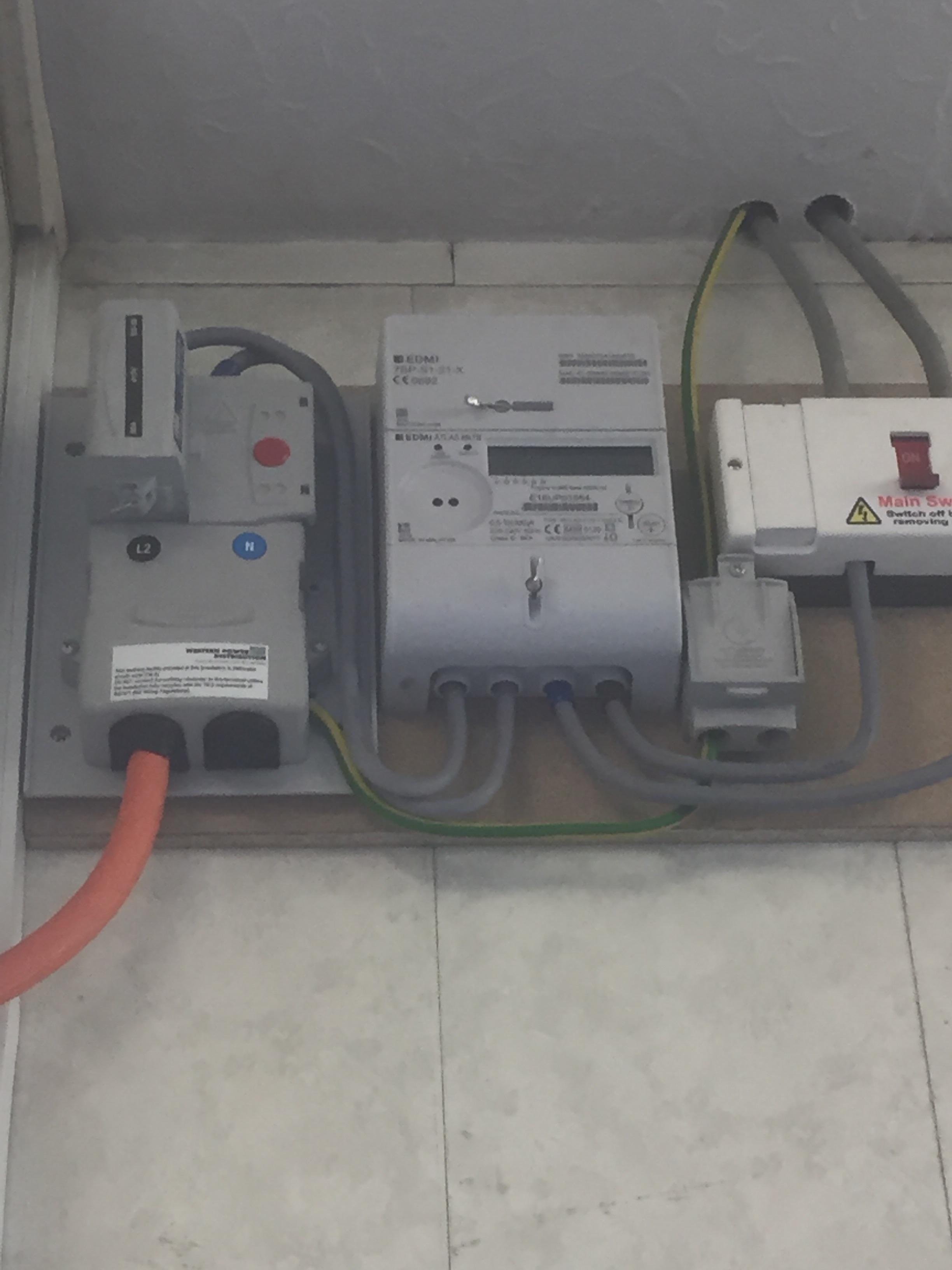
This shot shows the head, then the meter, then the DP fused isolator ( KMF ). 16mm2 tails to those. Then 25mm2 tails leave to go to the CU location 13 metres away .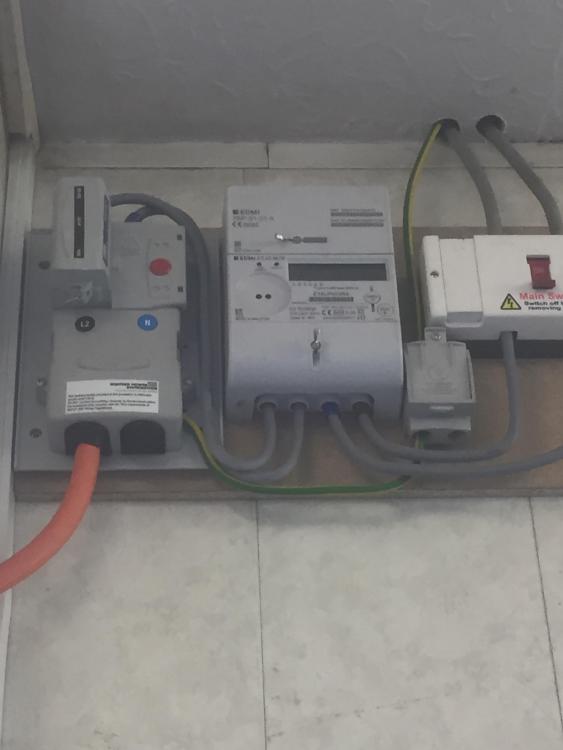
-
EWI paid for by your energy supplier.....
Nickfromwales replied to ProDave's topic in Heat Insulation
Whip around the day it's all clad with the insulation, and where the accessories are just rebate some panels of PVA coated OSB3 / similar, bonded in with foam. You could screw them too with some long screws if it were more than a socket etc. Other than that your Donald Ducked. Oh, and not extending the soil pipes is just horrific. -
@Grosey Can you update the link in your op as its a removed / deleted item . Thanks.
-
I will shut my mouth ✌️️
-
Don't start me off. For your entertainment Ian; I even questioned the spelling and after losing the plot I googled it. ? "Taxi!"
-
I see the confusion has been in referring to the osb former, as a former, when it's actually a mould.
-
Post liquid screed pour treatment - sanding?
Nickfromwales replied to readiescards's topic in Underfloor Heating
Carpet fitter was trying to push me out of the way in my house but I insisted on scraping and hoovering every inch of the dusty weyroc. I would have preferred to PVA it all too but it was 3 days before Xmas and I was running behind. . -
Design Help - Plumber not helping
Nickfromwales replied to DeeJunFan's topic in Other Heating Systems
Can you start a new topic for that when the time comes please Dave Thanks. -
Can't find the right stopcock (copper to mdpe)
Nickfromwales replied to ProDave's topic in General Plumbing
Distract him by talking about drainage..........they LOVE drainage. . -
Can't find the right stopcock (copper to mdpe)
Nickfromwales replied to ProDave's topic in General Plumbing
He won t give a ? -
Design Help - Plumber not helping
Nickfromwales replied to DeeJunFan's topic in Other Heating Systems
Legionella purge would need doing weekly. If you set up a timer for the last hour of E7 then that would stay warm ( hot ) for the morning showers so wouldn't be 'wasted' ( heated high for purging then left to ebb away back to idle temp ). Fact is, with a pv based immersion it's likely that you'd be achieving high enough temps to purge at midday every day, but unless it was logged and automated then you'd still need a failsafe e.g. a timer on grid electric. If you only had a single immersion you could just mount that timer to bridge the pv diverter ( immersun / other ). -
Cut them in half and go at 300mm centres. ? ☕️☕️☕️ ?
-
Fitting a tiger loop, even though you didn't NEED one, is what I'd do if I was on oil. That way the system will self purge from just pressing the lockout button so no more spanners and smelly hands. Plus, much less chance of starting a leak by frequently interrupting the oil line. .
-
At 2.4, I'd prob go for 5x2" but 6" would be better tbh.