

Nickfromwales
-
Posts
31377 -
Joined
-
Last visited
-
Days Won
346
Everything posted by Nickfromwales
-

Unvented Cylinder D2 discharge pipe calculations
Nickfromwales replied to ProDave's topic in General Plumbing
Patch the render and paint the 90 white first ? . -
Discount Offers of the Week
Nickfromwales replied to Ferdinand's topic in General Self Build & DIY Discussion
Lol http://www.ebuild.co.uk/topic/16955-desk-top-pc-died-what-next/page__fromsearch__1# Guess who the author was -
Help me deal with a neighbour!
Nickfromwales replied to hmpmarketing's topic in General Self Build & DIY Discussion
Have you ever heard the phrase "suicide mission"? 1) I doubt he'll be appreciative of you saying his house is scruffy and you'd like to make it more pleasing to the eye. If you knocked my door and told me that I'd tell you to Foxtrot Oscar. 2) Don't make such a daft gesture, ask @JSHarris where goodwill to your new neighbours gets you. Bollocks to that. Black and white is what this is. If he'd read the planning he'd already know what's happening. If he didn't then that shows his level of giveafuck is around 2%. If it were me, I'd pay for the highways contractors to come and burn the road markings off and ask them to do as @ProDave suggested, with his new space painted accordingly. As you say, man up a little, tell him what is happening and await his next response. Until then this is all a bit 'hypothetical'. Let's get a response, then deal with the outcome. You have planning so the worst that can happen is you don't speak to him as you drive into your house. Big deal. You can please some of the people all of the time, so to be -1 wont exactly cause you any panic. After a while he'll come around any way, ( he'll have to! ). -
Discount Offers of the Week
Nickfromwales replied to Ferdinand's topic in General Self Build & DIY Discussion
Search here as I've had advice, lots of it, for breathing new life into my old machine for very little outlay. . I plan to do the upgrades quote soon after @Onoff finishes his bathroom. ? -
Design Help - Plumber not helping
Nickfromwales replied to DeeJunFan's topic in Other Heating Systems
Got to love the simplicity, but I think I'd have at least put a tap next to it with a hose. . One of my 'I'll do it one day' ideas is to put a huge TS ( 2000 litres or more ) in my shed, entombed in poly beads or similar, and use my chimnea to heat it. When that thing is going flat out I can barely stand 8' away from it. Can't help wondering how much DHW ( cold mains uplift via a instantaneous coil in the TS ) I could generate by my evening BBQ sessions. ? Was thinking of a home made ST rig ( old rads painted black ) on the flat roof of the shed as a means to keep it from going 'cold' for background input. Theoretically, after two 'burns' per week, it should always be above the flow temp of ST so weighing up the options. ?? DIY PV becomes more sensible too then as I'll always have somewhere to dump excess. Hopefully I'll live long enough to find out, maybe another 200 years would suffice ? -
Design Help - Plumber not helping
Nickfromwales replied to DeeJunFan's topic in Other Heating Systems
Exactly what I would do. Light it once, heat a giant tank, and enjoy. Same principal as charging a battery. If you've got a big charger, charge a much bigger battery. . -
How to find a slow leak?
Nickfromwales replied to Fallingditch's topic in Central Heating (Radiators)
And on further inspection, the gauge shows zero, which reinforces my last. Therefore :- Result 3) previous plumber is a penis. -
How to find a slow leak?
Nickfromwales replied to Fallingditch's topic in Central Heating (Radiators)
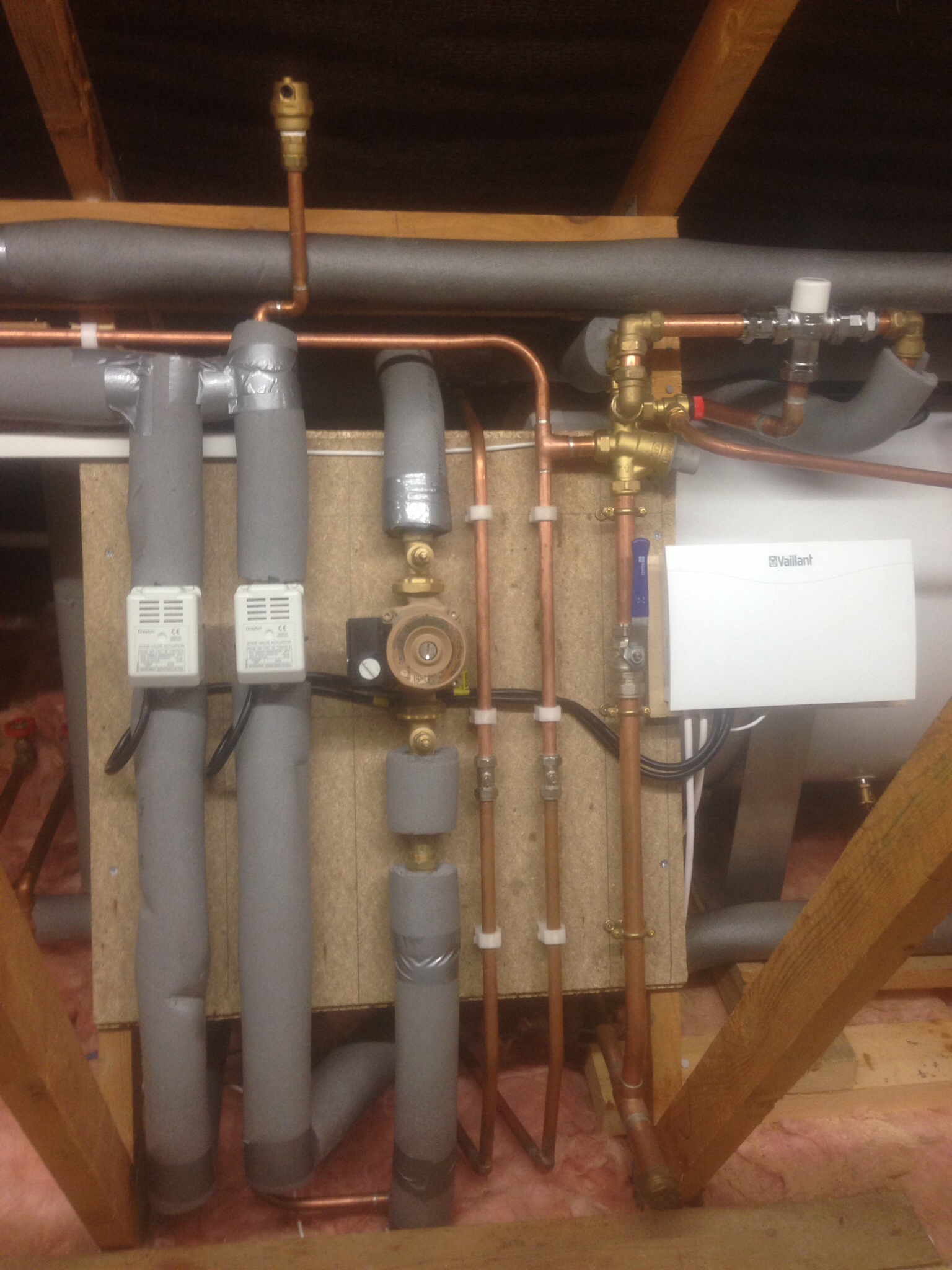
Ok, I think I've got it. Sounds like they've put the additional EV in accordingly, but have inadvertently connected it to one of the severed pipes, rather than connect it to a live central heating pipe. Result 1) water pisses out where it shouldn't. Result 2) you aren't benefitting from the secondary EV volume, so your boiler is giving the pressure issues that started this thread. A non-retired plumber needs to attend and make said connection accordingly, at which point your books and towels will be dry and your CH will be reliable and function as it normally should . -
They're basically the same type of valve as I've got, but with the facia plate removed. Often referred to as 'fully concealed'.
-
How to find a slow leak?
Nickfromwales replied to Fallingditch's topic in Central Heating (Radiators)
Which valve did you turn in the attic? The silver hose black tap ( secondary ( unnecessary) top up link ) or the red capped valve ( prv ) ? Do you know where the water came out from? -
How to find a slow leak?
Nickfromwales replied to Fallingditch's topic in Central Heating (Radiators)
Also, not a very neat install . Is the red EV supported by a clamp / bracket ? -
How to find a slow leak?
Nickfromwales replied to Fallingditch's topic in Central Heating (Radiators)
Ah. Just tapped out and deleted a response as I missed the previous from you. It looks like an additional EV has been fitted, so the plot thickens. The leak you've uncovered seems the obvious culprit. Do you know exactly which pipe it's coming out of? The 15 and 22mm pipes which are sheared off should be dead, as if they weren't there would be a lot coming out. -
Sealing cable holes in brickwork - what's best to use?
Nickfromwales replied to readiescards's topic in Electrics - Other
If your airtight, you'd be better off drilling a hole, putting a 20 or 25mm PVC conduit through and then use airtight tape to seal the inside end of the conduit to the cables. Use something like CT1 or Sikaflex to seal the conduit to the fabric of the house accordingly, squirting just a little in the outside end around the cables to make it weathertight. A bit more tape that end if possible. A cheat here is to fix the conduit last so you can slide it back into the house to make off the inside with ease, then slide it too fat out to make off the outside. When you slide it back in, to its final position, the tape should be almost all inside the walls with next to nothing showing, thus making any exterior fitment of lights / other much easier. -
The corrugations are a bit of a concern if you are trying to push a flimsy wire past more than one bend. Fwiw, try long radius bends, or even better, as near to straight as possible. Fine if your getting the sensor in on the day into loose conduit, but a pita when your trying to change one out. Smooth walled pipe for me every time.
-
I've bought a lot of stuff off eBay and may have just been lucky, but my experience has been pretty good tbh. I bought some shitty LED lights once, but after getting annoyed with them, ( and then connecting them up to the mains just to watch them die ), I bought some replacements and was back in business. High 'ranking' sellers mean they've been in business for a good while, so is a reasonable measure of their character. Negative feedback can be viewed to affirm or remove that confidence. The fleas come with the dog so buy unfamiliar stuff and take your chances, but the BetterBathrooms one I'm pretty sure is the one I've got. Still going strong and gets a hammering in my house.
-
Tiling behind Wall mounted toilets
Nickfromwales replied to JanetE's topic in Bathrooms, Ensuites & Wetrooms
These ones are 56mm deep and roughly £2 a blade. You won't get any longer than that, I don't think, as the end of the blade will be travelling too far then and putting much more stress on the tool head which will end up frying it. -
Yes, is the short answer . As long as it can be accessed then it's a 'get out of jail' card. And there's MY get out of jail card upstairs manofold : 1 tee and air vent : 0 On a more grown up point, consider @PeterW's solution, as the manifold pump upstairs may give you some noise issues which wouldn't be so evident if it were downstairs. That said, they should be near inaudible anyway as the pumps run very quietly TBH.
-
Liquid screed, regular screed / other ?
-
You can get away with just one manifold upstairs ( serving up and down ) if that helps
-
Can you upload floor plans? It's not as much of a nightmare as you think. . I bullied Hugh ( @Bitpipe ) until he caved in and fitted it all between himself and the eversohelpful chaps of MBC. Draw it out a few times, get it wrong a few times, buy some more paper and keep going until you have no crossed pipes and just keep pipe runs to <100m and you'll be an UFH designer / fitter in no time. It really isn't rocket science, just a bit intimidating for the newbie as most look at it from a whole of house PoV, whereas it seems far more digestible if you just do it one room / space at a time ??
-
Concrete Screed for wet UFH - advice please
Nickfromwales replied to JohnW's topic in Underfloor Heating
Have you established a CoP ratio from your data so far Jeremy? 3:1 more / less? Best to reiterate that the 400w with a CoP of 3:1 would net ~1200w of heat energy, give or take losses / efficiency etc. -
Design Help - Plumber not helping
Nickfromwales replied to DeeJunFan's topic in Other Heating Systems
It's pretty well documented by many, with a few on each side of the fence. 1) Do you have a wbs ? 2) Do you have a wbs + b/b ? 3) No wbs at all. This is mostly down to heart over head imo. If you REALLY want to light a fire, I know I do ( outdoors chimnea for BBQ ) then you'll go for one regardless. The relative question here is about yield. Do you really see yourself lighting it that often, and keeping it alight for long enough to store the heat from it ? During the summer it would probably see you vacating the room at the least, vacating the ground floor at worst, but it's also well documented that it's pretty much summer all year around inside if your up to PH or very near to. . @DeeJunFan Whats your fuel source for heating and water? And don't say wood -
How to find a slow leak?
Nickfromwales replied to Fallingditch's topic in Central Heating (Radiators)
Sounds like you had fun. The muppets should have asked Vaillant to attend as they're quick at sorting problems and would rather have dealt with this swiftly than have a customer lose confidence in the product. Why they changed the pressure switches is a mystery TBH. The boiler automatically restarts upon sensing the pressure increase ( when you top up ) so that would have removed that from the process of elimination immediately, for me at least, ( by simply draining and refilling to prove it works ) . Thanks for the explanation though, as inside information is never a bad thing. ? Ill add the fault code as a tag . -
Unvented Cylinder D2 discharge pipe calculations
Nickfromwales replied to ProDave's topic in General Plumbing
The pipe that rises before meeting the tee is my variation bit. Not quite a vertical fall on that bit of D1! -
This weekend's most inappropriate use of...
Nickfromwales replied to daiking's topic in General Self Build & DIY Discussion
This is using 102% of my processor power Nee bother lad .
