

Nickfromwales
-
Posts
30312 -
Joined
-
Last visited
-
Days Won
295
Everything posted by Nickfromwales
-
They usually don't. The most a 'conventional' roofer would do is cut a cross in the membrane and poke the flue through it. The breathable membrane only needs to not let any accumulated water / dew etc through to the fabric of the dwelling, so making some form of upstand at the highest point would satisfy that criteria. As long as the outermost junction is rain / watertight then your protected against water coming down the flue wall, and if your sealed at the airtight layer your ok for airtighthess. The breathable membrane is the least of your concern or liability imo.
-
I've fitted gas burners in commercial buildings, and they've been stainless twin wall and on corrugated metal roofs. Don't see this being too difficult to sort . Fit one of these to the airtight junction, with a ton of CT1 / intumescent mastic, and then another at the roof junction. Simples.
-

Bath Surround / Boxing In, and concealed pipework
Nickfromwales replied to Onoff's topic in Bathrooms, Ensuites & Wetrooms
I shit you not, I was in the process of thinking up something appropriate to add to the title, to pay homage to the efforts you've made in documenting your "journéy dù crappér" ( that's French for toilet adventure btw ) and the delights held within. I think it's due for an amendment....... . Id leave the void empty, and consider a chrome plated 'magazine' that relies purely on gravity. Loaded from the bottom, and dispenses from the bottom, with a slight trough at the bottom to hold the next roll from popping out. You'll still need a loo-roll 'holder' though, as I think an all-in-one device may be a bit tricky to make work AND not look chavvy. Why not just fit a bidet, and then do a handstand under the body drier to finish off ? ??. -
Bath Surround / Boxing In, and concealed pipework
Nickfromwales replied to Onoff's topic in Bathrooms, Ensuites & Wetrooms
Only now catching up on your "bog mini-blog" ?? You ever watch "Fast 'n' Loud"....? Change the 'beer assistant' for a 'bog-roll assistant' maybe? ? -
A few ASHP / UFH bits of information.
Nickfromwales replied to ProDave's topic in Air Source Heat Pumps (ASHP)
Your forgetting that @JSHarris does what I would do, and utilises the buffer as a DHW pre-heat via a PHE fed from a second set of tappings. For a dumb buffer I agree, as long as the ashp can draw back from the UFH water, as a medium to aid defrost, then a buffer with a unified slab circuit may well be ott. NOTE: This would be a very different argument in a regular British BR built house however, so we must remember that these 'disciplines' need to be taken as suitable for this topic alone. Just a nudge for the wider viewing audience. -
A few ASHP / UFH bits of information.
Nickfromwales replied to ProDave's topic in Air Source Heat Pumps (ASHP)
Iirc, @JSHarris has a wunda manifold which utilises a thermo / hydraulic head that requires no such differential as it's not a 'typical' blending valve. That uses a hydraulic probe which sits in ( again iirc ) the flow rail of the manifold and regulates the flow temp VERY accurately. ( his blog gives specifics ). -
Architrave options for tiled wetrooms
Nickfromwales replied to TerryE's topic in Doors & Door Frames
Painted hardwood is not a bad option tbph, and, as said, allows one to paint accordingly, rather than be stuck with whatever options are available with the plastic / PVC / metal 'generic' trims. I've seen wooden quadrant used in a half-height tiled bathroom, not wetroom, and it looked / worked very well. I am very much a fan of a pukka polished chrome ( mirror chrome not cheap ass aluminium stuff ) tile trim, but be ready to fork out £25-£50 and upwards per 2.5m length depending on size. Many people will instantly choke on that and say they're not paying those prices, but when your in the finished room looking at them, it's very hard to deny that they look absolutely stunning. -
Yup, agreed. Just ( wet ) sponge it back between layers and allow 24hrs between applications for it to shrink back.
-
Use Toupret once, and no need to redo it .
-
?Link
-
I'd recommend Toupret filler ( powder mixed with water ) and hard fill the big cracks. Mix some 50/50 pva / water and saturate the insides directly before the initial fill. Wipe the surface with a damp cloth to remove excess pva solution. . Only use the acrylic 'caulk' to do the internal corners as it can't be sanded or re-finished after it cures.
-
'Designer' basins missing overflows
Nickfromwales replied to daiking's topic in Bathrooms, Ensuites & Wetrooms
And no draught . -
There is a "one property in 10" rule you could have used there perhaps. I've got away with no vent at all on some jobs where I can clearly demonstrate that 5 houses down and 5 houses up have vents. The difficulties from there are probably exasperated by you being detached. Personally, Dave, I'd get my completion cert and drop the vent out of the house roof and leave the plant vent do the job. BCO's sometimes need to chill out a bit, but they're just covering their arses most of the time which makes them over-cautious.
-
As long as the pipe is packed snug / all around with some type of fines / shingle then it's pointless tbh. You'll also regret it if you ever come to want to expose / alter it later in life .
-
Black Friday Bargains
Nickfromwales replied to Ferdinand's topic in General Self Build & DIY Discussion
-
..........continue...........
-
..........continue...........
-
Openreach. Pissup. Brewery.
-
I got all my stuff from Boulder Developments, but many on here have sourced via Wunda too.
-
Attic cold water tank - anti-freeze measures?
Nickfromwales replied to readiescards's topic in General Plumbing
FYI the video shows the mdpe pipe acting exactly as the accumulator would, just with near zero means to hold the pressure for any meaningful period. The pipe is swelling slightly under static pressure and 'inflating' ever so slightly. The tap being opened just releases that tiny bit of stored energy and then it's back to normal dynamic potential. The accumulator would offer a means to store that energy but with much greater capacity and sustain. -
Attic cold water tank - anti-freeze measures?
Nickfromwales replied to readiescards's topic in General Plumbing
The dynamic pressure and dire flow rate are irrelevant as you know you need to reinforce it by whatever means . Id fit an accumulator, as Dave says, and size it around 500ltr ( so around 300ltr useable water volume ) and fit a pressure reducing valve set to around 4.5 bar. The important thing now is to plumb the house accordingly in anticipation of an acc being installed. Can you get a pipe between the garage and the house easily enough so the vessels can go in the garage out of the way? -
All manifolds and pipe work can be procured in standard 15mm format for ease of installation . The pump on the manifold for the rads will more than suffice, and the blending valve will allow you to fine tune the heat delivery for maximum comfort. The last one I did had two large convector rads downstairs on 10mm pipe runs and they worked perfectly well, with the manifolds some 15-18m away on the first floor. Sizing the rads is down to calculation. Tbh, in a low energy home, the 'standard' used for sizing rads would probably see you with rads much bigger than you actually need anyhoo so ask your local merchant to do the rad sizes per their rough as toast calculator and you'll be more than covered. Without any further specifics it's a bit of a "how long / piece of string" question but not rocket science by any means
-
What needs done to add an elec shower?
Nickfromwales replied to Crofter's topic in Consumer Units, RCDs, MCBOs
It's just a bit overkill unless fitting the smaller unit IMO. The larger units are suitable for running an entire property, basin / bathing / kitchen / utility etc, just like a small combi would. Only downside is that the flow rates aren't great. A pumped electric shower has a good flow rate and will run consistently during use, which is more than any other type of instant will ever offer you. Instant water heaters are massively susceptible to fluctuations in the cold mains supply, other hot / cold outlets being opened elsewhere in the property whilst the shower is in use, so factor in all these things when making your choice. -
Attic cold water tank - anti-freeze measures?
Nickfromwales replied to readiescards's topic in General Plumbing
? -
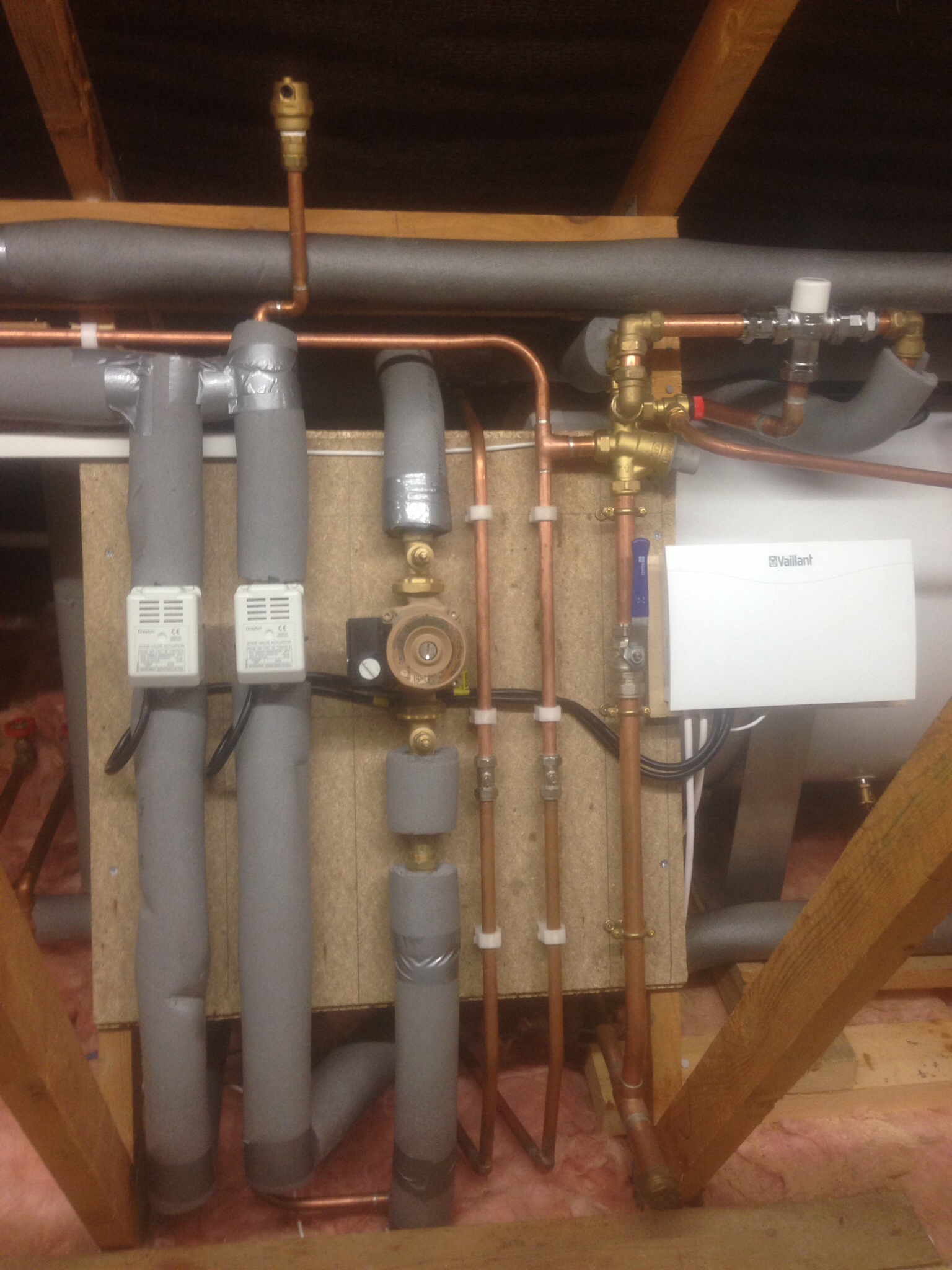
A TS will best deal with the rads / Ufh mix, and you may want to improve that with a separate coil in the TS to supply heat to the rads. That'll enable you to isolate the Ufh and therefore not allow any ferrous particulate ( rust / corrosion ) to contaminate the Ufh and associate components. That would create a separate circuit which would require its own filling loop / PRV / and exp vessel but would ensure the water stayed clean in the Ufh system, which it wouldn't do in a conventional 'mixed' setup. Contamination in a mixed system can be managed with inhibitors and a good maintenance schedule, but will not remove all of the problem like isolating it would. Consider slightly oversizing the rads and running them off an Ufh manifold to get the flow temp down so the rads run at a lower flow temp as you'll not want the rads running of the TS direct because then they'll be at the boiler flow temp which, with a TS, would be uncomfortably / unnecessarily hot in a well insulated house Running off an Ufh manifold will easily allow integration of individual room stats in each bedroom / space served by rads for total comfort control and will prevent any unoccupied spaces from getting heated when not required. I've done these setups before, exactly like this, and they work really well, just depends on how much control you do / don't want.
