

Nickfromwales
-
Posts
31390 -
Joined
-
Last visited
-
Days Won
346
Everything posted by Nickfromwales
-
Power wall will want to charge off grid electricity in the winter, DC won’t. There are a few existing threads there for continuation of relative dialogue, so please try and resurrect one of those to keep things current
-
Why not batteries on the DC side? AC coupled is such a waste. DC also means you use a 3-phase inverter and lose nothing plus you size to what you want instead of the PW ‘one size fits all ( which it doesn’t ). Plus no limited throughput with SolarWatt batteries either. DC is a no brainer afaik. No DNO permissions needed either. I’d be surprised if the DNO let you put a PW on each phase!! plus your PV?!?
-
No, but another danger which is derating of the cables if they are not sheathed ( or protected by other such means of containment ). Conduit or other such containment is advised at that point.
-

Using an UVC as a buffer for ASHP & PV heating
Nickfromwales replied to Brian Paul's topic in Boilers & Hot Water Tanks
That will be a decision the DNO will make based on the local infrastructure, and may be refused. Eg they may say 5kWp and export limitation at 3.96 etc, instead of limit at 3.96 and you can have the full 8kWp. Don't assume they will give you this, and then go and base all your assumptions on that for the synergy of the M&E side. Also, if you box clever and plan for the retrospective addition of a DC battery, then the DNO application will ignore your batteries altogether. If you go for an AC battery system you will need DNO approval and the two figures ( PV + Batteries ( total kW size combined )), will be the number they use. DC batteries are designed to mothball themselves and hibernate when there is no current / no long term excess PV available to store, and are warrantied to operate that way too vs AC which need babysitting and constant topping up to stay within acceptable state of charge. -
Chemical. The cause of a number of house fires. The plasticisers get absorbed and the cable insulation degrades to a point where it crumbles and falls away from the copper cores. Then ?
-
Ok, just for clarity, that concrete subfloor is staying yes? Be advised that EPS insulation CANNOT come into contact with the electrical cables.
-
Doesn’t need to be compacted hardcore. Needs to be sound and stable, and we obviously need a bit of feedback before saying more. Ive done loads without, just a quick blinding and a whack and job done. What I do, ( if at all unsure of the subfloor ), is build up the 1st 50 / 75 / 100 with individual sheets of 25mm EPS so they can easily conform to the subfloor. DIY not here tbh, so one assumption is a builder with at least 3 brain cells will be employed and able to govern. But then again, you’d probably then end up with a 150mm slab, 50mm of insulation and 50mm liquid screed
-
You’ll get fractures from curing, but nothing that’s not expected. To say that will crack is a bit coarse a statement. At 70mm I wouldn’t be laying a liquid screed anyway, I would be using a dry sand and cement screed. No need for 4” thick reinforced concrete unless you’ve got very big rooms and no possibility of introducing relief joints at the doorways etc. The most important thing is to get the ground level, flat and true, and to apply a blinding layers of sharp sand over the compacted subfloor. Also remember the perimeter insulation up-stands, made from 25mm PIR for thermal break, and then a thin compressive strip of the small foam stuff to allow expansion. If the subfloor prep is spot on, the floor won’t go anywhere.
-
250mm of EPS will be ample, and cheap. 300mm is heading for passive house standard levels of insulation. If you can get hold of seconds for the upper 150, then go for PIR ( celotex / kingspan etc ) and use 100mm EPS underneath. Or 150 EPS and 100mm PIR atop. Anything above EPS is a benefit, but I’d be more than happy with 250mm EPS tbh. Depending upon how you want to use the heating ( timed for working family / on long and low for retired ) then there could be argument for putting a slightly thicker screed down, but 70mm is a good average for this type of emitter and will give an even spread of heat output.
-
https://www.bes.co.uk/1in-bsp-female-outlet-brass-essex-cylinder-flange-12266/
-
A lot of turnkey suppliers will AT test the dwelling with all of the windows and doors taped off, so not usually representative of the 'big picture'. If you are around 1 with the doors and windows exposed then you've done very well IMHO.
-
Ok. Try tightening it a little, then loosening a little, and repeat until it gives up fighting you. You may be lucky, but they are bonded in in the factory so they are always facing completely vertically and cannot be tweaked by the inept plumbers who would do so for a 2 minute quicker install.
-
Not under warranty?
-
They're a pig to get out, so be careful. Usually bonded in with a product like Loctite etc.
-
Unvented Cylinder Installation. Spot the Problem!
Nickfromwales replied to Iceverge's topic in Boilers & Hot Water Tanks
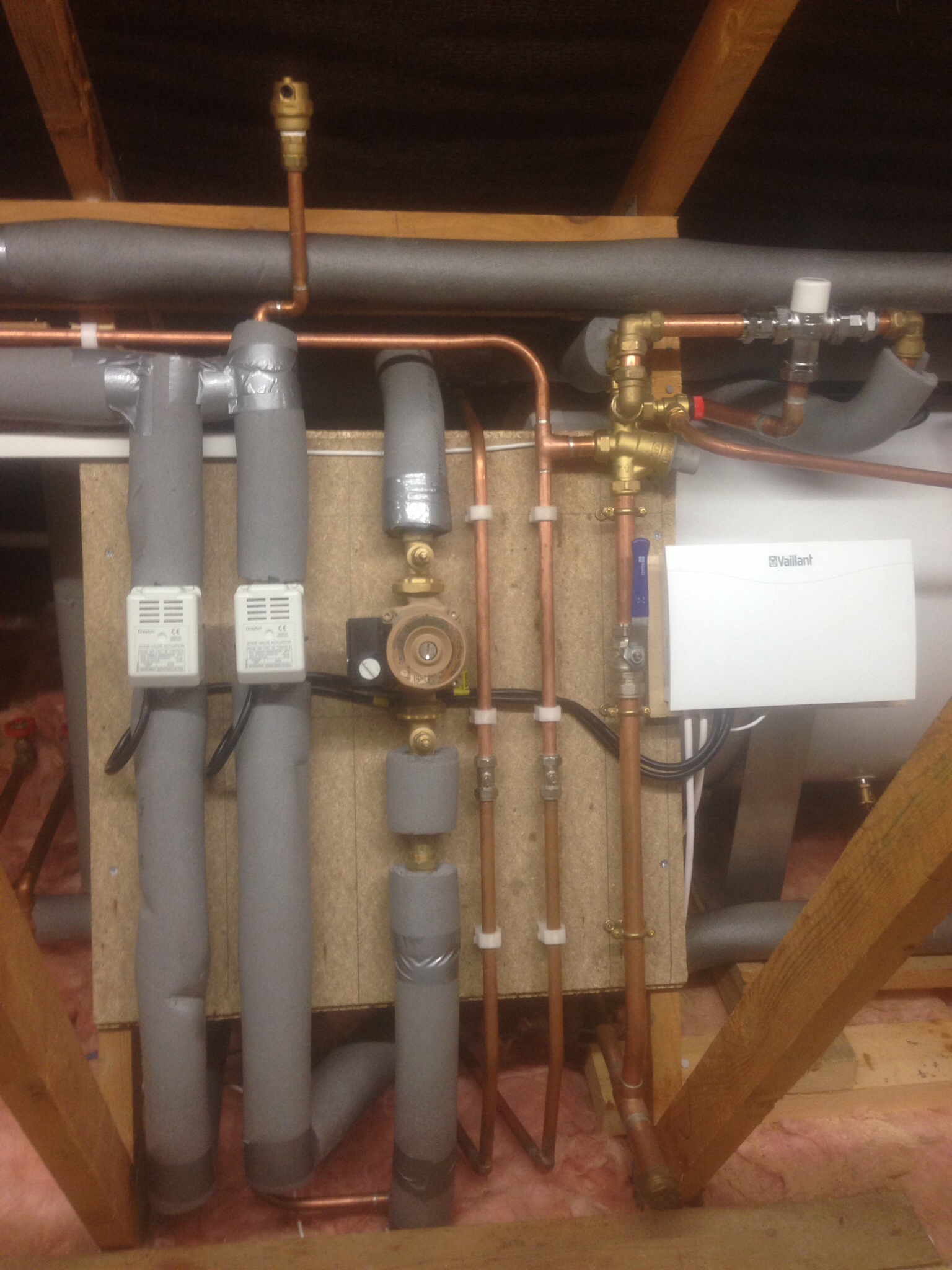
Hmmm......I feel your pain. My 2 penneth, is get in there, tackle it now, and live a long and prosperous life full of instantly available hot water. I suppose you'd have loved it if your plumber cajoled you into fitting an HRC, but hey ho. If the builder will sort the materials, then bite the bullet and go for it. Remember the delivery AND the return pipes will both need uber-insulating with the best amount you can get onto them. Neoprene gives good values if space ( diameter ) is tight. -
Unvented Cylinder Installation. Spot the Problem!
Nickfromwales replied to Iceverge's topic in Boilers & Hot Water Tanks
Oh, and insulate the ? out of all the hot pipework and ancillaries too, of course. -
Unvented Cylinder Installation. Spot the Problem!
Nickfromwales replied to Iceverge's topic in Boilers & Hot Water Tanks
That would remove about half a pint of dead water, probably less in actuality. What you could do is have the TMV hot inlet connected to the top of the UVC, with that going in on a 90o bend, so the mixed output of the TMV is rising vertically, and then have the hot manifold rising vertically off the TMV. That would promote natural convection into the TMV and manifold thus creating a setup that Pre-heats itself prior to hot water being drawn from the smaller, downstream pipes. Not yet heard of high energy losers, or an UVC overheating a PH, as these are all design considerations when building such a dwelling ?. Jeremy Harris stated he had such problems, but that was with a very high temp thermal store, not an UVC. That’s the single and only instance I can recall, as is no comparison model here at all. If the HRC pump is only pumping around the airing cupboard then I see no such high losses occurring, as the cupboard will attain an ambient and the delta T between the pipes and their immediate surroundings will be negligible, ergo the transfer from A>B will be hugely stunted. Fit some seals to the A/C door to promote that environment being maintained and you’ll be fine. Work out what these heaters and extra plumbing / additional points of loss & failure will amount to, and reconsider. Yes, the option of using the multipoint heater will work, but why not just improve the UVC install and improve the whole of house scenario vs invest more / lose cupboard space, and the rest of the house gets zero benefit..... The improved performance of the kitchen sink will exacerbate the issue in the rest of the house, and that would piss me off even more. 2 choices, both require money. One solves one problem, the other improves the whole of house situation. I know what I’d be doing.- 69 replies
-
- 1
-

-
- uvc ( unvented hot water cylinder )
- plumbing
- (and 1 more)
-
Airtight walls & fixing stuff to them
Nickfromwales replied to WWilts's topic in New House & Self Build Design
Bingo. No £20 a bag necessary. -
Airtight walls & fixing stuff to them
Nickfromwales replied to WWilts's topic in New House & Self Build Design
@nod Is there any need to be paying £20 a bag for slurry? Cant this just be a few quid bag-o-cheapo-cement and a bit of additive to DIY mix? -
Unvented Cylinder Installation. Spot the Problem!
Nickfromwales replied to Iceverge's topic in Boilers & Hot Water Tanks
Ouch. There is a cheap seats fix which will reduce these huge waiting times. Downside is you’ll need to heat hot water on demand by the sounds of things. You can fit a HRC ( hot return circuit ) pump at the UVC which just warms through the pipework in the plant room, so just pumping through all the local large bore stuff and back to the UVC. I can see a HRC tapping blanked off I think, so the facility is there. Heating the cylinder on E10 may be something that works better for you, as with the HRC being needed throughout the day you’ll need to keep the tank up to temp, and E10 will lend itself to you coordinating with that to minimise running costs. If you have PV, then summertime costs should be significantly reduced. Thets the only way you can get a good overall outcome here, just a shame your designer didn’t ‘see this one coming’ and then “cajole” you into fitting a HRC ( eg to suggest an elegant solution for your ongoing comfort and practicality ). Tye above solution would be cheap to implement, and will help out quite a bit as I think the biggest issue is the large dead leg in between the UVC and manifold. -
Ahhh, the A-word You will need to confirm that the unit has a condensation trap and drain point, as when cooling is used it’ll likely produce condensation. That also means a gravity waste pipe to drain that away in each location. Likewise, please keep us informed as an all-in-one solution is difficult to find in anything near a decent price range. Check out BPC’s website for some examples of bare units with which to construct such a setup.
-
Willis heater not heating! Scaled up?
Nickfromwales replied to oranjeboom's topic in Underfloor Heating
Appreciated by some, anyhow ? -
Willis heater not heating! Scaled up?
Nickfromwales replied to oranjeboom's topic in Underfloor Heating
I turn the stats down to circa 35-45oC depending upon the type of dwelling / emitter. It won’t pump 6kW in unless 6kW is required, the stats will simply allow the arrangement to crudely ‘modulate’. As I install these systems for Joe Public, I have to show diligence so I always aim at around 50-100% redundancy where it’s not cost prohibitive. The heating controls do of course need to be robust fir one, and I say that with the fact that I always fit low temp suited UFH setups to manage / regulate heat input to the dwelling ( ergo overheating has not ever been an issue ). You can drive a Ferrari to the shops at 10 mph I would agree with an ethos of fitting one, and buying a spare to sit on the shelf ready to go, but if Mrs Public loses the heating whilst the hubby / household plumber is unavailable, the double setup will be appreciated and understood -
Willis heater not heating! Scaled up?
Nickfromwales replied to oranjeboom's topic in Underfloor Heating
A few have fitted ‘cheap’ ASHP’s ( @readiescards bought a 9kW IVT for £700 iirc and it’s still going and in a rental / @PeterW same circa £900? All still performing admirably. ). Is a Willis heater “too cheap”? Work it on a lifespan of say a decade, do the maths, and make your choice on that. Any new half decent HP should see a decade out with ease. -
Ok. So I googled older PP UFH setups and they do actually fit the pump upside down and put the rails the ( IMO ) wrong way around!?! They change this in their latest / current offerings to the 'right way around'...... ? Has the system been re-treated with inhibitor after / during each plumbers visits?
