
Nickfromwales
-
Posts
31390 -
Joined
-
Last visited
-
Days Won
346
Everything posted by Nickfromwales
-
Hence my phrasing “not necessarily”
-
Not necessarily. If it’s a 30mm system atop a 100mm layer of PIR or PUR then it’s a very efficient solution for the OP. Prob need to self level the block and beam to get a flat, uniform surface, so maybe allow 10-15mm worst case for that.
-

So are there two layers of roof tiles around the edges?
Nickfromwales replied to CalvinHobbes's topic in Demolition
Usually only doubled up at the bottom courses but time will tell! -
Under cabinet lighting bars
Nickfromwales replied to Tyler's topic in Electrics - Kitchen & Bathroom
The item in the OP looks to be a polarity-conscious connector, whereas the figure of 8 is not? TLC offering is difficult to say from pics. Shouldn't really matter tbh but the OP item may need the leads cutting to create a hybrid interlink. -
You'd have had to dig out regardless, for a decent sub-structure for the overlay to go atop. You'd have tried to make the overlay panels yourself, and we'd still be tiling if you went that way The overlay needs a solid structure or it'll all disintegrate.
-
What is the intended floor covering? Porcelain tiles? If so you can get an overlay system and have all insulation. https://www.wundagroup.com/underfloor-heating/wundatherm/the-system/
-
Under cabinet lighting bars
Nickfromwales replied to Tyler's topic in Electrics - Kitchen & Bathroom
@Tyler Check out TLC directs offering https://www.tlc-direct.co.uk/Main_Index/Lighting_Menu_Index/Lighting_Kitchen_Index/Linkable_Flourescent_Fitting/index.html -
Can I just fit heat alarms instead of smoke alarms
Nickfromwales replied to Adsibob's topic in Building Regulations
I meant in respect of the sprinkle system. It seems to be a knee-jerk, by some less versed individuals, to use the term sprinkler system where it should actually read automatic fire suppression system, which allows a sprinkler OR mist system to satisfy this requirement. For any areas where you may get false alarms, eg a smoke detector directly adjacent to / off a kitchen ( open plan area ), you can use an optical smoke detector vs an ionisation detector to reduce false triggers. "Ionisation alarms are very sensitive to cooking vapours and if placed near a cooker or toaster are likely to give frequent false alarms. Optical alarms detect larger particles of smoke, the kind that are produced by a slow smouldering fire before it bursts into flames." This will be as good an option as you can get to mitigate the issue, and what I've done for many previous M&E clients. It's something that any decent designer should have implemented as standard in any such proposal TBH. -
Can I just fit heat alarms instead of smoke alarms
Nickfromwales replied to Adsibob's topic in Building Regulations
Visual impact of the lesser diameter vs nearly the same depth = a smoke detector that does look like it sticks out a lot more as the shape doesn’t lend itself to being inconspicuous imho. Forst glance and I thought “ceiling tit”. Aico for me still, sorry, but thanks for the alternative suggestion. -
Can I just fit heat alarms instead of smoke alarms
Nickfromwales replied to Adsibob's topic in Building Regulations
Does this requirement actually not read "automatic fire suppression system"? -
Sorry, my comments were on the assumption the surfaces were on show after drilling, whereas that is not the case. The best investment here is a set of very high quality ( Bosch / DeWalt )1000mm SDS drill bits at 10, 16 and 24mm sizes for provisional drilling. Drill the first side with the 10, then the 16, and then send the 16 through the rubble fill and into the second side. The 16 will stay relatively straight whereas the 10 will not. Go to next size up accordingly, and best of British with the rubble fill cave-ins. One trick is to drill the 10 and 16 and then get a closed cell expanding foam, push the nozzle in as far as you can get, and inject a punt or do of foam. Squirt some water into the hole first to soak the rubble fill, which will make the foam cure faster and spread better, and then leave for an hour or two. The cured foam will keep the rubble fill in check whilst you drill through and install the resin.
-
Techniques for speeding up screed drying
Nickfromwales replied to Paene Finitur's topic in Floor Structures
Ok, not great, could be worse. I assume you’ve got solar PV to offset the known constant electric consumption? Would be a no brainer for you as you’ll be using your excess without a doubt eg 100% self consumption would be feasible. -
Start off small ( 6mm SDS ) and go up in 4mm increments. Should be easy enough that way tbh. When you get within 6-10mm of the desired size, use a diamond tipped hole saw to start off the hole, so as to prevent the surface breakout, and then put the same size SDS in to complete. Use a hozelock pump up spray bottle to keep the diamond bits soaking wet slushy cutting. Will the the remaining surface be on show afterwards?
-
Techniques for speeding up screed drying
Nickfromwales replied to Paene Finitur's topic in Floor Structures
You are confusing curing times with how long a cured screed would dry out if it got wet after curing A cured screed won’t absorb the moisture as much as you think it will / has, so the issue will be the trapped water between the layers / membranes / Insulaton etc where water will sit and have to be extracted through forced ( mechanical ) ventilation / dehumidification. As stated, metering and monitoring will be your only means of measuring success. Sounds like a pita of a basement to look after. What height did the water get to above the top of the screed? -
Thats the reason why I thought to double ( at least ) the CCC of the SSR, eg to hugely improve reliability. The whole point of moving to SSR(s) will be to get away from the noise of operation which can be hugely problematic in a new TF dwelling. More so when there are multiple loads to switch at different times / intervals / other sporadic loads etc. In fairness, if these are switching end equipment which has its own internal thermostat, if the output of the SSR were to latch permanently on then the worst case would be say a DHW cylinder heating to the immersion max temp setting outside of the desired time-slot or a Willis primary ‘loop’ heating similarly, both with no ill effect to the dwelling or end user ( see next ). This comes full circle to reinforce my comments about always having a TMV on an UFH manifold, as a doomsday device, and similarly with the UVC’s where I install a TMV on the hot outlet to cap the max output water temp to ~50oC. With these types of downstream failsafe disciplines it matters not one jot about delivery heat temps running away and removes totals reliance on the load switching device. IMHO it is a contractor which os more likely to fail than an SSR. @TerryE have you had to replace any yet? Reliability / degradation of any concern? Duly noted on affixing to a metal chassis vs convection cooled. Many thanks.
-
Can you ( or is there any advantage to ) use 2x SSR's in parallel to boost reliability / shed excess heat from a singe device? Or would I just double the CCC of the SSR to allow longevity / minimise generated heat I am looking to get away from the Finder relays ( not contactors ) for switching Wills and immersions on / off and need to order stuff up for one client this week ideally.
-
@Merv I've had a few beers, but that still makes no sense to me whatsoever...... Try again mate
-
Simple setup with willis heater & 2 zones
Nickfromwales replied to Buzz11's topic in Underfloor Heating
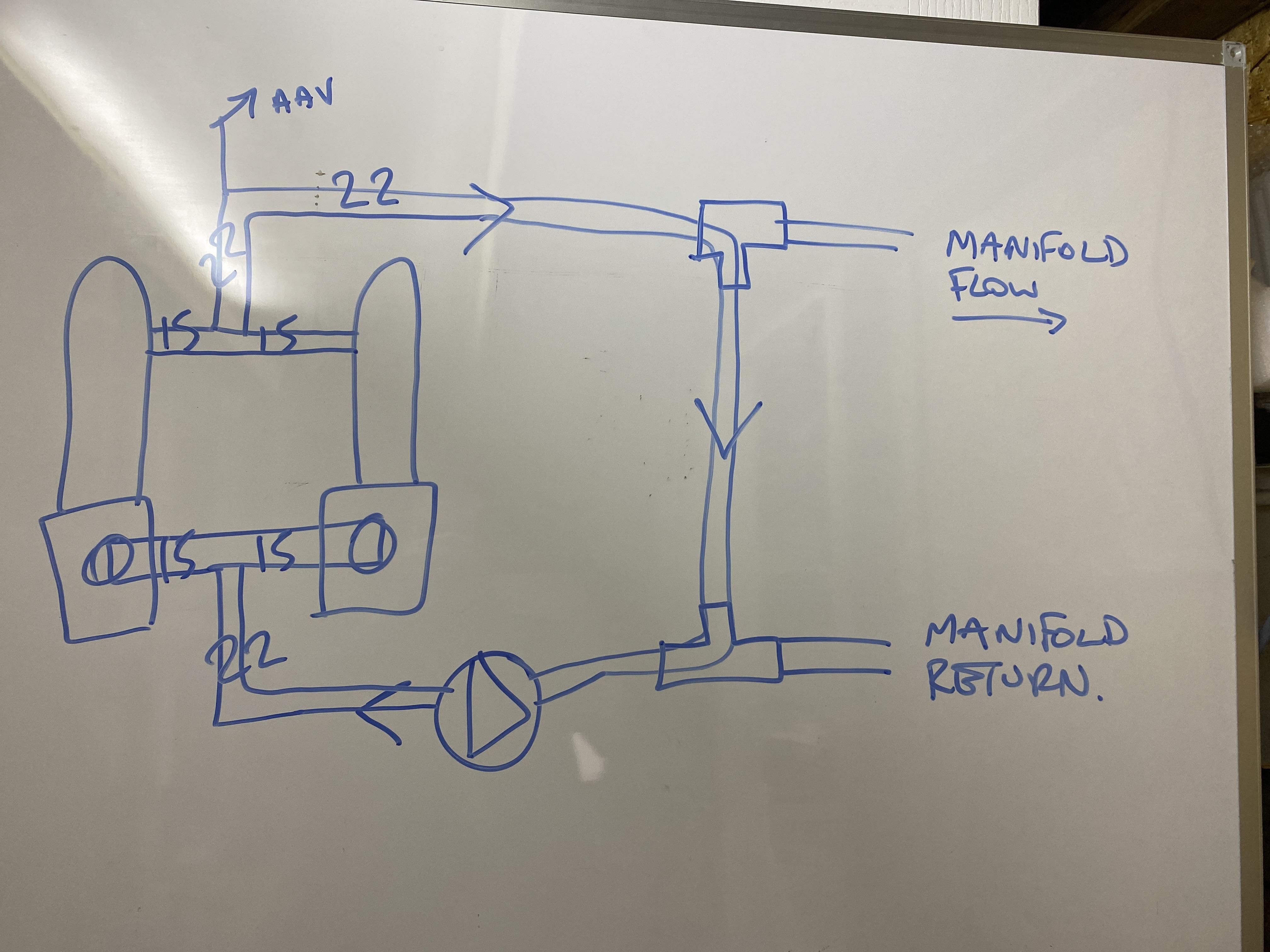
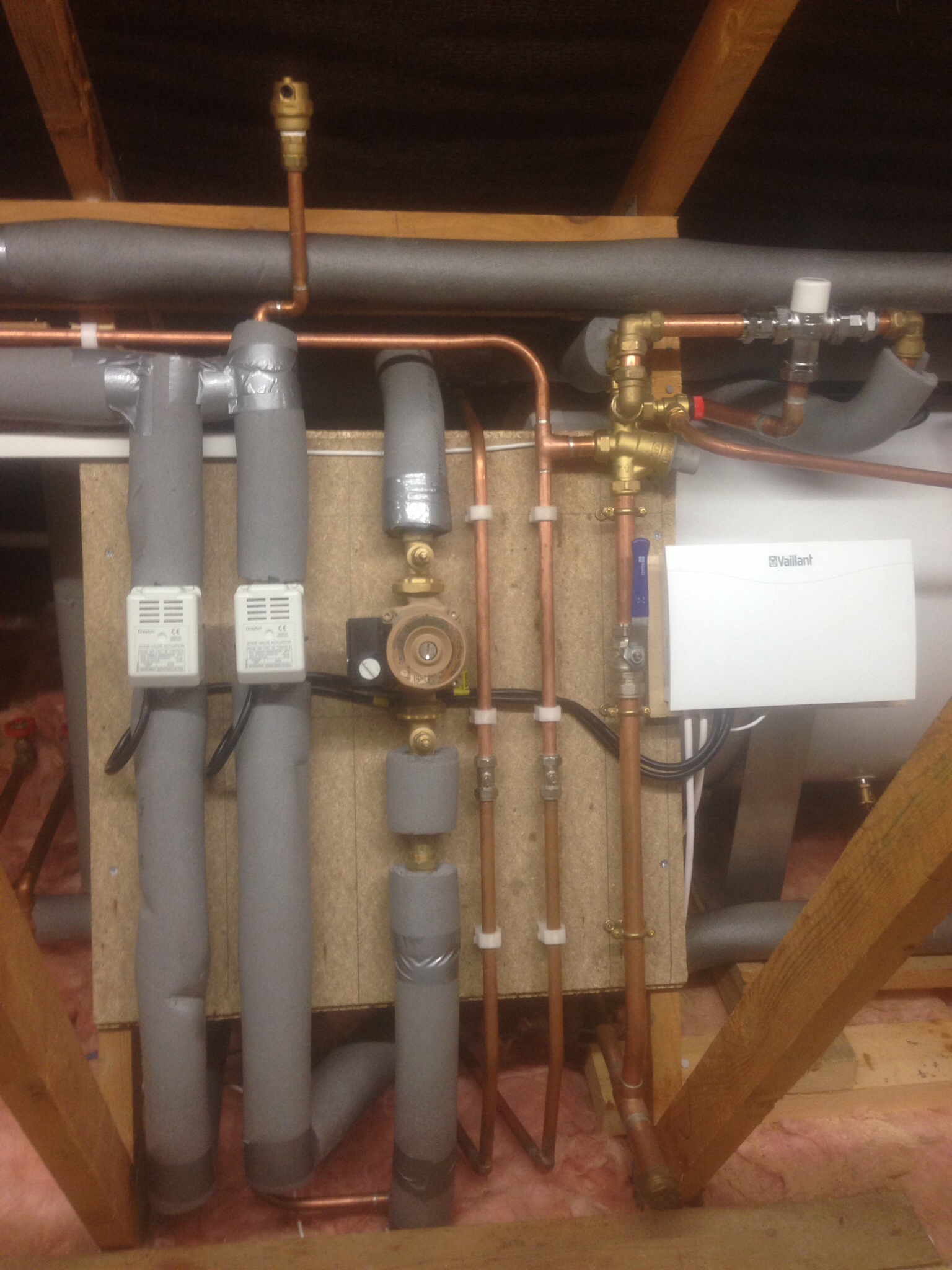
As close to the desired flow temp as possible. That will stop the thermostat clicking in / out as much. Sounds like a decent guy tbh. It's as simple as that.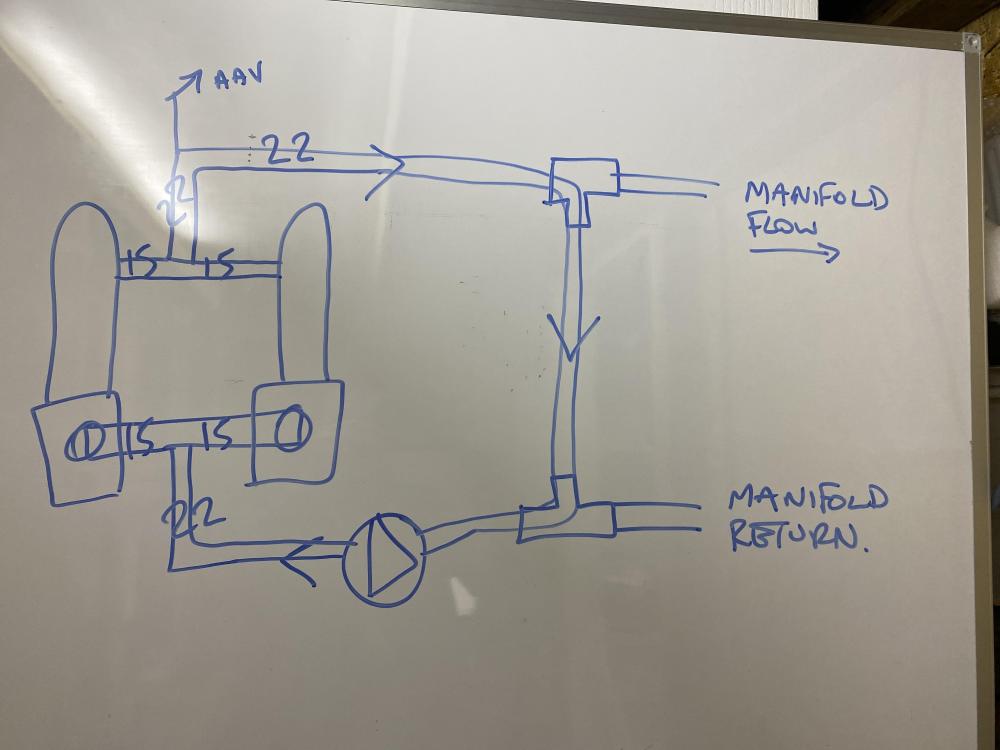
-
Simple setup with willis heater & 2 zones
Nickfromwales replied to Buzz11's topic in Underfloor Heating
Yes, and near silent in operation. Regular TMV's often start to choke the flow and make a lot of noise when asked to sit at their lowest setting. Steady on Buzz......nothing is going "to infinity and beyond" The Willis will be a little less 'erratic' with a constantly recirculating body of water going through them at a regular pace. Some more of my waffling can be found here; -
Yes, I do on most of my jobs as they’re destined to be coupled up with an ASHP. Only issue is the extra pipe, extra manifold ports but benefits are more volume of water per m2 which will help convey the heat energy in the pies / water to the room. You cannot increase the temp past 27oC floor surface temp, but additional pipe will allow more energy to be input to the floor aka emitter.
-
Temp sensing should really be done at around 1450mm from floor level, to give a reference to what you ‘feel’ in the room when vertical. Putting them down low will give a misrepresentative reading, but of course you can adjust that during commissioning by fitting a temporary room thermometer to show what the lower reading needs to be for you to be comfortable ‘up top’. Depending on the choice of heat pump, you can get quite sleek looking wall mounted stats which do the heating and cooling control in one gadget. The Panasonic one I’ve just fitted is certainly non-ugly and the display goes to sleep when you’ve finished playing with it. Not sure how / where you connect the remote sensors in, do you have a link to the installation manual for the equipment you’ve chosen?
-
Quote for plumbing supplies without itemised prices
Nickfromwales replied to faby's topic in Building Materials
Impossible to say / judge until the entire list is posted up to be fair. if there is any copper / brass / 110mm stuff on there the bill will shoot up at an alarming rate of knots. The merchants are completely correct in not disclosing prices / further detail etc, as I assume the contractor is the client in that respect. If you want such clarity on anything, don’t ask us, ask your contractor . It is normal to see between 10 - 15% on top of list which you are paying for, to cover what the contractor would lose when not working whilst compiling these lists / discussing things with you, so beware cutting all of the meat from the bone as you’ll just end up with nobody wanting to work for you. Where your chap appears to have gone wrong is not explaining this relationship to you in detail before proceeding to request that you pay these orders. I arrived at site the other day with two ‘not huge’ sacks of brassware and copper fittings. Client was amazed that when I showed him the invoice it was north of £500!!! If the relationship is for you to supply, then ask your chap for a comprehensive list and expect to slow him down and annoy him when he’s short of something or you’ve inadvertently picked up the wrong item etc, and to be billed for that downtime. Most will also ask for 10% on top of your invoices as they would get that working elsewhere and you may be removing that from their expected income. If you were happy with quotes where is the issue? Have they gone way over? -
Range Tribune HE 150ltr issue
Nickfromwales replied to Makeitstop's topic in Boilers & Hot Water Tanks
May the force be with you…… -
Range Tribune HE 150ltr issue
Nickfromwales replied to Makeitstop's topic in Boilers & Hot Water Tanks
Stinks of hard water issues. I’ll tell you straight out, there is no “internal part” that would ‘break down’ in a stainless steel vessel. Zero. Zilch. Nil. Nada. If hard ( even non aggressive hard category ) water is left to drip dry at taps / shower heads etc then residue will become apparent there, just from the crud left over when the water evaporates away, so do not confuse these occurrences with there having to be some mystical crud source. Do a water test ( like your initial installer should have done ) and rule that out first as last. We cannot help trouble shoot this without a process of elimination. Start there please. Valid point, but not if the plumber was a lazy arse and just fitted a secondary PRedV at the incoming main ( to balance the whole house at source ) to avoid running a lot of extra pipework to collect balanced cold at the control group. Even on new installs, but particularly with mass-produced homes, these corners still often get cut. Ideally a decent plumber in for one days fault finding snd rectification should sort this out and offer up a plan for mitigation against recurring issues. @Makeitstop Get a plumber to remove the control group and link the cylinder ( temporarily ) to the incoming main. That would prove where the issue lays in an hour. NOTE: this temporary swap CANNOT be left in, not even short term. It is a serious safety item. Also this test should be done on a cold cylinder. -
Range Tribune HE 150ltr issue
Nickfromwales replied to Makeitstop's topic in Boilers & Hot Water Tanks
Telford stainless will have a lifetime warranty. Speak to Trevor at cylinders2go and mention my username and the forum for best prices. No annual service / inspection ( G3 ) = no warranty regardless of supplier. An ideal solution for providing mains pressure hot water for domestic applications. Mains pressure hot water for powerful showers Good flow rate ideal for homes with multiple bathrooms and fast filling of baths Suitable for use with gas or oil boilers Fast reheat times for quick availability of hot water Economical to run with minimal maintenance and no hidden costs 50mm CFC and HCFC-free foam lagging for low heat loss Manufactured from ‘Duplex’ stainless steel for superior corrosion resistance 25-year guarantee on basic vessel subject to T&C's* *T&Cs apply. 25-year anti-corrosion guarantee on inner container. See product brochure for more information. So the issue will likely be the control group gauze filter. Have you actually tried to work out what is causing the issue before pulling this out?