

Nickfromwales
-
Posts
31373 -
Joined
-
Last visited
-
Days Won
345
Everything posted by Nickfromwales
-

Void Behind Bay Window Roof - How bad of an issue is this?
Nickfromwales replied to EinTopaz's topic in Heat Insulation
The internal leaf of masonry should be a continuous ‘layer’, so draughts can only travel through the cavity. What we’re seeing is typical ‘builder quality’ work for that era. -
Cheap as in simple and cost effective? COP is 1:1, but you’ll be nearly 100% efficient doing direct electric > hot water via immersions.
-
Defo A2A AC for heat & cool, almost instant hit vs panel heaters, cheap to run as COP will typically be above 3. Unvented cylinders with 2 immersions, for failsafe, as you're letting these to fishermen and hot water is critical.
-
South Cambridgeshire Local Authority, yay/nay?
Nickfromwales replied to Gema's topic in Building Regulations
BCO and warranty provider (private, combined) walked past a load of faux pas, totally focussed on a few things. Council guys seem more focussed on the project, but also seem overworked. Double edged sword for council vs private imo. -
This is prevalent…..”all the gear, no idea” The number of jobs where I’ve corrected the architects, even PH certified ones, is just astonishing. Flashy websites and zero clue…..last one I beat by 1% in PHPP and I’m not qualified lol. I find the higher ranking / higher qualified ones often deliver the most underwhelming results; I find the pretty picture and concept for the dwelling is the sole focus, and the clients are a second thought. Not just a blasé statement btw, factual feedback from my many, many interactions, and real world experience. Hi Gema (and other half). A really comfortable home will be difficult to achieve if you comply with the many constraints of a certified PH. I have helped folk create homes which exceed PH levels, without certification, complimented with total focus on the folks who will then reside within. Beware the info that is often left to be discovered, when the decisions have been made and the house then built and occupied. Many instances of happy home builders on here, most without PH certification (so the maths have already been done for you ).
-
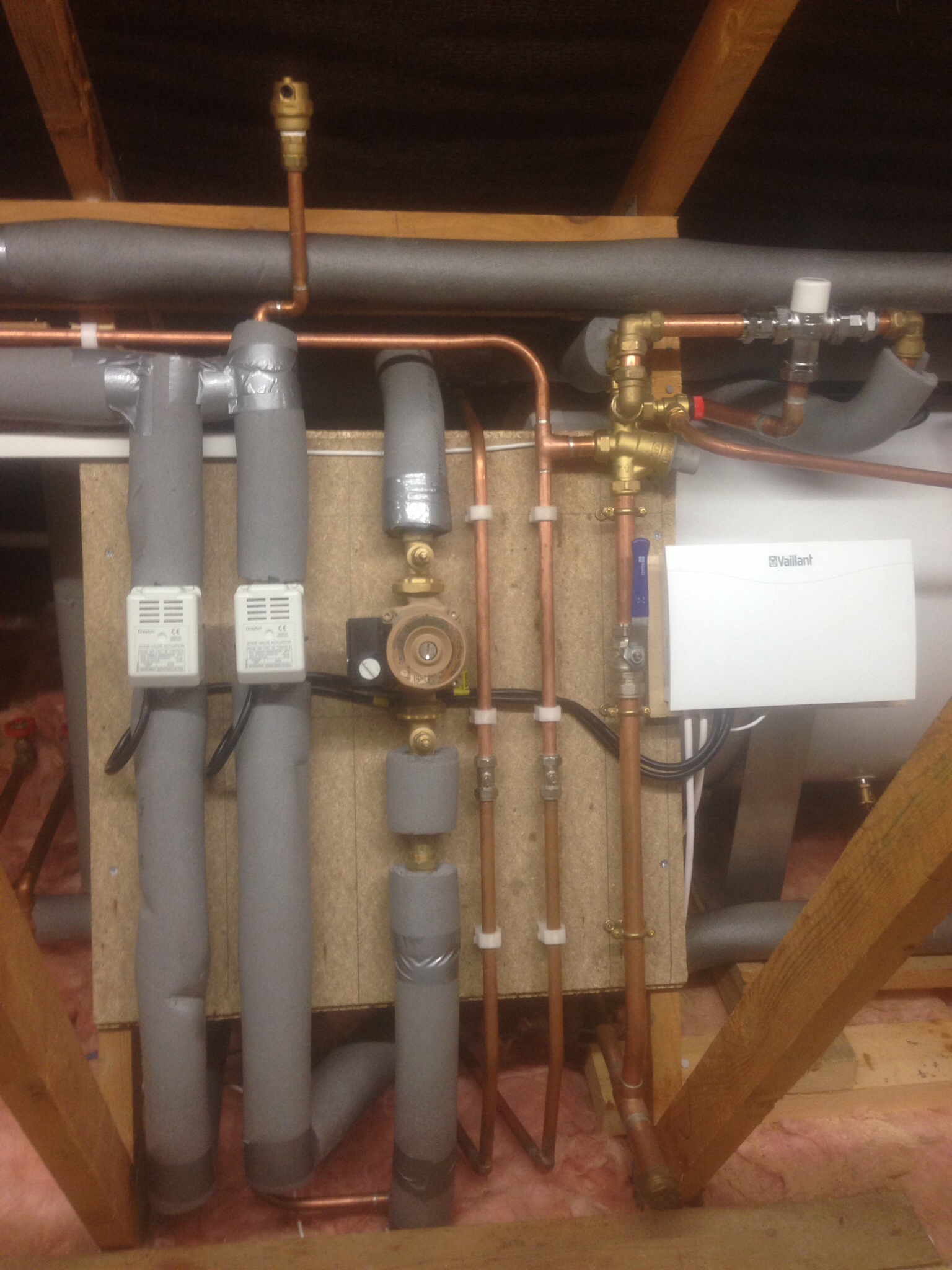
Ok, is this a system or combi boiler? You say cylinder so assume there’s an unvented hot water cylinder? If its in the garage, make an insulated boiler cupboard and reduce your latent losses by a fair bit (sounds expensive if you’re heating a cold ventilated garage!). Need as much info as possible, and a picture of all plumbing and the cylinder plz.
-
A hell of a lot more than you (x3 eg 30+ years of it). I appreciate the title though, quite catchy If a wall isn’t skimmed, then its bare plasterboard, so either way you’d need to call Tanky McTankface. Absolutely zero issue to have skim on the boards. “15 all, new balls please!”.
-
This is completely inaccurate. A single failure, once, is no measure for the rest of the trades and how they deliver work. If the tiles leak then having hardie board wont save you, it'll just delay the inevitable. @Lincolnshire Ian, why are the walls white?
-
Not heard this, and I would not be doing 4mm radials unless someone had a gun pointed at my last beer in the fridge.
-
Oven cannot go on to a ring main, again ( @Pappa ) this needs a dedicated RCBO and it's own cable to an isolator.
-
Been 'a thing' since the 18th iirc. No, a dedicated RCBO and a single cable to an FCU is required for an integrated microwave, but things like Quooker taps and warming drawers can go on a ring main socket.
-
Neighbours want to scaffold in my courtyard
Nickfromwales replied to DannyT's topic in General Self Build & DIY Discussion
Good outcome, and thanks for the update. -
Thread tidied. As you were people. The management.
-
Put the washer & dryer on a dedicated ring and take the outside socket(s) off that. Feed the outside sockets via a 20a DP switch, off that ring, and if there’s any issue (damage or water) to the outside socket you can isolate it; the washer / dryer can carry on being used then without the RCBO tripping. Treat both of those bathroom power circuits as the ‘utility ring’, extending it to the loft. You want anything outside segregated so any issues you may have outdoors won’t take anything indoors with it. Have the basement emergency light fed off the basement light loop, not off a dedicated breaker, just way OTT to segregate that; it’ll have the same functionality that you seek. I’d put another em lgt on the first floor landing close to the stairs to allow someone to come down safely from the upper level in a power out, as I have done here. You can convert almost any generic light fitting to an em lgt with an add-on pack. That will do a hob or large oven. Single ovens and fixed (integrated) microwaves both need dedicated circuits, whereas a ‘loose’ microwave sat on a worktop doesn’t. CAT6 to all TV’s, solar inverter, desktops, network printer, and WAP locations. Include duct grade CAT6’s to the outbuilding (garden wifi) and EV charger location. Consider xmas lights, and a single socket (where a chuffing airwick will live forever) and also which ones would be useful if it’s a USB double socket; buy a tidy high-powered one if charging a tablet is a must at the bedside(s) etc. Saves losing a socket outlet everywhere you need to plug a charger in.
-
Why plywood and not ‘no more ply’ / other board type?
-
Neighbours want to scaffold in my courtyard
Nickfromwales replied to DannyT's topic in General Self Build & DIY Discussion
Kindness is always taken as weakness. Sad, but true. Be on top, or underneath, but decide now which one of those two options sits least well, and dig down deep. -
First thing out of the box is the trusty laser. Saved my arse soooooooooo many times. Hopefully the return coving will be perfectly acceptable, and you'll need to fast-forward to a year from now when you (actually) no longer even look at it. Too many people get utterly lost in these micro-details, and then come 12 months later, life has returned to normal, and these things are of zero consequence anymore.
-
You shouldn't be mixing water based and oil based products. Have you sought professional advice before proceeding?
-
Sorry to be a stick in the mud, but your electrician will not thank you for doing this, and it may deter some. You will need to size the appliances, so for my current client I have pulled 1x 10mm T&E for the hob, 1x 6mm T&E for the large double oven, 1x 4mm T&E for the smaller oven, 1x 2,5mm T&E for the fixed microwave (you cannot plug a fixed microwave into a socket, it must have its own cable and its own RCBO), 2x 2.5mm T&E for kitchen ring, and have sized the CU according to the total number of circuits required for the whole house. PLEASE get input from your chosen electrician, as you're just flying blind and will likely just waste time and money vs saving it. They should be happy to let you do some of the 'donkey work' especially if they are busy, but THEY must tell you what to run as you are quite a far way off with what you're typing out here....sorry again.
-
Bathroom ceiling insulation
Nickfromwales replied to Super_Paulie's topic in Bathrooms, Ensuites & Wetrooms
I can't see any reason it would be a problem on the back, but the front is usually taped (with foil tape) across boards and timbers to create the vapour barrier; this negates installing a dedicated VB. Working in a lath and plaster filled house currently (for my sins methinks) and I wholeheartedly agree. -
Neighbours want to scaffold in my courtyard
Nickfromwales replied to DannyT's topic in General Self Build & DIY Discussion
Time to drop anchor and grind them to a halt. Sounds like they need a bit of bringing down to earth, along with the boisterous builder. If this is how they begin, christ knows how difficult / arrogant they'll be as they get comfortable. -
Bathroom ceiling insulation
Nickfromwales replied to Super_Paulie's topic in Bathrooms, Ensuites & Wetrooms
Cant you get the 50mm in there? Recess it where necessary etc. -
You will be putting the DPM in underneath the insulation, so anything above that won’t be in direct contact with damp / moist ground, so just go with 200mm insulation. You should be using PIR vs EPS at <250mm btw, as EPS is a poorer performing product. You’d be fine with 50mm EPS at the bottom and 150mm PIR, if on a shoestring.
-
Option 2 will work, just add a sharp sand blinding layer over the compacted hardcore and use that to level the ground, plus also protect the DPM.
-
Neighbours want to scaffold in my courtyard
Nickfromwales replied to DannyT's topic in General Self Build & DIY Discussion
Oh, absolutely. Yup, 6 months means <12.


