
Nickfromwales
-
Posts
31362 -
Joined
-
Last visited
-
Days Won
345
Everything posted by Nickfromwales
-
Ouch. Agreed. People, let’s play the ball and perhaps avoid direct insults, please. If the subject matter induces emotion / provokes / annoys, it’s best to ignore or not comment at all, as per the T&C’s of Buildhub membership. “As you were folks!”
-

Help with Twinwall Flue Detail Through Timber Frame
Nickfromwales replied to Stratman's topic in Timber Frame
Because you value your testicles. -
Help with Twinwall Flue Detail Through Timber Frame
Nickfromwales replied to Stratman's topic in Timber Frame
Yup. -
Turning off a mechanical fan that is forcing air into rooms, for the sake of £100, is worth the extra effort imo. All ground floor plaster-in vents have intumescent fire collars on them.
-
Nope!! B Regs have an aversion to death inducing systems being installed in residential dwellings lol. Waking up to a home being fully filled with Halon would not go well……
-
The benefit outweighs these ‘odds’, as the MVHR not supplying a fire with a plentiful feed of fresh air (to aid combustion) would be my preference; the significance of this was enough for me to consider it robustly, pros and cons, before suggesting it to my client. Any future electrician would be informed by the owner, before they took any tools out, and would also encounter printed labels on the CU stating the additional measures required. However, if that all failed, the absolute worst case scenario THEN, would be the owner eventually realising that the lMVHR wasn’t on then they’d simply go and reset it. Number of people who test their smoke detectors monthly? . Not so sure but I’d bet that It’s a VERY low percentile….. …..like single digits. Only the relay would wear, not the RCBO🙂, and this will likely be tested and approved for 1000’s of operations. In actuality, it’ll fire maybe 2-5 times per decade.
-
Not exceptionally high, just 225 vs 178, so 47mm higher. Wall hung WC’s on frames tend to have this a lot higher up.
-
Advice Needed – Localized Floor Collapse Above Plumbing Pipes
Nickfromwales replied to BonnieW7's topic in General Plumbing
Any loose material alongside / under the pipes needs removing. Attempting to compact anything in this small void is completely OTT and (IMHO) a waste of time and effort. You’re far better off with the whole void fully filled in one sitting, as a single solid mass. Foot traffic is considered ‘light’, so fully encapsulating the wrapped pipes with 20mm over them will be fine. That compound I linked to is particularly well suited to this exact application because it has fibres in it, so it’s very tolerant of the tiny amount of movement you’ll get here. A wrap with duct tape will offer some more protection and ‘decoupling’, which os best practice vs just pouring onto bare pipes. You can do this in lots of little bits of tape and it doesn’t need to be perfect as every little helps. -
Help with Twinwall Flue Detail Through Timber Frame
Nickfromwales replied to Stratman's topic in Timber Frame
Are we agreed thos could only ever be used in deep winter time, in a “passiv-esque” dwelling? -
A lot of members here have been looked after by Trevor from Cylinders2go, and he’s also my go-to for cylinders and has been for a long time. Mention my username and the forum and he will ‘quote you happy’, minus the HG tax
-
Madness I know (IRL) and that was my exact concern. If I can buy one thing to be a maybe, or another that’s a definite, and the price isn’t hundreds apart, then I’ll go definite each and every time.
-
Help with Twinwall Flue Detail Through Timber Frame
Nickfromwales replied to Stratman's topic in Timber Frame
You just fit a room sealed WBS that sucks air in from outdoors. 👍. Sad fact is, folk spend thousands fitting one, suffer silently in protest whilst roasting to death, and then it’ll eventually become an ornament. The further irony is the several hundreds of thousands spent making an airtight, well insulated home, that requires next to no heat at 0° OAT, and then fitting the most fierce heat source that you can lay your hands on….. The heart and the head are two very different things -
Phone Charger under Kitchen Worktop ?
Nickfromwales replied to Spinny's topic in Kitchen Units & Worktops
Depends on how much time you spend in there? The kitchen / dining / living, open space lifestyle puts folk in that area for socialising quite a lot, whereas at mine I’m either behind my desk or I’m perfecting my ass-imprint on the settee. I have USB’s everywhere, house with 6,7, or 8 occupants at a time, so just leaving wires everywhere (lightning and USB C) seems to be useful here. -
Advice Needed – Localized Floor Collapse Above Plumbing Pipes
Nickfromwales replied to BonnieW7's topic in General Plumbing
No probs https://www.screwfix.com/p/no-nonsense-d2-pva-adhesive-5ltr/474ek?ref=SFAppShare 👍👍 -
Sticking Aerogel to steel
Nickfromwales replied to Great_scot_selfbuild's topic in General Construction Issues
For a box section of equal dimension, this I assume would be difficult for heat to affect easily, but I beams (UB & UC) with different thickness materials making the one profile, thus reacting differently over time / temp, the focus would be more on those? However, the ‘system’ would just blanket the solution for worst case, methinks, vs giving chapter and verse for each different scenario. Just my uneducated guess….. -
Advice Needed – Localized Floor Collapse Above Plumbing Pipes
Nickfromwales replied to BonnieW7's topic in General Plumbing
Are they heating pipes, or a hot & cold? 20mm doesn’t leave much (any) room to insulate effectively. 15mm pipe with 9mm wall insulation = 33mm diameter, x2. You can buy a thin (3mm) neoprene tape LINK which may suit and give you that little bit of wiggle room. -
I have some odd, inbuilt aversion to this needing any kind of constant (continuous / maintained) signal or feed to function, and am favouring something that flip / flops with a single ‘hit’. I may need therapy……but I do also like belts, braces, and for my phone to continue to remain silent each and every night.
-
Advice Needed – Localized Floor Collapse Above Plumbing Pipes
Nickfromwales replied to BonnieW7's topic in General Plumbing
I’ve done these types of jobs hundreds of times over the past 35 years, and defo zeto need for a stainless plate; I think that would make the repair fail again. Do as you suggest, clear the trough and hoover it all out. Prime (saturate) with 50/50 PVA/water, applying copiously until you don’t see it being sucked into the concrete any more, and then pour in some of this: Will be right for life after that goes in there. Mix it with fresh water and to a consistency a-la a thick gravy. If the pipes are bare copper, try and tape these up with gaffa / duct tape. Lay it directly on to the soaking wet PVA mix and don’t fear that being any compromise to it, it’ll be fine.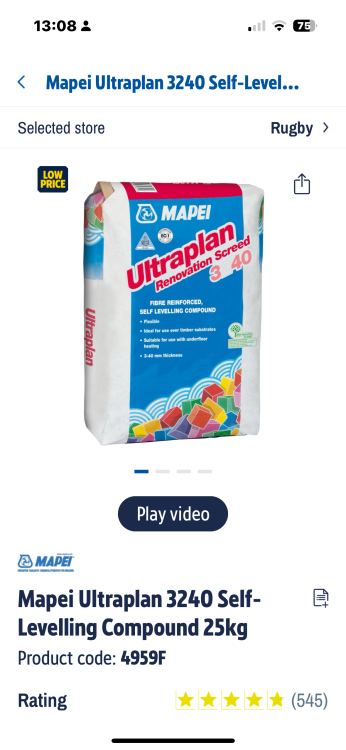
-
Does an island need to be fixed to the floor?
Nickfromwales replied to saveasteading's topic in Kitchen Units & Worktops
1) Fit and forget 2) Never let me down 3) Tried and tested CT1 or Ever build Stixall, which I think is the same stuff / different packaging, but as we realised on site 2 weeks or so ago, Ever build stuff is a 1/3 of the price if you hunt it down online; ergo I’m 2 of 3 boxes of EBSA down, 1 to go. I failed to put up an argument for CT1 for bulk mastic work (such as topping up where the Norrsken fitters left off), but for the wetroom shower former / waste / trap etc I won’t use anything other than CT1; as I am employed by clients to do things, I cannot (point blank refuse) to compromise on stuff that my names going on (plus I am obvs then liable for too). As principal consultant I could not, however, offer any good reason to use CT1 on the many large doors and double height gallery windows etc, as there was (still remains) a huge volume of ‘goop’ that is anticipated to be needed to complete that specific task, so calculated bean-counting had to be on the table for discussion. -
These are OK, but are poor on an ASHP vs gas boiler. If a horizontal is used with an ASHP you should install a stratification pump across cold in / hot out, to ‘stir’ the contents of the cylinder and max out the heated volume of water. The pump is energised by the cylinder stat, so comes on with DHW reheat cycle only. @Stu789 assuming room sealed / external air fed WBS?
-
Typically these are still at the old 7” off floor to centre dims, to sympathise with retrofit. They just raise the rim, and the rest of the pan stays put.
-
Does an island need to be fixed to the floor?
Nickfromwales replied to saveasteading's topic in Kitchen Units & Worktops
Lifting the legs up one at a time, and then setting them back down again into a blob of CT1 (10p piece sized is fine) will be ample over the number of legs. I’d say you’d be fine doing this with just the front legs, so easy to do / easy to reverse without going commando on your belly. -
Moving an incorrectly placed soil vent pipe
Nickfromwales replied to Bancroft's topic in General Construction Issues
One of these, and have a piece of 50mm pipe dropping through it with a 100-150mm tail, as this will be more forgiving than a solvent weld joint; given you’ll be fiddling with it and working around it as you lay the new 50mm pipe. Set the falls in place with off cuts of PIR insulation or plastic packers, then foam into place and leave to cure for a few hours / day. When cured you trim it square with a handsaw and then butt your sheet PIR up to that. Make up any deficit with more foam, job done.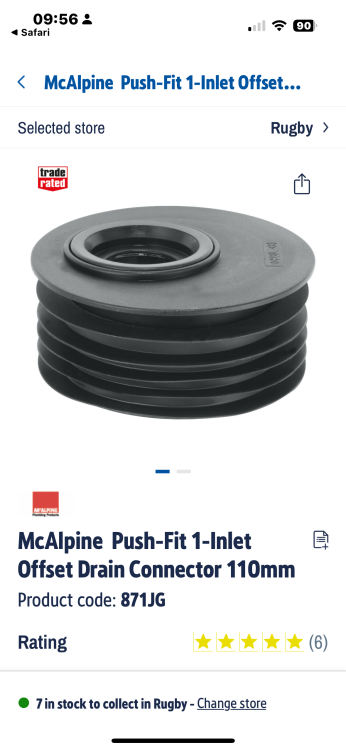
-
Moving an incorrectly placed soil vent pipe
Nickfromwales replied to Bancroft's topic in General Construction Issues
As above, just reduce to 50mm and move onto the next part of the build. Do NOT start savaging the slab!!!!! -
A robot in cyberspace says this: 13 A latching contactor relay (or bi-stable relay) maintains its state without continuously powered coils. A momentary pulse "sets" the contacts closed, while a reverse polarity pulse or a separate mechanical/electrical reset pulse "resets" them to the open position. This saves significant energy and prevents buzzing or drop-out during power dips. [1, 2, 3, 4, 5] Why Latching Contactors are Used Standard relays and contactors are "fail-safe," meaning they require constant power to hold a circuit closed. Latching contactors are highly beneficial in specific applications: [1] Energy Efficiency: Ideal for systems that stay on for long durations, as no power is consumed to keep the contacts engaged. [1, 2]