


Temp
-
Posts
10641 -
Joined
-
Last visited
-
Days Won
43
Everything posted by Temp
-
Help with ply selection - garden building
Temp replied to Chef40's topic in General Self Build & DIY Discussion
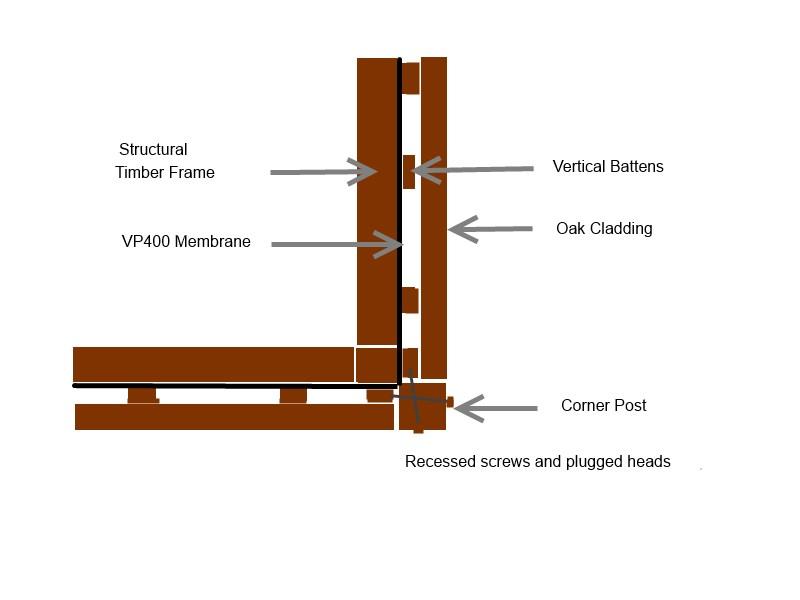
I can't find my old sketchup drawings but made this sketch. Think the construction is similar to yours. Some details... * When I laid the slab I pushed 12mm stainless steel threaded rods (with nuts on) into the slab so I could bolt down the wall plate later. Mostly because we are in a windy location near top of hill. (Caution: These are very dangerous until covered up. I nearly fell onto one!) * I extended the vertical battens down until they are about 30mm off the top of the slab so the lowest cladding plank hides most of the brick. I used gravel around the slab to reduce splashing and haven't had a problem with the bottom planks (but they are oak). * I didn't bother with rebar mesh in the slab but probably should have done. Not been a problem though. * I used 12mm WBP rather than 9mm OSB because mine has a pitched tiled roof. Some of the frame (eg corners) was also made from 4x4 rather than 2x4. * Where there are joints in the cladding boards I put strips of DPM behind to deflect water to the outside. These were trimmed back flush with the bottom of the planks later and can't be seen unless you peer into a joint. Not sure if this is essential or not. To support the joints you can either use wide battens (so nails aren't too close to the end of a board) or fit short extra vertical battens so there are two, one either side of the joint. * At the corners of the building I fitted (mostly decorative) posts like this (Plan view). These corner posts were also supported 30mm off the slab using stainless steel bolts in holes drilled into the ends. They were also screwed to vertical battens and the screw heads plugged to simulate pegged construction.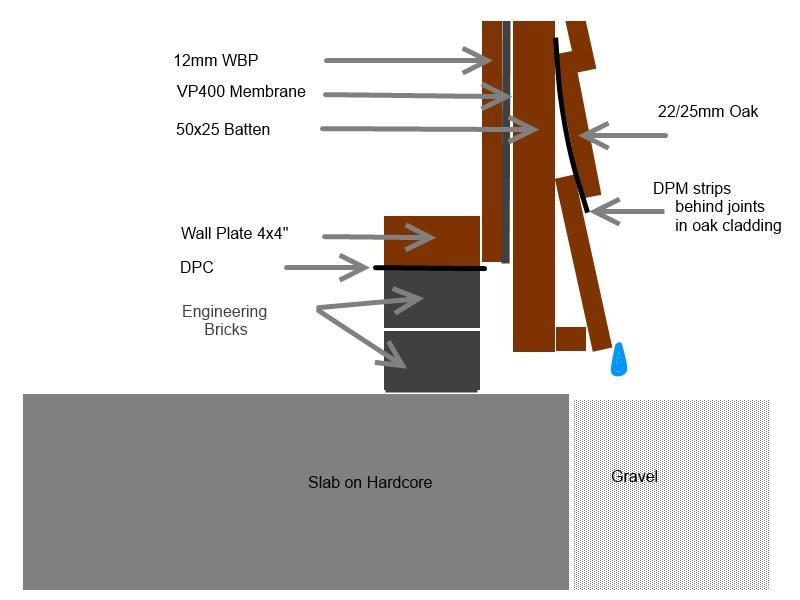
-
Help with ply selection - garden building
Temp replied to Chef40's topic in General Self Build & DIY Discussion
Looks good to me. Perhaps be prepared to adjust the size of the floor a bit in case their tolerances are off. -
Help with ply selection - garden building
Temp replied to Chef40's topic in General Self Build & DIY Discussion
Yes exactly that. I designed and built my own outbuilding on a concrete slab. Put a lot of thought into keeping water out. What I did was arrange for the slab to be the size of the frame but smaller than the clading. I laid two courses of engineering blocks on the slab then a DPC and the frame sits on top. The cladding extends down over the brick. Any water running down the cladding drips onto gravel surrounding the slab. Any water blown under the bottom edge of the cladding is stopped by the brick courses. This one doesn't have an insulated floor but i could lay a sand blind on the slab, DPM lapped up the wall then PIR topped with OSB flooring. -
There are still quite a few companies offering oak framed houses. Give some a call and ask about construction details and u-values.
-
Help with ply selection - garden building
Temp replied to Chef40's topic in General Self Build & DIY Discussion
You never really want a building sitting on a larger flat surface as rain will pool on the edge and run under the walls or at least they will be sitting in water. If the building is clad with weather boards on battens then I'd size the floor so the battens and cladding can extend down over the edges of the floor. If you really can't do that I think I would put something like DPM or flat roofing membrane on top of the floor and wrap it down over the edge. Whatever it needs to be UV stable or covered with something to prevent UV degradation. Still gives you a problem sealing the walls to the top. Be careful if you decide to use wood preserver because I think it is difficult to glue to so presumably hard to get any sealers to stick? My builders merchant stocks at least 4 grades of WBP. If its going to be exposed I'd want the best they can give me. I've previously had WBP from one of the DiY sheds delaminate in a few weeks outdoors. -
Hot return circuit, how to control it.
Temp replied to Russell griffiths's topic in General Plumbing
Another way is to put a pipe stat on the return so the pump runs until water returning to the tank is hot. Then it stops until the pipe cools down. -
Apparently lumber is falling again.. https://fortune.com/2021/06/16/lumber-prices-falling-2021-chart-update-price-of-lumber-going-down-wood-costs/ 20% down from peak.
-
Google found some info from the NHBC written in 2011.. http://nhbccampaigns.co.uk/landingpages/techzone/previous_versions/2010/Part5/section1/sitework.htm Main points..
-
Soil is fine on the outside. In the inside it depends how you are doing the floor. If its going to be a concrete slab then hardcore. If its a suspended floor then soil is OK. Some of us on sloping sites or clay soil have dropped perforated pipe into the space and covered with gravel to make a French drain.
-
Welcome. I think sprinklers are mandatory in all new houses in Wales so they must be pretty sorted/mainstream now.
-
I expect you meant under the insulation. The vapour barrier should be on the warm side of insulation. As I recall the 50mm gap is to allow roofing membrane to drape 25mm between rafters and still leave a 25mm ventilated gap (eg when there are no sarking boards to support the membrane). So my guess is 25mm would be ok if the BCO allows it. The main problem with ventilation is usually at the eaves and ridge. Builders tend to forget and just mortar on ridge tiles. Later when there is a problem you are faced with fitting tile vents one per rafter bay as the rafters stop lateral air flow. Typical suggested ventilation schemes for different roofs are something like this. Yours would be the one top right. Note that the dimensions are per meter. eg at the eaves (marked B) you need the equivalent of a 25mm wide slot the whole length of the eaves. If using round vents you need enough to provide 25,000 square mm of free area per meter. If you were to fit this type of common round soffit vent .. https://mytradeproducts.com/products/manthorpe-circular-soffit-5-colours-g700?variant=37765056233625¤cy=GBP&utm_medium=product_sync&utm_source=google&utm_content=sag_organic&utm_campaign=sag_organic&gclid=CjwKCAjwq7aGBhADEiwA6uGZp6QEf45bAAjO8jSqSrNeEZ7XuVKpoEqsHIx7wO44fffOpy19cZL1BRoCwkgQAvD_BwE ..it has only 2150mm² free area per vent. Meaning you need ELEVEN per meter !! You probably cant fit that many in a single line as the rafters get in the way. You need two staggered rows. That's a lot of vent holes to drill. Not so bad at the ridge where you need 5mm gap or 5000 mm² per meter each side.
-
A single stud should have no problem carrying the weight. The only issue I see is that if someone knocks the rad sideways the bracket might dig into the plasterboard unless its a decent area. I believe wires are meant to be at least 50mm deep in the wall so I'd use screws that penetrate the wall around 40mm. So 40mm plus the thickness of the bracket. See what others say.
-
Oil boilers aren't a great match for UFH unless you can add a buffer tank of some sort. Oil boilers don't modulate their burner, instead they turn the burner on and off to maintain the required flow temperature. This is a bit like driving a car in stop start traffic. So you might find the burner cycles on and off a lot if only one UFH loop is calling for heat. We fitted a thermal store which acts as a buffer. The store supplies the hot water for both the UFH and DHW. When the temperature in the store falls the boiler fires up and in our case runs flat out until the store is back up to temperature. The down side is that a thermal store can leak a lot of heat if not well insulated and some leave a bit to be desired in that respect. This was our first oil boiler so not sure how big aa problem the cycling issue is.
-
Could just concrete it but might have to remove some of the hardcore first. India stone if thats acceptable.
-
Perhaps look at oak veneered mdf? I mean for internal use.
-
Which Circular Saw (blade?) to cut with the grain
Temp replied to AndrewR's topic in General Joinery
Perhaps look at Saxon TCT blades. Not the best but cheap enough that you can buy more than one with different number of teeth. I'd look for something around 40 teeth. The overall diameter and the hole diameter need to match your saw. Personally I'd use a table saw for this rather than a hand held circular saw. Its difficult or rather time consuming clamping narrow boards so they can be cut down the middle with a hand held. Not enough (any) board sticks out of the side so the saw can't go past the clamp. If you have a lot to do perhaps look on YouTube for ways to turn a hand held saw into a table saw? -
Difference between a warm and cold roof construction (not to be confused with a warm/cold loft).... * Cold roof - the insulation is between and under the rafters. This means there are structural elements on the cold side of the insulation (eg the top of the rafters). * Warm roof - the insulation is above the rafters. This means the structural elements are on the warm side of the insulation. The vast majority of houses built now and in the past are of the cold roof type. The risk with a cold roof is that water vapour created by people in the house can escape through the insulation and condense on the cold part of the rafters or other structural elements. There are two main ways of preventing this, both are aided by a vapour barrier on the warm side of the insulation.. * Vapour permeable: If sarking boards and the roof membrane are vapour permeable then you only need to ventilate the void between the tiles and the roof membrane. * Vapour impermeable: if any sarking boards or roof membrane are not vapour permeable then you need a 50mm ventilated void below the impermeable layer. So the question you need to answer is : Are your sarking boards and roof membrane sufficiently vapour permeable that you can avoid needing a 50mm ventilated void below? My understanding is that narrow sarking boards with 3-5m gaps are considered permeable but large sheets of OSB with no gaps might not be. Discuss with your BCO or Architect.
-
This is what they are doing.. https://www.burges-salmon.com/news-and-insight/legal-updates/planning-and-compulsory-purchase/update-on-agricultural-occupancy-conditions/ MARKET TESTING It is possible to remove an agricultural occupancy condition though the applicant will first need to demonstrate certain things. This includes adducing evidence that the property has been marketed for sale or rent, at a substantially reduced price, to agricultural workers in the area for a significant period of time. In April 2019 the Planning Inspectorate emphasised that evidence of a robust marketing exercise is essential when applying to remove a condition. This related to an application to remove an agricultural occupancy condition at Sutton Springs Trout Fishery Grounds. The Inspector found that there had been sufficient marketing of the property as it had been consistently publicised online, included in various publications and promoted in mail campaigns. The agricultural occupancy condition was therefore successfully removed. This decision is illustrative of what level of marketing is acceptable and adds to the tips provided by the Upper Tribunal in the case of Rasbridge, Re Cefn Betingau Farm in 2012. The Tribunal found the applicants' market testing exercise was not sufficiently rigorous and suggested that the applicant should have: offered to rent the property in order to establish if there was rental value to the land; advertised the property in the specialist farming press; and made adjustments to reflect general market movements.
-
Concealed toilet cisterns: Grohe vs Geberit vs Tece
Temp replied to Adsibob's topic in Bathrooms, Ensuites & Wetrooms
Now you remind me we did have a problem with the flush pipe on our Geberit cistern. The rubber seal degraded and the whole joint became loose and leaked but I think they have changed the design now.. -
Not seen that wording before. I suspect it means they are waiting for you to resolve issues they have raised? Or it could mean they believe the issues have been resolved?
-
Concealed toilet cisterns: Grohe vs Geberit vs Tece
Temp replied to Adsibob's topic in Bathrooms, Ensuites & Wetrooms
Would be interesting to see what the small print on the warranty says. In my limited experience ... Geberit Fames will easily last 10 years. I've had flush valves fail after 4 years. The chrome plating on the flush plate buttons can also wear through in 4 years. -
I wonder if its worth trying solvents like acetone. Eg clear solvents that evaporate totally. Perhaps test on scrap wood first.
-
+1 It won't move with the ply on it. The alternative would be to cut wedges to match and fix to the edges ?
-
Not seen one but only £6.. https://www.haspod.com/documents/method-statements/building-demolition-template?gclid=CjwKCAjwn6GGBhADEiwAruUcKs-oVmVP-XzXB9maGAdc56O6ThCLnpfS8HJkM1g9SjrpGKoNwuryhxoCwJ8QAvD_BwE
-
I very much doubt having a thinner screed will make any difference to the UFH. What pipe spacing did you go for? On a renovation Id recommend a close spacing as they can need more heat than a new build.

