


Temp
-
Posts
10690 -
Joined
-
Last visited
-
Days Won
43
Everything posted by Temp
-
Presumably you need two times the angle to the vertical not two times the pitch angle?
-
Can you get local stone as slips? Wet plastered 5-10mm Single Block 100mm Membrane? EWI & Stone Slips Something like.. https://www.blackmountainquarries.co.uk/products/stone-cladding-slips/random-cladding-slips/ More.. https://www.blackmountainquarries.co.uk/products/stone-cladding-slips/
-
See.. https://www.planningportal.co.uk/info/200130/common_projects/17/extensions You have to work through all the rules to see if one triggers the need for PP. It seems likely from what you say. However if you do apply then there are no rules on what you can apply for but the planners are likely to refuse some things more than others.
-
Anyone know a good large format tile cutting company?
Temp replied to hendriQ's topic in Wall Tiles & Tiling
Yikes. All those very long thin strips. Not a chance of cutting them all without several breaking. I suspect you can't even pick up such long thin strips without them breaking under their own weight. I'd look at using shorter strips on the curved parts, something like this aspect ratio.. https://m.facebook.com/gilesbrostiling/posts/marble-mosaics-on-curved-wall/1099325933556049/ -
Some traps like this one only have a 25mm water seal... https://mcalpineplumbing.com/traps/shower-traps-accessories/st90cp10-53c-90mm-shallow-shower-trap-53mm-high
-
If the pressure in "mm of water" is greater than the depth of water in your trap you will get bubbling. So have you got a very shallow trap in the shower? Have you fitted the innards if it's a top access trap? Try topping them up with water slowly to making sure they are full of water before doing the test.
-
Dont forget the neighbours would have to prove your work was responsible for the damage. How close will your foundations be to theirs? All houses on same level?
-
Think we used crushed limestone hardcore but then my builder used that stuff everywhere. Think he had shares in the company ?
-
If the joists deflect/bend too much then normally I'd suggest replacing with solid floor (hardcore, sand blind, DPM, insulation, UFH in screed) but if you have 700mm deep voids it might be worth replacing the 100mm joists with deeper or possibly a beam and block floor (B&B, DPC, insulation, UFH in screed). Alternatively add more supporting walls under the 100mm joists. If sticking with 100mm joists I would fit 100mm insulation between them. Then board with something like two layers of 18mm WBP screwed down at 150mm centres then use an UFH system like this one on top.. https://ambienteufh.co.uk/tiling-over-underfloor-heating/ I might be wrong but think this type is limited to medium and large format tiles. Not small mosaic as they can be damaged by point loads. The more insulation below the UFH the better. Less wood above is also better.
-
I suspect they might carry the weight but might not be rigid enough to stop tiles cracking. One test I've seen mentioned is to put a glass of water on the floor and have someone walk around. If you can see the surface if the water vibrating then it's not rigid enough. Not very scientific though.
-
Seems there are also different types of core used in laminstead glass... https://www.narm.org.uk/glass-rooflights-clarifying-safety-standards-and-recommendations-for-specifiers/
-
+2 Toughened glass can still shatter but does so in small bits to prevent deep cuts. Laminated holds itself together to prevent you falling once its shattered... https://www.elitebalustrade.com/glass-juliet-balcony/?v=79cba1185463
-
Will widening my connection to Thames Water make a difference?
Temp replied to hendriQ's topic in General Plumbing
Ideally you would turn on all taps that are mains fed at same time (even hot taps if you have a combi). Measure flow rate at each and add them up. Still won't be measuring the max available from the main but about as close as you can get. -
+1 although I wouldn't spend a fortune. Basically its agricultural rather than residential land. So you can normally use it for growing things or keeping animals (unless other restrictions apply). You cant officially treat it as garden so you're not allowed to set up permanent swings and slides. Even jumps for a pony have caused problems elsewhere because jumping a pony is different to grazing one. What you can do is use it for almost anything you like for up to 28 days a year. So things like letting the scouts use it for a 1 week scout camp or even a motor bike scrambling session is normally ok (as long as you don't create a statutory noise nuisance). If you want to turn it into part of your garden officially you could apply for planning permission for "change of use". If you just "do it anyway" you might get away with it unless its very obvious from the road or someone complains. If you get away with it for 10 years the planners loose their ability to take enforcement action. So make dated records of when you started using it as a garden. Even if the planners get unhappy they almost never just hit you with formal enforcement action. There are no instant fines. They would first send you a letter warning you that unless you return it to its original state they "intend to take enforcement action". Don't panic. At that point you could either comply or apply for planning permission. The latter would delay any enforcement until the application is considered (perhaps a few months). If planning permission was refused you could appeal potentially delaying things for a year. In theory if you still refuse to remove the playground then the council could take it down and bill you for the work so don't let it get that far but you can still give them a good run. Deliberately hiding the equipment with say straw bales allows the planners more time to initiate enforcement action (law changed after someone hid an illegal castle that way!)
-
Will widening my connection to Thames Water make a difference?
Temp replied to hendriQ's topic in General Plumbing
You can get improvements in pressure. Not the static pressure, that won't change, but the pressure in your house at a set flow rate can improve. So for example suppose your static pressure is 2.8-3 bar and your open pipe flow rate is 20L/min. Then the pressure at say 10L/min can improve. Likewise the flow rate you can draw before the pressure falls below say 2 bar can increase. How and where was your 20l/min measured?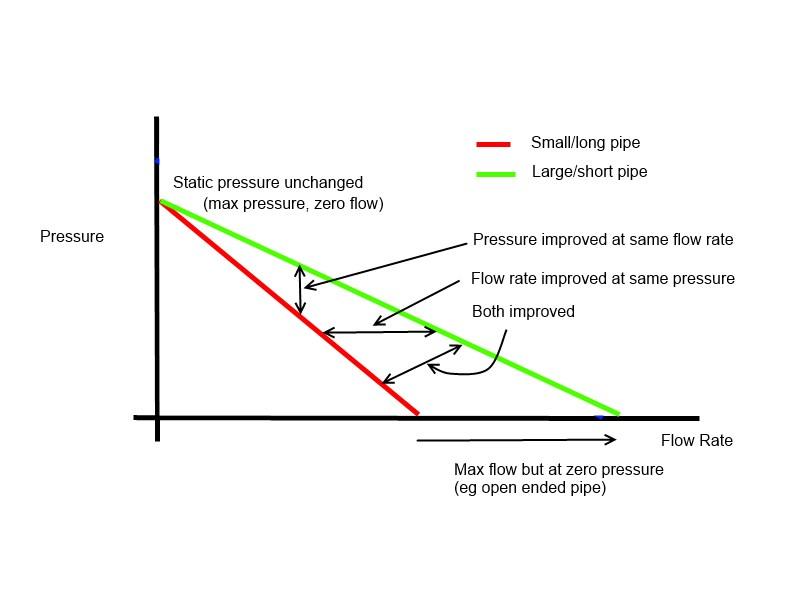
-
+1 Some companies that sell non-negligent insurance claim other policies only cover you if the damage to a neighbour results from your negligence. So read the T&C for your site insurance policy and see what it says.
-
Have you checked that the asking price for the freehold is reasonable? These days you can get the leasehold extended to 999 years effectively making the freehold worthless if the ground rent is low. The cost of the extension should be similar to the freehold I would think.
-
-
Can't you buy duct with a draw string already installed? That's what we did for the electric. Otherwise I'd try laying it out straight on flat ground, tie something like a sash window weight to a light string. Lower it in one end using a step ladder, then pull the duct over the steps or "walk" a wave shape section of pipe along to the other end (eg so the weight surfs down the wave ?
-
Now I understand what he's built I agree with both you and the builder. It's close enough. Just make sure the fitters use packing. We had to raise a window or two.
-
Yes that clearer. Dealing with people is the hardest thing about self building.
-
All you need now are some lights and a hydroponic system ?
-
Door sizes disabled regs.
Temp replied to Russell griffiths's topic in General Self Build & DIY Discussion
+1 The sill and waterproofing the level entry/ramp seem to cause more issues. -
Retrofit a ridge board between roof trusses, how?
Temp replied to epsilonGreedy's topic in Roofing, Tiling & Slating
Just read the OP again... So just 4 bays or 8 rafters. Should be simple enough. -
Retrofit a ridge board between roof trusses, how?
Temp replied to epsilonGreedy's topic in Roofing, Tiling & Slating
Presumably because its hard to hammer nails into springy battens? Would 2*2 battens solve the problem?


