


Temp
-
Posts
10690 -
Joined
-
Last visited
-
Days Won
43
Everything posted by Temp
-
Most of the £150k cost will probably be digging up and reinstating the road. Who owns the road and is there an alternative route across fields to the main?
-
Source for IBC in Notts / Derbys
Temp replied to Ferdinand's topic in General Self Build & DIY Discussion
Try Gumtree. Search within say 30 or 50 miles. Ask what it's been used for. Wants to be something water soluable you can put down a drain. -
Oak beam versus steel/concrete lintel strength comparison
Temp replied to jfb's topic in RSJs, Lintels & Steelwork
This is our dining room ceiling. None of the oak is structural. It's got steel and concrete B&B floor above it. Ignore the cobwebs.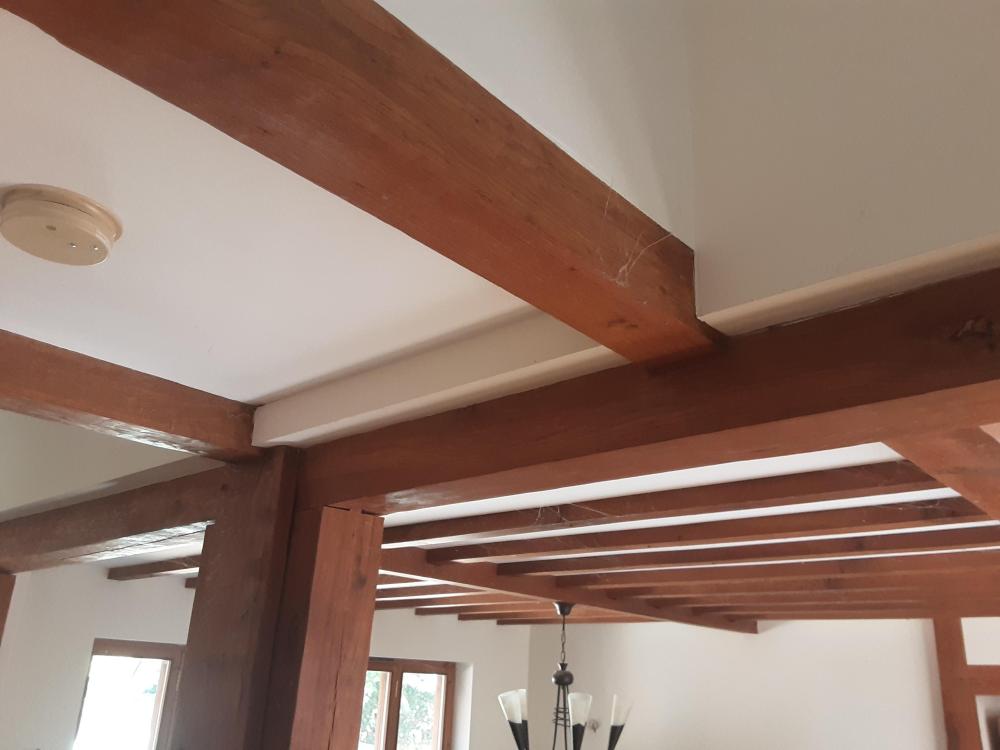
-
Oak beam versus steel/concrete lintel strength comparison
Temp replied to jfb's topic in RSJs, Lintels & Steelwork
Have you considered a concrete structural lintel set above a decorative oak beam? If its only one or two short spans the cost would be modest. Possibly less than getting new calculations done? The conc lintel would probably need to be slightly longer as it rests on pad stones either end of the oak beam. Oak beam carries no weight so could be cheaper lower grade with knots for character etc. Possibly even Green oak if you don't mind filling shrinkage gaps in a year or two. -
It doesnt take much of a leak. You probably won't see it, you have to physically feel around pipes with a dry hand. Check all valves in particular. Eg All motorised valves (turn off electric) and radiator valves. Perhaps also any expansion vessels.
-
Wayleave question - SP Energy Quote
Temp replied to MarkW1979's topic in General Self Build & DIY Discussion
That's less than £100 a meter which is what I was quoted back in 2007. I think it's a very good price for them doing the work. -
Where is the kWh price heading in 2022?
Temp replied to epsilonGreedy's topic in General Self Build & DIY Discussion
Just before the pandemic some energy companies were setting up tariffs that paid you to use electricity at certain times of low demand. Seems like a distant memory.. https://www.energylivenews.com/2018/02/22/want-to-get-paid-to-use-electricity/ -
Where is the kWh price heading in 2022?
Temp replied to epsilonGreedy's topic in General Self Build & DIY Discussion
That's all true but energy is sold to the highest bidder and when demand exceeds supply look what happens... https://www.dailymail.co.uk/news/article-11047167/UK-forced-electricity-Belgium-heatwave-stop-blackout-paid-5-000-MORE.html Fortunately.. -
Where is the kWh price heading in 2022?
Temp replied to epsilonGreedy's topic in General Self Build & DIY Discussion
https://www.telegraph.co.uk/business/2022/08/11/markets-live-latest-coronavirus-news-pound-euro-ftse-100/ "Consultancy Auxilione said Ofgem may have to set the price cap at £5,038 per year for the average household amid elevated gas prices." -
Where is the kWh price heading in 2022?
Temp replied to epsilonGreedy's topic in General Self Build & DIY Discussion
I think they will remain high for longer... And in April Cornwall Insight were predicting they would remain high until 2030. -
I think this states their position on a planning application. You will need to decide if you are going to apply just for the fence or for change of use as well.
-
Small bill not zero rated
Temp replied to Water's topic in Self Build VAT, Community Infrastructure Levy (CIL), S106 & Tax
Try offering him a certificate. I think officially they are only needed for work on a charity building but they have helped in the past. There is an example on the VAT 708 in section 18. https://www.gov.uk/guidance/buildings-and-construction-vat-notice-708#section17 https://www.gov.uk/guidance/buildings-and-construction-vat-notice-708#section18 Will need editing. -
Where is the kWh price heading in 2022?
Temp replied to epsilonGreedy's topic in General Self Build & DIY Discussion
+1 It's not clear how it scales to people above and below average due to standing charges and the like. -
Where is the kWh price heading in 2022?
Temp replied to epsilonGreedy's topic in General Self Build & DIY Discussion
Some percentages.. 1st April 2022 - The cap increase was £693 from £1,277 to £1,971 per year. 1971/1277 = 154% or a 54% increase. 1st October 2022 (predicted) - "Cornwall Insight expect that the energy price cap will increase from the current figure of £1,971 per year based on typical use, to £3,500". 3500/1971 = 178% or a 78% increase. 1st January 2023 (predicted) - Offgen say any predictions for next year are unreliable but If we take the £4200 figure in the media that's... 4200/3500 = 120% or a 20% increase. Overall Jan 22 to Jan 23 the percentage change would be 1.54*1.78*1.2 or 4200/1277 = 328% or a 228% increase. -
Where is the kWh price heading in 2022?
Temp replied to epsilonGreedy's topic in General Self Build & DIY Discussion
Think this is behind recent predictions.. https://www.catalyst-commercial.co.uk/wholesale-electricity-prices/ "This Chart Shows The Price Of Electricity On The Wholesale Market In GB For Delivery The Next Season - Winter 2022" So any predictions made before about mid June are out of date.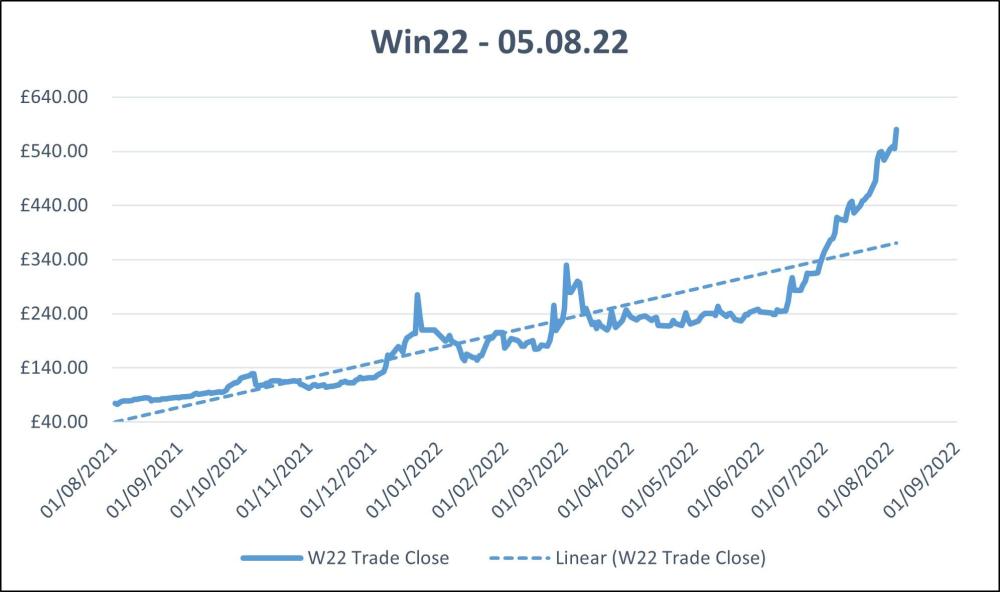
-
Where is the kWh price heading in 2022?
Temp replied to epsilonGreedy's topic in General Self Build & DIY Discussion
It's not just the BBC. The £4,200 figure is being quoted in most of the mainstream media. The Telegraph says £4,400 in January. iNews say £4,700 in April. Mirror and others suggest £400/m or £4,800/y. Edit: I think I heard on the radio today that there are a few more days (weeks?) of possible wholesale price rises to go before Ofgem can tell us the October cap. -
Where is the kWh price heading in 2022?
Temp replied to epsilonGreedy's topic in General Self Build & DIY Discussion
Someone once told me that the max safe income you can draw from investments is around 4%. So a £millionaire could draw around £40k per year. If energy bills rise to >£4k that would mean even a millionaire could technically meet the definition of someone in fuel poverty (More than 10% of income spent on energy). Not that they need sympathy but its an amazing state of affairs. -
Exactly. https://www.cncbuildingcontrol.gov.uk/wp-content/uploads/2019/07/CNCD-053-Warm-Roofs-Easy-Guide.pdf
-
Given the work needed up top I'd get the flue replaced while they are up there.
-
Perhaps make a "manifold" from copper pipe and fittings. That's what our plumber did for our bathroom. It has a mixture of 22mm and 15mm isolation valves on it to suit pipes going to different places like the bath, shower, basin, WC etc.
-
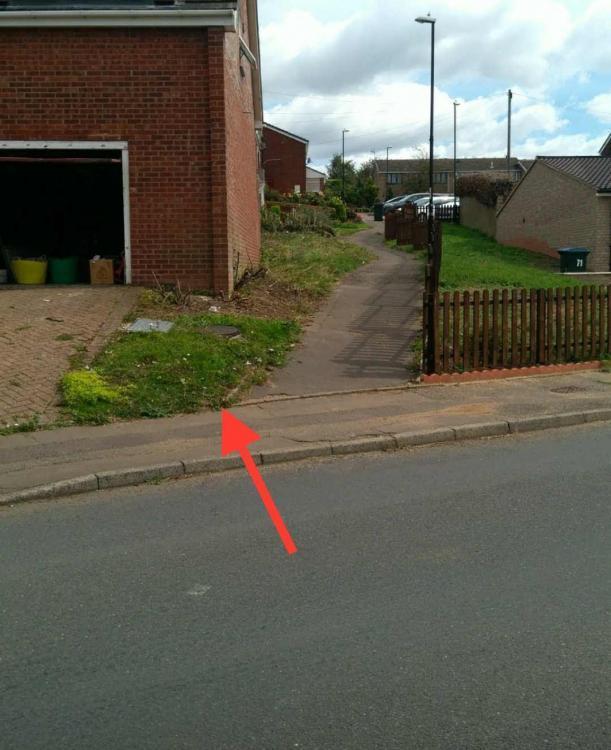
Not sure but the house othe side of the path has similar line. I think the garden wall should have been on that line but it has been angled back so not visible in the photo.
-
The vents normally go in the soffit not the fascia so would be hard to drill from the inside. I think the holes would also be big enough that the strips would be cut into sections that come out unless they are glued together. Think you will have to ask your BCO if that's OK. Our BCO allowed it but we have tiles rather than slates .
-
I don't see a major contradiction. Looking closely the first plan has a very faint red line same place as second one. I think the brick wall referred to must be in the wrong place. Eg not in line with the garage wall as per the black line on the first plan or it would be visible in the photo of the site. I'm afraid I think these plans just reinforce the idea that the site (in red) includes garden (bounded by black line/wall) and some amenity land (between black line and red).
-
Is that a new wall as I can't see one in the photo. At least if there is a wall it's not inline with the garage wall or the black line on your plans. Is it angled so hidden behind the garage?
-
You can get round black soffit vents like these.. https://www.roofingsuperstore.co.uk/browse/ventilation/circular-vents.html However you might be surprised how many you need. Each one typically has a free opening of 2500mm^2. I think they normally recommend a slot 25mm wide which is 25,000mm^2/m. So you need around 10 vents per meter. Don't just drill holes as you will eventually hit a rafter. Plan a pattern of vents that fits between rafters, make a jig for a hole saw etc so the end result looks uniform. One potential problem... are the two strips nailed together or just to the rafters? Would it be easier to take the strips down and replace with one and a linear vent? https://www.upvcbuildingplastics.co.uk/soffit-vent-strip-black-ash-5mt-723-p.asp



