
ragg987
-
Posts
873 -
Joined
-
Last visited
-
Days Won
1
Everything posted by ragg987
-
Wow !..........so much to learn and so little time !
ragg987 replied to Canoehq's topic in Introduce Yourself
I suggest you factor this in at an early stage as a design principle, it will be harder and more expensive to retro-fit. Example the pasiv standard calls for high insulation, minimised thermal bridges, controlled solar gain, well sealed fabric and positive ventilation approach. None of this will happen by accident, if your intention is to aim for something similar get it agreed early as it has impacts all the way through the design. @JSHarris has provided one example - bi-folds. -
Wow !..........so much to learn and so little time !
ragg987 replied to Canoehq's topic in Introduce Yourself
Welcome and best of luck with this venture. Apart from concerns about over-heating when sunny, you should also consider heat losses in winter. On a cold grey day, or at night, all that glazing will dump heat out, though if slightly sunny the solar gain would be a great boost. You might want to consider how you can use this to your advantage - e.g. having mass in the building envelope that will capture heat in the day and emit it in the evening. Could be something as simple as thick concrete or brick elements. How well insulated are the other elements of the fabric - roof, walls, floor? -
We blow heat into the bedroom, suck it out in the bathroom, then the heat exchanger in the MVHR recovers 90% (approx) before chucking out the stale air. Comfort comes from air flow temperature, the small heater gently warms the air so not hot and dry. This only works as our build is very low energy. If it was not then the low air flow would make it difficult to supply sufficient heat into the room. And if you could the air would be pretty warm and I expect comfort would suffer.
-
It is a small electrical element that is connected in line with the MVHR flow duct. I have a thermostatic clock on the landing to control it. As I did not want this to heat downstairs, only upstairs, I split the outlet from the MVHR into 2 runs and the heater is connected to the upstairs supply. I am using semi rigid piping to the ducts, it also meant I needed 2 manifolds. MVHR > splitter > heater > manifold > ducts https://www.bpcventilation.com/circular-electric-duct-pre-heater
-
Yes you are right. I read it as getting sunnier.
-
That makes sense. Looking at it another way, if there was a positive correlation then, over time, it would get sunnier and sunnier until we were all blinded. Sunshine Or is that what global warming is all about?
-
We have micro inverters installed below each solar panel, a long DC cable from there to our plant room where the main inverter is. AC run from inverter to electric panel is very short. Works fine. I had our solar installer try to convince me we need to mount the inverter next to the PV panels as the DC cable had to be as short as possible to reduce losses. His suggestion was to mount in the warm roof or bedroom (we have no loft space). I found a solar calculator that assesses losses including cable diameter and length, it showed the opposite of what the installer claimed. He said no more and just installed it as I wanted after that. Yes the inverter is warm, I see it as a positive in the winter, though the plant room does get a few degrees warmer in the summer due to all the plant and DHW cylinder.
-
Most of that went above my pay grade. Damn, I've been outed, that was my approach, the "others" being you! Except my plots are limited by my skills in Excel.
-
Will be interested in any analysis you can provide. I once tried to do this and even loaded the data into a PowerBI "big data" tool to see if there were any interesting correlations in the data apart from the obvious. All it proved is that I am no data analyst and have no idea of how the toolset work !
-
I think the only way to do it is real PV data as there are other variables with brightness, examples: PV efficiency will drop with external temperature - this seems pretty significant e.g. 2 full sun days 1 year apart 7 Feb 2018, avergae temp -1C, PV generation 16.7kWh 7 Feb 2019, average temp 8C, PV generation 13.6kWh length of day - brightness in spring may be same as in summer, but summer days are longer sensor brightness orientation - it can easily be moved by a few degrees which could have a big impact on readings
-
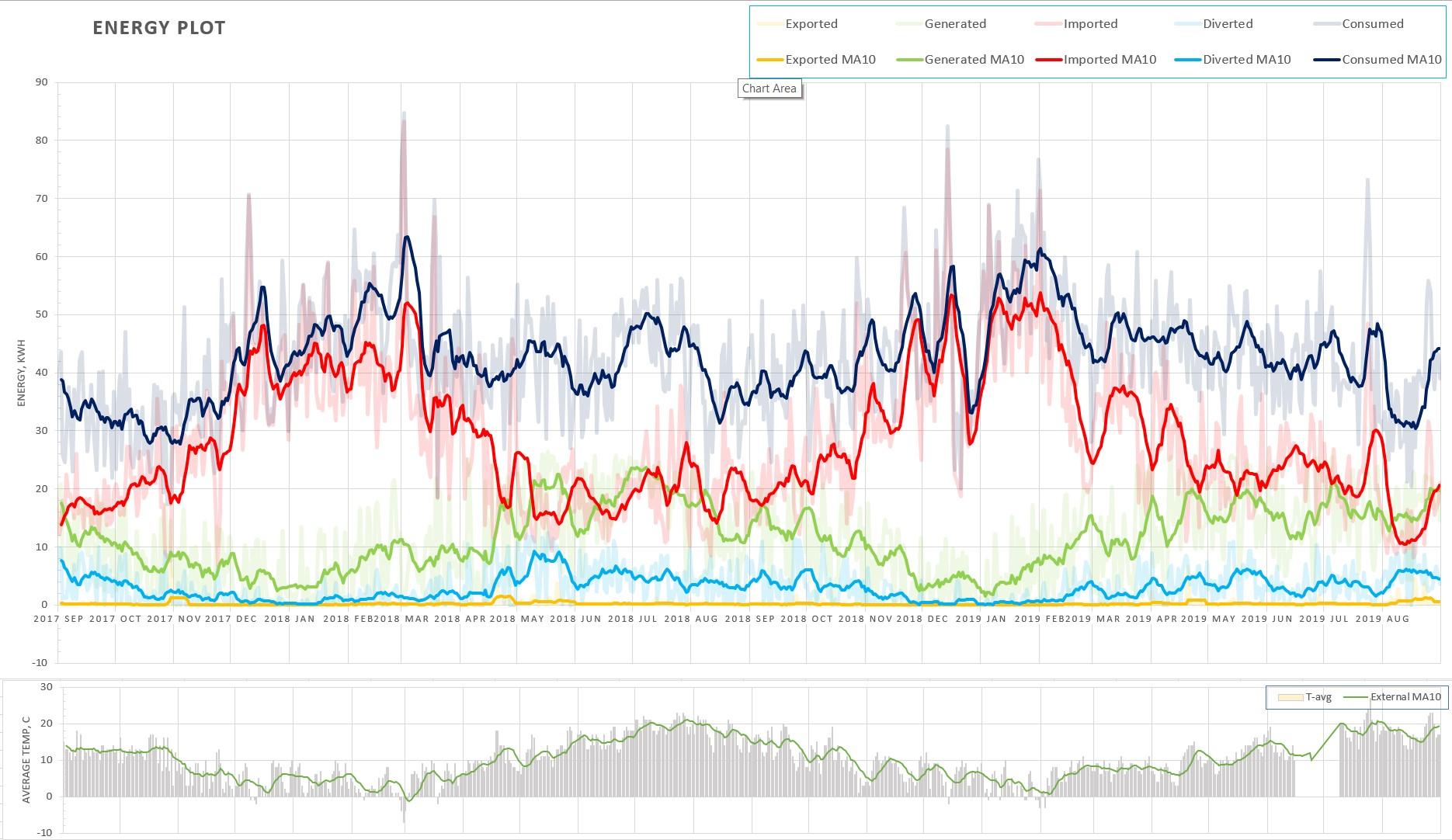
Attached, file suffix is .TXT and will need to be renamed to .XLSX 4kWp array, 16 panels, each with a Solaredge microconverter. Solaredge 4kW inverter. Due south facing (within a few degrees) on 40 degree angle roof. Mounted flush with roof using GSE system. Aylesbury, Bucks Tall trees on east side provide shading soon after sunrise, but completely clear after that Weedon energy.xlsx.txt
-
Example visualisation - not directly related to your correlation question. Hopefully self-explanatory, "Diverted" refers to spare energy sent to my immersion heaters rather than being exported. As subsidised by @SteamyTea.
-
If it helps I can share my spreadsheet of daily PV generation, shows kWh per day. I also have some weather info like temperature and rainfall, but this is a bit hit and miss in places. Approx 2 years worth.
-
Vat reclaim on demolition?
ragg987 replied to dnb's topic in Self Build VAT, Community Infrastructure Levy (CIL), S106 & Tax
I had resistance from some suppliers, but once I supplied my planning permission to them it was fine, their accountants then had a basis to zero rate and everyone was happy. -
Vat reclaim on demolition?
ragg987 replied to dnb's topic in Self Build VAT, Community Infrastructure Levy (CIL), S106 & Tax
If this demolition is part of a larger piece that is zero-rated and is on your planning permission, then yes you can request that the demolishing company zero-rate it. You cannot reclaim it after as they are providing a service (i.e. the demolition). -
When we replaced our bungalow with a double storey we created sight lines into both neighbours' gardens on either side. This was not mentioned by anyone, either architect or neighbours or planning. So maybe you were unlucky? Or I was lucky? In that case you may well be fine. Sit tight is good advise.
-
Second vote for Neff with magnetic disc control. Cannot notice any pulsing, when I want controlled low heat I simply dial in the number and it works without fail (porridge is no 3, Moka pot is no 4.5). Super easy to operate with rotary knob, cleaning surface is flat after knob removed, has power boost mode and flexible zones. Came from gas and also have used ceramic hob. I only miss gas when cooking in a wok.
-
Can't comment on sound, but air temperature will be the same on north or south side of house unless you have a massive heat trap due to local conditions. Also, my ASHP external unit has a temperature sensor which is used for compensation control purposes. Siting it on the north side will prevent false readings due to direct solar on the casing.
-
We did not install UFH upstairs. We have direct electric towel rails in bathrooms which are on 24x7 in winter at the lowest setting, maybe about 50W on average - about 2-3 months of the year. Rest of the time not needed (approx 6-7 months) or short bursts (2-3 months). Our 4 upstairs bedrooms have direct electrical heating through the MVHR supplies (I think it is a 0.5kW heater - my memory is not so good) which I installed as a "just-in-case". I am glad I did it does need the heat when very cold outside, this has it's own thermostatic timer and I have it on a couple of hours in morning and same again early evening. The cost of installing these devices is a few hundred pounds and running costs are low - maybe £50-70 per year. So much cheaper than a £5k install of UFH that you mention. This is in the context of a passiv-standard build. Others have said they do not need heat upstairs. We like it quite warm - bedroom below 19 or 20C is too chilly for us apart from for sleeping. Just done the sums given 12 months experience with the plug-in hybrid electric car. Simple payback of PV installation is reduced by approx 1 year, to between 7 and 8 years. [July 2018 to June 2019 : Generated 4,413 kWh of which I exported 1%, consumed 76% and diverted (to DHW) 23%]
-
Recommendations needed for double ended bath
ragg987 replied to Ferdinand's topic in Bathrooms, Ensuites & Wetrooms
We have the Bette One, they come in a range of sizes and are pretty solid, though pricey. https://www.bette.de/en/produkte/badewannen/detail?p=One Part of the reason for this particular model, in addition to the generous size and double-ended nature, is the wide lip which permits mounting of taps on it - had to be custom drilled at the factory. -
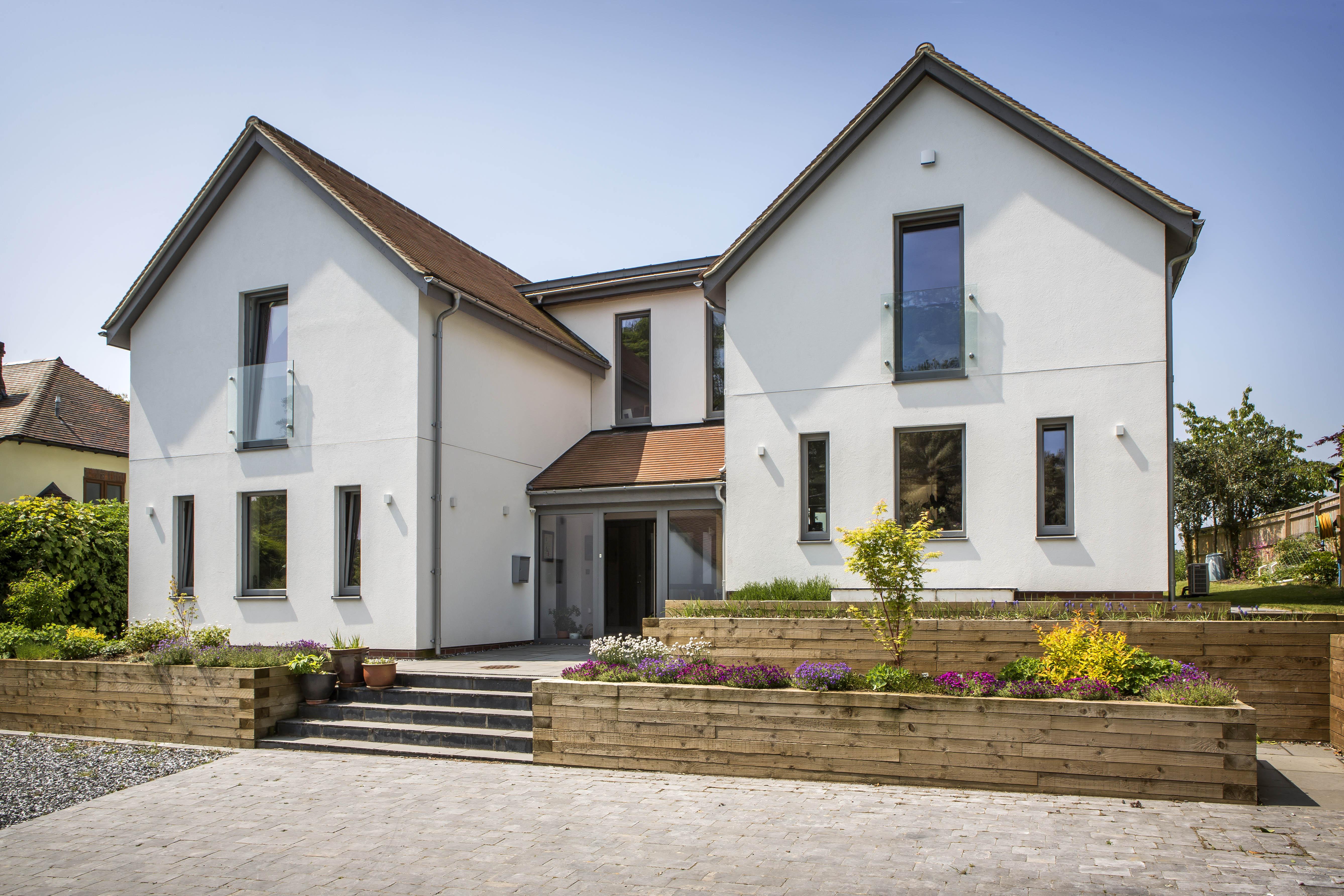
Lovely in the evening light. These moments remind you why you started.
-
Thank you.
-
Apart from the assumptions around cost of fitting, the calculators will assume 50% is exported. Done right you can reduce export to nearly nothing. Our export in the 3 years has been 3%. I calculate payback at 8 to 9 years, though I get FiT payments. I recently got a plug in hybrid electric car, this could improve payback but I have not done the sums.
-
Cross Laminated Timber and other Engineered Materials
ragg987 replied to puntloos's topic in Timber Frame
Room within a room. And attention to detail both at spec and build. Lower frequencies especially benefit from mass of construction materials. -
If you are getting PV, then you need to think of balancing the generated power against load so you are not exporting too much. This is where an ASHP is useful - a gas boiler is not much of a load. In theory, for a low(ish) energy house, running cost of ASHP is similar to gas. If not a low energy build (which includes insulation, air-tightness and MVHR) then you may need to run the ASHP hotter so efficiency will reduce, and the equation might swing towards gas. And UFH makes more sense if ASHP as you can run it cooler and hence at higher efficiency. A regular ASHP cannot heat water beyond 55C, so something to bear in mind. Also recovery time for the DHW is likely to be slower, so if you have a large number of occupants / lots of hot water demand you will need a larger water cylinder. Finally think about gas for other uses - e.g. gas hob or oven. These are likely to be cheaper to run than electric appliances (though unless you cook loads the difference will be small), however can you live with full electric for cooking or must you have a gas hob? If you can live with full electric then this favours ASHP as you do not need the gas connection or pay the standing charge. Sorry no clear recommendation, but I guess what I am saying is factor in your personal circumstances and also the WHOLE house and equipment should be seen as a system, you cannot make single decisions in isolation. Other factors as others have already mentioned - cooling capability, connection costs etc. In my low-energy build I have PV, UFH, ASHP, MVHR. I have previously always had gas / boiler / rads / unmanaged ventilation (i.e. opening windows!). If I were to build again I would not hesitate to repeat this combination, though of course the capital outlay is higher, but the increase in comfort is great and running costs as low.