
ragg987
-
Posts
872 -
Joined
-
Last visited
-
Days Won
1
Everything posted by ragg987
-
Thanks for the plug @Simplysimon. I have also offered them on buildhub classifieds for free if collected - still clogging up space in my garage. @TheMitchells the wall channel we screwed into the wall and the rubber seal prevents the glass from rattling around in it while providing a water-seal. No need for Sika - getting the glass to be completely square to the wall as well as level on the floor is not likely to happen, so the channel and seal provide for 'latitude' when fitting. Also we found our shower tray settled a few mm after a few months so the glass was able to slide down the channel. On the bottom we left a gap of about 5mm and filled it with clear silicone. Works a treat and seals perfectly. Small, clear, wedges of some plastic were used to lift the glass as well as to level it.
-
Overheating plant room (inc MVHR)
ragg987 replied to Besidethewye's topic in Mechanical Ventilation with Heat Recovery (MVHR)
A number here have. Some have found overheating, I have not though the room tends to be a touch warmer (maybe 1-2 C) than the surrounding rooms. Our plant room also doubles as utility and is about 6m2. 300l DHW, 90l buffer, indoor ASHP unit, 3 circulation pumps, MVHR, electrical meters, UFH manifold, PV inverter, PV diverter, internet and router, washing machine. I have a MVHR extract in there as we also dry clothes on an indoor line. I have taken care with insulation - DHW tank was pre-insulated at above normal level, I took care of all pipes including junctions to the tank. -
Grand Designs Gravenhill - Budget vs Reality
ragg987 commented on Ferdinand's blog entry in God is in the Details
So case of pots and kettles... -
Grand Designs Gravenhill - Budget vs Reality
ragg987 commented on Ferdinand's blog entry in God is in the Details
You calling me barmy? Exactly what I paid for our old bungalow. New build is valued at £100k + above the total cost of the bungalow, demolition, build. Now that is barmy, but no complaints from me ?. I had done the maths before we demolished, a local estate agent have an estimated value of the plan, on paper should have about broken even. -
We ended up with Canadian Western red Cedar, half lap, from vastern. Very helpful and good prices. Now nearly 3 years and is silvering nicely, though not completely even e.g. areas in shade are less silver. As I understand it, if you want to keep that red or brown colour you have to protect it immediately and then reapply every couple of years. Seems too much faff so we used timber in the raw. For a while I was hooked to the smell of the natural oils in the timber. Had to have a sniff when I walked past. Faded after a few months.
-
All good stuff above, but do remember there are three modes of sound transmission and you need to tackle them all equally. AIR-TO-AIR TRANSMISSION - e.g. through holes and other apertures. This is usually the floor or ceiling junctions - seal these carefully. Also, think about the doors (usually the weakest point) and if you have MVHR and were counting on gaps under the doors you will have to think again. This one is a lot more effort to solve, requiring baffles in the air-flow. VIBRATION - e.g. vibrating drywall. As you mention "daughter singing" this may be less of an issue, vibration becomes more of a problem at lower frequencies. Staggered stud and resilient bar solves this problem. TRANSMISSION THROUGH SOLID MATERIALS - which you can solve with the techniques mentioned above - mass (double plasterboard) and rockwool - no more than 65% of the void. If you decide to go with double-plasterboard, suggest you consider a flexible "glue" (I used Green Glue - probably have some left lying around if interested) between the sandwich and pay attention to sealing all the way round on both layers, plus stagger and seal all joints. Done right this technique will tackle all three modes, above, to some degree.
-
Not necessarily. We used the built-in controller in our ASHP to provide UFH cooling, plus the ASHP manufacturers room thermostat to provide heating and cooling control in one unit. All we needed use to set a link in the unit to enable cooling. No need to add any other components or controls, just switch the word "heat" for "cool" - e.g. the heated buffer becomes a cool buffer. My view on battery storage is that it is not (yet) cost effective. I divert extra solar to my DHW, and having a hybrid electric vehicle helps to consume some of the excess electricity. I don't think this one was addressed - our MVHR keeps humidity steady at around 40 to 50%. Why would you want to adjust this? It is possible to add a humidity sensor to the MVHR which would boost it when (e.g.) showering.
-
Cembonit. No maintenance and through coloured so a cut edge matches the front. Difficult to cut though, I had mine precut by the supplier based on a cutting specification. You also get colour matched screws. Ring the manufacturer and they will send samples for free.
-
Pass - good question. In our case was clear-cut as separated due to living arrangements.
-
Be aware that a second kitchen may lead to this being classified as separate for council tax purposes. I think they say that having services in place (gas, water, drainage) defines if it is a kitchen for council tax - do check the definition. In our case we have a second kitchen and 2 council tax bills - one of them is set to zero on account of my retired parents using it.
-
Comical EPC thingy
ragg987 replied to Russell griffiths's topic in General Self Build & DIY Discussion
Is this part of your vendor selection process? #MeToo ? -
Plant can be noisy, so if adjacent to bedrooms you have a potential problem. Noise can be direct, which is easier to muffle, but also beware sound transmitted by vibration of surfaces. Our MVHR is wall mounted and I can hear it in the toilet next door - this type of noise is not as easy to stop.
-
In my area octopus are 18p e7 day rate Vs single rate 15p. I have not found any supplier whose e7 day rate is cheaper than their single rate.
-
I found running the pump fully modulated provides best COP - usually 30% of max capacity is the lowest speed. So running at max capacity to take advantage of the shorter hours for E7 will result in lower COP - both because it is colder at night and because you are running at full power. This may not matter as E7 is "half-price" - your bills should still be lower. I prefer to run it at a fixed set temperature 24x7, so I can get away with a smaller pump and run it at lower power / higher COP. Plus, I have PV so running in the daytime can give me free electricity on sunny days. I do not have E7, our consumption pattern (bearing in mind said PV) does not makes it worthwhile as daytime prices are higher. As a reference, I have 7kW ASHP with a 330m2 house built to PH standards. This provides both space and DHW.
-
I think they publish an API (I have a vague memory of registering this to use a third party app). I also use an immersun with the add-on monitoring myimmersun device connected via ethernet cable. This can provide 5 measures (generated, imported, exported, diverted, consumed) and uses current clamps. You can log into their website and download the stats since year dot, though these are aggregated to 1hr. If you Google, it seems someone has reverse engineered the app and was able to write their own script to intercept the measurements. Went over my head.
-
I have a solaredge inverter, monitoring is standard via an app. You need an ethernet cable.
-
Not really answering the question, but my Hitachi (domestic) ASHP has a separate circuit for swimming pool. The standard logic for priority is DHW, then space heating and finally swimming pool heating. Includes ability to connect to a pool thermostat, valve and circulating pump to control it. I have used the capability to heat a 90l buffer (that is another story), and it works well. From observation, the modulation behaviour is different from DHW and space heating - it tends to run at a higher rate.
-
I took possession of the old house and moved it to a minimal tariff whilst we went through planning. Disconnection carried a charge. We went on to a £5 a month direct debit. At the end the supplier refunded the unused portion. Was worth having electric on the odd occasions we popped in to do some bits e.g. gardening to stop it taking over the neighbours land. Prior to demolition I had it relocated to the front of the property as a builders supply. If memory serves right this was cheaper than disconnection and reconnection.
-
This will depend on sizing more than anything else. An over capacity hp will not struggle, a 'just-right' one will be running at, or over, capacity. Though do not way over size as it will cycle excessively in milder weather. A hp will typically modulate up to 30%. Having lived with one through 3 winters, I suggest you don't overthink this, just make sure the sizing takes into account the heat demand.
-
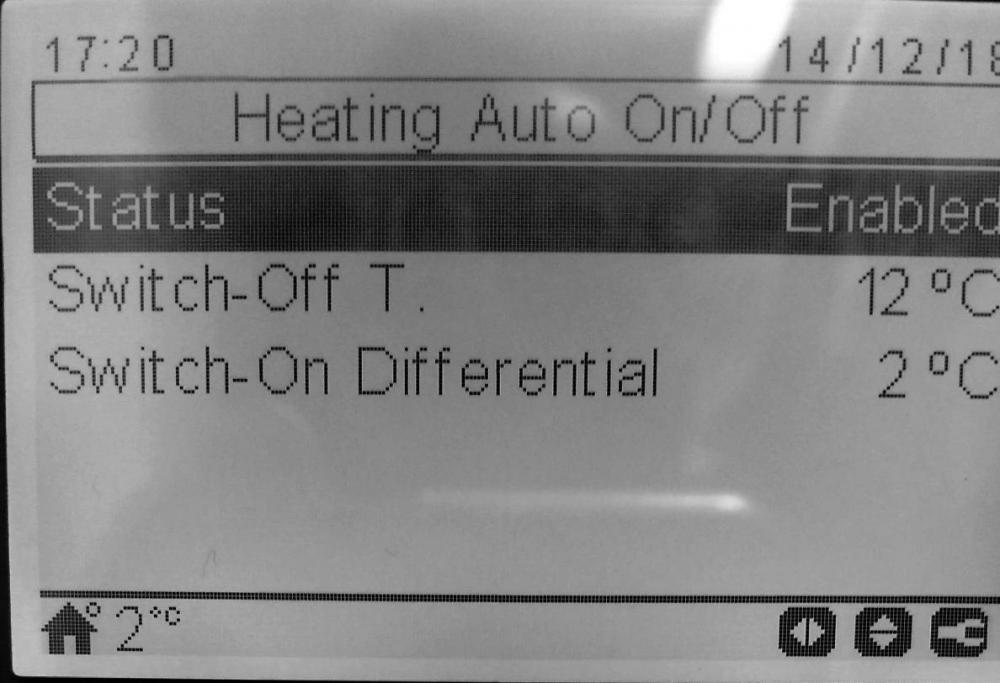
Should point out - that Auto On/Off setting is based on a 24hr average.
-
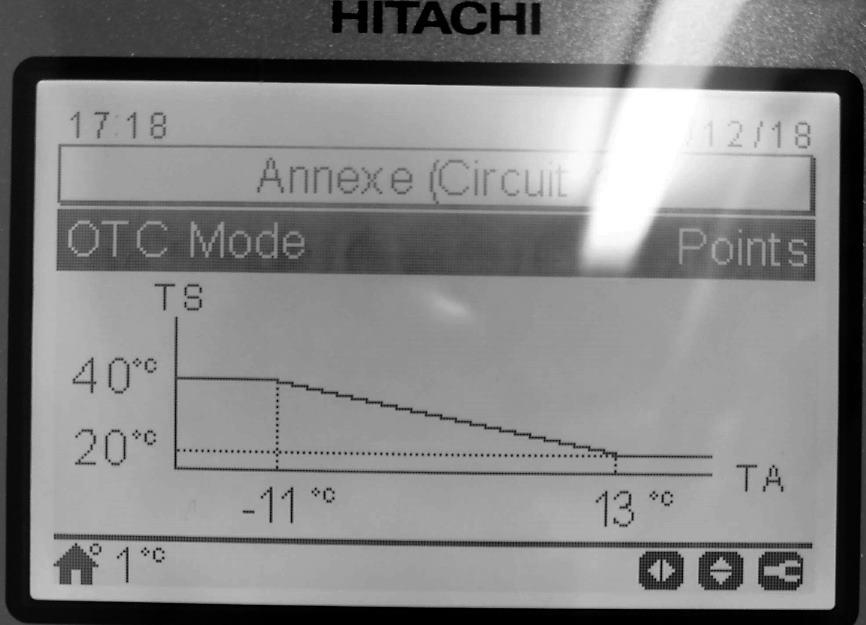
I think this is what gives the poor COP, hence I leave it on all time at the same temperature. FYI, here is the custom curve I arrived at by trial-and-error, seems to work well for our low energy build. And an image of an optional setting that means I can be hands-off all year round and the HP takes care of itself.
-
I use the compensation control that is already built into the heat pump, so no extra stuff required other than the separate controller / thermostat. Though it took a but of fiddling to find the best heat curve, the ones pre-programmed were not suitable for our build. The flow varies from about 22C to 30C when below zero outside. I found leaving it on all the time to provide the best COP, when I use the timer it took a big hit. Presumably this is as it runs at a higher temperature differential due to cooler slab.
-
I believe the rules are changing here, but when we sold our second home, the gain between purchase price and sale price was reduced by the proportion of time we lived in the house as our primary home. Plus two years. The reduced gain was then subject to CGT allowances and rates.
-
No experience, but it looks like a toy to me. Tiny surface area and small fan dumping 1kW is likely to be noisy in a quiet bedroom. One of the reviews mentions that.
-
Not in my case. I suspect they rely on someone complaining and then comparing it to the PP conditions by exception. Just don't upset your neighbours - they may not have seen the conditions but might complain if your hardcore spills into the road. Cheapest is likely to be tarmac or waste concrete (e.g. surplus from a pour elsewhere) over the appropriate solid core. 'Half-decent' is tricky, your hell could be my heaven. Blockwork tends to be most expensive, though I am sure others will chip in with more expensive options - like gold-plated taps, I did not believe they could exist when I first heard of them!
- 11 replies
-
- 1
-

-
- moving in
- reasonable
- (and 1 more)